
To reach 4.0 in pickleball, coaches want more than better shots: deep serves and returns, cleaner spacing, earlier contact, smarter shot selection, disciplined transition play, and clear partner communication under pressure.
Most recreational players assume the jump from 3.5 to 4.0 comes from adding more shots. A better topspin dink. A nastier serve. A two-handed backhand. A more aggressive speed-up.
Those things can help.
But coaches usually notice something more basic first: can you execute the routine parts of doubles well enough that your partner always knows what is coming next?
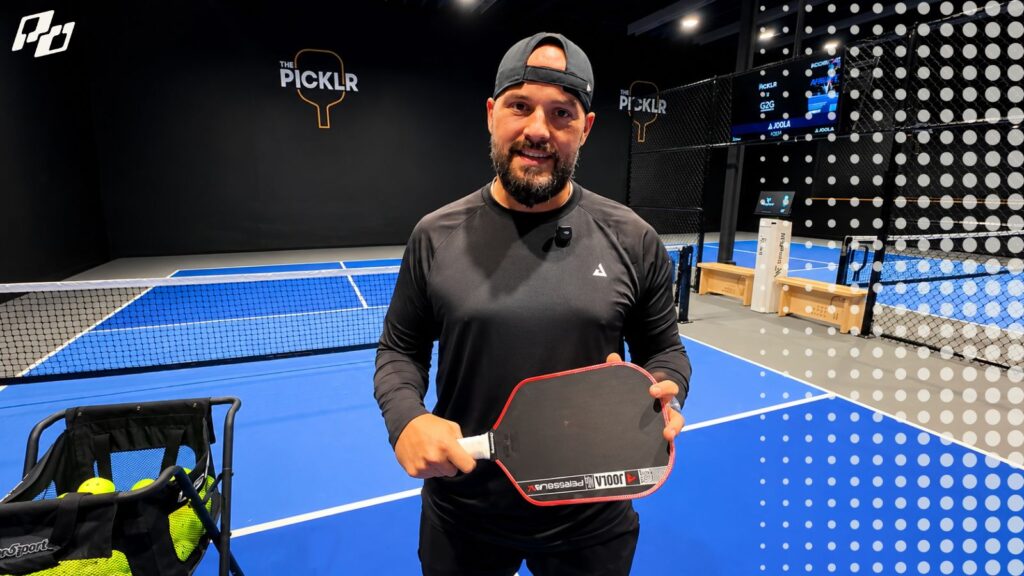
We recently shot a video with our Pickleball Union coach Marko Grgic on the habits coaches want to see from players trying to get beyond 4.0. You can watch that video below.
The interesting part is that most of his list is not flashy.
It is about depth, footwork, contact point, ready position, shot selection, communication, and making good decisions under pressure.
That is also where current coaching guidance from USA Pickleball and other experienced instructors tends to converge. At the 4.0 level, the game becomes less about whether you can hit a certain shot and more about whether you can choose and execute the correct one repeatedly.
Coaches Want Your First Three Shots to Look Boring
The serve and return should not be the unstable part of your game.
A deep serve pushes the returner farther from the kitchen and makes the return more difficult to attack. A deep return buys you time to move forward and establish the kitchen line.
For an intermediate player, the goal is not necessarily serving harder. It is making depth routine.
Think:
Serve deep. Return deep. Get organized.
If those three things happen automatically, you begin the rally from a much stronger tactical position.
The Return Is Not Finished When You Hit It
One of the easiest ways coaches spot a developing player is what happens after the return. Many players hit a nice deep return and then admire it.
That wastes the entire advantage.
The returning team should generally try to establish both players at the kitchen line quickly because the serving team must still let the return bounce. Moving through the return and carrying that momentum forward can help you reach the NVZ efficiently instead of stopping after contact.
But “rush the kitchen” is not the cue I would use. The better cue is:
Return with purpose, then arrive balanced.
Getting there quickly does not help if you arrive upright, paddle down, or still moving when the opponent strikes.
Watch Marko Break Down the Habits Coaches Want
Here’s the video of our coach Marko Grgic giving you the essential things pickleball coaches are begging players to do if they want to progress beyond 4.0.
Watch the footwork and positioning sections closely. The individual mechanics are simple; the harder part is making them automatic enough that they still happen when the rally speeds up.
“Move Your Feet” Is More Specific Than It Sounds
Coaches say this constantly because a huge percentage of technical errors are actually spacing errors.
You miss a drop and assume your paddle face was wrong.
Maybe.
But perhaps the return jammed you, you reached sideways, and contact happened beside your hip instead of in front.
Move behind the ball rather than reaching, because good positioning creates a cleaner, more repeatable contact point.
A useful sequence is: Move → set → hit.
Not: Reach → improvise → hope.
The more balanced you are before contact, the more shot options you retain.
Contact in Front Is Really About Keeping Options
“Take the ball in front” can sound like generic coaching advice. There is a tactical reason for it. When contact stays in front of your body:
- your paddle face is easier to control
- you can redirect more easily
- you see the opponent longer
- your body can contribute to the shot
- you are less likely to flick or rescue the ball late
Contact behind you removes choices. And once you reach 4.0-level pace, lost options matter. A player who is constantly jammed does not just hit worse balls. They become predictable.
Your Ready Position Should Change With Court Position
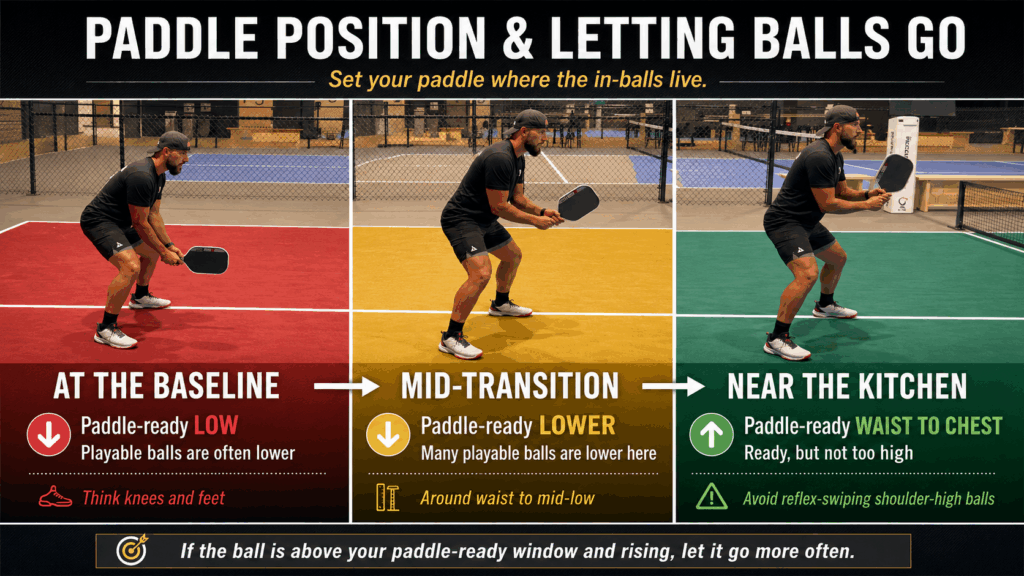
This is one of Marko’s most useful points because recreational players often use one ready position everywhere.
At the kitchen, your paddle should generally be up and in front, because the ball can reach you quickly and may arrive at chest or shoulder height.
As you move deeper into transition or toward the baseline, the likely contact window drops. That means your paddle can lower with it.
The principle is:
Match your ready position to where the next ball is most likely to arrive.
Keeping the paddle unnecessarily high near the baseline can actually slow your preparation for lower balls.
Likewise, holding it down around your knees at the kitchen makes counters unnecessarily difficult.
Shot Selection Is the Real Separator
This may be the most important section for players trying to move from 3.5 to 4.0. At that level, coaches are not simply asking:
“Can you hit a drive?”
They are asking:
“Do you know when not to hit one?”
Ball height, body balance, and court position should determine whether you attack or reset. A high ball contacted from a stable base creates an offensive opportunity; a low ball or off-balance contact should usually be neutralized.
I would simplify Marko’s decision framework into four questions.
1. Am I balanced?
Balanced → more options.
Off balance → simplify.
2. Where am I?
At the kitchen → more attacking options.
In transition or deep → reset more often.
3. How high is the contact?
Above the net + balanced → think offense.
Below the net → attack risk goes up.
4. How much pressure am I under?
Stretched, late, or defending pace → neutralize first.
Don’t force offense from a bad position.
Simple rule:
Good balance + good height + good position = attack.
Bad balance, low contact, or pressure = reset.
The Middle Should Be Your Emergency Exit
Intermediate players often believe good pickleball requires increasingly precise sidelines and angles. Under pressure, that can be exactly backwards.
The middle is one of the safest bailout targets because it:
✅ gives you more court
✅ reduces available attacking angles
✅ can create hesitation between opponents
✅ keeps the next ball more predictable
When you’re unsure where to place a third-shot drop, the middle is often the higher-margin target because it gives you more court to work with and reduces the opponents’ available attacking angles.
So if you are stretched in transition and just trying to survive:
Middle first. Fancy later.
Your Third Shot Should Come With a Report
Good doubles partners communicate before the next problem arrives. On the third shot, the two biggest calls are:
Who is taking it?
and
How good was it?
If your partner hits the third and you can see it is dropping nicely, a simple:
“Good.”
or:
“Go.”
helps both players advance together.
If it is floating:
“Stay.”
or:
“High.”
can prevent your partner from walking directly into an attack.
Advance after a quality third shot.
If the third is poor, hold your ground, stay balanced, and prepare to defend.
That decision becomes much easier when someone actually says it.
Protect Your Partner While They’re Coming Forward
This is one of the least-discussed habits that coaches notice immediately. Your partner returns serve and has to run from the baseline to the kitchen. You are already standing at the line.
What should you do?
Not just stare straight ahead.
If the opponent drives into the middle while your partner is still moving, you are often the player in the better position to protect that space.
Shade enough toward the seam to discourage the drive and give your partner time to arrive. This does not mean stealing every ball. It means understanding who is temporarily more vulnerable.
Strong doubles players do not just cover “their half.” They adjust responsibility based on what is happening in the rally.
Stop Treating Every Ball Like a Chance to Win
One thing coaches love in better players is patience without passivity. At 3.5, players often try to win rallies with:
- low speed-ups
- third-shot drives from bad positions
- aggressive transition volleys
- sideline dinks with tiny margins
At the 4.0 level, weak resets, poorly timed speed-ups, and abandoning your team’s structure can quickly turn a neutral rally into an attackable ball for your opponents.
Sometimes the correct shot is simply the one that keeps your team in a good position for another ball.
That is not passive.
That is disciplined.
Coaches Want You to Become Predictable—in a Good Way
This sounds strange. You do not want your opponents to know exactly what shot you are hitting. But your partner should be able to predict your decisions.
They should know:
- you will return deep and come forward
- you will not attack from your shoelaces
- you will call the third shot
- you will communicate whether to advance
- you will reset when under pressure
- you will cover middle when they are vulnerable
That reliability is what makes doubles partnerships work. A player with ten spectacular shots and random decision-making can be exhausting to partner with.
A player with six very solid shots and dependable choices is often much more effective.
Don’t Confuse a Lesson With Practice
This is another thing coaches wish more recreational players understood. A lesson introduces or corrects a skill. It does not install it.
If a coach fixes your drop mechanics on Wednesday and you play six games Thursday without intentionally practicing the change, the old movement usually wins.
The better cycle is: Lesson → isolated drilling → variable drilling → games.
For example, if your coach works on contact out front:
- hit controlled feeds with perfect spacing
- add movement
- randomize forehand/backhand
- use the cue in live points
The lesson tells you what to change. Repetition teaches your nervous system to actually use it.
What to Bring to a Lesson
One of the best things an intermediate player can tell a coach is not:
“I want to get better.”
Be specific.
Try:
“My third drops break down when the return lands deep.”
or:
“I keep getting jammed on my backhand counter.”
or:
“I don’t know when I should advance from transition.”
That gives the coach a real problem to solve. Even better: tell them what happens under pressure, not only what fails during warm-up.
That is usually where the useful coaching starts.
The Six Habits I’d Want Before Chasing 4.0
If I were evaluating an intermediate recreational player, I would care less about whether they own every modern shot and more about whether these six things happen routinely:
| Habit | What I Want to See |
|---|---|
| Serve / return | Consistent depth |
| Footwork | Move behind the ball rather than reaching |
| Contact | Comfortable and in front |
| Shot choice | Based on balance, height, position, pressure |
| Transition | Advance when earned, stop when threatened |
| Communication | Clear calls with the partner |
Those are not beginner skills. Doing them under pace, fatigue, and pressure is advanced.
What Coaches Are Really Asking You to Do
The jump beyond 4.0 is not usually about adding another trick shot. It is about making fewer rallies unnecessarily difficult.
Deep serve.
Deep return.
Move your feet.
Get the contact in front.
Change your ready position with court position.
Attack good balls.
Reset bad ones.
Use the middle when you are in trouble.
Communicate with your partner.
Then repeat those things until they stop feeling like instructions. That is what coaches are really begging recreational players to do. Not become more complicated.
Become more reliable.