
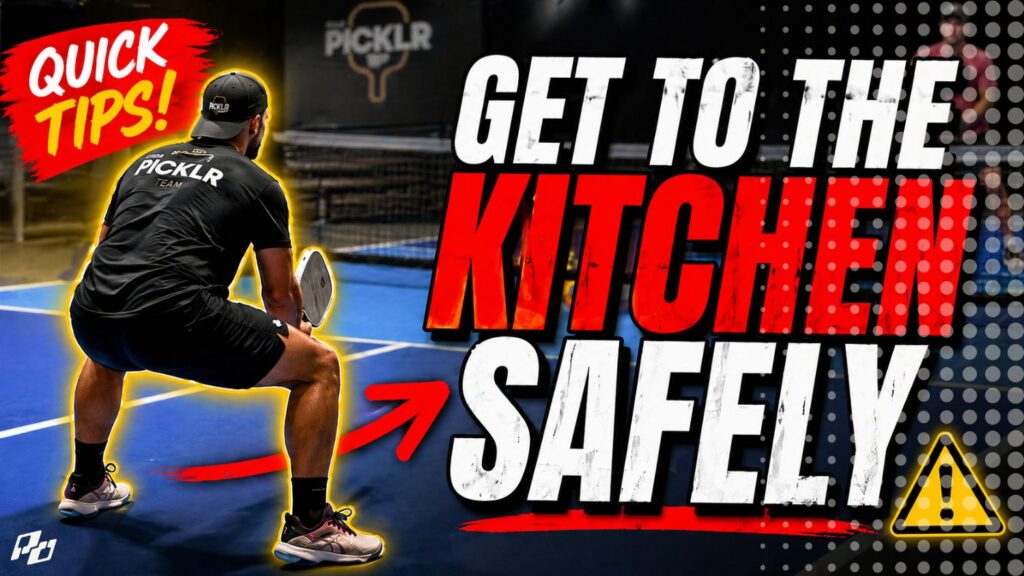
Getting from the baseline to the kitchen safely is one of the most important skills in doubles pickleball — right after the serve and return.
Most rec players don’t lose points at the kitchen. They lose them trying to get there.
They rush.
They guess.
They move forward on bad balls.
They overrun good ones.
They freeze at the wrong time.
They attack balls that were sailing out.
➡️ Transition is where games swing.
And here’s what makes it tricky: it feels urgent. When you’re stuck at the baseline and your opponents are already at the kitchen, your brain screams, “Get up there!” That urgency leads to rushed decisions. The best players override that instinct. They don’t sprint forward — they earn their way forward.
So we shot a full tutorial breaking this down step by step.
Watch the Full Tutorial with Coach Marko Grgic
In the video above, Marko walks through exactly how to read ball flight, when to move, when to stop, and how to structure your transition so you’re not getting crushed on the way in.
Watch it first — then we’ll go deeper and break it down.
The Real Question of Pickleball
Marko says it perfectly:
“Can I get myself from baseline to kitchen effectively and safely every single time?”
That’s the game.
- Not speed-ups.
- Not trick shots.
- Not paddle tech.
If you consistently win the transition phase, you will outplay most 3.0–4.0 players without hitting harder.
Why? Because most recreational rallies are decided before the dink battle even starts. The team that arrives balanced and organized wins the first neutral exchange. The team that arrives scrambling loses it.
Transition determines who controls the first dink.
Step 1: Ball Flight Recognition (This Is Everything)
The entire system starts with one decision: am I safe to move forward?
✖️ Most players decide emotionally.
✔ Better players decide visually.
Marko teaches “high, medium, low” based on your opponent’s paddle height at contact. That’s brilliant because it simplifies chaos.
What You’re Actually Reading
You are not reading the ball. You are reading your opponent’s:
- Paddle height
- Swing shape
- Preparation
- Body position
Here’s what it means mechanically:
- High paddle contact = ball is attackable = expect pace
- Medium contact = neutral exchange
- Low paddle contact = ball is unattackable = you’re safe
The lower their paddle, the safer you are. That’s not philosophy — that’s geometry.
And this is important: low does not mean “weak.” It means your opponent cannot hit down on the ball. If they cannot hit down, they cannot accelerate aggressively.
Downward contact creates offense. Upward contact creates defense.
Why Most Rec Players Get This Wrong
They move forward because:
- “It felt like a good shot.”
- “I think it was low.”
- “I hope it was good.”
Hope is not a strategy. You must train your eyes to categorize ball quality instantly.
Advanced Clarification
Low doesn’t just mean “soft.” Low means:
- The ball is below net height at reception.
- Your opponent must lift.
- Their only safe option is upward.
That upward lift is your green light.
And here’s the subtle layer: even a fast ball can be “low” if it forces upward contact. Pace alone doesn’t determine danger — paddle angle does.
Step 2: Green Light, Red Light (The Plane of the Net Rule)
This might be the most important concept in the entire video. When do you stop moving?
Answer: the moment your ball crosses the plane of the net.
Why? Because once it crosses:
- Your opponent is about to contact it.
- You need to be balanced.
- You need to prepare to split step.
Most players keep running. That’s how you get crushed.
And here’s why this rule is powerful: it removes guessing. You don’t stop “when you feel like it.” You stop at a specific visual checkpoint — net plane crossed.
The Physics Behind the Freeze
You should be fully stopped and balanced before your opponent makes contact.
If you’re still moving forward as they strike the ball:
- Your weight is forward.
- Your center of gravity is unstable.
- You cannot react laterally.
- You cannot retreat efficiently.
The correct sequence is:
Ball crosses net → You stop forward movement → Small split step → Opponent makes contact → You react.
➡️ Freezing buys you reaction time.
➡️ Reaction time wins transition battles.
Important: Rarely Is It One Shot
Most rec players expect this sequence:
Baseline → Drop → Kitchen.
That works maybe 10% of the time. Realistically, it’s:
Baseline → Good drop → Step in → Freeze
Midcourt → Good reset → Step in → Freeze
Transition → Neutral ball → Step in → Freeze
Dink battle begins.
It’s a 2–3 shot progression.
There is no clock. The only players rushing are the ones getting attacked.
And here’s the mental shift: your goal is not to “arrive.” Your goal is to “advance safely.” Those are different mindsets.
Step 3: Paddle Height = Decision Filter
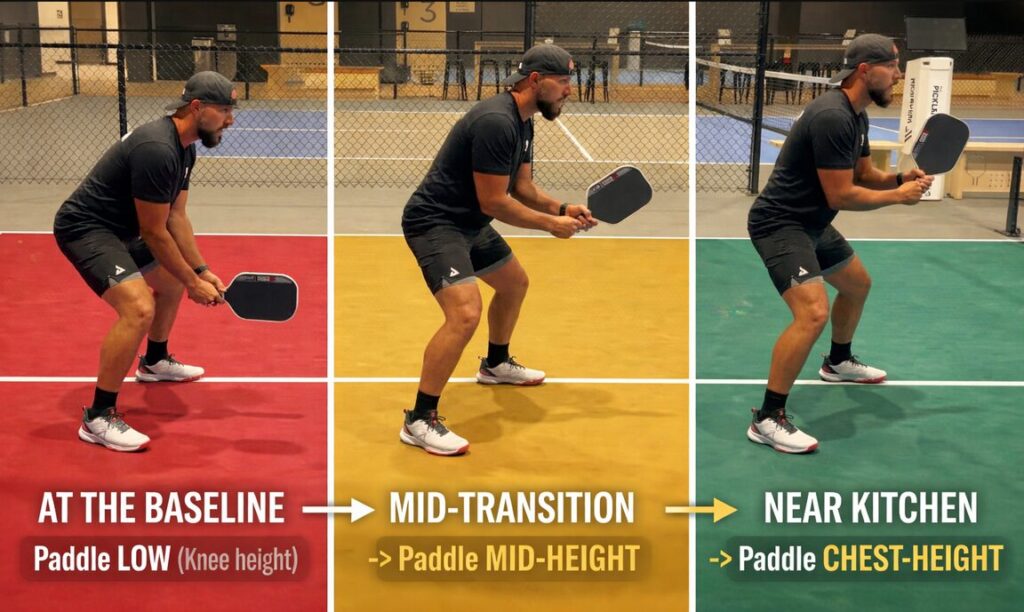
This section is incredibly underrated. Your paddle ready position should match your court position. Here’s what that means practically:
At the Baseline
➡️ Paddle low (around knee height)
Why?
Because there is more court behind you.
Balls can land deep.
You need upward coverage.
If you hold your paddle too high back here, you’ll stab at low balls and pop them up.
Mid-Transition
➡️ Paddle mid-height
Now you are close enough that:
- High balls are likely going out.
- Low balls are playable.
- Your reaction window shrinks.
This is where most players struggle because they don’t adjust their paddle height gradually — they either keep it too low or raise it too early.
Near Kitchen
➡️ Paddle chest height
At this point:
- There is very little court behind you.
- If the ball is higher than your paddle with pace, let it go.
This is how advanced players stop hitting balls that were sailing out. Your paddle height becomes your out-call filter. Instead of guessing whether a ball is out, your paddle position pre-decides it.
Bonus: The Split Step That Makes This Work
Marko mentions freezing — but let’s clarify the footwork layer. Every time your ball crosses the net:
➡️ Small split step.
Even in transition.
Especially in transition.
The split step:
- Neutralizes forward momentum
- Pre-loads your legs
- Improves reaction time by milliseconds
- Prevents overrunning your shot
Without the split step, “freezing” turns into flat-footed panic. And it doesn’t have to be dramatic. A small, controlled hop is enough.
The Biggest Mistake Rec Players Make
They move forward on medium balls. Medium is not green. Medium is caution. Only low is green.
Medium means:
- Expect counter.
- Expect pace.
- Expect a test.
If you advance aggressively on medium balls, you will get attacked.
Medium is “earn one more.”
Low is “advance.”
Retreating Is Not Failure
One of the most mature things in transition play: retreating on a bad ball.
If your drop floats?
Back up.
If your reset sits up?
Back up.
Backing up:
- Creates more reaction time
- Makes speed-ups less dangerous
- Prevents panic volleys
Only ego prevents retreat. Great transition players are comfortable moving both directions.
Communication: The Missing Skill
Marko says say it out loud: “Go” or “No.” That is elite-level advice. Because doubles is shared responsibility. Your partner must also be reading your ball quality.
If one moves and one doesn’t: you’re exposed.
The team must see the same thing. Even advanced teams call it subtly — a small “yes” or “stay.” Clarity removes hesitation.
Practice Structure: 7–11 Drill Upgrade
Marko gives you skinny singles / 7-11 variation. Let’s upgrade it.
Level 1
One player stays at kitchen.
Other works forward slowly.
Level 2
Kitchen player can speed up medium balls.
Level 3
Transition player must retreat on any high ball.
This forces:
- Ball recognition
- Discipline
- Patience
The goal is not winning the drill. The goal is mastering decision-making.
Advanced Bonus: The Drop That Makes This Easy
Let’s clarify what kind of drop we’re talking about — because not all drops are equal.
The safest transition drop is a high-arc, neutralizing drop with a compact swing and upward-outward paddle path. This is not a flat push. It’s not a driven third. It’s a controlled lift designed to force your opponent into upward contact.
Technically, it should have:
- Comfortable net clearance (not barely skimming tape)
- A peak above the net before descending
- A landing point near your opponent’s feet
- Minimal backswing
- Stable wrist and smooth acceleration
The goal is simple: make your opponent contact the ball below net height.
Flat drops are dangerous.
Jerky drops are dangerous.
Big backswings are dangerous.
➡️ Smooth and upward wins.
Coach Marko breaks down the ideal third-shot mechanics in the video below:
Here’s the subtle performance cue: if your opponent’s paddle stays low at contact, your arc was high enough. If their paddle rises above net height, your drop was too flat.
You’re not trying to hit a winner. You’re trying to start a dink battle from farther back — safely and on your terms.
The Ultimate Transition Checklist
Before moving forward, ask:
- Was their paddle low?
- Did my ball land below net height?
- Am I balanced?
- Did I split step?
- Is my paddle set to the right height?
If you cannot answer yes to most of these — stay put.