
Most pickleball players notice little decline after one week off. After two to four weeks, timing, touch, footwork, and conditioning may begin to fade. After several months, consistency and match fitness drop more noticeably, but well-learned skills usually return faster than they were originally learned.
Take a week off pickleball and your first few dinks may feel strangely stiff. Take a month off and the ball may seem faster than you remember.
After several months, you may know exactly where to hit—but arrive late, contact the ball too close to your body, and miss shots that once felt automatic.
That does not mean your pickleball skills have disappeared.
Most well-learned motor skills are retained far longer than players assume. What fades first is usually not your knowledge of the game. It is your calibration: timing, spacing, touch, movement efficiency, and the ability to make good decisions at match speed.
Physical conditioning can also decline during a layoff, particularly if you stop exercising altogether. Aerobic adaptations generally fade faster than strength, while established motor patterns can remain stored for months or even years.
Here is what the return usually looks like.
The Real Timeline
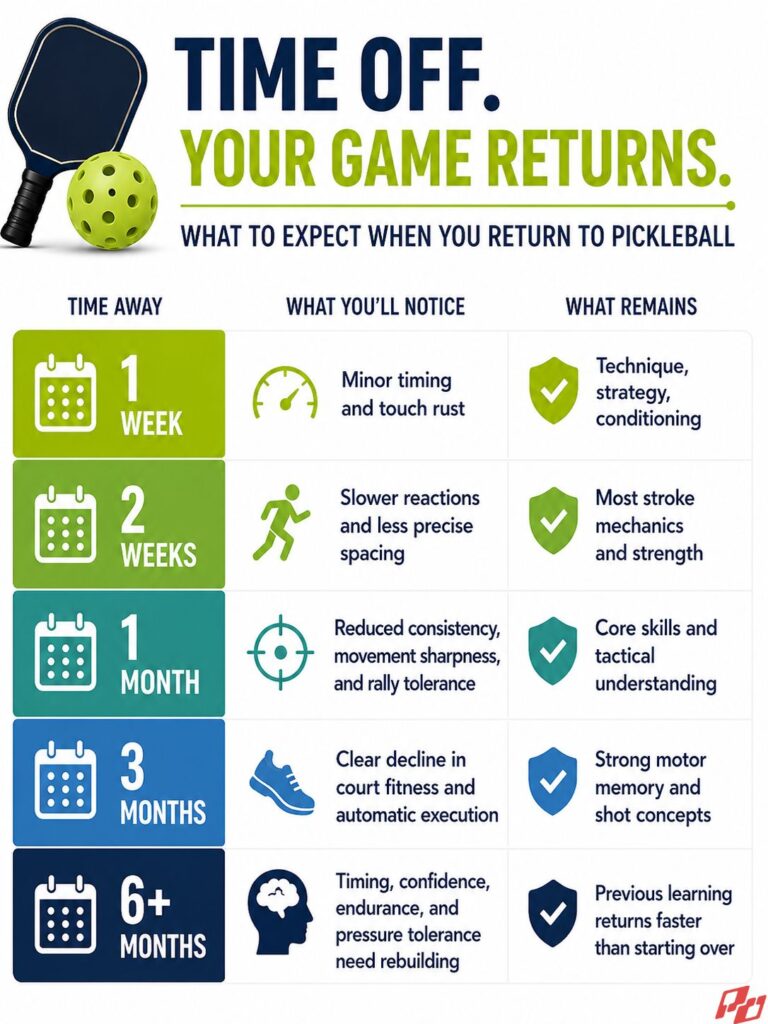
| Time away | What you are likely to notice | What probably remains |
|---|---|---|
| 1 week | Minor timing and touch rust | Technique, strategy, conditioning |
| 2 weeks | Slower reactions and less precise spacing | Most stroke mechanics and strength |
| 1 month | Reduced consistency, movement sharpness, and rally tolerance | Core skills and tactical understanding |
| 3 months | Clear decline in court fitness and automatic execution | Strong motor memory and shot concepts |
| 6+ months | Timing, confidence, endurance, and pressure tolerance need rebuilding | Previous learning returns faster than starting over |
This timeline assumes you are healthy and previously played regularly. Injury, illness, complete inactivity, age, training history, and skill level can shift it substantially.
One Week Off: You Are Usually Rested, Not Worse
For most regular players, a week away produces little meaningful skill loss.
Your first session back may still feel awkward. The ball might appear faster, your paddle may feel unfamiliar, and your dink height may vary more than usual. That is usually a temporary calibration problem rather than lost technique.
In fact, players carrying fatigue or minor soreness may return feeling better after a short break. The nervous system and connective tissues have had time to recover, while the underlying movement patterns remain intact.
What tends to feel rusty first:
- contact-point precision
- dink depth
- serve rhythm
- judging balls near the baseline
- hand speed during the first few exchanges
Do not use those first ten minutes as evidence that your game has declined.
Best return plan
Spend 10–15 minutes rebuilding ball feel:
- Cooperative dinks.
- Controlled transition resets.
- Half-speed volleys.
- Serves and returns with full routines.
- A few live points before competitive games.
The cue is:
Recalibrate before you evaluate.
You probably do not need to change your mechanics. You need enough repetitions for your timing to resynchronize.
Two Weeks Off: Timing Usually Fades Before Technique
At around two weeks, many players begin to feel a more noticeable difference.
Research on detraining suggests that cardiovascular changes can start appearing within roughly two to four weeks of complete inactivity, while strength is generally retained longer.
On a pickleball court, however, the first problem may not feel cardiovascular. It may appear as poor positioning.
You recognize the shot but move a fraction late. That small delay changes everything:
- volleys contact closer to your body
- dinks are taken lower
- third shots are struck while moving
- wide balls require reaching instead of shuffling
- counters become defensive blocks
Your stroke has not vanished. Your preparation is simply arriving later than it did before the break.
What coaches often mislabel as “rust”
A player returns, misses several drops, and immediately starts adjusting the swing.
But the real issue may be:
- no split step
- late paddle preparation
- poor distance from the bounce
- upright posture
- feet continuing through contact
Before rebuilding a stroke, check whether you are arriving in the same position you used before the layoff.
Best return plan
For your first session back, avoid jumping directly into fast open play. Use drills that restore the relationship between movement and contact:
- serve, split, and hit the third shot;
- transition reset followed by two controlled steps;
- crosscourt dink with mandatory recovery;
- volley exchanges that gradually increase in pace.
Your cue:
Restore the feet before repairing the hands.
One Month Off: Your Game Is Still There, but It Is Less Automatic
After a month away, many recreational players feel genuinely worse.
You may still hit excellent individual shots. The problem is reproducing them repeatedly while reading opponents, moving, communicating, and managing score pressure.
This is where the difference between skill retention and performance retention matters.
Motor learning describes relatively lasting changes in the ability to perform a skill. Day-to-day performance is more fragile and depends on current timing, attention, physical readiness, and recent practice.
That explains why you can hit a perfect third-shot drop during warm-up and then miss three in a game. The movement pattern remains available, but it is not yet running reliably under changing conditions.
Likely signs after one month:
- touch shots lack consistent depth
- speed-ups are mistimed
- anticipation is slower
- transition movement feels rushed
- longer rallies elevate your heart rate more quickly
- decision-making becomes more conservative or impulsive
Do not try to recover everything at once
The worst return strategy is to play three hard hours and judge your level by the results.
Instead, rebuild in layers:
Session 1: Touch, spacing, and controlled movement.
Session 2: Serve, return, third shot, and fifth-shot patterns.
Session 3: Live decision-making and moderate competition.
Session 4: Normal play intensity.
One or two focused sessions often restore more useful timing than several chaotic rec games.
Three Months Off: Conditioning Begins to Affect Technique
After roughly three months without pickleball—and especially without other exercise—the decline becomes harder to hide.
At this point, the problem is not only touch. Reduced conditioning can alter the way you perform your strokes.
When your legs fatigue sooner:
- your stance becomes higher
- your split step becomes smaller or disappears
- you reach rather than reposition
- your contact point drifts backward
- your paddle face becomes less stable
- your decision-making speeds up because you feel physically rushed
Longer periods of detraining can reduce aerobic capacity, muscular endurance, and sport-specific efficiency, although the amount varies considerably according to previous training and activity during the break.
This is why a player may believe the paddle suddenly lacks control when the real problem is that the lower body no longer supports the same contact position.
What normally comes back quickly
Established strokes often reappear faster than expected. Research on motor memory shows that well-learned movement patterns can remain stored for long periods, even when immediate performance has declined.
You may therefore experience an unusual mix:
- technique that looks familiar
- fitness that feels unfamiliar
- decisions that are correct
- execution that is late
Best return plan
Treat the first two weeks as a short preseason.
Combine:
- 20–30 minutes of deliberate drilling
- short games rather than marathon sessions
- lateral movement and balance work
- strength training for legs, hips, calves, and trunk
- at least one recovery day between demanding court sessions
For older players or anyone returning after illness or injury, rebuilding volume gradually matters more than proving that the old level is still there.
Six Months or Longer: You Have Not Forgotten—But You Must Rebuild the System
After six months, expect noticeable rust in almost every part of the game:
- ball judgment
- paddle timing
- court movement
- rally tolerance
- partner spacing
- confidence under pressure
Yet you are still not starting from zero.
A former 4.0 player returning after six months normally retains a much stronger internal understanding of spacing, shot selection, and movement than a new player. Previous motor learning creates “savings,” meaning relearning is typically faster than learning the skill originally. Long-term motor-skill research has found retention lasting well beyond short layoffs, including in older adults.
The danger is expecting the old game to appear at full speed immediately.
Knowledge tends to return before precision. Precision returns before endurance. Endurance may return before confidence in competition.
Use a three-phase return
Phase 1: Restore predictable contact
Start with serves, returns, dinks, volleys, and drops from stable positions. Don’t chase pace yet. The goal is simple: find the center of the paddle again and again.
Phase 2: Add movement and variability
Alternate forehand and backhand contacts. Move through transition. Mix up depth, speed, and height. This reconnects your read of the ball with your actual execution.
Phase 3: Add pressure
Now bring in skinny singles, conditioned games, and regular doubles. Use scoring only once movement and contact quality feel stable.
Competitive pressure should be the final layer. Not the first test.
What Actually Declines First?
Players often say they have “lost their game,” but different abilities fade at different rates.
1. Calibration
This includes judging pace, bounce, distance, paddle angle, and contact height.
It can feel noticeably worse after even a short break, but it usually returns quickly.
2. Automatic footwork
You may know where to move without moving early enough. Split steps, recovery steps, and partner movement become less instinctive.
3. Rally-specific conditioning
General walking or gym fitness helps, but it does not perfectly reproduce repeated lateral starts, stops, lunges, and rapid exchanges.
4. Decision speed
Tactical knowledge remains, but it takes longer to recognize the correct option at full pace.
5. Confidence
Players returning from a break often guide the ball, avoid attacking, or overhit to compensate for uncertainty.
Confidence is usually the last piece because it requires successful repetitions under real pressure.
Newer Skills Fade Faster Than Established Skills
Not every part of your game has the same shelf life.
A backhand roll you developed over several years is likely to survive a layoff better than a two-week-old forehand speed-up you had only recently begun using.
New motor skills are initially less stable and become more durable through consolidation and repeated retrieval.
That gives you a useful maintenance rule:
Protect your newest skill first.
When travel, weather, or scheduling prevents full play, spend even 10–15 minutes maintaining the skill you have most recently changed.
Shadow swings, wall drills, footwork patterns, or gentle ball work cannot replace live play, but they can keep the movement mentally and physically accessible.
How to Lose Less During a Break
You do not need full matches to preserve much of your game. The biggest difference is between reduced pickleball and complete inactivity.
During a break, maintain three things:
⮕ Movement capacity
Walk briskly, cycle, strength train, or perform short lateral-movement sessions. General activity helps preserve the physical base even when it cannot fully reproduce court demands.
⮕ Paddle-ball contact
Wall volleys, rebounder drills, serves, or soft-ball practice can maintain rhythm and visual tracking.
⮕ Tactical rehearsal
Watch points actively rather than passively. Predict the next ball, identify who has the advantage, and decide where you would move. Observation can support motor memory, although it is not a substitute for physical practice.
Even one short maintenance session each week can make a return feel much less abrupt.
Do Not Test Your Old Level on Day One
Your first session back is not an examination. It is a recalibration session.
Do not judge your rating by early misses, and do not rebuild your strokes because the first 20 balls feel strange. Start slower than your ego prefers. Recover your spacing, balance, and contact point before adding pace or pressure.
After a short layoff, your timing usually returns within a session or two. After several months, expect a gradual rebuild—but remember that you are recovering an existing game, not creating a new one.
The skill is still there.
Your job is to make it automatic again.