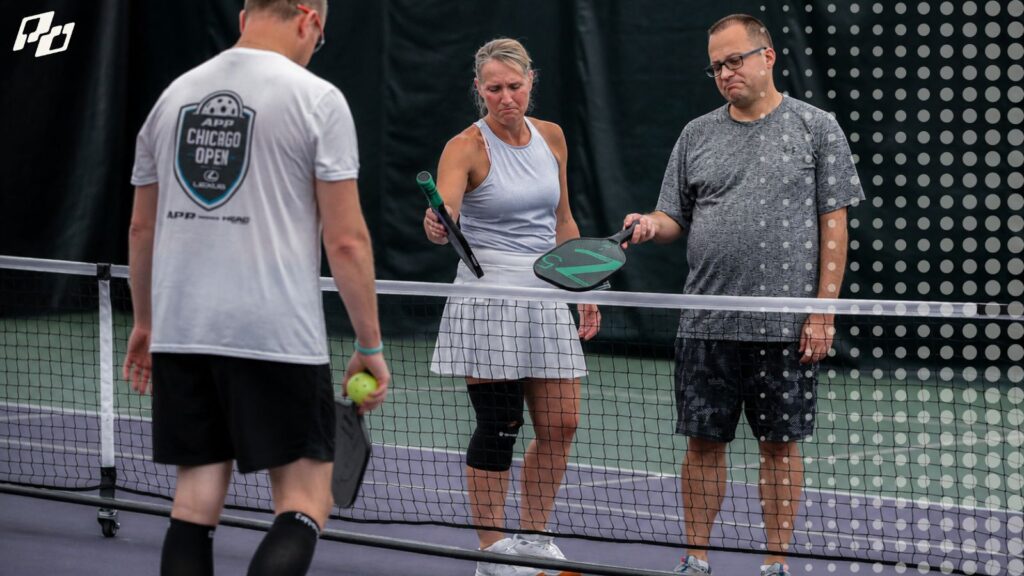
To handle losing in pickleball, focus on what the match exposed rather than what the score says about you. Use specific self-talk, support your partner without overcoaching, give opponents credit, and leave with one or two clear adjustments to practice next.
Nobody likes losing. But some pickleball players lose a match and walk away with useful information.
Others lose the same match and spend the drive home replaying every missed dink, blaming themselves, blaming their partner, or inventing reasons the opponents “weren’t actually that good.”
The first group usually learns more from the experience.
That is because they are treating the match like a scouting report, not a referendum on their ability.
For recreational players, especially competitive 3.5–4.0 players, that distinction matters. You are going to lose games you expected to win. You are going to get picked apart tactically. Sometimes you will simply play badly.
The skill is learning how to process that without letting one result poison your confidence—or your relationships on court.
Sport-psychology research backs up the general idea. Self-talk interventions show a moderate positive effect on athletic performance, while confidence, mindfulness, cohesion, and other psychological skills are consistently associated with better performance outcomes.
So losing well is not just etiquette.
It is a competitive skill.
First, Stop Treating the Score as the Entire Story
A score like 11–4 can mean very different things.
Maybe you were completely outplayed.
Maybe six rallies were decided by one poor third-shot decision.
Maybe your opponents discovered your backhand dink and simply stayed there.
Maybe they were not technically better at all—they just made fewer bad decisions.
The final score tells you what happened. It does not necessarily tell you why.
That is why the first question after a loss should not be:
“Why did I play so badly?”
Ask:
“What pattern kept beating us?”
That shifts your brain from judgment to diagnosis. Look for specifics:
- Were returns landing short?
- Were you attacking below net height?
- Did one opponent dominate the middle?
- Did you and your partner leave a seam?
- Were your third shots giving the returner comfortable fourth balls?
- Did you lose mostly in hand battles or before you even reached the kitchen?
That is what being a scout means. You are collecting information, not writing a character review of yourself.
The Loss Doesn’t Change—But Your Interpretation Can
There is an important psychological idea behind all of this: the event and your interpretation of the event are not the same thing.
You lost 11–6.
That is the event.
But your brain can interpret it as:
“I’m not as good as I thought.”
Or:
“They exposed two patterns I need to improve.”
Same score. Completely different psychological response.
Sport psychology describes something similar through challenge and threat appraisal. When athletes perceive a difficult competitive situation as a challenge they have the resources to handle, they tend to experience greater control and more adaptive emotional responses. When they interpret the stressor primarily as a threat, the psychological response can look very different.
That matters after a pickleball loss because perspective determines what you do with the result.
Threat perspective:
“They proved I’m not a 4.0 player.”
Challenge perspective:
“Their pace exposed my backhand transition reset.”
The first attacks your identity.
The second identifies a trainable skill.
You are not trying to convince yourself that losing feels good. You are deciding whether the loss becomes evidence against yourself or information for yourself.
Cue
Turn judgment into information.
Use a Two-Column Post-Match Review
Keep it ridiculously simple. After a meaningful loss, mentally divide the match into two categories:
| Keep | Change |
|---|---|
| Deep returns were working | Too many low-ball speed-ups |
| Backhand resets held up | We left middle open |
| Crosscourt dinks were solid | Third shots sat too high |
| We stayed composed | We rushed transition |
Limit yourself to two items in each column.
Why?
Because a match can easily produce 20 things you want to fix. You are not going to fix 20 things.
Two gives you something actionable. The purpose of reflection is not to generate a longer list of flaws. It is to decide what deserves practice next.
What to Tell Yourself When You’re Losing
The worst self-talk is vague and personal:
“I suck today.”
“I always do this.”
“Why can’t I make anything?”
Those statements give you no solution.
A meta-analysis of 32 self-talk studies found that self-talk interventions had a moderate positive effect on performance, with instructional self-talk particularly beneficial for fine motor tasks.
Pickleball is full of fine motor decisions. So replace judgment with a short instruction.
Instead of:
“Stop missing drops.”
Use:
“More height.”
Instead of:
“I’m getting destroyed in hands battles.”
Use:
“Compact paddle.”
Instead of:
“I keep rushing.”
Use:
“Split before contact.”
Instead of:
“We’re down 3–9.”
Use:
“Win this serve turn.”
Cue
Describe the adjustment, not yourself.
Don’t Use Fake Positivity
You do not have to tell yourself:
“I’m playing amazing!”
when you clearly are not. Your brain knows that is nonsense. A better statement is realistic and controllable:
“I’m late on returns. Give myself another foot.”
Or:
“They’re winning the crosscourt pattern. Let’s change middle.”
That kind of self-talk keeps the emotional temperature down while still acknowledging reality.
The goal is not to eliminate frustration. It is to prevent frustration from choosing your next shot.
You can be annoyed. Just do not let annoyance pick your next speed-up.
What to Say to Your Partner When You’re Losing
This is where sportsmanship and performance overlap. Your partner already knows they missed the return, and as we recently discussed in our article on what to say when your partner is struggling, adding more pressure will get you nowhere.
They do not need:
“You’ve got to get those in.”
What they need is information or reassurance.
Useful:
“Let’s play more middle.”
“I’ll take more seam.”
“That was the right ball.”
“No problem—same pattern.”
“Let’s slow this next point down.”
Not useful:
“Come on!”
after every error.
“Why did you hit that?”
“Just relax.”
“You need to stop driving.”
The difference is that the first group gives your partner something they can use. The second group adds pressure.
Your partner should leave the conversation feeling clearer, not smaller.
If You’re the One Playing Badly, Say It Once
There is nothing wrong with acknowledging that you are struggling. But do not apologize after every point.
One simple sentence is enough:
“I’m a little off today. I’m going to simplify and make more balls.”
That tells your partner you are aware of it and have a plan. Then stop talking about it.
Repeatedly saying:
“Sorry, sorry, sorry…”
turns every miss into a larger event and forces your partner to constantly reassure you. That becomes exhausting.
Own it once.
Adjust.
Play.
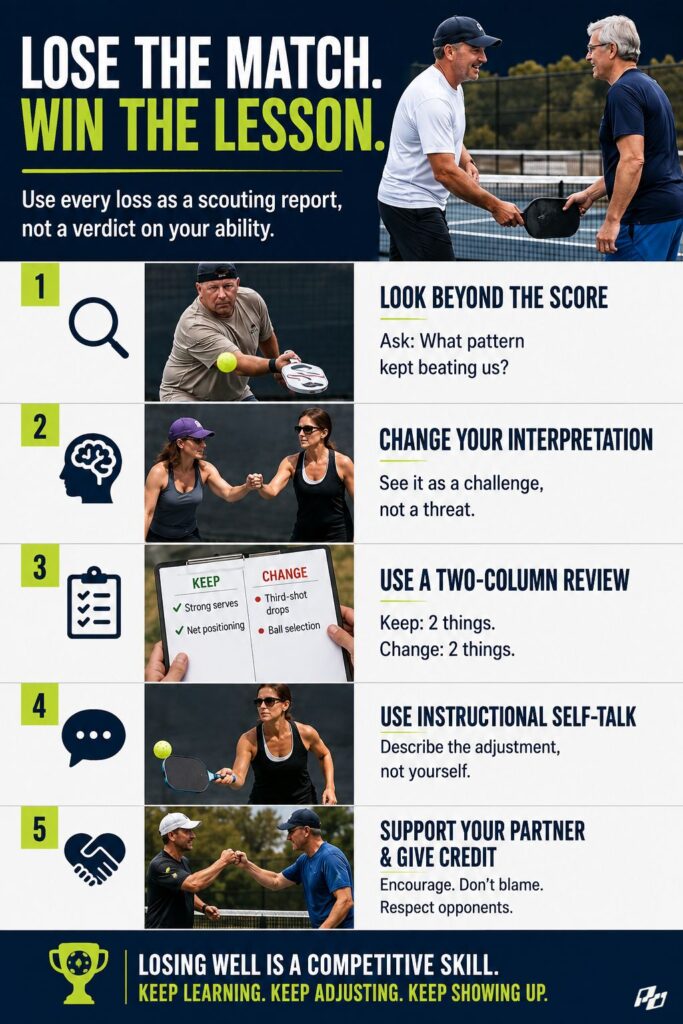
Give the Opponents Credit Without Diminishing Yourself
A lot of players struggle with this. After losing, they say:
“We played terrible.”
That may be true. But sometimes the opponents made you play terrible. Giving them credit does not mean surrendering your confidence. It means accurately identifying what worked. At the net, something as simple as:
“Great game—you guys kept us uncomfortable all day.”
Or:
“Nice match. You found our feet really well.”
is enough.
USA Pickleball’s Sportsmanship Guide emphasizes courtesy, respect, and graciousness in both winning and losing.
You can be competitive and gracious at the same time.
Stop Giving the Post-Match Excuse Report
Everyone has heard this one:
“I didn’t sleep.”
“My shoulder’s tight.”
“I normally never miss that shot.”
“We haven’t played together much.”
Some of those things may genuinely be true. But announcing them immediately after the match usually sounds like one thing:
You are trying to reduce the value of the opponent’s win.
If someone asks later, fine. At the net, keep it clean:
“Good game.”
“You guys played well.”
“That was fun.”
Then analyze the match privately. Your explanation does not need to become their problem.
The Scout Mindset: What Did They Expose?
This is where losing becomes valuable. Every good opponent exposes something.
Maybe they taught you:
- your backhand block sits too high
- your return does not have enough depth
- your dink pattern is predictable
- your transition footwork collapses under pace
- you do not recognize out balls
- you and your partner have no clear middle rule
That is useful information. A strong opponent just showed you what your next practice session should include.
Try ending every serious loss with one sentence:
“They exposed ______.”
Then fill in the blank.
For example:
“They exposed how slowly I recover after my forehand dink.”
“They exposed our middle communication.”
“They exposed that I cannot reset pace to my backhand in transition.”
That sentence is far more valuable than:
“They were just better.”
Don’t Confuse Losing With Playing Badly
Sometimes you play well and lose. This is surprisingly hard for competitive players to accept. You can:
- choose the right shots
- execute at a high percentage
- stay composed
- communicate well
and still lose because the opponents are better. That is not automatically a poor performance. In fact, those may be some of your best developmental matches.
Your standard should not always be: Did I win?
Try: Did my decisions hold up against this level?
If yes, the match may have been useful even if the score says otherwise.
What About Losing to Players You Think You Should Beat?
This one hurts more. The mistake is entering the next game thinking:
“I have to prove I’m better.”
That is exactly how players start forcing speed-ups, poaching recklessly, and aiming too close to lines. Instead, treat the loss as evidence.
Ask:
“What did they do that made my normal game less effective?”
Maybe they simply made more balls.
Maybe they attacked your impatience.
Maybe they were better at letting your out balls go.
A lower-rated or less athletic opponent can still make better tactical choices.
Respect that.
Then learn from it.
Give Yourself a Time Limit for Being Annoyed
You do not have to pretend losing does not bother you. If you care about competition, disappointment is normal. Give yourself a short window.
Five minutes.
Ten minutes.
Then convert emotion into information. Write down:
One thing they did well.
One thing I need to improve.
One thing I did well despite losing.
Then move on.
The problem is not disappointment. The problem is letting the same disappointment become repetitive negative thinking that follows you into your next game.
Do the review once. Do not replay the same missed 9–9 dink 46 times on the drive home.
Be Careful With the Idea That Beating Yourself Up Makes You Better
Competitive players sometimes believe harsh self-criticism keeps them accountable. The psychology is more complicated.
Research involving athletes has associated greater self-compassion with healthier responses to mistakes and failure.
In one randomized intervention involving varsity women athletes who identified as self-critical, a brief self-compassion program reduced self-criticism, rumination, and concern over mistakes.
A larger intervention involving 250 NCAA student-athletes also found that athletes receiving self-compassion training showed greater increases in self-compassion, lower self-criticism, and improvements in perceived sport performance compared with a waitlist group.
Self-compassion does not mean:
“Whatever. Losing doesn’t matter.”
It means:
“I played badly today. Let’s figure out why without turning it into an attack on myself.”
That is a very different mindset. You can hold yourself accountable without humiliating yourself.
In fact, separating “I made poor decisions today” from “I am a poor player” makes it much easier to identify something useful to change.
The Three Sentences I’d Keep
If I wanted a simple script for losing better, it would be this.
To yourself:
“What did they expose?”
To your partner:
“We’ve got one adjustment—let’s try it.”
To your opponents:
“Great game. You guys played that really well.”
That covers almost everything.
- Curiosity toward yourself.
- Clarity with your partner.
- Respect toward your opponents.
Perspective Is the Real Skill
Two players can walk off the court after exactly the same 11–5 loss. One thinks:
“That was embarrassing.”
The other thinks:
“Interesting. Every time I sped up crosscourt, they countered behind me. I need to work on that.”
Only one of them has turned the loss into practice material. That is ultimately what losing well is about.
You cannot control whether someone across the net is better than you today. You can control the meaning you assign to the result, the way you speak to yourself, the way you treat your partner and opponents, and what you carry into your next practice.
The score is fixed.
Your interpretation of it isn’t.