

You’ve just served, the return sails back deep, and now it’s your turn to play the all-important third shot. Every player knows what’s coming next: the drop. You take a breath, set your paddle, and float the ball over. But here’s the truth—what happens after contact isn’t just about your drop’s height or spin. It’s about where you and your partner are standing when the ball crosses the net.
As one coach told me, “You can hit a beautiful drop and still lose the point if your feet are in the wrong place.”
That’s because in doubles, the third shot is a team play. One person hits the ball, but both players succeed—or fail—based on how well they move together.
Why Positioning Is So Critical
Think of the third shot drop as a bridge. It’s not just a shot—it’s your transition from baseline defense to kitchen offense. And like any bridge, the way you walk across matters as much as the structure itself.
Good positioning makes your drop safer, reduces the pressure on your partner, and shortens the distance to the kitchen line.
Poor positioning? That’s when gaps open, middle balls slip through, and your opponents feast on floating drops.
Who Struggles Most
You can spot the common culprits right away:
- Tennis converts who hang back at the baseline, waiting for the “right” time to charge forward.
- New players who focus so much on making contact with the ball that they forget to move their feet.
- Over-eager athletes who sprint all the way to the kitchen before the drop has even crossed the net—only to get jammed by a drive.
The pattern is always the same: the shot might be okay, but the court positioning turns it into a liability.
A Tale of Two Partners
Picture this:
Player A hits a soft, well-placed drop but stays glued to the baseline. Their partner rushes forward to the kitchen, eager to start dinking. In that moment, there’s a yawning gap in the middle of the court. The opponents see it instantly, drive hard through the gap, and the point is over.
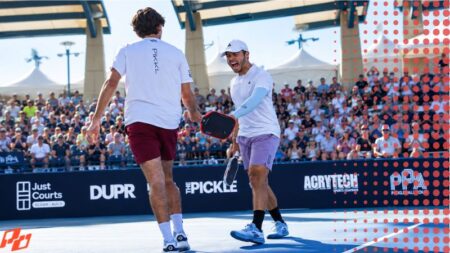
Now imagine Player B. After hitting their drop, they move forward with the shot, stopping in the transition zone. Their partner mirrors the movement—same depth, same pace. Shoulder to shoulder, they close the court. Even if the drop floats a little high, they’re in sync, ready to defend.
The difference? Not mechanics, not paddle, not luck. Just positioning.
The Psychology of Positioning
Here’s the real mental trap: most players hesitate to move up because they’re afraid of being passed or attacked. Staying back feels safe. In reality, it’s the opposite.
When you stay deep, you give your opponents open angles and endless targets. Moving forward shrinks the court for them, cutting off opportunities and buying you reaction time.
As Sarah Ansboury puts it: “Respect the quality of the ball you just hit. If it’s good, move in. If it’s average, pause and defend. But don’t abandon your partner either way.”
In other words, confidence comes from matching your feet to your shot—not guessing or panicking.
Partner Dynamics & Communication
Good positioning doesn’t just happen—it’s communicated. Doubles teams that thrive often talk more than they think they should:
- A simple “hold!” if your partner’s drop floats too high.
- A quick “go!” if the drop is perfect and you can both advance.
- Non-verbal cues: a glance, a shift of weight, or even a paddle tap.
And here’s a simple framework to follow:
👉 As soon as you see the return is going to your partner, take two steps inside the court.
👉 Make eye contact — see where they’re striking from.
👉 If their drop is good, crash the net together to apply pressure.
👉 If their drop floats high, pause or step back to defend as a unit.

One veteran coach told me: “Think of yourselves as tied together with a six-foot rope. If they move forward, you move forward. If they stop, you stop.”
Real-Match Scenarios
So what does positioning look like in practice? Let’s break it down:
- High, shallow return:
- Dropper can take the ball comfortably just behind the baseline.
- Both players move forward as the ball is struck, pausing in the transition zone until the drop bounces.
- If it’s good, continue to the NVZ together.
- Deep, heavy return:
- Dropper may need to step back, hitting a more defensive drop.
- Partner mirrors the depth—don’t rush forward.
- Hold transition until you see how the ball lands.
- Lob return:
- Both retreat together, reset behind the baseline.
- Play a safer drop, then rebuild the advance in sync.
These are the little “chess moves” of doubles—adjusting together, not as two individuals.
Visualizing Good vs. Bad Positioning
Imagine looking down at the court from above:
- Good Positioning: Two dots side by side, halfway between baseline and kitchen, six feet apart, moving forward in sync.
- Bad Positioning: One dot at baseline, the other at the kitchen line—giant diagonal gap in between. Or two dots ten feet apart, begging for a ball down the middle.
Even a simple sketch like this helps players see why rallies unravel.
Skill-Level Adjustments
Positioning isn’t one-size-fits-all. It changes with experience:
- 3.0–3.5 Players: Focus on staying shoulder-to-shoulder. Don’t rush. It’s better to pause in transition together than to sprint separately.
- 4.0+ Players: Begin reading returns and adjusting proactively. Control angles, shift laterally as a unit, and anticipate where the fifth shot will land.
- Tournament-Level Players: Positioning becomes dynamic. You’re not just reacting—you’re actively baiting opponents with spacing, then closing in to cut off options.
Take This With You
The third shot drop will always be a touch shot, a gamble, a challenge. But positioning is the safety net that makes that gamble worth it. Get it right, and even a “just okay” drop keeps you alive in the rally. Get it wrong, and even your best drop gets punished.
As pickleball coach Steve Dawson says, “It’s not the beauty of the drop that wins points. It’s the discipline of your feet after you hit it.”
So next time you step onto the court, don’t just think about the ball. Think about the bridge you’re crossing with your partner. Step forward together, stay compact, and you’ll turn one of pickleball’s trickiest shots into one of its greatest weapons.
Quick Do-or-Die Reminders
- Trust your partner’s movement more than your instincts.
- Small steps forward beat big lunges every time.
- A “good enough” drop with great positioning is better than a perfect drop with poor positioning.
- When in doubt—pause in transition, don’t rush the kitchen.