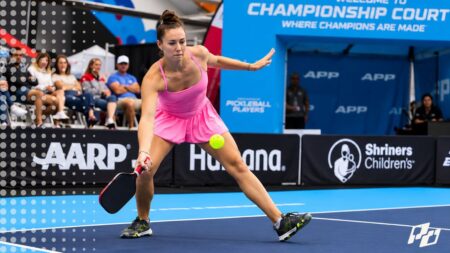
When Catherine Parenteau steps to the baseline after a crisp return, opponents know what’s coming—but they can’t stop it.
Her third-shot drop combines feather-light touch with laser-like precision, floating softly into the kitchen while landing exactly where she wants it. It’s this harmony of touch and control that forces resets and gives her team control of the point.
This signature shot has helped make Parenteau one of the most consistent and formidable forces in professional pickleball, earning her the reputation as a player who simply doesn’t make mistakes when it matters most.
The Canadian Steady Hand
Catherine Parenteau grew up in Montreal, Canada and was introduced to tennis at age four. Her tennis background at Michigan State University under coach Simone Jardim—herself a pickleball legend—provided the perfect foundation for her transition to the sport.
She started playing in October 2016 and only six months later was competing in the US Open, one of the biggest and most competitive pickleball tournaments in the world.
Parenteau’s stats speak to her consistency:
| Category | Stat/Detail |
|---|---|
| US Open Championships | 3× Champion |
| PPA Tour Titles | 16 Titles |
| Total Pro Titles | 53 Gold Medals (PPA + APP + MLP) |
| Triple Crowns | 2 (Gold in Singles, Doubles, and Mixed at same event) |
| PPA Tour Ranking | Former World #1 in Women’s Singles |
| Current Ranking (as of 2025) | Top 3 in Women’s Singles and Women’s Doubles |
| MLP Team | Las Vegas Night Owls |
| Major Titles | US Open, USA Nationals, Tournament of Champions, MLP |
| Known For | Elite third-shot drop, court patience, mental toughness |
| Style of Play | Aggressive control—mix of finesse, spin, and high-percentage shot selection |
| Tennis Background | Former NCAA tennis player under Coach Simone Jardim at Michigan State |
| Age | 29 (born 1994) |
| Country | Canada (now based in the U.S.) |
What Makes Her Third-Shot Drop Special
Parenteau’s third-shot drop is all about smart execution over power plays.
She’s mastered two complementary elements: the soft touch that absorbs pace and the precise control that places the ball exactly where it needs to go.
1. The Touch Element
Grip and Setup
She uses a continental grip positioned like shaking hands or holding a hammer. The key is maintaining minimal grip tension at around 3 out of 10 pressure; this is loose enough for the paddle to absorb and redirect the ball, rather than fight it.
“I think the kitchen game is the hardest part in pickleball. It’s much easier to hit the ball hard than soft. Having a tight grip is very natural, but when you’re hitting dinks, think about having a loose grip, because that’s what helps absorb the ball on your paddle.”
Catherine Parenteau, IntoPickleball Interview
Contact Point and Absorption
Contact happens after the ball bounces and starts dropping toward its second bounce. This contact point provides the optimal/least turbulent moment to strike the ball to prevent pop-ups. Think “push the ball off the paddle,” rather than hitting it.
Weight Transfer and Follow-Through
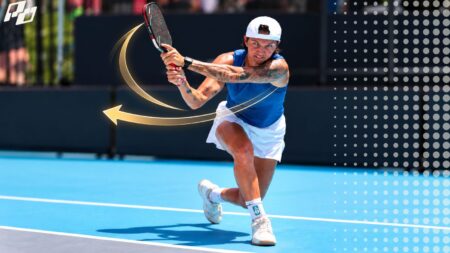
The motion starts from her shoulder with complete follow-through, shifting weight forward through the shot.
Shoulder-initiated swings prevent the short, “wristy” motions that kill consistency and touch.
2. The Precision Element
Strategic Placement
Her approach favors cross-court placement, buying extra time to advance to the kitchen line while forcing opponents to cover more court.
The cross-court angle also provides a larger target area and more net clearance than straight-ahead shots.
Timing and Arc Control
She waits for the ball to bounce and begin its descent, making contact after the apex when the ball begins to descend slightly, to prevent pop-ups.
This approach to ball timing delivers machine-like precision shot after shot.
Court Awareness
Parenteau reads opponent positioning and chooses targets that maximize her team’s advantage while minimizing risk. It’s not about hitting winners, it’s about building rallies where her team controls the tempo.
Watch Parenteau demonstrate her third-shot drop techniques. Her coaching emphasizes that the third-shot drop isn’t about athletic ability, but about understanding physics and practicing patience:
Drills to Perfect Your Third-Shot Drop
Parenteau’s training builds from simple to complex, emphasizing muscle memory over power.
Ball Toss Practice – Start without a paddle. Stand at the baseline and toss balls over the net and into the kitchen, focusing on weight transfer and follow-through. This builds the motion without paddle complications.
Add the Paddle – Same baseline position, no backswing. Drop balls in front of you and practice the follow-through motion to land drops in the kitchen. Only move to partner feeds after you can consistently hit your targets.
Arc Control Training – Set up a 5-foot ladder at your kitchen line and practice dropping balls over it from the baseline. This is a great visual aid for training higher percentage drops with proper trajectory.
Advanced Partner Drills
Volley Dinks Drill – Practice forehand and backhand cooperative volleys straight across the net, focusing on soft hands and open paddle faces. Keep your arm out in front, lifting from the shoulder to execute soft, low-flying volley dinks to establish comfort dinking balls out of the air.
Try hitting 30 volley dinks cooperatively with a partner to build consistency and confidence.
The Slinky Drill – Both players start behind the kitchen. One works back to the baseline while practicing drops. Hit two successful dinks (partner contacts at knee level or below) before taking two steps back.
Continue until you’re dropping from the baseline, gradually extending follow-through as distance increases.
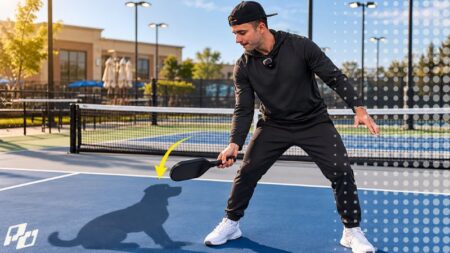
Watch Parenteau demonstrate the slinky drill for mastering your third-shot drop follow-through:
Want to Train With Catherine?
Catherine Parenteau isn’t just one of the most accomplished players on tour. She’s also one of the most active teaching pros in the game.
With her IPTPA certification and role as professional instructor at Collier’s Reserve in Naples, Florida, she brings the same systematic approach to coaching that makes her third-shot drop so effective.
Her teaching philosophy centers on quickly identifying each player’s strengths and weaknesses, then providing immediate feedback for improvement. Students consistently report game-changing results after just one session with her.
Digital Training Resources:
- Personal Website: Her main coaching hub with clinic information and testimonials
- YouTube Channel: Features comprehensive lessons from basic third-shot drops to advanced serve-strengthening drills and volley techniques for faster hands
- TopCourt Platform: Full coaching program covering technical fundamentals, doubles strategy, and the “shake and bake” move
- Apple Fitness+: Stars in their new pickleball-specific workout program designed to build court-ready strength and agility
- Instagram: Regular technique tips, training insights, and behind-the-scenes content
“I believe innovation is crucial to the success of almost anything. Personally, as a professional athlete, I am constantly having to learn new skills and incorporate new strategies after every tournament to make sure I remain at the highest level of competition.”
Catherine Parenteau, Innovation Strategy Interview
Parenteau’s Systematic Approach is Changing Pickleball
Catherine Parenteau’s third-shot drop mastery isn’t about having the fastest or softest hands on tour.
It’s about building a systematic approach that prioritizes:
- Consistency over flashiness
- Arc control over power
- Patience over aggression
For players at any level, her method offers a clear path: start with ball tosses, maintain loose grip pressure, make contact just as the ball begins to descend after the apex.
The third-shot drop might be pickleball’s most difficult shot to master, but Parenteau proves that with the right technique and consistent practice, it becomes the foundation for controlling every rally.