
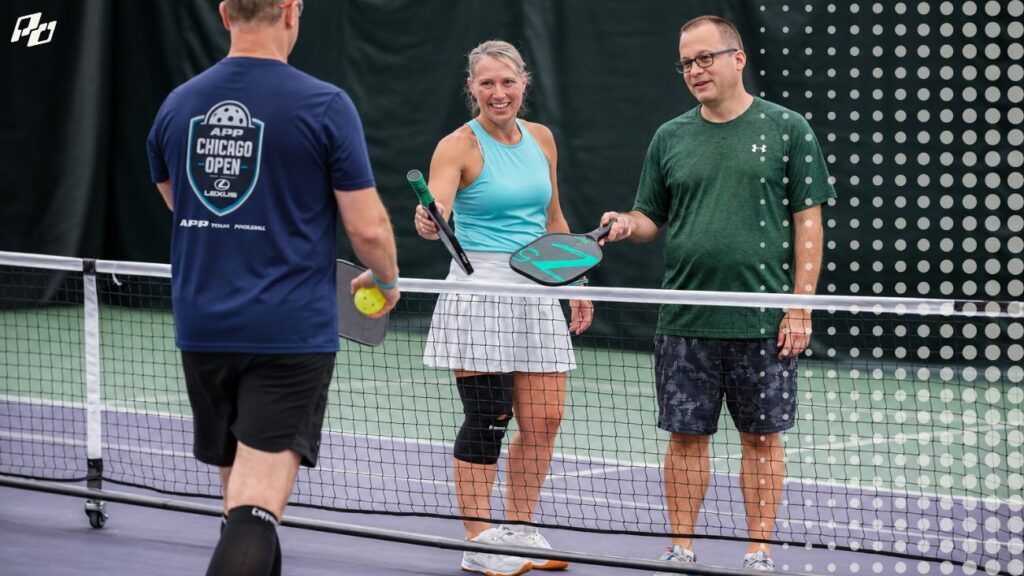
Complimenting opponents in pickleball is good sportsmanship—as long as the timing is right. Wait until the rally ends, keep praise brief, and avoid turning it into commentary about your partner’s mistake. A simple “nice shot” can show respect without hurting focus, teamwork, or competitiveness.
We recently watched a rec game where one player complimented an opponent’s excellent shot.
Nothing unusual.
Except the player’s partner was furious.
Essentially: Why are you praising them? They’re the other team.
That made us wonder: is there actually a best way to handle this?
Because most pickleball players would probably say that recognizing a great shot is simply good sportsmanship. USA Pickleball explicitly describes the sport as competitive and highly social, with respect, fairness, and graciousness in winning and losing as core sportsmanship values.
But doubles adds another layer.
Sometimes “nice shot” is heard as: “They played that well.”
Sometimes your partner hears: “You should have gotten that.”
Those are very different messages.
First: yes, complimenting opponents is completely normal
If someone hits a beautiful angle, disguises a speed-up, chases down an impossible ball, or drops one perfectly at your feet, saying: “Nice shot.” is not surrender. It is not cheering against your own team.
And it certainly does not mean you want to lose.
Good competitors are perfectly capable of recognizing quality play and then trying to beat it on the next rally.
In rec pickleball especially, the social side of the sport matters. Fairness, good sportsmanship, and keeping the game enjoyable should matter more than squeezing every possible competitive edge out of casual play.
The important question is not really whether you compliment opponents. It is when, how, and what happens immediately afterward.
The easiest rule: wait until the ball is dead
This solves most of the problem. During a rally, your voice should mostly have a job:
Mine.
Yours.
Bounce.
Switch.
Out.
A mid-rally “great shot!” may be friendly, but it can also pull your partner’s attention away from the next ball.
And there is an actual rules component here: USA Pickleball prohibits distracting an opponent when they are about to play the ball.
So save the social commentary until the rally ends. Then say whatever you want.
“Great ball.”
“Nice angle.”
“How did you get that?”
Now it is sportsmanship rather than noise.
A useful little rule:
Ball live = communicate.
Ball dead = socialize.
But why does praising the opponent bother some partners so much?
This is where things get more interesting. Imagine your opponent hits a sharp passing shot. Your partner misses.
You immediately say: “Wow, great shot.”
You mean: That was genuinely difficult.
Your partner may hear: That miss was your fault and I’m impressed with the person who just beat you.
Especially if they are already frustrated.
That reaction is not really about pickleball etiquette. It is about where attention goes after failure.
Some competitive players want immediate reassurance from their partner:
✔ Eye contact.
✔ A paddle tap.
✔ “We’re good.”
✔ “Next one.”
If the first thing they hear instead is praise directed across the net, it can feel—fairly or unfairly—like you have emotionally joined the other side.
The easy fix does not require you to stop complimenting people. Just change the sequence.
Use the “partner first” rule
After a point your partner loses, especially on a difficult ball: acknowledge your partner first, then the opponent.
It can be almost invisible.
Paddle tap.
“Good try.”
Then: “Great shot.”
That two-second sequence can completely change how the same compliment lands.
You are telling your partner: I’m still with you.
And your opponent: I saw what you did.
There is no conflict between those two things.
Do not compliment the opponent in a way that grades your partner
This is a more subtle mistake.
There is a big difference between: “Nice shot.” and: “Wow, there was no way you were getting that.” The second sounds supportive.
But now you are publicly analyzing your partner’s failure.
Likewise:
“That was such a good serve—you had no chance.”
“He totally jammed you.”
“She keeps catching you on that side.”
Now it is no longer a compliment. It is commentary.
And unsolicited coaching or criticism is exactly the kind of partner behavior USA Pickleball’s sportsmanship guidance recommends avoiding. Keep opponent praise about their shot, not your partner’s inability to handle it.
Good: “Beautiful drop.”
Less good: “That drop completely fooled you.”
Tiny difference. Big social effect.
There is also a competitive reason to say “nice shot”
This might be the most useful part for intermediate players. Accurately recognizing a good opponent shot can improve your own decision-making.
Suppose you miss a backhand. There are two possible explanations:
A. You made a poor error.
B. Your opponent gave you a genuinely difficult ball.
Those require different fixes.
If you label every lost rally as: “I missed.” you can start tinkering with perfectly decent technique.
Sometimes the correct analysis is simply: They created a very good ball. That matters. Recognizing an opponent’s quality can help you distinguish between:
Execution error
and
Forced error.
That is not weakness. That is accurate match analysis.
But don’t turn into the opponent’s personal cheerleader
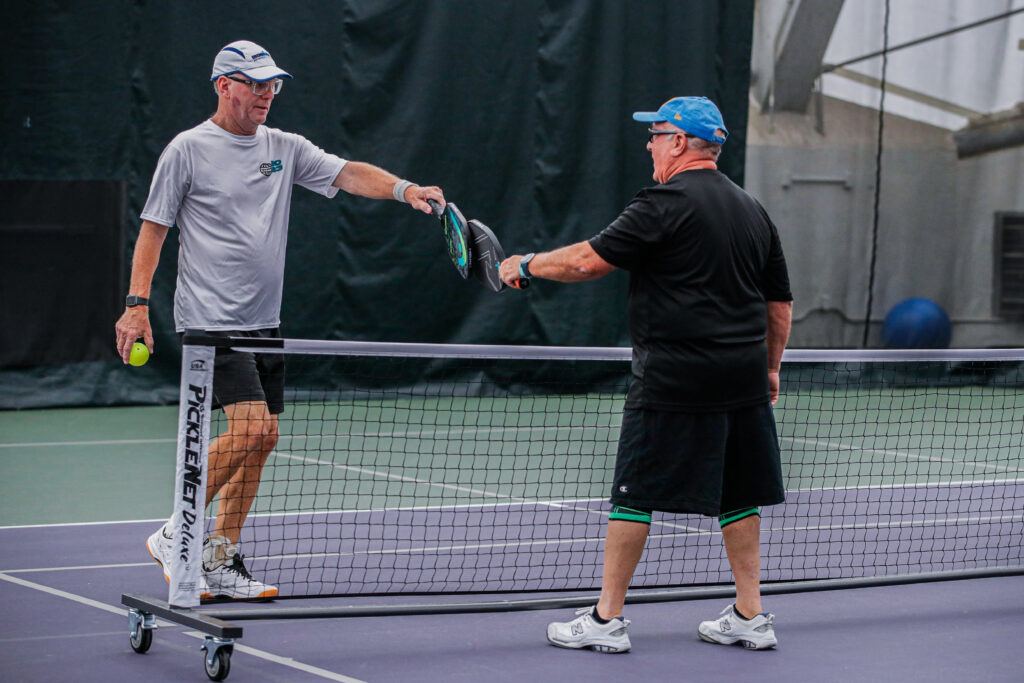
There is a limit. If you compliment every decent shot:
“Great serve!”
“Great dink!”
“Great return!”
“Awesome reset!”
your partner may reasonably wonder who you came with.
Constant praise also becomes meaningless. Save it for shots that are actually notable. This has another benefit: your compliment becomes information.
When you say: “That was a really good speed-up.” you are mentally marking: That pattern worked against us.
Now ask why.
Was your paddle down?
Were you leaning?
Did the opponent disguise it well?
Did they attack the right hip?
You can appreciate the shot and learn from it at the same time.
What if your partner tells you not to compliment opponents?
Do not turn the disagreement into a court-side debate. The worst possible response is spending the next five rallies arguing about sportsmanship.
Try something simple: “I like acknowledging good shots, but I’ll keep it brief and wait until the point is over.”
That is a reasonable boundary.
You are not asking permission to be courteous. But you are also acknowledging that doubles partners share the emotional space of the court.
If your partner says the compliments are distracting during rallies, that is worth changing.
If they simply believe opponents should never be praised because “they’re the enemy,” you probably do not need to adopt that philosophy.
And if someone routinely gets angry over harmless behavior, criticizes you, or makes rec play uncomfortable, the practical solution may simply be to play with different people.
Pickleball etiquette includes knowing when a partnership is not particularly enjoyable.
The best partners do both
They compete hard. And they make the court pleasant. Those things are not opposites.
You can desperately want to win a rally, lose it to a fantastic shot, say: “Nice ball.” and immediately start figuring out how not to let it happen again.
That may actually be the healthiest competitive response.
No denial.
No excuse.
No blaming your partner.
Just: That was good. Now solve it.
So if you like complimenting opponents, keep doing it. Just remember the three rules:
- Wait until the rally is over.
- Keep the compliment about the opponent’s shot—not your partner’s mistake.
- And when your partner just lost the point, acknowledge them before you admire the other side.
That last one is the small detail most players never think about. You can be a good opponent. But first, be a good partner.