Intermediate players should favor a slightly backhand-ready position at the kitchen because many speedups target the body, paddle shoulder, or middle. The backhand counter is compact, stable, and faster from crowded contact points—but use the forehand when the ball is clearly outside your forehand shoulder.
There’s a piece of advice floating around more and more in pickleball circles: At the kitchen line, favor your backhand when countering.
And at first, that sounds strange to a lot of intermediate rec players.
Most players trust their forehand more. The forehand feels stronger. It feels more natural. It feels like the shot you want to use when someone speeds the ball up.
But in fast kitchen exchanges, “stronger” is not always the same as “faster,” “cleaner,” or “more reliable.”
So yes, intermediate players should generally bias their ready position slightly toward the backhand at the kitchen line — but they should not become backhand-only players.
That distinction matters.
You are not trying to force every counter with your backhand. You are trying to organize your paddle so the backhand is ready for the most common and dangerous attacks: body balls, paddle-side speedups, and shots into the chicken wing.
Why the Backhand Works So Well at the Kitchen
At the kitchen, you do not have much time.
A speedup from 14 feet away gets on you fast. And because most attacks are aimed at the body, paddle shoulder, hip, or middle seam, the ball often arrives in a zone where your forehand can get jammed.
That’s where the backhand counter shines.
The backhand side is naturally better at protecting the body. You can keep the paddle in front, make a smaller move, stabilize the face, and counter without having to wrap your arm around your torso.
Several coaching sources point to the same core ideas: fast exchanges are not just about reaction time; they are about ready position, compact movement, contact in front, balance, and paddle stability.
Why the Backhand Bias Helps Intermediate Players Specifically
At the 3.0–4.0 level, most hand-battle problems are predictable.
Players tend to:
- start with the paddle too low
- start with the paddle too close to the body
- over-favor the forehand
- swing too big
- get jammed on the right hip or paddle shoulder
- panic-block instead of countering
- and use the wrist to save late contact
A slight backhand bias cleans up a lot of that.
It puts the paddle in a better defensive position before the attack happens. I recommend a semi-backhand paddle angle — roughly 10 or 11 o’clock for right-handers, or 2 or 1 o’clock for left-handers — because it helps defend both forehand and backhand volleys while keeping transitions quick.
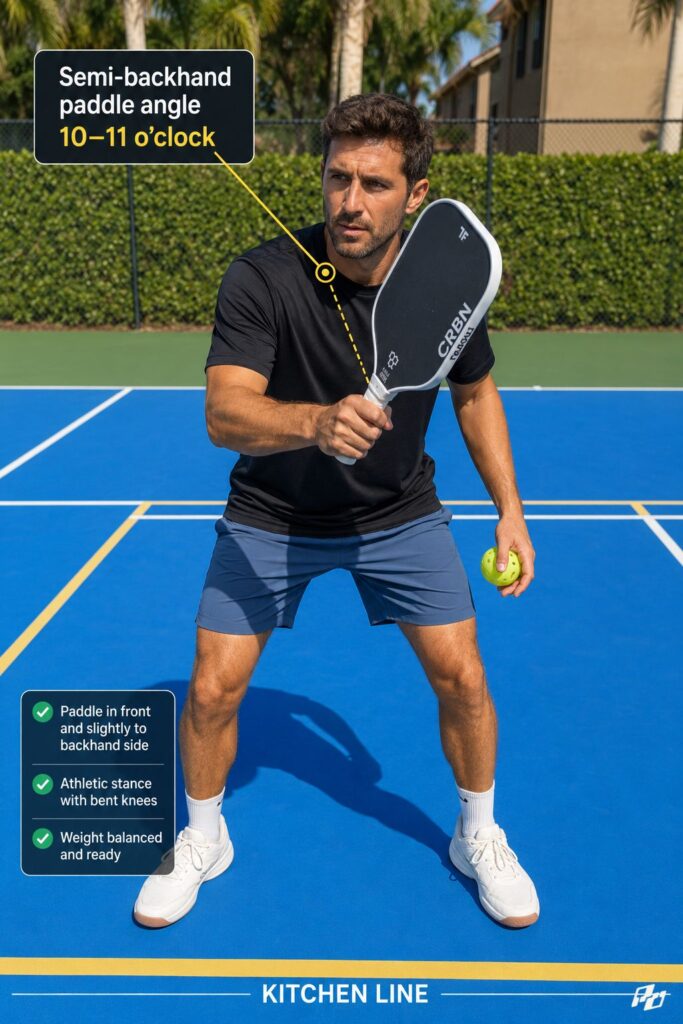
That semi-backhand position is not extreme. You are not turning sideways and giving up the forehand. You are simply organizing the paddle so the backhand is already available.
Think of it this way:
A forehand counter usually needs more space.
A backhand counter can happen closer to the centerline.
At the kitchen, the ball often attacks your centerline. So the backhand deserves priority.
The “Paddle Shoulder” Problem
A lot of smart speedups are not aimed at open court. They are aimed at discomfort.
Effective speedups are often directed at the opponent’s body or paddle shoulder because those targets make clean reactions harder.
That is exactly why the backhand counter matters.
If your opponent speeds up into your paddle shoulder and your paddle is forehand-biased, you often have to make a messy choice:
Do I chicken-wing a forehand?
Do I open the paddle face and block?
Do I flick late with my wrist?
Do I move my elbow out of the way?
By the time you answer, the ball is already on you.
A backhand-biased ready position gives you a simpler answer: Paddle face there. Wrist stable. Short counter.
That simplicity is why it works.
One-Handed or Two-Handed Backhand Counter?
Both can work. The better choice depends on spacing, strength, and your personal mechanics.
The two-handed backhand counter
This is best when the ball is slightly left of center for a right-handed player, or into the less-dominant shoulder area, and you have enough room to turn and extend.
It gives you more stability, more power, and more control under pace. A strong two-handed backhand counter is built on simplicity: stay balanced, use your hips for power, keep the swing compact, watch the ball into contact, and avoid unnecessary wrist action.
For intermediate players, that is gold.
The two-hander is not supposed to be a tennis backswing. It is not a wind-up. It is a compact kitchen-line counter powered by posture, timing, and a stable paddle face.
The one-handed backhand counter
This is best when the ball is jammed closer to the body, when you are reaching, or when you need more freedom.
On body volleys with no time to move, releasing the non-dominant hand may prevent you from getting jammed.
Intermediate players should learn both versions.
The two-hander is your weapon.
The one-hander is your escape valve.
The Cue I Like: “Backhand Ready, Forehand Available”
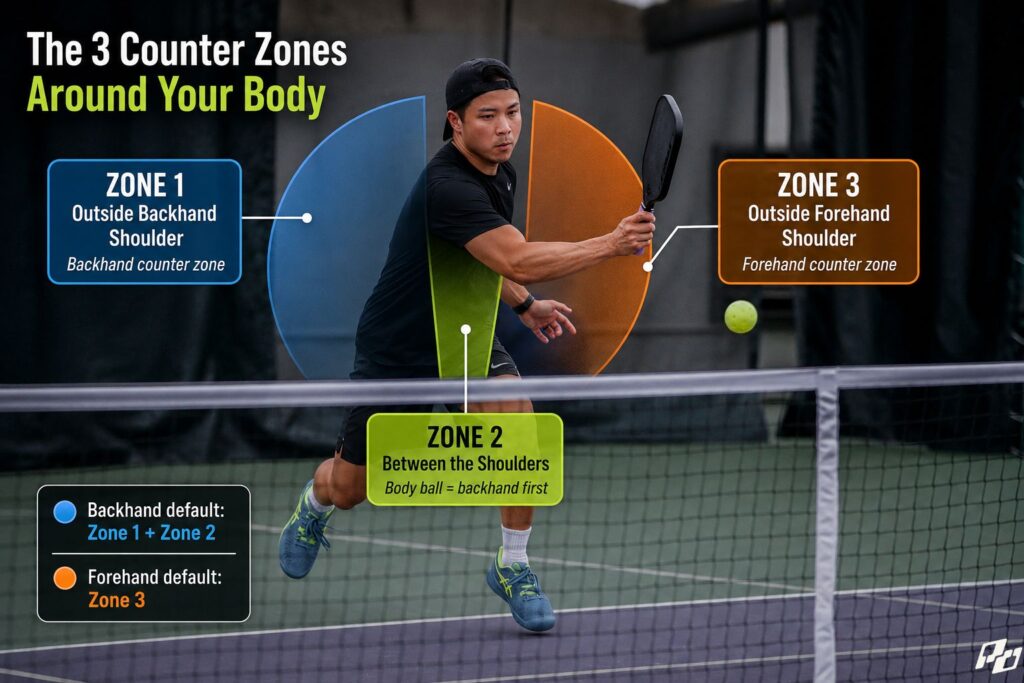
This is probably the cleanest way to teach it to rec players. Do not stand there thinking, “I am only using my backhand.”
Instead, think: Backhand ready, forehand available.
That means your paddle sits slightly backhand-biased in front of your body. Your elbows are not pinned. Your hands are not collapsed into your chest. Your paddle is ready to protect the middle. But if the ball is clearly outside your forehand shoulder, you still take the forehand.
This solves the biggest mistake intermediate players make: they cheat too far one way.
If they are forehand-biased, they get jammed in the middle.
If they are too backhand-biased, they get late on obvious forehand balls.
The goal is not favoritism for its own sake. The goal is coverage.
The Contact Window: When to Counter With Backhand
Use the backhand counter when the ball is:
✓ coming into your body
✓ coming toward your paddle shoulder
✓ between your shoulders
✓ slightly to your backhand side
✓ fast but not past you
✓ high enough to meet around waist to chest level
✓ and close enough that a forehand would feel cramped
That is the “yes” window.
In that window, the backhand is usually quicker, cleaner, and safer than trying to force the forehand.
But do not force the backhand when the ball is:
✕ wide to your forehand
✕ already behind your body
✕ too low and dipping
✕ too far outside your frame
✕ or so jammed that two hands trap you
Those are different balls. Different balls need different answers.
The Ready Position That Makes This Work
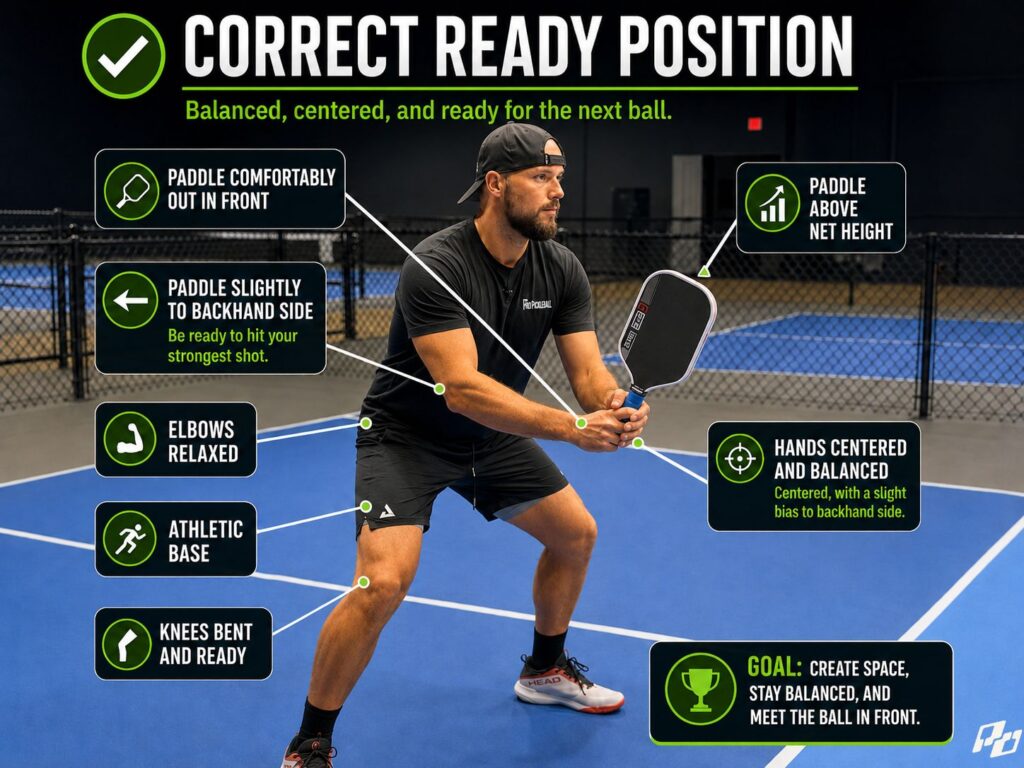
Your ready position should give you access to the backhand without locking you into it.
Try this:
✅ Feet slightly wider than shoulder width
✅ Weight gently forward
✅ Paddle in front of your body
✅ Hands away from your chest
✅ Elbows in front of your ribs
✅ Paddle face slightly backhand-biased
✅ Grip pressure relaxed until contact
Good volley positioning starts with an athletic base, weight slightly forward, paddle in front, and a relaxed grip around 3 or 4 out of 10 before firming up at contact.
That relaxed-to-firm grip pattern matters.
If you are death-gripping before the attack, your hands are slow. If you are too loose at contact, your paddle twists. You want relaxed readiness, then firmness through the ball.
A useful cue: Soft before. Strong through.
Why This Makes Your Hands “Faster”
Favoring the backhand does not literally increase your reaction speed. It reduces the amount of movement required.
That is the secret.
If your paddle is already in the middle, slightly backhand-biased, and out front, your counter is a short move. If your paddle is low, tucked, or forehand-biased, the move is longer.
Longer moves feel like slower hands.
Shorter moves feel like faster hands.
This is why better players look calm during hand battles. They are not always seeing the ball sooner. They are simply starting from a position that requires less rescue work.
Common Mistakes
Mistake 1: Turning the backhand counter into a full swing
At the kitchen, the ball already has pace. You do not need a big backswing. Big swings create timing problems.
Cue: Punch, don’t swing.
Mistake 2: Keeping two hands when the ball jams the body
Two hands add stability when there is space. They can trap you when there is not.
Cue: Two hands when you can. One hand when you must.
Mistake 3: Over-cheating to the backhand
A backhand bias should still allow forehand coverage. If your paddle face is so closed or turned that you cannot handle a forehand speedup, you have overdone it.
Cue: Backhand ready, forehand available.
Mistake 4: Countering balls that should be reset
Not every speedup deserves a counter. If you are late, off balance, jammed, or reaching, a reset may be the higher-level answer.
Cue: Counter from strength. Reset from trouble.
Mistake 5: Trying to aim too fine
Intermediate players often miss counters because they try to paint lines. You do not need that.
Aim through the middle, at the opponent’s feet, or back toward the attacker’s hip. Make the counter uncomfortable, not perfect.
Cue: Big target, firm ball.
So, Should Intermediate Players Favor the Backhand?
Yes — with nuance.
At the kitchen line, a slight backhand bias gives intermediate players better coverage against the attacks they see most often: body speedups, paddle-shoulder attacks, and balls into the middle. The backhand counter is compact, stable, and easier to use from crowded contact points than a forced forehand.
But the advice only works if you understand the limits.
⮕ Use two hands when you have space.
⮕ Release to one hand when you are jammed.
⮕ Use the forehand when the ball is clearly outside your forehand shoulder.
⮕ Reset when the counter window is gone.
That is the real 4.0+ version of the tip.
Not “always backhand.” Not “forehands are bad.”
More like: Protect the middle with your backhand, punish the right ball, and stop trying to win hand battles from bad contact points.
That is how intermediate players start looking faster at the kitchen — without actually needing superhuman hands.