Have you ever been told your soft game is great, but your power game is holding you back? If you’re around a 3.5, you might relate to this. You’ve got dinks, resets, and blocks dialed in. But drives? Overheads? That finishing speed? It’s just… not there yet.
It’s not always about paddle choice or arm strength—often, the difference in power and consistency comes down to one key factor: weight transfer.
Let’s unpack how weight transfer really works in pickleball, shot by shot—from dinks to drives to overheads.
Why Weight Transfer Is the Key to Power and Precision
Weight transfer is how we move energy from the ground up—through the legs, hips, core, shoulders, arm, paddle, and finally into the ball. It’s what makes your shot feel effortless but look explosive.
When you see a clean drive explode off someone’s paddle, 90% of that isn’t upper body—it’s timing, rotation, and momentum from the legs.
Without proper weight transfer:
- Your drives feel “arm-y” and weak.
- Your overheads lack pop.
- Your timing on volleys feels off.
- Your body feels out of sync.
The Mental Reframe: Don’t Hit, Just Throw
Here’s the lightbulb moment for me—and maybe it’ll click for you too. Think of hitting a drive or overhead like throwing a ball. Not just chucking it, but throwing it as far as you can. Watch a baseball pitcher or a quarterback: the hips rotate first, the shoulders follow, then the arm whips through like the tail end of a whip.
✅ You step forward with your opposite foot of your dominant arm (left foot if you’re right-handed).
✅ Your hip initiates rotation, not your shoulder.
✅ Your arm lags behind slightly, then snaps forward with the motion.
Most of us—especially if we haven’t thrown much growing up—default to stepping with our same-side foot when throwing. That might feel natural, but it robs you of rotational energy. If your pickleball drives and overheads feel off, this could be why.
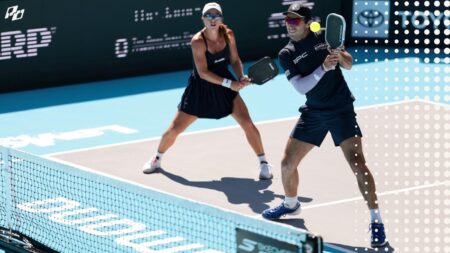
Watch pro Callie Jo Smith demonstrate proper weight transfer in action:
Weight Transfer by Shot Type
Let’s break it down across different types of shots, with detailed positioning tips.
1. Drives (From the Baseline or Transition Zone)
This is where most players (myself included) lose potential power. You may think you’re stepping into the ball, but if your weight isn’t transferring in sync with rotation, you’re leaving power on the table.
Key Cues:
- Start with knees bent and weight on the back leg.
- As you begin your swing, transfer weight forward to your front foot (left foot for righties), while…
- Rotate your hips toward your target (your belly button should finish facing the net).
- Your shoulder should follow your hip, and your paddle whips through last.
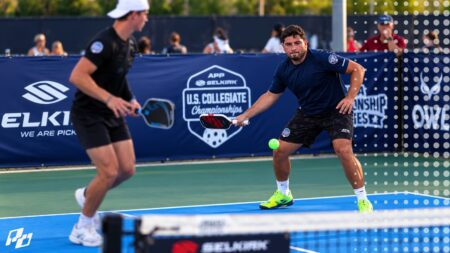
Here’s how pro player Zane Navratil does it:
Common Mistakes:
- Stepping and swinging at the same time, which short-circuits hip rotation.
- Hitting flat-footed—there’s no energy transfer if you don’t move through the shot.
Pro Tip: Do a “shadow drive” with a ball in your hand. Throw it as far as you can using your full body. Now mimic that with your paddle. That’s your power base.
2. Overheads
Overheads rely on vertical and rotational transfer, not just arm strength.
Key Cues:
- Start in a semi-open stance.
- Step forward with your opposite foot (left foot if you’re right-handed).
- Push off your back leg, drive up through your core.
- Rotate your hips and shoulders, letting your arm follow through.
- Land on your front foot as you finish the motion.
Bonus Tip: The higher your contact point, the more rotation and downward energy you can generate. Don’t just swing at the ball—swing through it using your legs and torso.
3. Dinks
You might not think “power” matters here, but weight transfer affects control and disguise.
Here’s a fun pro-level secret: You want your weight to match the direction of your dink.
- Outside dink (e.g., wide to your forehand): shift weight to your outside foot.
- Inside dink (e.g., toward your body or crosscourt): shift to your inside foot.
This helps you:
- Stay balanced for the next shot.
- Add softness or spin.
- Disguise direction (especially crosscourt vs. inside-out dinks).
Check it out:
Try This Drill: Dink 10 balls while consciously shifting your weight per direction. You’ll feel smoother instantly.
4. Volleys (Especially Speed-Ups and Blocks)
Weight transfer on volleys is all about subtle shifts and core control.
For blocks:
- Let the pace come to you.
- Slightly lean forward into the contact to absorb and redirect.
For speed-ups:
- Compact swing, but add pop with a mini weight shift forward and slight hip rotation.
- Don’t swing with your arm only—use your torso and legs even in close-range shots.
Foot Cue: Try “step-press-hit.” A micro-step forward and slight pressure into the ground helps with snap and timing.
How to Feel It: Drills and Cross-Sport Training
1. Medicine Ball Rotational Throws
Mimics the drive and overhead. Use both sides. Start slow and build speed.
2. Shadow Swings in Slow Motion
Film yourself. Watch if your weight actually shifts from back foot to front, or if you’re static.
3. Wall Throws (With a Ball or Paddle)
Throw a tennis ball hard against a wall, then mimic the same motion with your paddle. Watch your hips and feet
Power Isn’t Just Arm Speed—It’s Ground-Up Energy
Once I started focusing on weight transfer and not just paddle swing, everything changed. My drives got faster without trying harder. My overheads felt cleaner. Even volleys felt more in rhythm.
It’s not about swinging faster—it’s about syncing your body from the feet up.
So next time you’re on the court, ask yourself:
“Where’s my weight right now?”
“Am I transferring it into the shot, or am I stuck in place?”
If you start feeling your legs working in your drives, you’re on the right track.