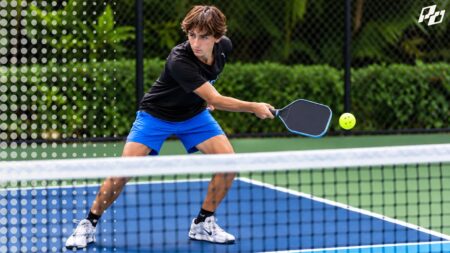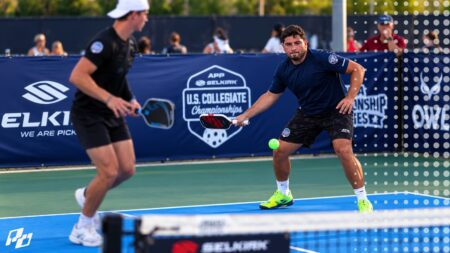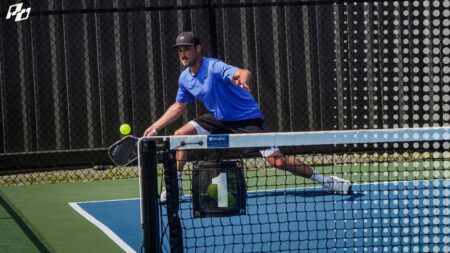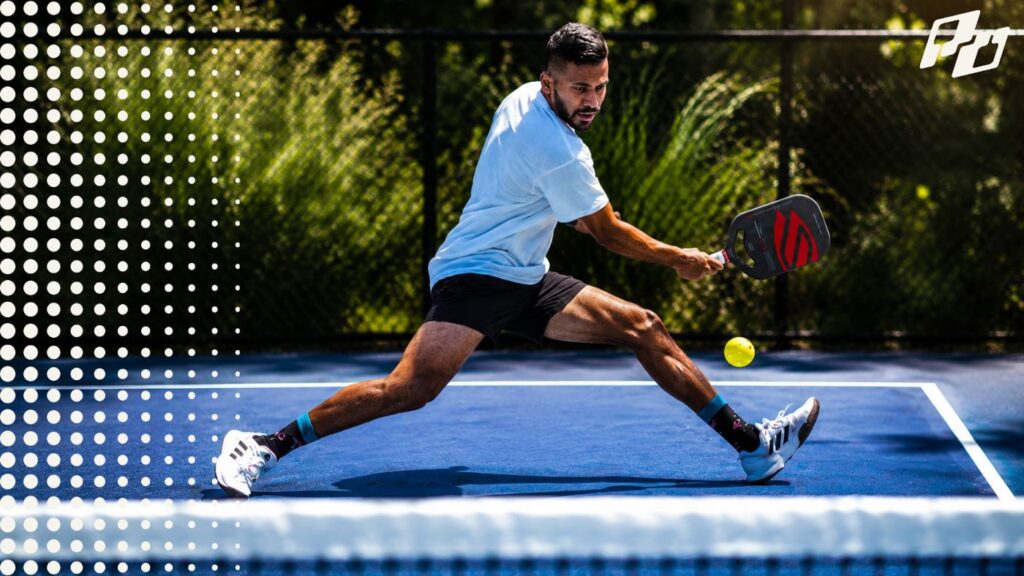
Make a one-handed backhand drive dangerous by creating space, contacting the ball in front, setting the paddle below the ball early, staying sideways longer, and accelerating loose through the outside of the ball. The goal is not just power — it is pace, topspin, dip, precision, and pressure at your opponent’s feet.
The one-handed backhand drive is not for everyone.
But if you already use it — especially if you came from tennis or never felt comfortable with a two-hander — it can become one of the most dangerous shots in your game.
Not because it looks stylish.
Because it can turn your backhand side from a target into a problem.
A good one-handed backhand drive creates pace, spin, dip, and pressure. It can punish players moving forward, attack their feet, and make opponents think twice before feeding your backhand.
The issue is that many rec players hit a one-hander that looks aggressive but does not actually hurt anyone. It is loud, loose, and dramatic — but not precise.
This guide is about fixing that gap: turning your one-handed backhand drive from a shot you can hit into a shot opponents have to respect.
First, Know What This Shot Is Supposed to Do
A dangerous one-handed backhand drive is not just “hard.”
Hard is nice.
Hard and flat is often attackable.
The real goal is a ball that has pace plus shape. You want it to travel with enough speed to rush the opponent, but with enough topspin to dip before it becomes a free counter.
That matters most in three situations:
| Situation | Why the One-Hander Can Hurt |
|---|---|
| Return or fourth-shot drive | It can stay deep, low, and heavy enough to slow the opponent’s advance. |
| Passing shot against players moving in | Topspin can pull the ball down at their feet. |
| Backhand-side attack from midcourt | It gives you offense without needing to run around the ball. |
The shot becomes dangerous when your opponent cannot comfortably decide whether to block, counter, or let it go.
That is the standard.
Adjustment 1: Stop Contacting It Like a Rescue Shot
Most weak one-handed backhand drives start with bad spacing.
The ball gets too close. The elbow bends. The wrist panics. The paddle cuts across the ball. Now the shot is not a drive — it is a late save with extra drama.
For a dangerous one-hander, the contact point has to be in front and slightly away from your body, with enough room for the arm to extend through the ball.
This is where many intermediate players need to be honest. If your contact point changes every time, you do not really own this shot yet. A strong backhand depends on having a consistent contact point at roughly the same distance and angle from the body.
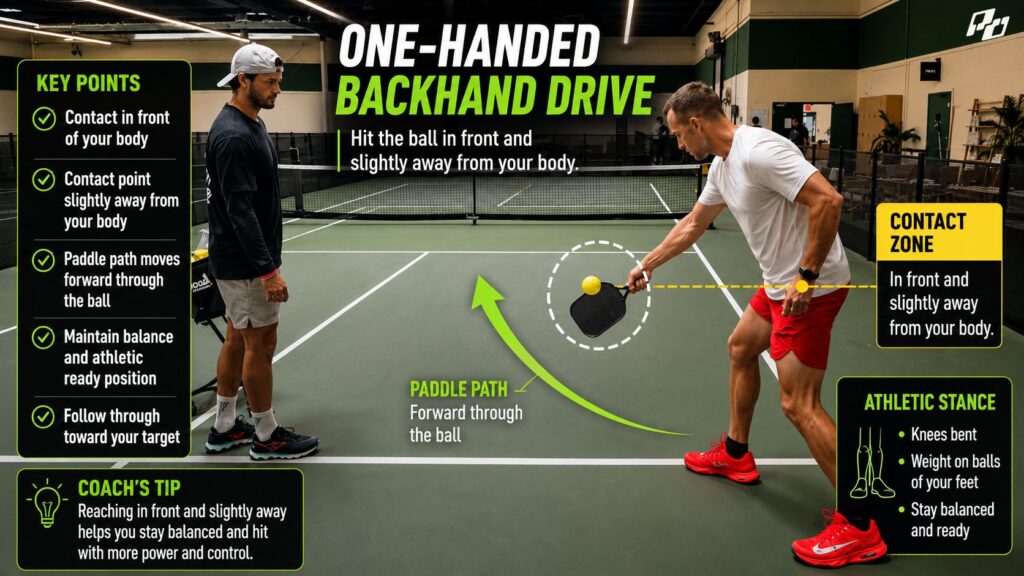
⮕ What it fixes: jammed contact, weak pace, late flicks, balls pulled wide, and drives that feel powerful but go nowhere.
⮕ The feel: the ball is not under your ribs. It is out where your arm can actually work.
⮕ Cue: “Give the arm a runway.”
That is the whole spacing idea. Your arm needs room to accelerate. No runway, no real drive.
Adjustment 2: Get the Paddle Below the Ball Early, Not Suddenly
A lot of players know they need to get under the ball. They just do it too late.
They stay tall, paddle high, then drop at the last second and try to rip upward. That creates a scoopy drive that either floats long or catches the tape.
The better move is getting the paddle below the ball early enough that acceleration can happen naturally. You are not digging the ball out. You are setting the paddle under the ball so you can drive forward and up with control.
This is also how you create the topspin that makes the shot dangerous. The goal is not just to hit the backhand hard — it is to make the ball dip, pressure the opponent’s feet, and get uncomfortable for players moving forward.
⮕ What it fixes: net balls, floaters, late lifting, and backhands with no dip.
⮕ The feel: the paddle is already under the ball before the swing gets fast.
⮕ Cue: “Set low early, accelerate late.”
That cue matters because the shot should not feel rushed from start to finish. It should feel calm early, then fast through the contact window.
Adjustment 3: Keep the Arm Stable Enough to Transfer Power
A one-handed backhand drive does not mean a stiff arm. But it also cannot be an elbow slap.
One of the biggest rec-player leaks is bending the elbow and swatting across the ball. That may create the illusion of racket speed, but it usually destroys control. The paddle face changes too much. The contact point collapses. The ball sprays.
A more dangerous one-hander has a firmer hitting structure. The arm stays long enough that the shoulder, torso, and legs can send energy into the paddle instead of dumping everything into a wristy flick.
In an article we published a while ago on the one-handed backhand drive, coach Will East emphasized the same idea: the shot should come from body turn and controlled release, not an arm-only swing.
⮕ What it fixes: swats, mishits, random paddle angles, and drives that feel powerful but cannot be aimed.
⮕ The feel: the arm is connected, not locked.
⮕ Cue: “Long arm, loose hand.”
That combination is important. Long gives you structure. Loose gives you speed.
Adjustment 4: Use the Off-Hand as Your Brake and Balance System
This is the part many one-handed players ignore. Just because the shot is one-handed does not mean the non-hitting hand is useless.
Your off-hand helps organize the paddle before the swing, then helps balance the body as the hitting arm accelerates. When the off-hand disappears, the shoulders often spin open too soon. The shot turns into a baseball swing. The ball goes wherever the paddle face happened to be when your body flew open.
The off-hand gives the swing a counterweight.
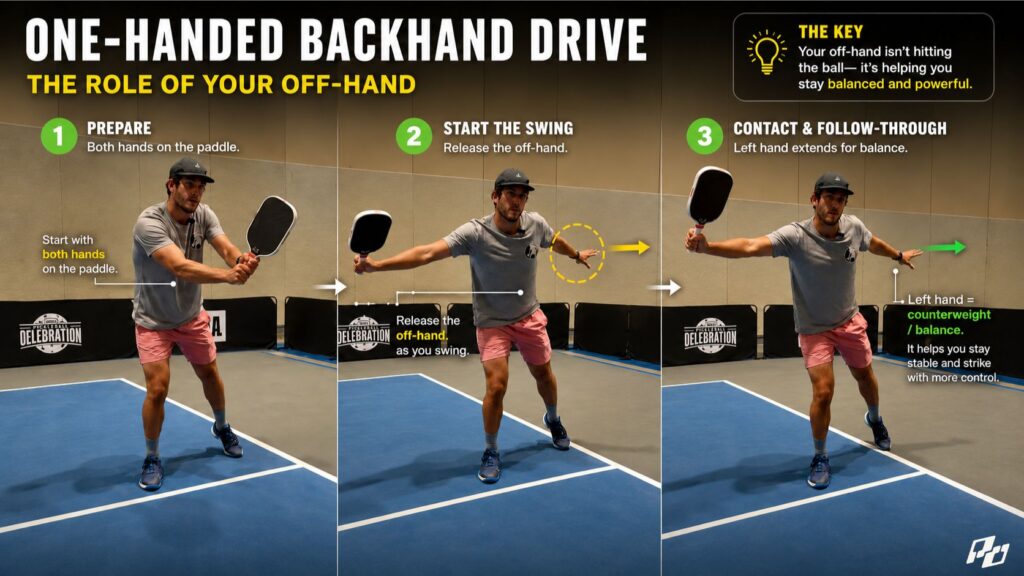
It helps keep your chest from opening too early. It helps you stay sideways longer. It gives the hitting arm something to work against.
⮕ What it fixes: over-rotation, pulled drives, loss of balance, and balls sailing wide.
⮕ The feel: your hitting arm goes forward while your off-hand keeps your upper body from spinning out.
⮕ Cue: “Let the off-hand hold the line.”
That cue is better than just “use your left hand” or “use your non-dominant hand.” The job is not decoration. The job is control.
Adjustment 5: Stay Sideways Longer Than Feels Natural
This is where the one-handed backhand drive becomes precise.
Most rec players open their chest too soon because they want power. The problem is that early opening pulls the paddle across the ball. Now instead of driving through the target, you are dragging the shot sideways.
That is why one-handers often miss wide or fly long.
The better feeling is staying sideways through the hit just a little longer. You still rotate. You still finish. But you do not let your chest outrun the paddle.
This is especially important in pickleball because the court is smaller and the ball comes back faster. A huge tennis-style unwind may feel athletic, but it can be too much for the shot you actually need.
⮕ What it fixes: sideways misses, flat launches, unstable contact, and “baseball swing” backhands.
⮕ The feel: your body supports the swing without stealing it.
⮕ Cue: “Chest quiet. Paddle through.”
If your chest opens before the ball is gone, the paddle path usually gets noisy.
Adjustment 6: Think “Throw the Paddle,” Not “Hit the Ball Hard”
This is the best feel for many one-handed backhand players.
When you try to hit hard, you often squeeze. When you squeeze, the paddle slows down and the ball comes off heavy but flat.
A better one-handed drive feels more like you are throwing the paddle through the outside of the ball. Not literally letting go, obviously. But the sensation should be loose, fast, and extended.
That “throw” feeling helps create whip without forcing the wrist. It also keeps the swing moving through the ball instead of punching at it.
Pro player James Ignatowich shows the exact “throwing the paddle” motion that makes this backhand click.
@selkirktv @jamesignatowichpb will teach you the 1-handed backhand drive 👌 #pickleball #pickleballislife #pickleballlessons ♬ original sound – Selkirk Pickleball TV
This is one reason the one-hander can create so much spin. You are not muscling the ball. You are letting the paddle accelerate through a clean window.
⮕ What it fixes: muscled drives, tight grip, dead pace, and balls that do not dip.
⮕ The feel: smooth setup, late speed, relaxed release.
⮕ Cue: “Throw it through the outside.”
Not straight up. Not around your body. Through the outside of the ball toward your target.
Where to Aim If You Want It to Hurt
A powerful one-handed backhand drive is only dangerous if the target makes sense. Do not just rip through the middle and hope.
Use the shot to create uncomfortable contact for your opponent.
| Target | Why It Works |
|---|---|
| At the opponent’s feet while they move in | Forces a low volley or half-volley. |
| Through the middle seam | Reduces angle risk and creates partner confusion. |
| Behind the outside foot | Great when a player leans toward the middle. |
| Deep to the backhand corner | Buys time and keeps the opponent from attacking early. |
| Crosscourt with shape | More court to work with, but only if you can keep it dipping. |
For most rec players, the best target is simple: Drive heavy to the feet or through the middle.
That gives you pressure without needing a perfect highlight shot.
When Not to Use the One-Handed Backhand Drive
This shot is fun, but it is not always the right answer.
Do not force it when:
⮕ The ball is too close to your body.
You need space. If you are jammed, block, reset, or slice.
⮕ The ball is too low and you are late.
That usually becomes a scoop or net ball.
⮕ You are moving backward.
A one-handed drive off your back foot often turns into a launch.
⮕ You cannot contact in front.
Late one-handers look confident for half a second and then land long.
⮕ The opponent is already sitting on your drive.
Mix in slice, drop, roll, or middle targets.
The one-hander becomes dangerous when you choose it from the right ball. It becomes expensive when you use it to prove a point.
The Diagnostic Table
| What Happens | Likely Cause | Fix |
|---|---|---|
| Ball goes long | Chest opens early or paddle face is too open | Stay sideways longer and drive through the outside |
| Ball hits the net | Paddle got below the ball too late | Set the paddle lower earlier |
| Shot feels weak | Contact is too close or too late | Create more spacing and contact in front |
| Ball sprays wide | You are swinging across the body | Keep chest quiet and extend through the target |
| Shot has pace but no dip | Too much flat contact | Brush forward and up, not just through |
| You feel off-balance | Off-hand is not stabilizing the body | Use the off-hand as a counterbalance |
| Elbow feels involved | You are swatting | Long arm, loose hand |
The Drill That Makes It More Precise
Do not start by hitting max-speed backhands. Start with a three-speed progression.
Speed 1: Shape
Hit 10 one-handed backhands at 50% pace. Your only goal is clean contact, early paddle depth, and dip.
Speed 2: Depth
Hit 10 at 70%. Now aim for a deep target or the opponent’s feet. The ball should still dip.
Speed 3: Pressure
Hit 10 at 85%. Only increase speed if the ball still has shape.
If the shot gets flatter as you swing harder, you are not building a weapon. You are building a coin flip.
A good practice rule: Power is allowed only if shape survives.
That rule will save your backhand drive.
The Few Cues That Actually Matter
“Give the arm a runway.”
Spacing creates the swing.
“Set low early, accelerate late.”
Topspin starts before the swing gets fast.
“Long arm, loose hand.”
Structure without tension.
“Chest quiet. Paddle through.”
Do not rotate yourself out of the shot.
“Power is allowed only if shape survives.”
A dangerous drive dips.
When You Should Stick With the Two-Handed Backhand
The one-handed backhand drive can be nasty, but it is not automatically the better choice.
For many rec players, the two-handed backhand is still the smarter weapon because it is usually more stable, compact, and forgiving under pressure.
Stick with the two-hander if several of these sound familiar:
✖️ Your one-hander only works on perfect balls.
If you need ideal spacing, timing, and balance every time, it is not match-ready as your main backhand.
✖️ You struggle to control the paddle face.
If the ball sprays long, wide, or into the net even when you feel set, the second hand may give you the structure you need.
✖️ You get rushed on your backhand side.
A one-hander needs room. If most of your backhands happen under pressure, the two-hander may hold up better.
✖️ Your contact point changes too much.
Late, jammed, or inconsistent contact makes the one-hander hard to trust.
✖️ You play mostly fast doubles exchanges.
If your game is built around counters, resets, and kitchen reactions, a compact two-hander may fit better.
✖️ Your arm, wrist, elbow, or shoulder complains.
Do not force a one-hander if it creates discomfort.
✖️ Your two-hander already creates pressure.
You do not need to switch just because the one-hander looks cooler.
The simple test:
If your one-handed backhand looks great in drills but disappears under pressure, keep building it — but do not make it your main weapon yet.
Use the backhand that gives you the best mix of shape, control, balance, and recovery. That is what wins points.
Don’t Make It Your Identity Shot
The one-handed backhand drive is beautiful when it works. That is also the danger.
Some players fall in love with it and start forcing it from bad positions because it feels like their “signature shot.”
Do not do that.
Use it when the ball gives you the right window: enough space, enough time, contact in front, and a chance to create topspin with purpose.
A great one-handed backhand drive should not feel like you are trying to prove you have one. It should feel like the obvious answer.
When you build it that way, the shot becomes genuinely dangerous. Not because it wins every point, but because it changes how opponents play your backhand side.
They stop assuming they can attack it.
They stop floating balls there.
They stop charging forward comfortably after hitting to it.
That is the real upgrade. Your one-handed backhand drive becomes powerful when it has speed. It becomes dangerous when it has speed, shape, and a target. And it becomes precise when you stop swinging harder and start making the contact window cleaner.