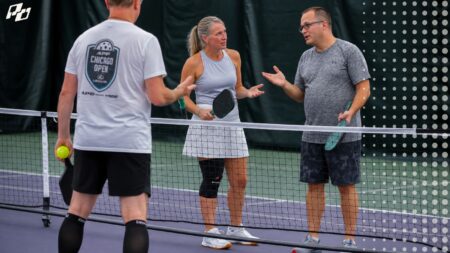


Because nobody wants to be “that player” on the wrong court.
It happens at every rec center and club. You walk onto the court, paddle in hand, excited for a solid game. Within a few rallies it’s obvious: someone doesn’t belong at this level. Maybe they’re blasting through everyone like they’re auditioning for the pro tour. Or maybe they’re struggling just to get a serve in and the rally dies before it begins.
And then you think: Uh oh. Someone’s going to have to say something.
But how do you tell another player they’re in the wrong group without coming across as rude, condescending, or hurtful? That’s the challenge—and it’s trickier than it sounds.
Why It Matters More Than You Think
Pickleball’s magic is in the rally. The rhythm of the game—the cat-and-mouse dinks, the satisfying exchange at the kitchen line—only happens when players are reasonably well matched.
When levels are way off, the fun evaporates. For stronger players, there’s no challenge. For weaker players, there’s only frustration. And for everyone else, the game feels lopsided and awkward.
Getting the right mix isn’t about gatekeeping or exclusivity. It’s about protecting the flow of play so everyone leaves smiling instead of sighing.
The Psychology of Placement & Ego
Why do players cling to the wrong level? It’s rarely just ignorance—it’s identity.
- Level = Status. For some, “I’m a 4.0” isn’t just a rating—it’s a badge of pride. Moving down feels like moving backwards.
- Belonging. Pickleball is incredibly social. If all your friends play at a certain level, you’ll want to stay—even if you’re not really there yet.
- Fear of Regression. Dropping down feels like failure. But in reality, it’s often the fastest way to improve, since you get longer rallies and more practice.
When you understand that it’s not just about skill but also about ego and community, it becomes easier to approach the conversation with empathy.
Spotting When the Fit Isn’t Right
Before you even think about saying something, be sure the mismatch isn’t just a bad day. Even the best players shank balls sometimes, and beginners can catch fire once in a while.
The real sign is consistency:
- If one player dominates every game without breaking a sweat, they may need to move up.
- If another repeatedly struggles just to keep a rally alive, they may be happier—and improve faster—at a lower level.
The key isn’t judging their worth. It’s noticing whether they’re getting quality games.
The Gentle Art of Saying Something
Here’s where most of us freeze. Nobody wants to embarrass someone in front of their peers. But there are respectful ways to nudge without making it feel like a rejection.
One of the best approaches is to use inclusive language. Instead of saying, “You’re not good enough for this court,” frame it as helping them get the most out of their time.
“You’ve got some great shots—have you tried the 3.5 court? I think you’d get better rallies there.”
That tiny shift makes it sound like an opportunity, not a demotion.
Timing matters too. Never blurt it out mid-game. Pull them aside before or after, maybe while hydrating or stacking paddles. That private setting makes it feel like a tip from a friend, not a public call-out.
And if there’s an organizer or club manager? Let them handle it. That’s literally their job, and it keeps you out of the line of fire.
Sample Scripts You Can Borrow
- Encouraging Upward Move: “You’re playing really strong today—you should check out the 4.0 court. You’d find more of a challenge there.”
- Gentle Suggestion Downward: “This group is working on consistency. I think you’d have more fun with the 3.0 group—they’re all about keeping the rally going.”
- Highlighting Opportunity, Not Rejection: “That 3.5 court is working on some great drills—you’d probably get more rallies and touches over there.”
- Framing as Growth: “You’ve really improved—you might surprise yourself at the higher-level court.”
- Casual, Non-Threatening Redirect: “Hey, want to try a couple games with that group? I think their style would match yours really well.”
- Using Humor to Soften It: “If you keep smashing like that, we’ll have to promote you to the advanced court for everyone’s safety.” (said with a smile)
- Friendly Option Offering: “There’s a 3.0 group starting in 10 minutes—you want me to introduce you? I think you’d enjoy the pace there.”
- Deflecting to a Neutral Organizer: “The club usually sends players to this group after a certain point—want me to check with them?”
- Light Exit Strategy for Awkward Doubles: “Let’s rotate partners after this game—it keeps things interesting for everyone.”
Short, light, and positive phrasing makes the conversation less about exclusion and more about opportunity.
A Story From the Kitchen
A friend of mine once played in a ladder where one guy kept showing up to the 4.0 courts, even though he was really closer to 3.0. People groaned when he stacked his paddle. Eventually, someone finally spoke up, but they did it cleverly.
Instead of saying, “You don’t belong here,” they said, “Hey, we’ve got a group at 3.0 that’s working on longer rallies—you’d probably enjoy that more than the bang-bang up here.”
And you know what? He moved down, had better games, and later thanked them for pointing him in the right direction. The whole group benefited.
A Quick Self-Assessment Checklist
It’s not always about others. Sometimes the best thing you can do is ask yourself if you might be mismatched. Try these questions:
- Do I consistently win or lose by wide margins?
- Am I often bored (too easy) or frustrated (too hard)?
- Do my opponents struggle to rally with me, or am I the one struggling?
- Do I feel like the game rarely “flows”?
If you answer “yes” to most of these, it might be time to try a different court.
What Not to Do
Here’s the fastest way to make enemies on the court: be blunt and dismissive. Phrases like “You’re dragging us down” or “Nobody wants to play with you” don’t just hurt—they can push someone away from the game entirely.
Pickleball prides itself on being the most welcoming sport around. The way you handle these conversations should reflect that.
Etiquette “Pro Tips”
Want to make sure you never come across as the pickleball police? Keep these etiquette reminders in your back pocket:
- Don’t roll your eyes when someone misses.
- Don’t groan when a mismatched player stacks on your court.
- Always invite them to warm up—even if you know they’re not at your level.
- Smile, encourage, and remember: everyone was a beginner once.
Helping Players Find Their Place
Sometimes players aren’t being stubborn; they just don’t know their true rating. Many never take lessons, never enter a tournament, and don’t know what a “3.0” or “4.0” really means.
That’s where you can step in as a guide. Suggest they try a rating clinic. Invite them to play with a group that matches their style. Offer to introduce them to others at their level.
By giving them options, you’re not just pointing out a problem—you’re offering a path forward.
The Partner Shuffle Problem
One of the trickiest situations is doubles when partners are at very different levels. It can turn into one-sided poaching fests where the weaker player barely touches the ball.
A simple fix? Suggest mixing up partners. Frame it as a fun shuffle:
“Hey, let’s swap for the next game so everyone gets a new challenge.”
Suddenly it’s not about pointing out who’s weaker—it’s just about variety.
Bonus Tips for Navigating the Conversation
- Lead with encouragement. Highlight something they do well before suggesting a change.
- Keep it casual. A smile and a light tone go a long way.
- Make it about fun. “You’ll get better games there” sounds inviting.
- Share your own story. Tell them about the time you moved levels and how much better it felt.
The Big Picture
At the end of the day, telling someone they’re at the wrong pickleball level isn’t about shaming them. It’s about helping them land where the game is more rewarding—for them and for everyone else.
Handled with kindness, it doesn’t have to sting. In fact, it can make them feel supported and motivated. Because pickleball, at its heart, isn’t about chasing points—it’s about building community.
So the next time you face that awkward moment, remember: you’re not pushing someone out. You’re pointing them toward better games, bigger smiles, and a place where they’ll actually thrive.