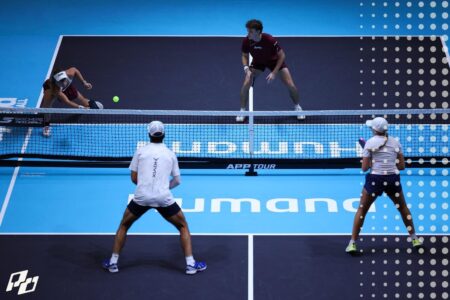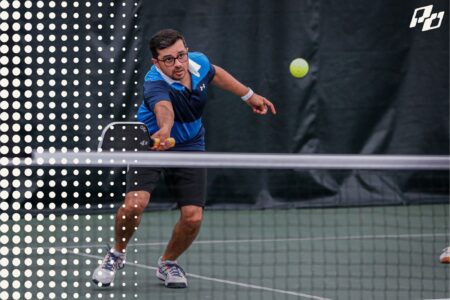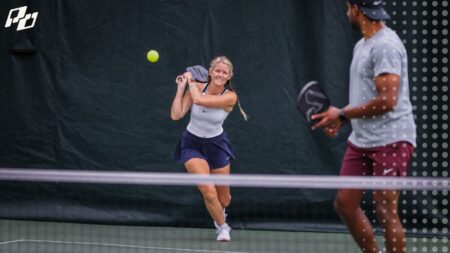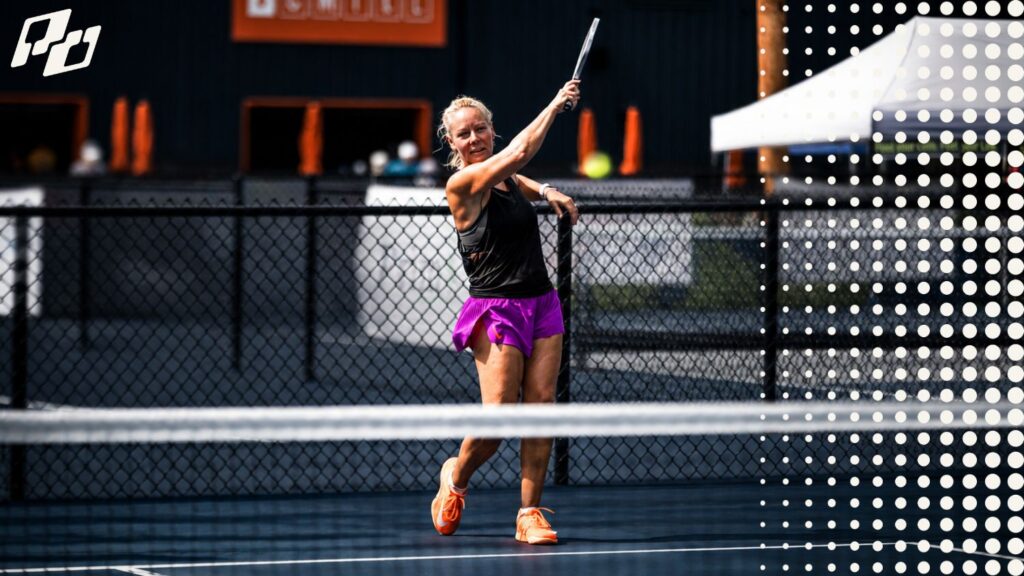
After serving in pickleball, stay near the baseline until you read the return. Moving forward too early can jam the ball at your feet and ruin your third shot. Hold your position, let the return bounce, choose a drop or drive, then advance only when your shot creates the opportunity.
A deep serve feels aggressive, so many players instinctively follow it into the court. Then the return lands near their shoes.
They reach, lean backward, contact the ball late, and either drive it into the net or float a third-shot drop high enough to be attacked.
The problem is not the third shot. The mistake happened two seconds earlier.
As the serving team, you must let the return bounce before playing it. That requirement gives the receiving team time to move toward the kitchen while you remain near the baseline. Your first job after serving is therefore not to gain ground. It is to protect the space you need for the return.
The useful cue is simple:
Serve, hold, read, then move.
Why Moving Forward Too Early Causes So Many Errors
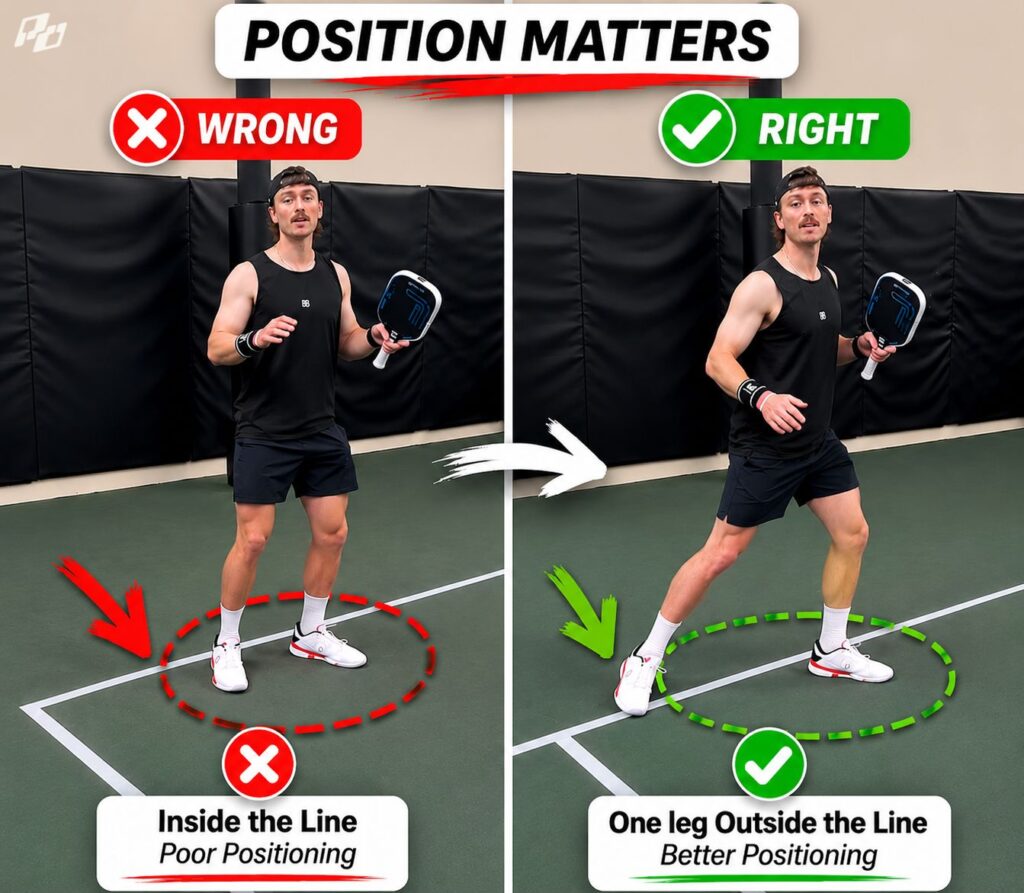
A good return is usually deep because depth keeps the serving team away from the kitchen and makes the third shot more difficult. When you drift several feet inside the baseline, you surrender the space that would have allowed that return to bounce comfortably in front of you.
Now the ball is not merely low. It is low and moving into your body. That creates several technical problems at once:
- Your contact point falls beside or behind you.
- Your weight moves backward instead of through the shot.
- Your paddle face tends to open as you try to lift the ball.
- Your swing becomes rushed because the bounce is crowding your feet.
- Your third shot is struck while your body is still moving.
This is why a routine return can suddenly feel difficult. You have converted a manageable baseline ball into a defensive half-volley or short-hop.
The deeper lesson is that court position changes shot difficulty. Better mechanics cannot fully rescue poor spacing.
Where Should the Serving Team Stand?
After serving, recover near the baseline rather than automatically stepping into the court.
For most players, that means finishing the serve with control and keeping at least one foot behind the baseline until the return’s depth becomes clear. On especially fast courts, against hard returners, or after a shorter serve, you may need to recover a step behind the line.
Your partner should follow the same principle. Because either serving-team player may receive the return, both players need enough room for the required bounce.
Do not turn this into a rigid rule that your heels must remain planted behind the baseline. Your actual position should respond to the ball:
| Return you read | Best adjustment |
|---|---|
| Deep and driven | Hold or retreat slightly |
| Deep with heavy topspin | Create space early and let it fall into your strike zone |
| High and slow | Set your feet, then consider driving |
| Short return | Move forward, but arrive balanced before swinging |
| Return toward your partner | Move with your partner and protect the middle |
The goal is not to stay back forever. It is to avoid entering the court before the ball has earned that movement.
Read the Return Before You Commit
Intermediate players often watch where the return is going but fail to read what it is doing. You need three pieces of information:
Depth
Will the ball bounce near the baseline, land in midcourt, or fall short?
Depth determines whether you should hold, retreat, or step in.
Height
Will the ball rise into a comfortable drive zone, stay low enough to favor a drop, or jam you below the knees?
A deep return is not automatically a drop ball. If it sits high and you are balanced, a drive may be the better third shot.
Pace and shape
A hard, flat return arrives sooner but may provide pace you can redirect. A slower, higher return gives you more preparation time but may push you farther back. Topspin can jump toward your body; slice may stay low or skid.
Try using this sequence while the ball travels:
Depth. Height. Decision.
Do not decide on a drop or drive before reading the return.
The Real Purpose of the Third Shot
The third shot is not simply your next hit. It is the serving team’s attempt to reduce the receiving team’s positional advantage.
A drop tries to force opponents to contact upward and gives you time to advance. A drive applies pace, challenges the returner who may still be moving, and can produce a weaker fifth ball.
Your choice should be based on the return you receive.
Favor the drop when:
- contact is below your ideal drive height
- both opponents are established at the kitchen
- the return gives you time to set your feet
- you want to neutralize rather than force the point
- your partner is ready to move forward with you
Favor the drive when:
- the return sits higher
- you can contact comfortably in front
- one opponent is still moving toward the kitchen
- the middle is open
- you intend to use the drive to create an easier fifth shot
A drive does not automatically mean sprinting behind it. A drop does not automatically mean charging all the way to the line. Your movement depends on the quality of the shot and the opponent’s contact.
Advance Behind the Ball, Not Ahead of It
One of the most damaging habits in recreational doubles is moving forward while hitting the third shot.
The player serves, creeps inside the baseline, sees the return, and continues running while trying to execute a delicate drop. The upper body drifts, the contact point changes, and the shot becomes almost impossible to calibrate.
Use this sequence instead:
- Read the return.
- Move to the bounce.
- Establish your base.
- Hit the third shot.
- Advance only if its quality allows it.
The key phrase is:
Move to the ball, stop for contact, then move through the court.
You may not become perfectly motionless on every shot, but your head and torso should be stable at contact. A controlled third-shot drop is already demanding because it must travel from the baseline and descend into a small area near the kitchen. Adding uncontrolled forward movement makes the required pace and launch angle much harder to reproduce.
A recent numerical study also found that successful third-shot drops occur within relatively narrow launch-speed and angle ranges, reinforcing how sensitive the shot is to poor contact conditions.
Do Not Rush Through the Transition Zone
A good third shot earns movement. It does not always earn the kitchen line. After hitting, watch the opponent’s contact.
- If your drop lands low and forces an upward dink-like response, move forward.
- If it sits high and the opponent prepares to attack, stop, lower your center of gravity, and prepare to defend.
- If you drive and receive a blocked ball, advance only as far as you can while remaining balanced for the fifth shot.
The split step is the braking mechanism that makes this possible. Begin moving after your shot, but settle your feet as the opponent is about to strike. That allows you to react in either direction instead of being caught running through contact.
For many recreational players, the better pattern is:
Third shot, two or three controlled steps, split step, then reassess.
That is far more reliable than sprinting from baseline to kitchen and hoping the ball stays unattackable.
Move as a Team
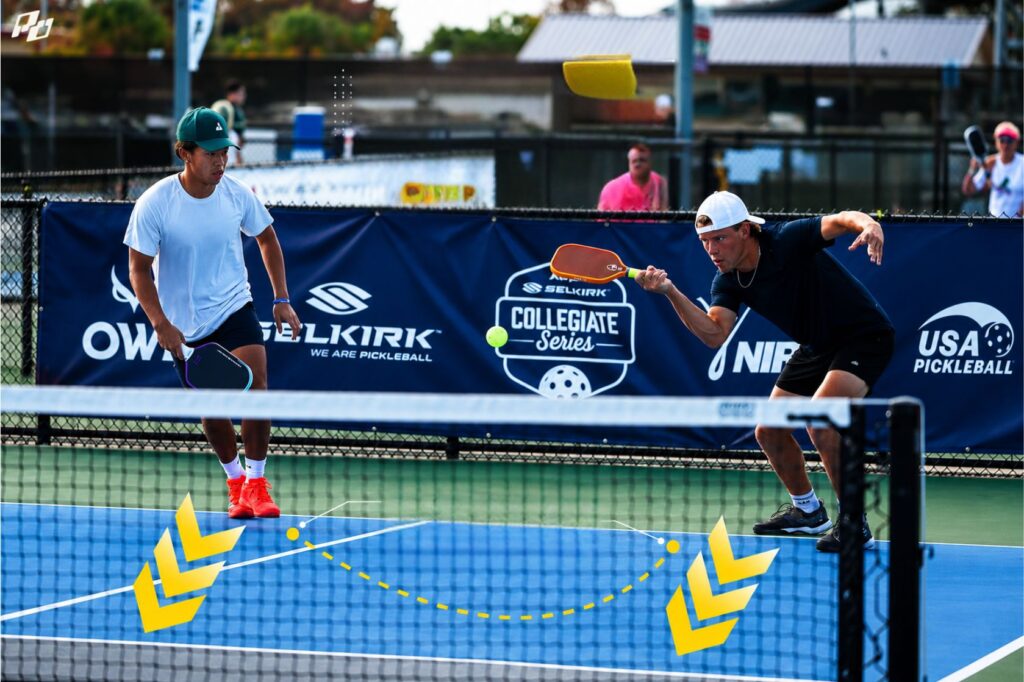
The server and partner should advance together.
When one player charges forward and the other remains at the baseline, the team becomes staggered. That opens large gaps through the middle and gives opponents an easy decision: attack the player who is closer or play behind the player who moved too early.
Try to maintain roughly the same depth as your partner as you transition. You do not need to stand on an exact horizontal line, but neither player should be several steps ahead without a clear tactical reason.
Team movement also improves shot selection. If your partner is still recovering from a difficult third shot, forcing your way forward may expose both of you. A neutral fifth-shot reset may be the smarter path.
A Drill That Fixes the Habit
Use a return-depth drill with one server, one returner, and an optional kitchen-line target player.
The returner alternates among:
- deep returns near the baseline;
- medium-depth returns;
- short returns.
The server must call “hold,” “back,” or “in” before the ball bounces. After the bounce, the server plays a drop or drive and advances only if the shot permits it.
Score one point for:
- making the correct movement call;
- contacting from a balanced position;
- choosing an appropriate third shot;
- stopping before the opponent’s next contact.
Play to 15.
This drill is more useful than simply hitting a basket of third-shot drops because it trains the decision that comes before the technique.
Protect the Bounce First
Do not measure a good serve by how far it lets you run forward. Measure it by the return it creates and the third shot it allows you to play.
After serving, give yourself room. Read the return before committing. Move to the bounce, establish balance, and let the quality of your third shot determine how far you advance.
The serving team does need to reach the kitchen eventually—but trying to arrive one shot too early often keeps you from getting there at all.