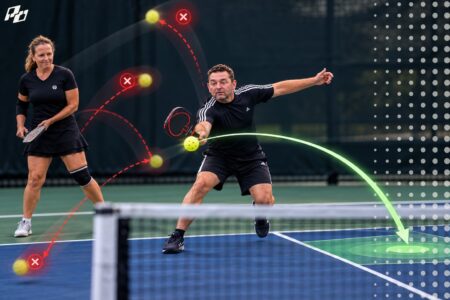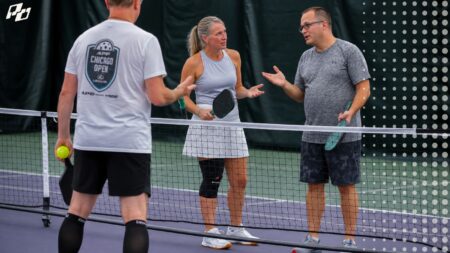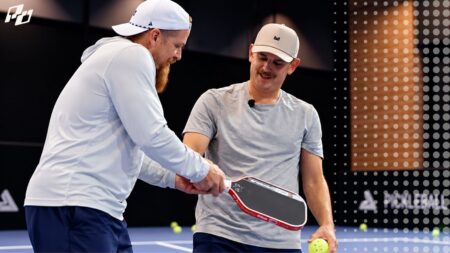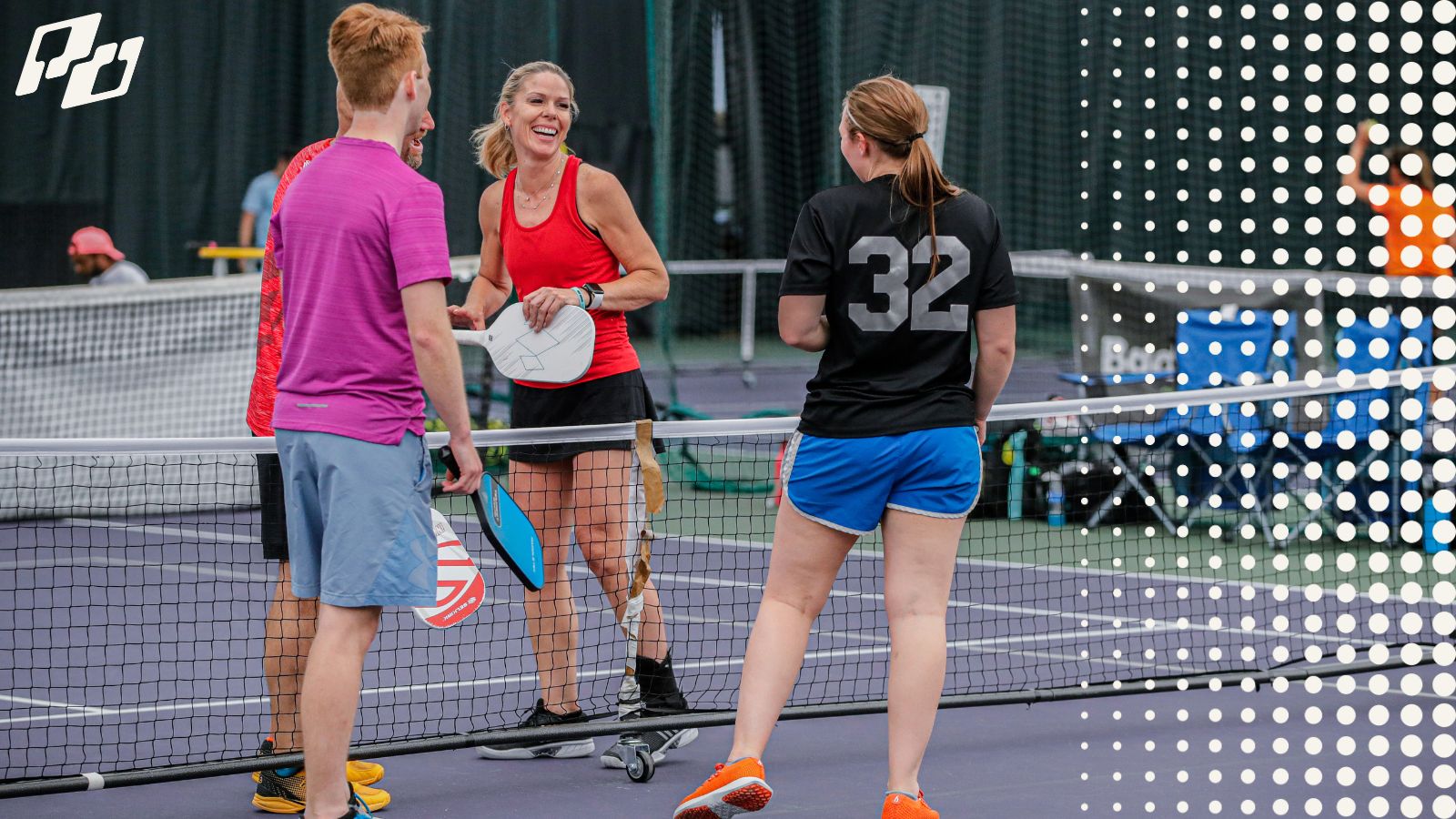
It’s Tuesday morning open play. You’ve warmed up, grabbed your paddle, and looked around — and instantly know you’re the best player there.
The rallies are slower. The serves are inconsistent. You could cruise through these games half-asleep. A voice in your head starts whispering:
“Is this going to make me worse? Should I even bother?”
Here’s the truth: playing down can either sharpen your game or sabotage it. It all depends on how you approach it.
Handled with purpose, it’s one of the smartest ways to strengthen your control, refine your technique, and develop mental discipline. Done carelessly, it’s where good habits go to die.
Let’s unpack how to turn “playing down” into a performance advantage — and still walk off court feeling like you got better, not just older.
Why Playing Down Can Still Build You Up
Most rec players assume growth only happens when they play better opponents. But pros — and smart amateurs — know that improvement also comes from slowing down and rebuilding precision under lower pressure.
A slower game gives you time — time to feel your paddle face, time to breathe through a rally, time to actually experiment. When you’re not under fire, you can fine-tune details that vanish in faster games: footwork balance, paddle prep, depth control, and clean contact.
Hayden Patriquin once said he uses slower practice days to “make the easy balls perfect.” That’s the point — not just winning, but mastering the fundamentals so they hold up when the chaos returns.
But there’s a catch: if you coast, you start learning the wrong lessons. Lazy footwork, reactive positioning, and bad shot selection creep in. The things you can get away with at lower levels are exactly the things that will betray you when you step up.
Playing down isn’t dangerous — drifting down is.
The Psychology Behind Playing Down
Here’s a quick mental reset: not every session has to be about proving something.
Sports psychologists talk about the Optimal Challenge Point — that sweet spot where the task is hard enough to engage you but not so hard you can’t adapt. Playing below your level can still sit right in that zone if you add intention.
Think of it as a chance to train different skills: focus, patience, consistency, composure. You’re not fighting your opponents — you’re training yourself.
It’s also a great place to practice humility and leadership. Open play exists because stronger players still show up and make it fun. The game grows when you help others grow, too.
And that’s not charity — it’s mental training. Learning to stay focused, encouraging, and disciplined in easy situations makes you calmer and more composed in hard ones.
Step One: Set a Micro Goal
Before every game, set one simple intention. You’re not trying to “win faster” — you’re trying to win smarter.
Maybe today it’s:
- Land every third-shot drop past the kitchen line.
- Keep your paddle out front for every volley.
- Split-step on every opponent contact.
- Hold your ready position for the entire rally.
One focus per game. That’s it.
If you want, write it on your wristband or paddle edge. It sounds small, but those micro-goals are what stop you from coasting through another forgettable game.
Step Two: Add Constraints That Challenge You
If your brain’s too comfortable, you stop improving. So give it something to solve.
Add a small “rule” that raises the bar for yourself:
- Only hit drops and resets — no drives.
- You can’t score unless your shot lands in the back half of the court.
- Every dink has to land crosscourt within a paddle’s width of the net strap.
- Play one-handed for half a game to train stability.
These constraints keep the game technical and creative. They mimic the mental load of competitive play — you’re processing, adjusting, and reacting instead of just cruising.
It’s not about making the game harder for your partners. It’s about making it richer for you.
Step Three: Protect Your Form
Here’s where most players slip. When the rally pace slows, the body follows. Your knees straighten, your paddle drops, your focus fades.
That’s when bad habits form — and they’re hard to unlearn.
Stay disciplined. Keep your athletic posture: knees bent, chest forward, paddle out front. Move your feet for every dink, even the easy ones. Split-step every time your opponent makes contact.
If you can maintain elite-level fundamentals in a 3.0-speed game, you’ll look — and feel — bulletproof when you face faster competition again.
The Real-World Scenarios Every Rec Player Knows
1. The “Bored Banger”
You get restless and start speeding balls up just for fun.
→ Instead, practice directional control. Hit at specific zones — their paddle hip, deep middle, or crossover point. You’ll turn autopilot aggression into precision pressure.
2. The “Floater Partner”
Your partner’s dinks are high and attackable. You’re itching to end points.
→ Work on resets and patience. Use those high balls to refine soft blocks, test your positioning, and perfect your counter-dink angles.
3. The “Everything’s a Drive” Opponent
You came to work on drops, but they’re blasting every ball.
→ Great. Turn it into a blocking clinic. Focus on soft hands, short contact, and landing the reset in the kitchen. The faster they drive, the better your practice gets.
These moments frustrate most rec players — but for you, they’re reps.
The Social Side: How to Be the Player Everyone Wants to Play With
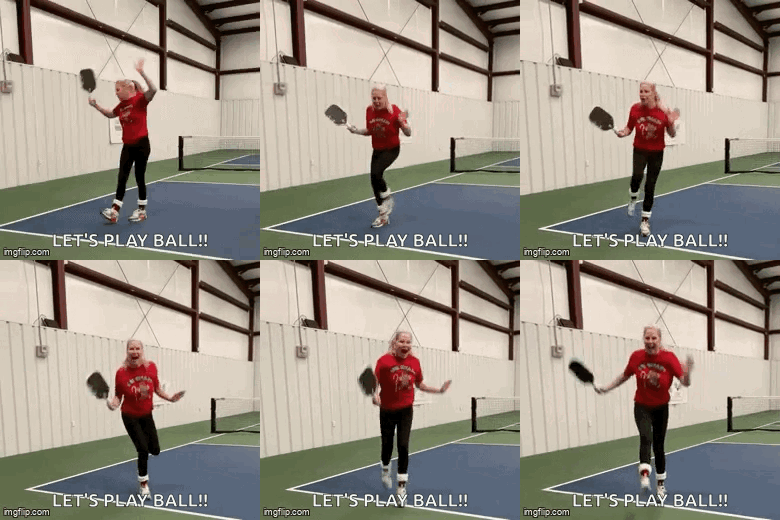
This part separates the “advanced” player from the respected one.
Walking onto a court with players below your level is an opportunity — not for domination, but for influence. You set the tone.
Start by being transparent: say, “I’m working on my soft game today,” or “I’m focusing on resets.” That one sentence disarms everyone. No one feels judged, and you can practice exactly what you need.
Keep rallies going. Compliment effort. Ask partners what they want to work on. If someone asks for help, give one clear tip — not a lecture.
And most importantly, model what composure looks like. The way you handle mistakes in easy games is how others will start handling them, too.
Pickleball is still a social sport. How you treat these games says more about your character than your DUPR.
Tactical Gold: Turning Easy Games into Learning Labs
When the pressure’s off, your creativity can finally breathe. Here’s how to turn slower sessions into high-value training:
Practice Your Patterns
Work on sequences instead of single shots. Try things like:
- Serve wide → drop middle → poach next ball
- Deep return → kitchen approach → dink-to-attack combo
- Body serve → 3rd drop → quick transition volley
Repeating these patterns builds muscle memory for tournament play — without needing high-level opponents.
Improve Communication and Positioning
This is the perfect time to work on doubles communication cues (“yours,” “mine,” “switch”) and off-ball movement. Talk more than you think you need to. Create habits now that’ll save you chaos later.
Test New Shots
Maybe it’s a new dink grip, a flick roll, or a backhand roll volley. These sessions are your testing ground. You can miss freely and feel the difference without consequence.
That’s how innovation happens — when pressure is low and curiosity is high.
The Mental Game: Learning Patience and Presence
If you’re easily frustrated or bored in easy games, that’s a sign — your mental discipline needs reps too.
Use slower play to practice focus. Notice your breathing before a serve. Track the ball’s rotation. Feel your weight shift on contact.
This is where you build the ability to stay present — the same skill that helps you reset in high-pressure matches.
And when your patience gets tested (“How did they miss that shot?!”), practice resetting emotionally. Smile, breathe, and re-center. That’s not fake positivity — that’s composure training.
One 4.5 player I spoke with calls it his “ego detox.” He plays down once a week just to practice staying calm. “If I can be patient here,” he says, “I can be patient anywhere.”
Building Your Weekly Routine
Here’s how to structure your pickleball week so you get the best of every level:
Monday – Compete Up: Play tougher opponents or challenge matches. Focus on problem-solving, adaptability, and pressure tolerance.
Wednesday – Technique Down: Join a slower open play. Work on control, consistency, and patience. Set constraints and micro goals.
Friday – Social Night: Mixed levels, relaxed vibe. Work on communication, confidence, and positive energy.
Weekend – Tactical Scrimmage: Play peers in match-like settings. Practice patterns, strategy, and point construction.
That balance keeps your game sharp, your skills diverse, and your love for the sport intact.
The Real Payoff
Playing down doesn’t mean wasting time. It means using time wisely.
You get to practice patience, precision, posture, and purpose — the ingredients of elite consistency. You get to lead by example and keep your fundamentals sharp when the game slows down.
You also remind yourself why you play — not just to win, but to improve, connect, and grow the community that makes pickleball what it is.
Because in the end, being a great player isn’t just about who you beat. It’s about how you show up — for the game, for others, and for yourself.
So next time you find yourself in a slower open play session, don’t roll your eyes. Roll your sleeves up.
Set a goal. Protect your habits. Lead with good energy.
That’s how smart players turn easy games into better ones — and good players into great ones.