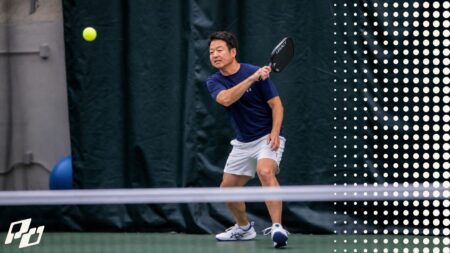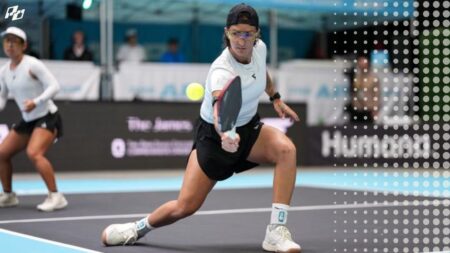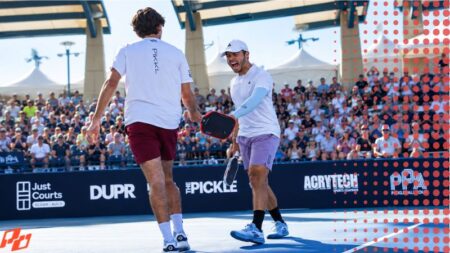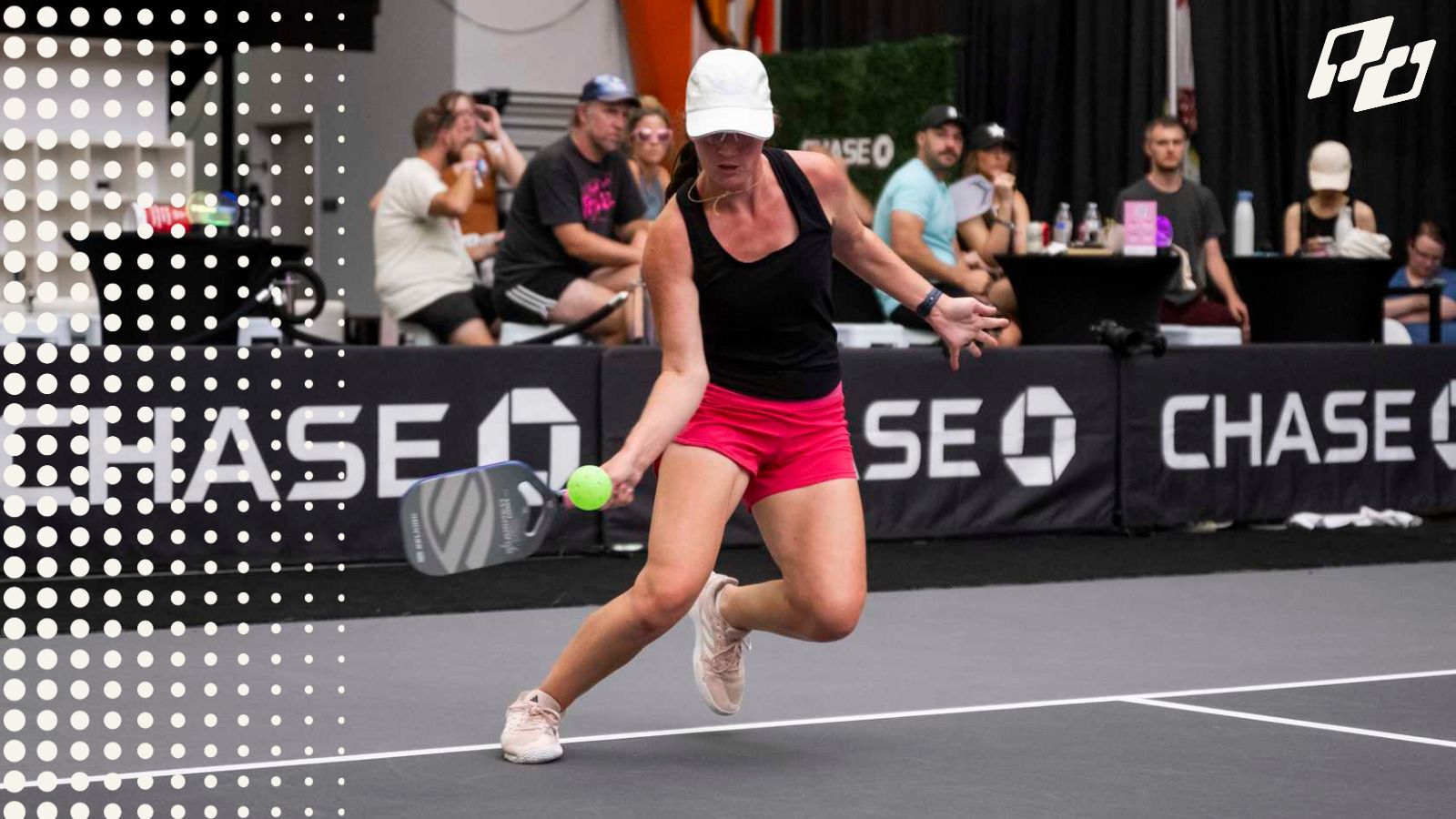
If you’ve been coached at all, you’ve probably heard some version of: “Set your feet,” “stay balanced,” “don’t run through contact.” And that advice is mostly right.
But here’s the confusing part: at open play, you’ll absolutely watch experienced players hit while moving forward—especially on returns, thirds, and transition balls. The secret isn’t that they’re breaking the rule.
It’s that they’re following a different rule:
Move through the shot when it buys you position… but be stopped (or re-balanced) at the moment you need to react.
In other words: they don’t “run through” the shot… they “flow through” it and then split-step. (And yes—people in rec play notice the same thing: beginners are told not to, but better players seem to “do it anyway.”)
The real reason the “don’t run through it” rule exists
When you’re still learning, running through contact usually causes:
- popped up balls (your momentum lifts the paddle face)
- sprayed shots (harder to control direction while your base is moving)
- late contact (you reach instead of loading and meeting the ball)
- no readiness after contact (you admire your shot while the ball comes back fast)
So coaches simplify it to: “Stop before you hit.” It’s a clean rule for building consistency.
But pickleball isn’t just “hit ball.” It’s hit + recover + be ready.
And that’s where advanced footwork changes the picture.
Why experienced players do hit while moving
1. Because position matters more than perfect mechanics
Pickleball rewards getting to strong real estate (especially the kitchen). After a return, for example, the best advice is still: hit your return, then move up—because the kitchen line is the strongest position.
So yes—good players often hit the return and keep moving forward… because the priority is getting up and being ready for the third.
2. Because they use a split step to “pay off” the movement
High-level players don’t just run forward and hope. They move—and then split step (or “stutter step”) so they land balanced and reactive as the opponent makes contact. That split step is a foundational tool for balance and reaction speed.
This is the part beginners don’t see. They notice the movement—not the re-balance.
3. Because some shots are designed to be hit on the move
There are legit situations where stopping is worse:
- your opponent hits short and you need to take it early
- you’re transitioning and need a soft reset while advancing
- you’re returning serve and using the “extra time” to close space
A lot of experienced rec players describe it as: the ball is slow enough that moving forward is free real estate.
The “allowed” times to move through the shot (and why)
1) The return of serve
This is the classic. You hit deep, then advance immediately—because you’re trying to claim the kitchen before their third shot.
How pros do it:
- contact out front (no reaching)
- compact swing
- move forward AFTER contact
- split step as the server strikes the third
2) Third-shot drop or drive while advancing
If you hit a third and just stand there, you get punished. Better players often hit and keep flowing forward—but they don’t arrive upright and dead-legged. They re-load with a split step so they can handle the next ball.
3) Transition-zone “reset while moving”
Sometimes you’re stuck mid-court and the point is speeding up. In that case, the best play might be a soft reset dink/drop while you’re still moving in—as long as you finish balanced and ready.
When you should NOT run through your shot
This is where most beginner/intermediate players get burned:
1) When you’re about to face a fast reply
If your shot is attackable (a pop-up, floaty drop, weak drive), you need to be stopped and ready, not drifting forward.
2) During hands battles at the kitchen
If you’re moving through volleys, you’ll get jammed, popped, or handcuffed. This is where split-step timing matters most.
3) On finesse balls that require touch
Dinks, resets, soft angles: momentum is usually your enemy. If you’re still learning touch, this is a “set your base” moment.
The technique that makes it work: “Get there fast, play it slow”
Here’s the simplest way to teach it:
Step 1: Move early
Don’t arrive late and lunge. If you’re late, your body panics and you sprint through contact.
Step 2: Contact first… then travel
For most rec players, the fix is this cue:
“Hit… then go.”
Not “go while you hit.”
Step 3: Split step as THEY hit
A split step is a small hop/landing that puts you in an athletic stance right as the opponent contacts the ball, so you can push in any direction.
If you steal one skill from advanced players, steal this.
A quick “Should I run through it?” decision table
| Situation | Better move | Why |
|---|---|---|
| Return of serve | Flow forward after contact + split step | Kitchen position matters most. |
| You hit a third shot and expect a soft reply | Advance, but re-balance | You need to be ready for the fourth. |
| You’re about to eat a speed-up | Stop / split step NOW | Reaction > momentum. |
| Dinking under pressure | Stabilize base | Touch requires stillness. |
| Transition reset ball | Small steps + soft hands | Control first, then position. |
The biggest mistakes rec players make (and fixes that actually help)
Mistake #1: Running into contact
Fix: Take two smaller “gather steps,” contact out front, then move.
Mistake #2: Never split stepping
Fix: Make split step non-negotiable—especially after returns and thirds.
Mistake #3: Moving forward on a ball that’s about to come back fast
Fix: If your shot sits up, your job isn’t “keep moving.” Your job is be ready.
Mistake #4: Believing “better players break the rules”
They don’t. They’re just better at the sequence:
Move → hit → recover → split step → react.
Two practical “steal this today” cues
- Return cue: “Hit deep… walk it in… split as they hit.”
- Transition cue: “Small steps… quiet paddle… stop drifting by the time the ball comes back.”
The teaching moment
The advice “don’t run through your shot” is meant to protect you from chaos.
But the real upgrade is understanding why better players sometimes look like they’re doing it anyway:
They’re not reckless. They’re efficient.
They take space without sacrificing readiness—and that’s the whole game.
If you want, paste the section/video you’re planning to embed (or tell me what moment you want highlighted), and I’ll tailor the “when to / when not to” examples to match that exact situation.