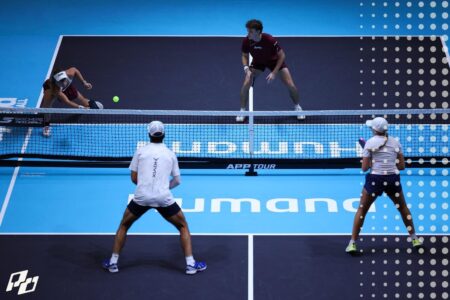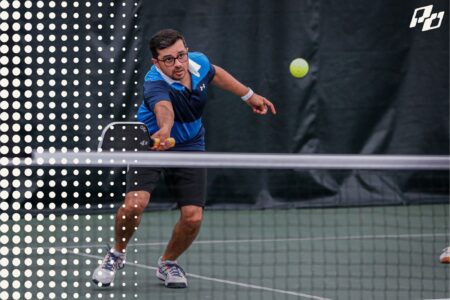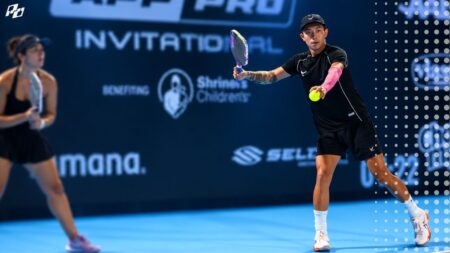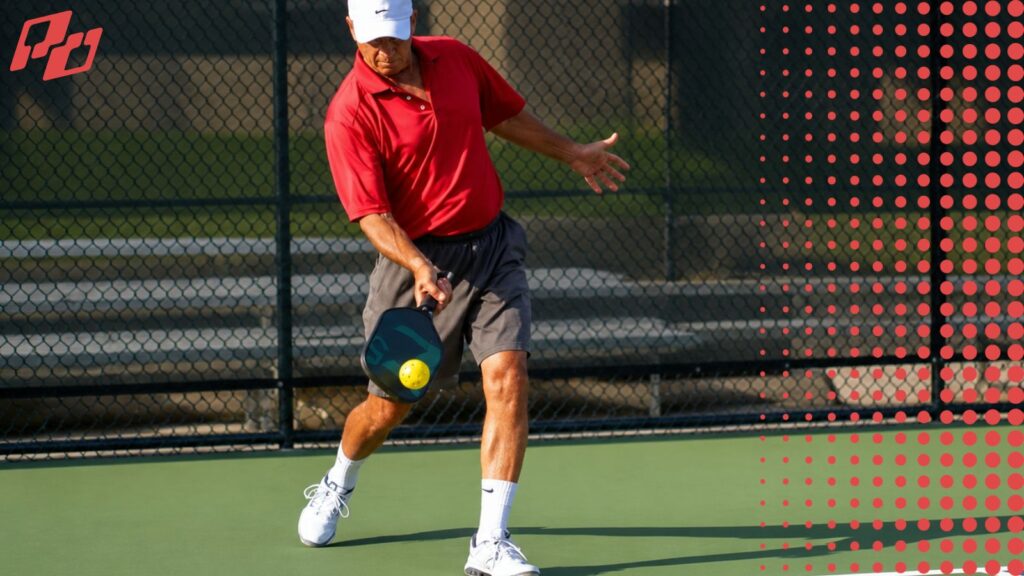
A short-angle pickleball serve uses reduced pace, topspin, and sidespin to pull the receiver toward the outside corner. Aim inside the sideline, brush up and around the ball, and use it as a changeup after deep serves to create an awkward return and an easier third shot.
We first learned about this serve from coach and pro player Nicholas Wade, who demonstrates exactly how to hit it in the video later in this article.
The idea is simple: instead of serving hard and deep, you take pace off, add topspin and sidespin, and pull the receiver toward the outside corner of the service box.
The short-angle serve is not designed to blast an ace past someone.
It is designed to make the returner hit while moving sideways, create a larger gap in the court, and give your team a more predictable third shot.
That makes it especially useful for intermediate doubles players who already have a reliable serve and want something more tactical than “hit it harder.”
What the Short-Angle Serve Is Really Trying to Do
A good short-angle serve lands near the outside corner of the diagonal service box, then curves or kicks away from the receiver.
Its value comes from geometry.
A deep serve pushes the returner backward. A short-angle serve pulls them forward and sideways.
That can:
- force contact outside the body
- make the returner hit while moving
- reduce their ability to drive through the middle
- leave more open court behind them
- delay their movement toward the kitchen
The goal is not just to serve short, but to force the receiver into an uncomfortable contact point.
A short serve that sits near the middle of the box can actually help the opponent move forward. The serve becomes dangerous only when the angle and spin pull them away from their preferred return position.
How to Create the Topspin-Sidespin Blend
The short-angle serve works best when topspin and sidespin are combined.
Topspin helps the ball clear the net and dip into the box.
Sidespin bends the flight and creates the lateral kick after the bounce.
For a right-handed server hitting from the right side, you will generally brush up and around the outside-right portion of the ball to create a serve that bends toward the receiver’s outside sideline. Reverse the directional idea from the other side or for a left-handed server.
The exact contact is less important than the paddle path.
Use:
- a low starting position
- an upward swing
- a slight outward-to-across brushing motion
- a finish that continues around the outside of the ball
Do not carve purely sideways. That produces sidespin without enough topspin, making the serve more likely to float long or clip the net.
Do not swing only upward. That creates topspin but not enough lateral movement.
Cue
Brush up first, around second.
Topspin keeps the serve legal and inside the box. Sidespin creates the angle.
Contact Point and Body Position
Don’t create the spin with a last-second wrist flick. Use a relaxed arm and an upward-and-around paddle path.
For the contact point:
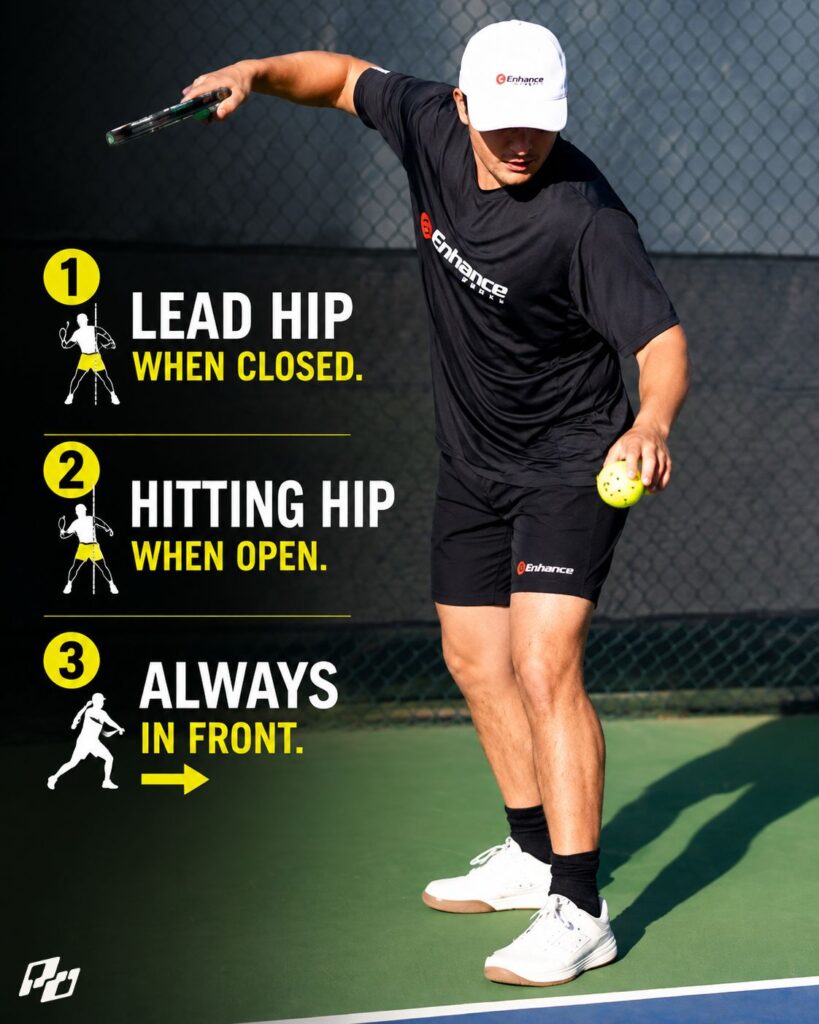
- Closed stance: contact slightly in front of the lead, non-dominant hip.
- Open stance: contact closer to the hitting-side hip.
- Every stance: keep the ball comfortably in front with enough space to swing.
If the ball gets too close to your body, the paddle cuts too sharply across it, which can send the serve wide or remove the topspin.
Cue
Lead hip when closed. Hitting hip when open. Always in front.
Volley Serve or Drop Serve?
You can build a short-angle serve from either legal serving method.
Under the 2026 USA Pickleball rules, a volley serve must use a clearly upward paddle arc, contact the ball clearly below the waist, and keep the paddle head clearly below the wrist at contact. Spin must come from the paddle strike, not from manipulating the ball during the release.
A drop serve gives you more freedom in the swing because the volley-serve contact restrictions do not apply after the ball bounces, although the ball must be released naturally without being propelled.
For many intermediate players:
- Volley serve: easier to disguise from the same setup as a normal serve.
- Drop serve: easier to experiment with paddle path and spin.
Whichever method you use, do not pre-spin the ball with your hand. The 2026 rules prohibit adding spin during the release.
Where to Aim
Do not aim directly at the sideline. That leaves almost no margin.
Instead, picture a target window roughly two to three feet inside the sideline and a few feet beyond the non-volley-zone line.
That gives the ball room to curve outward after it crosses the net. Your ideal serve should:
- clear the net safely
- begin traveling toward the middle of the target window
- curve toward the outside corner
- bounce low enough that the receiver cannot step in and attack comfortably
Cue
Aim inside the corner and let the spin finish the shot.
The sideline should be the result of the ball’s movement, not the place you initially point the paddle.
Why Less Power Usually Works Better
The original advice gets this part right: the short-angle serve is more about spin and shape than raw pace.
When players try to hit it at full speed, three things usually happen:
- the ball travels too deep
- the swing becomes too flat
- the target window becomes too small
Reducing pace gives the ball more time to curve and drop. That does not mean decelerating through contact. You still need a smooth, committed swing.
Think of using roughly 60–75 percent of your normal serving power while increasing the brushing action.
The paddle should still accelerate. The ball simply receives more rotation and less straight-line force.
The Best Time to Use It
The short-angle serve works best as a changeup. Use it when the receiver:
✔️ Stands several feet behind the baseline
✔️ Leans toward the middle
✔️ Prefers a strong forehand return from a fixed position
✔️ Struggles to move forward and sideways
✔️ Has started timing your deep serves comfortably
It is especially effective after you have established a deep serving pattern.
Three or four deep serves make the receiver settle farther back. The short angle then forces a late change in movement.
That is much more effective than using the short serve every point.
Simple pattern
Deep, deep, short angle.
The first two serves create the positioning. The third exploits it.
When Not to Use It
This serve has a real downside: a poor short serve helps the receiver move forward. Avoid it when:
✖️ Your accuracy is unreliable
✖️ The receiver is already standing close to the baseline
✖️ The opponent moves extremely well
✖️ You are missing wide under pressure
✖️ Your partner is not ready for the return angle
A receiver who reaches the ball comfortably may send a sharp crosscourt return or attack the open middle.
That is why placement matters more than surprise. A mediocre short-angle serve is often worse than a solid deep serve.
What Return Should You Expect?
The serve should help you predict the next ball. When the receiver is pulled wide, common replies include:
- a crosscourt return back toward your sideline
- a higher middle return hit while off balance
- a soft return designed to buy recovery time
- a down-the-line ball if the receiver reaches the serve early
Your partner should know the pattern before you use it. If you serve short and wide, both players must shift with the expected return.
The serving team should not admire the angle. Prepare for the third shot immediately.
Cue
Serve wide, expect crosscourt.
That expectation helps you organize the next ball instead of treating the serve as an isolated trick.
The Most Common Mistakes
❌ Aiming too close to the sideline — Give the spin room by starting farther inside the service box.
❌ Swinging only sideways — Add an upward component so the ball still dips.
❌ Slowing the paddle — Reduce ball speed, not swing commitment.
❌ Making the setup obvious — Keep the same stance and preparation, then change the paddle path late.
❌ Overusing it — Once the receiver adjusts, go back to serving deep.
A Better Practice Drill
Place three targets in the diagonal service box:
- deep middle
- deep outside corner
- short outside corner
Hit two serves to the deep targets, then one short-angle serve.
Score the short serve only if:
✔️ It lands inside the target window
✔️ It pulls the receiver outside their normal position
✔️ It does not sit high enough for an aggressive return
Do not score it merely because it lands short.
That teaches the real objective: create movement, not just a different bounce location. After ten successful target sequences, add a live returner and evaluate the third shot you receive.
The Real Value of This Serve
The short-angle serve is most useful when you stop thinking of it as a highlight shot. It is a positioning tool.
A good one does not need to produce an ace. It only needs to make the receiver contact the ball from a worse place than usual.
That is why the serve becomes more valuable at the intermediate level. You are no longer serving simply to start the rally. You are beginning to use the serve to shape the rally.
Keep your deep serve as the foundation.
Then, when the receiver drifts back, leans middle or settles into a comfortable rhythm, pull them toward the short outside corner.
You are not trying to win with the serve alone. You are trying to make the next ball easier.