
A slice drive in pickleball is usually a low-percentage shot because backspin makes the ball float more and gives better opponents extra time to attack. For most rec players, a topspin or flatter drive is a smarter choice, while slice works better on drops, resets, and occasional changeups.
A slice drive sounds clever.
It feels controlled. It looks tricky. And if you came from tennis, it can feel natural to carve under the ball and send a skidding shot through the court.
But in pickleball, especially at the rec level, the slice drive is usually a trap.
The simple reason is that a drive and backspin are often trying to do opposite jobs. A good drive is supposed to stay low, penetrate, and pressure your opponent into a weak block or a pop-up. Topspin helps that happen because it lets you swing aggressively while still bringing the ball down into the court, and after the bounce it jumps forward at the opponent.
Slice, by contrast, tends to keep the ball in the air a bit longer and is generally better suited to slowing the pace, defending, or adding variation rather than driving through the court. So the message is not that slice is useless.
It is that slice has jobs.
And for most rec players, driving is usually not one of them.
Why is the slice drive usually a bad idea?
Because the purpose of a drive and the behavior of slice do not usually match. A drive is an attacking shot. You want it to:
- travel with pace
- dip into the court
- stay low enough to jam your opponent
- and force a weak contact point
Topspin is built for that. Topspin is an offensive technique because it helps players hit more aggressively while maintaining control, and it makes the ball jump forward after the bounce.
Slice does almost the opposite kind of work: it adds backspin, keeps the ball in the air slightly longer, and makes it bounce lower, which can be useful in some situations but does not naturally support a penetrating attacking drive.
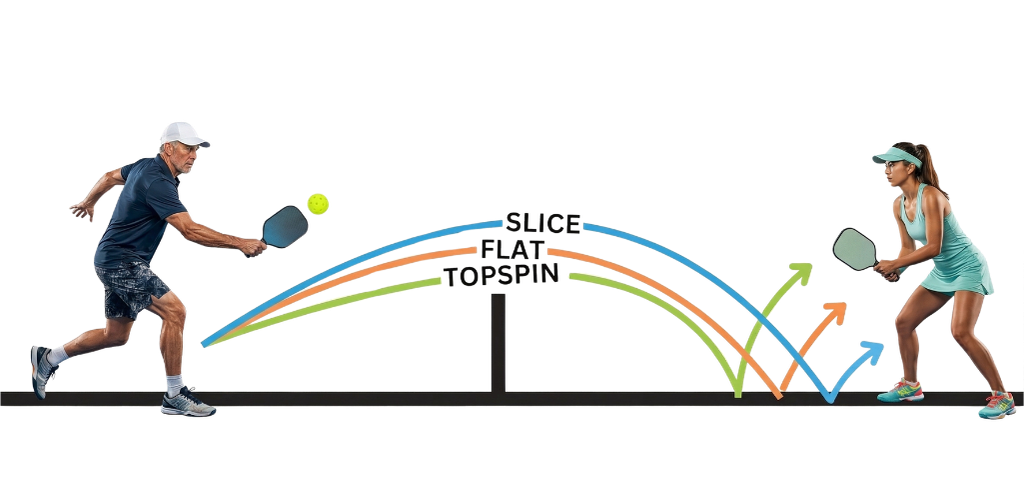
That is the core problem with the slice drive. You are trying to hit an offensive ball with a spin that naturally behaves more like a slowing, floating, control-oriented spin.
That does not mean every slice drive is automatically terrible. It means the shot is working uphill from the start.
Why does the slice drive fool rec players?
Because it often feels better than it actually performs.
This is one of those shots that can trick players into thinking it is smarter than it is. The contact can feel clean. The bounce can look annoying. Some lower-level opponents may mishandle it. So the shot gets rewarded just enough to seem legit.
But as opponents improve, the weakness becomes clearer.
Current high-level analysis has been making that point more often. Slice-based attacking shots have faded dramatically at the pro level because modern paddles and modern topspin mechanics let opponents convert your backspin into heavier topspin of their own. In other words, the shot that feels tricky to you can become a setup ball for them.
That is why the slice drive can be dangerous for rec players. It may win some ugly points at 3.0 or against people who do not handle spin well, but it can quietly become a bad long-term habit.
At what level does the slice drive stop being a good idea?
Usually right around the point where your opponents stop being surprised by slice and start reading it.
That is the honest answer.
At lower rec levels, a slice drive can still bother players because:
- they misread the bounce
- they are late getting under the ball
- they do not create topspin well
- or they simply are not used to backspin
So yes, around 3.0 and sometimes 3.5, the shot may still get some cheap points.
But once you reach stronger 3.5s, 4.0s, and especially above that, the calculus changes. Better players tend to read the bounce earlier, move better, and use your backspin against you. Topspin has largely replaced aggressive slice in serious play, with slice still having niche value in rec play mainly when opponents cannot punish it.
So the practical version is this:
- 3.0 and below: it may work more than it deserves to.
- 3.5: it can still be a surprise ball, but it is already becoming a lower-upside habit.
- 4.0+: most good players would rather see your slice drive than your heavy topspin drive. They can attack it, roll it, or at least neutralize it comfortably.
That is why I would not build a rec player’s offense around this shot.
Why is topspin so much better for a drive?
Because topspin gives a drive what a drive actually needs: speed, dip, and margin.
This is really the whole article in one sentence.
A lot of rec players hear “topspin” and think it just means “more advanced spin.” But the real value is that topspin gives you permission to swing with conviction without having to be perfect.
Ben Johns’ own topspin drive teaching also leans into that exact offensive profile: low-to-high swing path, shape on the ball, controlled aggression, and a shot that stays threatening without flying long.
That is what you want from a drive:
- more margin over the net
- better chance of dipping into the court
- more pace without losing control
- and a ball that pressures your opponent after the bounce
Topspin helps with all of that. Slice helps with almost none of it.
What is the big misunderstanding about slice drives?
Players confuse “low bounce” with “good drive.”
That is the trap.
Yes, backspin can make a ball bounce lower. USA Pickleball says that directly. But that does not automatically make it a good attacking shot, because the ball also stays in the air longer and usually arrives with less threatening shape and less natural dip.
A drive is not judged by whether the bounce is weird. It is judged by whether it makes the opponent uncomfortable before or at contact.
A good drive should make the opponent feel rushed, jammed, stretched, or forced into a defensive block.
If your slice drive gives them time to set their feet, see the ball clearly, and roll topspin back at you, then the lower bounce did not save you. It just delayed the punishment.
So should rec players never hit slice from the baseline?
Not exactly. They should stop trying to hit slice drives as their default attacking shot.
That is the more useful rule.
Slice still has a place in pickleball. It just tends to shine in different jobs:
- backhand slice drops
- resets
- some return-of-serve variations
- emergency retrievals when you are stretched
- and occasional pace-change balls
That distinction matters a lot. James Ignatowich’s guidance on topspin drops versus slice drops is especially helpful here: he says a topspin drop is usually the better option from deeper court positions because topspin helps pull the ball down more reliably, while slice drops are more useful when you are closer in and want a softer, floating landing.
That gives rec players a really clean framework:
The deeper and more aggressive the shot, the more topspin usually makes sense.
The softer and more touch-oriented the shot, the more slice may have a job.
That is a much healthier way to think about spin choice.
When can a slice drive actually make sense?
If a player insists on keeping one, it should live in the toolbox as a rare changeup, not a stock shot.
The best reasons to use it are usually these:
1. You are stretched and cannot generate a real topspin drive
In that case, slice may help you keep the ball lower and buy time. But now you are not choosing your best attacking ball. You are choosing the least bad option from a compromised position.
2. You want a pace change against a rhythm player
Some opponents love seeing the same ball over and over. An occasional skiddy slice can disrupt rhythm. That can be useful.
3. You are using it as a surprise ball at lower levels
This is real. If your opponents do not handle slice well, one occasional slice drive may still create awkward replies.
4. You are really hitting a penetrating slice return, not a true drive
That is a different conversation. Slice returns still exist, though current pro analysis says they are much less common than they used to be because strong players can now attack them more effectively.
So yes, there is a place for the shot.
But no, that place is not “every time I have a baseline backhand.”
If a player still wants to hit one, how should they do it right?
If you are going to hit a slice drive at all, it has to be a penetrating slice, not a floaty carve.
That is the line.
The biggest mechanical mistake players make is chopping too much. They think slice means “cut down hard,” and that usually just produces a ball that floats, sits up, and gives the opponent time.
If someone insists on having this shot, the better cues are:
- Forward, not chop
- Contact out in front
- Stay low with your legs
- Quiet head
- Knife through, do not carve up
- Use it sparingly
The goal is not huge pace. The goal is a ball that stays low enough, skids enough, and changes the rhythm enough to bother the opponent once in a while.
And that is important: once in a while.
The minute you try to make it your main attack ball, the shot usually starts hurting you.
What should rec players build instead?
A better shot family. For most rec players, that means:
1. A repeatable topspin drive
This should be your main offensive development project. It has better long-term upside and holds up better as opponents improve.
2. A flatter backup drive
If your topspin is not there on a given day, a cleaner flatter drive is still often better than carving slice.
3. A true slice drop or slice reset
This is where slice can still be very useful. James Ignatowich’s topspin-vs-slice drop framework is great here again: slice has more value when the shot is softer, shorter, and more touch-oriented rather than when you are trying to drive through the court.
That gives you a smarter toolkit:
- topspin drive
- flat backup drive
- slice drop/reset
That is a real progression.
So what is the bottom line on slice drives?
For most recreational players, the slice drive is a low-upside habit disguised as a crafty shot.
⮕ It may work a little at lower levels.
⮕ It may feel comfortable if you came from tennis.
⮕ And it may occasionally make sense as a changeup or emergency ball.
But if your goal is to build an offense that still works as you improve, the slice drive should not be your default answer. The better long-term path is:
- drive with topspin
- use slice for drops, resets, and occasional variation
- and stop feeding stronger opponents the kind of ball they often like seeing
That is the smarter way to think about it.