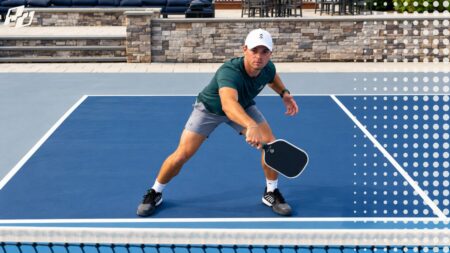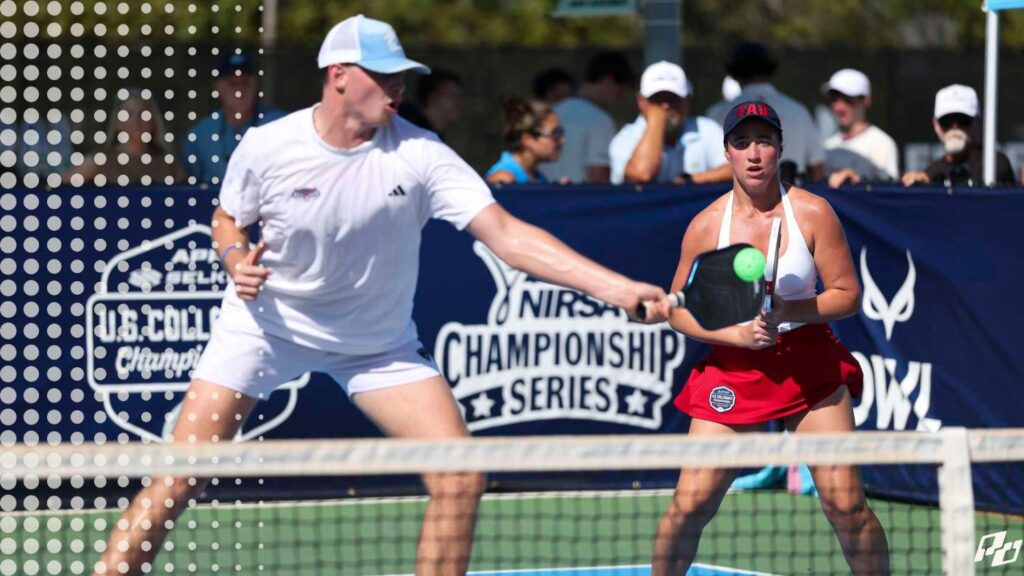
If your partner hits a weak return in pickleball, the smartest move is often to slide over and protect the middle until they recover to the kitchen. This works best when the return sits up, your partner is late, and you are already set and ready to absorb the third-shot drive.
Pickleball coach Tanner Tomassi recently shared a piece of advice that sounds a little aggressive at first, but is actually one of the smartest doubles concepts recreational players can learn:
If your partner hits a weak or short return and is late getting to the kitchen, you may need to step across and protect them.
And yes, that is legal.
A lot of rec players think there is some imaginary wall down the middle and that crossing over your partner’s side is automatically wrong. It is not. Under the rules, aside from the server’s required position before the serve, players are generally free to stand wherever they want and move wherever they want. There is no rule saying you cannot cross the center line area to help cover a vulnerable ball.
The real question is not, “Am I allowed to cross?”
It is: “Am I crossing for the right reason, at the right time, in a way that actually helps the team?”
That is where the good strategy starts.
Why this advice matters more than 3.5 players realize
At 3.5, a lot of points are lost not because the shot itself was terrible, but because the team never handles the next moment correctly.
That is especially true on the return of serve.
The receiving team’s job is to keep back and win the race to the kitchen line. A deep return helps you do that. But if the return lands short or sits up, the serving team gets a much easier third-shot drive and the returner often gets stranded in transition.
That is the exact situation Tanner’s advice is talking about.
- Your partner returns serve.
- The ball lands shorter than intended.
- The server or server’s partner now has a pretty tasty third-shot drive.
- Your partner is still moving forward and is not established at the kitchen line.
That is the danger zone.
If you are already set at the kitchen and see the attack coming, sometimes the smartest move is to slide across, take more of the middle, and protect the vulnerable space until your partner catches up.
That is not selfish.
That is high-level doubles.
So… does this actually work?
Yes — when it is done as temporary protection, not as random poaching. That distinction matters.
A lot of rec players hear advice like this and immediately think it means:
- “I should just take over.”
- “I should poach everything.”
- “My partner is in trouble, so now both halves are mine.”
That is not what good players do.
Good coverage is situational.
Better Pickleball’s “cover the middle” guidance says breaking normal lane responsibilities is perfectly fine when your partner is recovering or out of position, especially if you can intentionally take the correct ball and buy time for the team to reorganize.
That is the real angle here: This is not really a “cross the line” trick. It is a court coverage skill.
And for 3.5 players, it is one of the clearest ways to look more organized and more advanced without hitting any flashier shots.
Why does this help so much after a weak return?
Because the returner is the vulnerable player. That is the key concept.
After a good deep return, the receiving team usually has time to get both players to the kitchen line. But after a weaker return, the returner often gets caught in transition while the partner is already set at the line. That creates an ugly split formation: one player up, one player still moving.
Doubles works best when both partners get to the kitchen line together. One player up and one player back is one of the most common partner mistakes because it gives the serving team easy targets and easy patterns.
So if your partner is late, the most dangerous ball is usually:
- a hard third through the middle
- a drive at the moving player’s body
- or a ball hit through the seam between you
That is why protection matters.
By stepping over and shrinking that vulnerable seam, you take away the easiest attack and buy your partner one more second to get organized.
What pros and strong coaches are really saying here
High-level players are not saying, “Always cross.”
They are saying: Read the situation sooner, cover the danger faster, then recover cleanly.
That is a huge difference.
One of the most important ideas in modern doubles is that coverage is fluid, not rigid. Good players step in and poach when they see an opponent gearing up to attack their partner.
The move works because:
- you are already set
- your partner is not
- the third-shot drive is likely
- and your team’s biggest problem is not “who owns the middle?”
- it is “who can stop the attack right now?”
That is what advanced doubles players solve.
The biggest mistake 3.5 players make with this concept
They react late. Or they overreact. Those are the two classic errors.
1. Reacting late
The ball is already being driven before they decide to help. At that point, the move becomes a reach instead of a read.
2. Overreacting
They cross too far, too dramatically, or for too long, and now the team has created a new hole trying to fix the first one.
That is why I like this concept for 3.5 players, but only when it is taught the right way.
The goal is not: “Take your partner’s side.”
The goal is: “Temporarily take away the most dangerous ball until your partner recovers.”
That is much smarter.
How should a 3.5 player actually do this?
Think of it as a slide and protect, not a full poach mission. Here is the sequence:
Step 1: Read the return honestly
The moment your partner hits the return, ask:
- Did it land deep or short?
- Did it stay low or sit up?
- Is my partner moving well or still stuck?
If the return is weak and your partner is late, your mindset should shift immediately.
Step 2: Shade toward the danger
Do not sprint wildly across the court. Just slide enough to take away the easiest middle/body drive.
Usually that means:
- one or two controlled shuffle steps toward the middl
- paddle up
- ready for a block or counter
- eyes on the attacker’s paddle
Step 3: Expect the attack at your partner
This is the mental part. Too many rec players slide over but still do not really believe the ball is coming there.
If the return was weak, assume the serving team sees it too.
Step 4: Take the ball if it enters your protection zone
If you can take the drive cleanly and early, do it.
If not, at least your shading may force them to change direction or go riskier.
Step 5: Recover back out once your partner is established
This is huge. The move is temporary.
Once your partner gets to the line and the team is balanced again, you do not stay camped on their side like you just signed a lease there.
What should your cues be?
For 3.5 players, simple cues matter a lot here. Use cues like:
- Weak return, slide
- Protect middle
- Partner late
- Take the seam
- Cover, then recover
These are better than vague thoughts like:
- “Maybe I should help”
- “I hope they don’t drive it”
- “This seems bad”
You want a short cue that turns the read into action.
When should you definitely do this?
This tactic is most useful when:
- your partner’s return lands noticeably short
- the return sits up enough for an obvious third-shot drive
- your partner is still moving up and not set
- you are already balanced at the kitchen
- the opponents clearly like to drive the third
This is especially useful against teams that love ripping the third through the middle or at the moving player.
In those matchups, protecting your partner is not optional strategy flair.
It is just good doubles.
When should you not do this?
This is just as important. Do not do it when:
- the return was actually good and deep
- your partner is already set and balanced
- you are guessing instead of reading
- you would have to lunge awkwardly across too late
- crossing would leave your side completely exposed
- you and your partner have zero communication and collide every other game
That last one matters more than people think. Good coverage without communication quickly turns into chaotic poaching.
And chaotic poaching is one of the fastest ways to make your partner stop trusting you.
What should doubles partners say to each other?
Very little — but it should be useful. Short communication works best here.
Good phrases:
- I’ve got middle
- You’re late, I’m here
- Back up, recover
- Mine if it comes
Before the game, it also helps to agree on the basic idea: “If one of us hits a weak return and is late coming in, the player already set at the kitchen can slide middle and protect.”
That kind of pre-match conversation is exactly the kind of useful partner communication current strategy guides recommend. Even a quick agreement on who takes middle balls and when to shade can save a lot of confusion.
The bottom line
Yes, this works. And yes, more 3.5 players should learn it. But only if they understand what it really is:
- not random poaching
- not partner takeover
- not a license to freelance
It is temporary protection after a weak return.
If your partner hits a short or attackable return and is late getting to the kitchen, sliding over to protect the middle and absorb the likely drive is smart, legal, and very often the right play.
The key is to do it early, do it intentionally, and then recover back into balanced doubles positioning once the danger passes.