
Blaming your pickleball partner rarely helps the next point. Instead, turn mistakes into useful information: use calm body language, give one clear cue, avoid mid-game lectures, and focus on your own next action. Better partners don’t ignore errors — they respond in ways that keep the team functional.
There is a very specific kind of pickleball frustration that nobody likes to admit.
Your partner misses a return.
Then they pop up a dink.
Then they speed up from their ankles.
Then they leave the middle ball.
And suddenly, somewhere deep in your brain, a little voice starts keeping receipts.
“That was yours.”
“Why did you hit that?”
“We’d be winning if they just stopped missing.”
“I’m playing fine. They’re the problem.”
That is the dangerous part.
You may not say it out loud. You may even smile and say, “No worries.” But your body language changes. Your energy changes. Your decision-making changes. You start poaching too much, overcovering, forcing shots, coaching between points, or playing tight because you no longer trust the person beside you.
And once that happens, you are not just playing against the other team anymore. You are playing against your own partnership.
This is one of the most common hidden problems in rec pickleball. It shows up in open play, leagues, tournaments, mixed doubles, challenge courts, and casual games with friends. It is also one of the fastest ways to turn a fun match into an emotional mess.
The fix is not pretending your partner never makes mistakes.
The fix is learning how to stay accountable, useful, and tactically clear even when your partner is struggling.
First, Let’s Be Honest: Sometimes Your Partner Really Is Making More Mistakes
This is the part we need to say out loud.
Sometimes your partner is just having a rough game.
Sometimes they are the weaker player.
Sometimes they are getting targeted.
Sometimes their returns are short, their resets are floating, or their thirds are not landing.
And yes — sometimes you are losing partly because of them.
But here is the problem: that thought is usually not useful during the match.
Once your brain decides, “My partner is the reason we are losing,” it starts looking for proof. Every missed dink becomes evidence. Every bad decision becomes confirmation. Every good shot you hit feels like, “See? I’m doing my part.”
That is classic human behavior. Psychology describes attribution biases as the way people often explain their own behavior and other people’s behavior differently. One common pattern is self-serving bias: we tend to give ourselves more credit for success and push more blame outward when things go wrong.
In pickleball terms:
When you miss, it was windy.
When your partner misses, they choked.
When you pop one up, the ball skidded.
When your partner pops one up, they have terrible touch.
When you leave the middle, it was a communication issue.
When they leave the middle, they are not moving.
That bias is sneaky. And if you do not catch it, it can quietly wreck your doubles game.
The Real Question: Is Blame Helping You Win the Next Point?
This is the standard I like: A thought can be true and still be useless.
Maybe your partner did miss the last three returns. Maybe they did choose the wrong shot. Maybe they are being targeted for a reason.
But while the game is still happening, blame does not solve the next rally.
Your partner makes one error. You react emotionally. Now you make a positioning error because you are trying to cover for them. Then they feel judged and play tighter. Then you get more annoyed. Then the partnership collapses.
The other team did not have to beat you. You did it for them.
What Coaches and Good Players Usually Understand
Good doubles players are not blame-free because they are nicer people. They are blame-resistant because they understand the structure of the game.
Doubles pickleball is connected. One player’s shot changes the other player’s options. One weak return affects the third shot. One high dink changes your partner’s defensive responsibility. One poor movement decision can make the next ball look like someone else’s mistake.
That is why “whose fault was that?” is often the wrong first question.
The better question is: What created that ball?
- Did your partner pop up the dink because they were bad?
- Or because your previous shot pulled them wide and left them rushed?
- Did they leave the middle because they were lazy?
- Or because you had been poaching unpredictably for three rallies?
- Did they miss the reset because they are unreliable?
- Or because your team never got set in transition?
This is how better players think. They are not searching for emotional fault. They are searching for the tactical chain.
The Difference Between Accountability and Blame
This distinction matters.
Accountability says: “What can we control next?”
Blame says: “Who caused this?”
Accountability is useful. Blame is usually emotional noise.
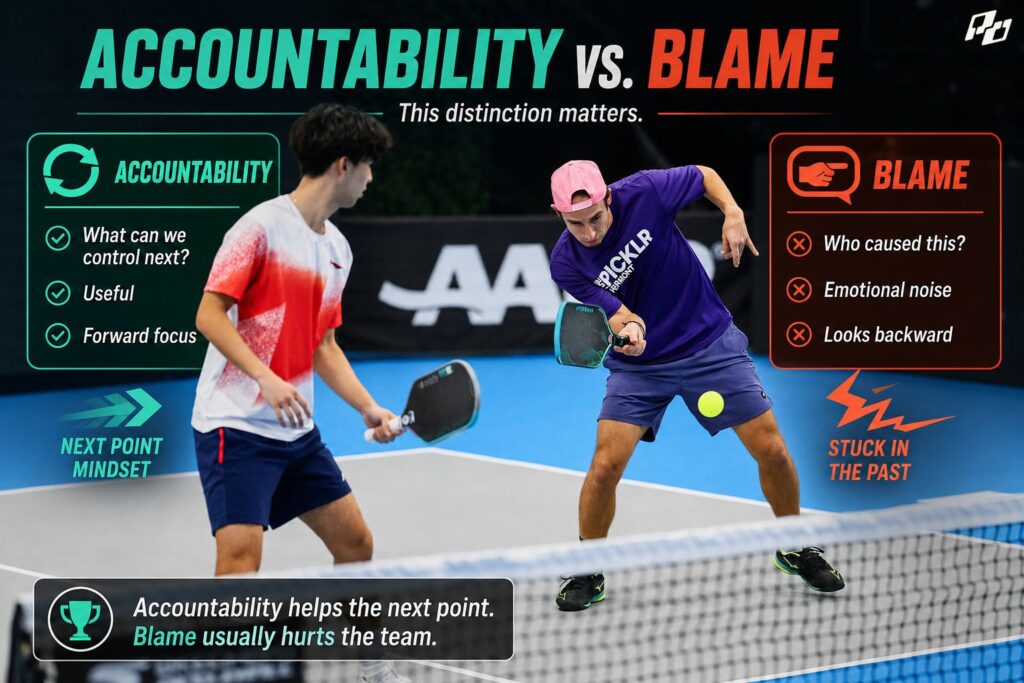
Accountability sounds like:
“Let’s return deep middle.”
“I’ll take middle if it’s high.”
“Let’s slow this down.”
“We need to reset one more.”
“Let’s make them play another ball.”
“I’ll cover line; you shade middle.”
Blame sounds like:
“You keep missing that.”
“Why would you hit there?”
“That was yours.”
“You have to get those.”
“Stop popping it up.”
“You’re standing in the wrong spot.”
One helps the next rally. The other drags the last rally into it.
Why Secret Blame Shows Up So Much in Rec Pickleball
Pickleball doubles has a weird emotional setup.
You are close to your partner. Very close. You can hear every sigh, see every facial expression, feel every moment of hesitation. The court is small, the mistakes are obvious, and the social pressure is real.
Also, because pickleball is often played in open-play formats with rotating partners, you may not have established trust. You might be paired with someone you barely know, someone at a different level, someone who communicates differently, or someone who plays a style you do not like.
That creates the perfect conditions for quiet resentment.
And rec play adds another layer: people are often trying to balance competition with friendliness. Basic pickleball etiquette applies perfectly here: compete hard, but don’t be a jerk. Stay encouraging with partners and opponents, and don’t snap at your partner every time they miss — especially in rec play.
That sounds simple. It is not always easy at 9-9 when your partner just missed a sitter.
But that is exactly when it matters.
The Body Language Problem
Here is the uncomfortable truth: your partner can usually feel your blame before you say anything.
You may think you are hiding it. You are not.
They see:
- the shoulder drop
- the turn away
- the fake smile
- the long exhale
- the paddle slap
- the silence after their miss
- the “helpful” correction that sounds irritated
- the sudden overpoaching
- the way you stop making eye contact
And once your partner feels judged, most players do not play better. They play smaller.
⮕ They guide the ball.
⮕ They avoid taking smart attacks.
⮕ They apologize too much.
⮕ They stop moving freely.
⮕ They become afraid to make the next mistake.
Now your silent blame has created the exact thing you were frustrated by: a tighter, less confident partner.
The First Skill: Own Your 50%
This is the best place to start. In doubles, you may not control every ball. But you always control your half of the partnership.
Your 50% includes:
- your shot selection
- your court positioning
- your tone
- your body language
- your communication
- your recovery after mistakes
- your willingness to adjust
- your ability to make your partner better, not smaller
Owning your 50% does not mean pretending every mistake was yours. It means refusing to become useless because someone else made an error.
A great cue: “My job is the next useful action.”
Not the next judgment. The next useful action.
The Second Skill: Replace Judgment With Information
When your partner misses, your brain wants to label it.
“Bad shot.”
“Poor decision.”
“Choke.”
“Again?”
Train yourself to translate judgment into information.
Instead of: “They can’t return.”
Think: “They need a bigger target.”
Instead of: “They keep popping up dinks.”
⮕ Think: “We need to reduce pace or choose safer dink height.”
Instead of: “They are getting destroyed in transition.”
⮕ Think: “We need to slow the fifth and maybe stay back longer.”
Instead of: “They don’t know whose ball is whose.”
⮕ Think: “We need a clearer middle rule.”
That shift is powerful because it turns irritation into problem-solving. And that is what you actually need in a match.
The Third Skill: Use Tactical Language, Not Emotional Language
When your partner is struggling, the words you choose matter.
Bad language focuses on the mistake.
Good language focuses on the next target.
Instead of:
❌ “Stop missing returns.”
✅ “Let’s go deep middle.”
❌ “You’re popping everything up.”
✅ “Let’s keep the next few dinks low and boring.”
❌ “You have to get to the kitchen.”
✅ “After your return, I’ll call us in.”
❌ “That was yours.”
✅ “Let’s make middle mine if it’s high, yours if it’s low.”
The best partner communication is specific, short, and forward-facing. It gives your partner a job without putting them on trial.
The “No Autopsy During the Game” Rule
One of the worst rec-player habits is performing a full point autopsy while the game is still happening.
After every rally:
“You should have let that bounce.”
“I thought you were going line.”
“You were too far back.”
“You need to take that earlier.”
“You have to drop that.”
Even when the advice is technically right, the timing is usually wrong.
During a game, your partner does not need a documentary about what went wrong. They need a simple adjustment they can actually use.
A good rule: During the game: one cue. After the game: one discussion.
During the game:
“Deep returns.”
“Cover middle.”
“Reset one more.”
“Slow it down.”
“Big targets.”
After the game, if they are open to it, you can talk about patterns.
That keeps the match from becoming a coaching lecture.
The Partner-Blame Checklist
When you feel yourself blaming your partner, ask these five questions quickly:
- Did I create pressure before their mistake?
Maybe your shot left them in trouble. - Did we have a clear plan?
If not, confusion is shared. - Did my body language make them tighter?
Silent judgment still counts. - Am I trying to win the point myself now?
Overhelping often creates new problems. - What is the next useful cue?
Not the next criticism. The next cue.
This checklist takes five seconds. It can save an entire game.
When Your Partner Really Is the Weaker Player
Sometimes there is no mystery. Your partner is being targeted because they are weaker.
That is common in rec play. Your job is not to resent them. Your job is to help them survive the pattern.
Here is how:
Give them bigger targets
A struggling player usually does not need precision. They need margin.
Try:
“Deep middle return.”
“Dink middle.”
“Reset crosscourt.”
“Make them hit one more.”
Reduce their decision load
Do not give them five tactical instructions.
Give one.
- If they are missing returns, the cue is “deep middle.”
- If they are popping up dinks, the cue is “low middle.”
- If they are losing speedups, the cue is “block first.”
Protect smart, not frantic
Yes, you can help more. But do not lunge across their body or steal every ball. That tells them you do not trust them and usually creates confusion.
Better:
“I’ll take middle if it’s high.”
“You handle your crosscourt.”
“I’ve got the lob.”
“If they drive, block middle.”
That is support, not takeover.
When You Are the Weaker Partner
This matters too. Sometimes you are the one getting targeted. If so, the worst thing you can do is spiral into apology mode.
A quick “my bad” is fine. But apologizing after every miss makes the court heavier and reminds everyone you are struggling.
Instead, use practical language:
“I’m going bigger target.”
“I’ll return deep middle.”
“I’m going to reset one more.”
“Keep me steady.”
“Tell me middle or line.”
That shows accountability without emotional collapse.
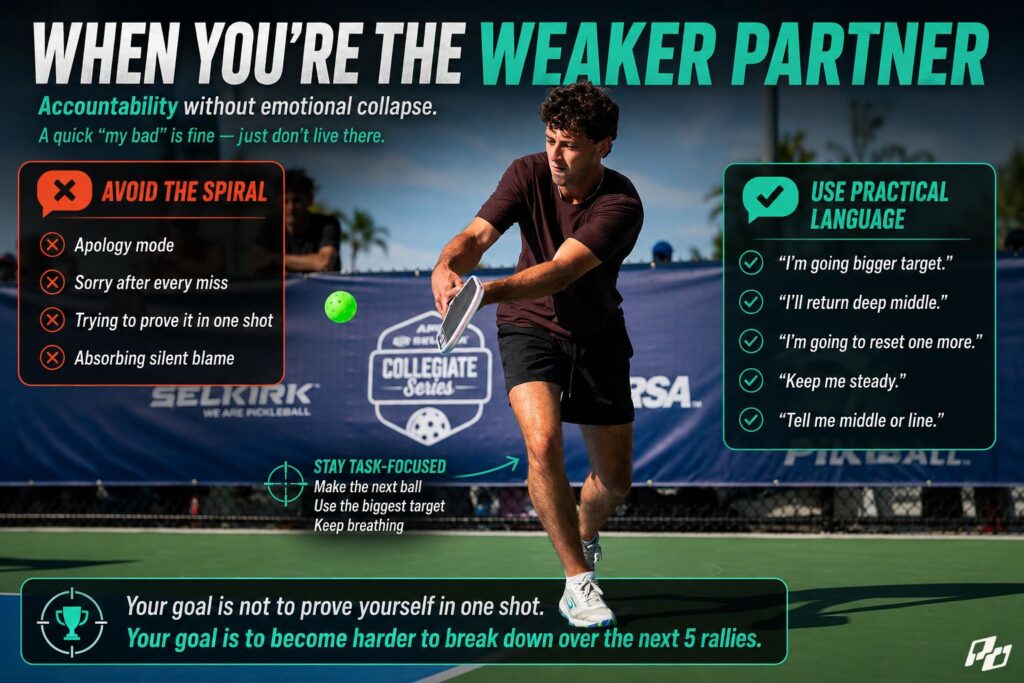
And if your partner is silently blaming you, do not absorb all of it. Stay task-focused. Make the next ball. Use the biggest target. Keep breathing.
Your goal is not to prove yourself in one shot. Your goal is to become harder to break down over the next five rallies.
The Overhelping Trap
Blaming your partner often creates overhelping.
You decide they cannot handle their side, so you start taking more balls. At first, it feels responsible. You are trying to rescue the team.
But overhelping creates problems. This is why “I’ll just do more” is not always good doubles.
Better partners do not cover every ball. They cover the right balls.
Take the ball when:
⮕ it is clearly middle and you are better positioned
⮕ you called it early
⮕ your partner is pulled wide
⮕ the ball is high and attackable
⮕ your team has an agreed pattern
Do not take it just because you are annoyed.
The Three Words That Help More Than Coaching
When your partner misses under pressure, try this:
“You’re good. Next.”
That is it.
It sounds almost too simple. But it does three things:
- It tells them the relationship is fine.
- It closes the last point.
- It points attention forward.
Then, if needed, add one tactical cue: “You’re good. Next. Deep middle.”
That is about as much as most players can actually use during a match.
How to Talk Between Games
Between games is where you can be more tactical. But even then, do not start with a list of everything your partner did wrong.
Use this structure:
- One thing that is working
“Our crosscourt dinks are holding up.” - One pattern we need to solve
“They’re attacking our short returns.” - One simple adjustment
“Let’s return deep middle and make the third harder.”
That is enough.
If you give your partner six fixes, they will remember none of them and feel criticized. The best between-game talk is short enough to play.
The “We” Language Rule
Not because every mistake is equally shared — but because doubles performance is connected.
Instead of: “You’re leaving the middle.”
Try: “We need a clearer middle rule.”
Instead of: “You’re getting stuck back.”
Try: “We need to move in together after good returns.”
Instead of: “You’re popping up resets.”
Try: “We need to slow down when they drive.”
“We” language keeps the team intact.
“You” language can be accurate, but it often sounds like accusation.
What to Do When You Feel the Blame Building
Here is a practical in-game reset.
Step 1: Notice the thought
“I’m blaming my partner.”
Do not judge it. Just notice it.
Step 2: Exhale before speaking
A lot of bad partner comments happen in the first two seconds after a point.
Wait.
Step 3: Give one useful cue
“Deep middle.”
“Reset one more.”
“I’ve got high middle.”
“Big target.”
Step 4: Fix your own next action
Better split step. Better return. Better dink. Better spacing.
Step 5: Praise the next good choice
Even if they miss.
“Good idea.”
“Right ball.”
“Keep that pattern.”
“Good reset choice.”
That matters because partners need to know you are not only watching for mistakes.
What If Your Partner Actually Blames You?
You also need tools for the other side. If your partner is sighing, correcting, or blaming, stay calm and set the tone.
Try:
“Give me one cue, not five.”
“Tell me the target.”
“Let’s keep it positive.”
“I’m good — next ball.”
“Let’s talk after the game.”
If the partner keeps being rude, you do not have to absorb it forever. In open play, you can simply avoid pairing with that person again. In league or tournament play, keep communication short and tactical.
You cannot always control your partner’s mood. You can control whether you join it.
The Rec Player Partner Agreement
Before a competitive rec game, league match, or tournament, try this quick agreement:
“Let’s keep cues short. If one of us is struggling, give targets, not criticism. If there’s confusion, we fix it between points.”
That one sentence can prevent a lot of drama.
You can also agree on:
- who takes middle
- when to switch
- how to call lobs
- what cue to use when one player is tight
- what to say after mistakes
- whether coaching during games is welcome
Most partner tension is not because people are mean. It is because they never agreed on how to communicate.
The Best Cues for Different Partner Problems
| Partner Problem | Helpful Cue | Avoid Saying |
|---|---|---|
| Missing returns | Deep middle. Big target. | “Stop missing returns.” |
| Popping up dinks | Low and boring. | “You’re popping everything up.” |
| Losing hand battles | Block first. | “You’re too slow.” |
| Getting targeted | Make them hit one more. | “They’re picking on you.” |
| Confused middle balls | High middle is mine. | “That was yours.” |
| Rushing attacks | Earn it first. | “Why did you speed that up?” |
| Playing scared | You’re good. Swing smooth. | “Don’t be nervous.” |
| Over-apologizing | Next ball. | “Stop saying sorry.” |
The Hard Truth: You Are Probably Not as Blameless as You Think
This is where the article gets uncomfortable.
If you often leave games thinking, “I would have won with a better partner,” maybe you are right sometimes.
But if you think that all the time, there is a pattern.
Strong players make partners better. They simplify. They stabilize. They communicate clearly. They do not emotionally punish normal mistakes. They create safer balls. They cover smart. They adjust patterns. They keep the team functional.
Weak partners blame loudly. Sneakier weak partners blame silently.
Do not be that player.
The Better Goal: Become the Partner People Play Better With
This is the real upgrade.
Anyone can be a good partner when everything is going well. The test is what you do when your partner misses three balls in a row.
- Can you stay steady?
- Can you offer one useful cue?
- Can you avoid the dramatic sigh?
- Can you keep your own shot selection clean?
- Can you help them reset emotionally?
- Can you still play the next point instead of arguing with the last one?
That is doubles maturity.
And honestly, that is one of the biggest differences between a player who is merely skilled and a player people actually want beside them in tough games.