To play smarter pickleball, move with the direction of your shot, read both your ball and your partner’s, and stop overhitting. For many rec players, swinging at 65–70% with better placement creates more control, fewer errors, and better court positioning than trying to overpower every rally.
Our friend and pickleball coach Will East recently shared three simple gems that sound almost too basic at first: move with your shot, read the rally before it happens, and stop swinging like every ball owes you money.
But honestly? These are not beginner throwaway tips.
They are the kind of quiet, high-leverage habits that separate a solid 3.0–3.75 rec player from someone who starts looking calm, connected, and difficult to beat in doubles.
Because at this level, most players are not losing because they do not know the rules. They are losing because they are a half-step late, slightly out of position, too reactive, or swinging at 95% when 65% would have won the point.
Let’s break down how these three ideas actually work.
This Guide Is For 3.0–3.75 Players Who Are Almost There
This is for you if you can already rally, dink a little, serve consistently, and play real doubles — but you still feel like points get chaotic too quickly.
You may notice that:
- you hit a decent ball, then get burned on the next one
- you and your partner leave gaps without realizing it
- you react after the ball is already past you
- you overhit when you feel rushed
- you win points with power but lose games with errors
- you are “busy” on court but not always organized
That is the level where these three habits become huge. They are not flashy. They are not trick shots. They are not paddle-dependent.
They are court IQ upgrades.
1. Move With the Ball You Hit
This is one of the simplest doubles ideas, and one of the most ignored.
⮕ If you hit crosscourt, your body usually needs to shade crosscourt.
⮕ If you hit down the line, your body usually needs to protect down the line.
That does not mean sprinting dramatically after every shot. It means your positioning should respect the direction and angle you just created.
A lot of rec players hit the ball, admire it, and stay frozen. That is where the trouble starts.
Why Your Shot Changes the Court
Every shot you hit changes the geometry of the rally.
A crosscourt ball pulls the rally diagonally. It often opens different middle angles and creates a different likely reply.
A down-the-line ball changes the danger. Now the opponent has a more direct line back at you or through the middle if your team does not shift.
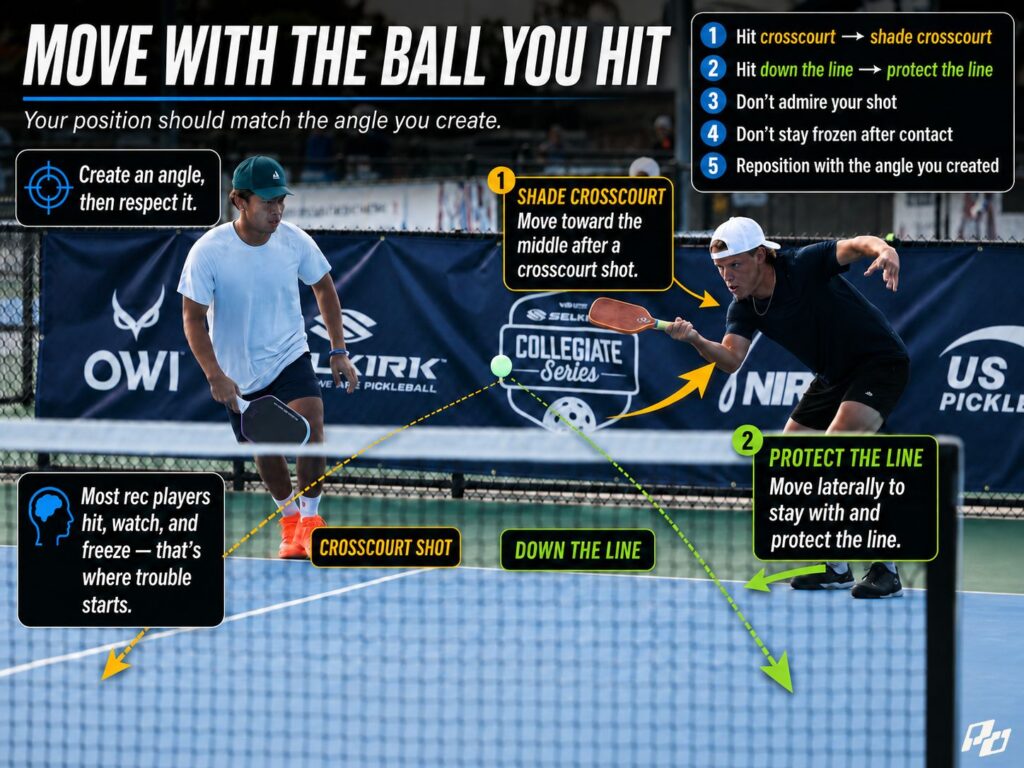
This is why doubles is often called a game of angles. The ball’s location affects the next available shot, and the team that adjusts first usually looks “faster” even if they are not more athletic.
The big rec-player mistake is treating your shot and your movement like separate events.
They are connected.
A better cue: Hit it there, move there.
The Crosscourt Example
Let’s say you are on the right side and you dink crosscourt.
If the ball pulls your opponent wide, you should usually shade slightly with the ball. Why? Because the likely replies are now coming from that angle: crosscourt back, middle, or a soft ball into the space you just created.
If you stay too centered or too upright, you may be late to the next crosscourt dink. If your partner does not shade middle, the seam can open.
This is not about huge movement. It is about small, smart adjustment.
Think: Ball goes crosscourt. We lean with it.
The Down-the-Line Example
Now imagine you attack down the line. This shot can be useful, but it is dangerous if you do not move with it.
If you hit down the line and stay too far toward the middle, you may expose your sideline. If your partner does not shade middle behind you, the next ball can split you.
The line shot is not finished when the ball leaves your paddle. It is finished when your team covers the reply.
Cue: Hit line, own line. Partner shades middle.
That one idea fixes a lot of rec doubles confusion.
The “Follow the Ball” Rule — But Don’t Overdo It
There is a danger here: some players hear “move with the ball” and start chasing everything.
That is not the point. You are not abandoning your half of the court. You are shifting as a team.
Good movement is usually:
✔️ small
✔️ early
✔️ connected to your partner
✔️ based on the ball you hit
✔️ based on the ball your partner hits
✔️ balanced enough to recover
Bad movement is:
❌ late
❌ panicked
❌ too big
❌ crossing into your partner’s space
❌ opening your line
❌ lunging after balls you cannot actually cover
The better phrase is not “follow the ball blindly.”
It is: Shade with the ball.
That keeps the idea controlled.
2. Be Proactive, Not Reactive
This is where the game starts feeling slower.
⮕ Reactive players wait until the opponent hits the ball, then scramble.
⮕ Proactive players read what is likely to happen before the opponent hits.
That does not mean guessing wildly. It means using clues.
Your shot gives clues.
Your partner’s shot gives clues.
The opponent’s body gives clues.
Court position gives clues.
Contact height gives clues.
Paddle face gives clues.
The better you get at reading those clues, the less you feel like you are constantly reacting late.
Most Rec Players Only Watch Their Own Shot
This is a huge issue.
A player hits a decent third shot, then watches it like a spectator. Meanwhile, their partner is moving, the opponent is setting up, and the next ball is already being shaped.
The more advanced habit is to ask immediately: What did my shot just make possible?
If your shot is low, you can move in.
If your shot floats, you should prepare to defend.
If your partner hits a great return, you should move up aggressively.
If your partner leaves a short ball, you should expect pressure.
If your partner is pulled wide, you should shade middle and protect the next ball.
This is what “proactive” really means.
Read Your Partner’s Shot Like It’s Yours
This is the part many rec players miss.
You are not only responsible for your own ball. In doubles, your partner’s shot changes your job too.
If your partner hits crosscourt wide, you may need to shade middle.
If your partner drives from the baseline, you should expect a block or counter.
If your partner hits a high dink, you should get your paddle ready for defense.
If your partner resets beautifully into the kitchen, you can move in together.
If your partner is off balance, you should not assume they are about to hit a perfect shot.
This is why good teams look connected. They are not just two people hitting individual shots. They are reading each other’s ball quality.
A strong cue: Read theirs like yours.
The Three-Ball Prediction Habit
Here is a simple way to train this. After every shot, quickly ask:
- Was that ball good, neutral, or attackable?
- Where is the most likely reply?
- What is my job now?
That sounds like a lot, but it gets faster with practice.
⮕ Example: Your partner hits a deep return.
Good ball.
Likely third shot is a drop or drive from deep.
Your job: get to the kitchen and get ready.
⮕ Example: You hit a short return.
Bad ball.
Likely third shot is a drive or aggressive drop.
Your job: get set, paddle ready, do not overcrash.
⮕ Example: You dink crosscourt and pull the opponent wide.
Good pressure ball.
Likely reply is crosscourt back, middle, or pop-up.
Your job: hold your line/angle while partner shades middle.
This is the kind of thinking that makes you look “quicker” without moving faster.
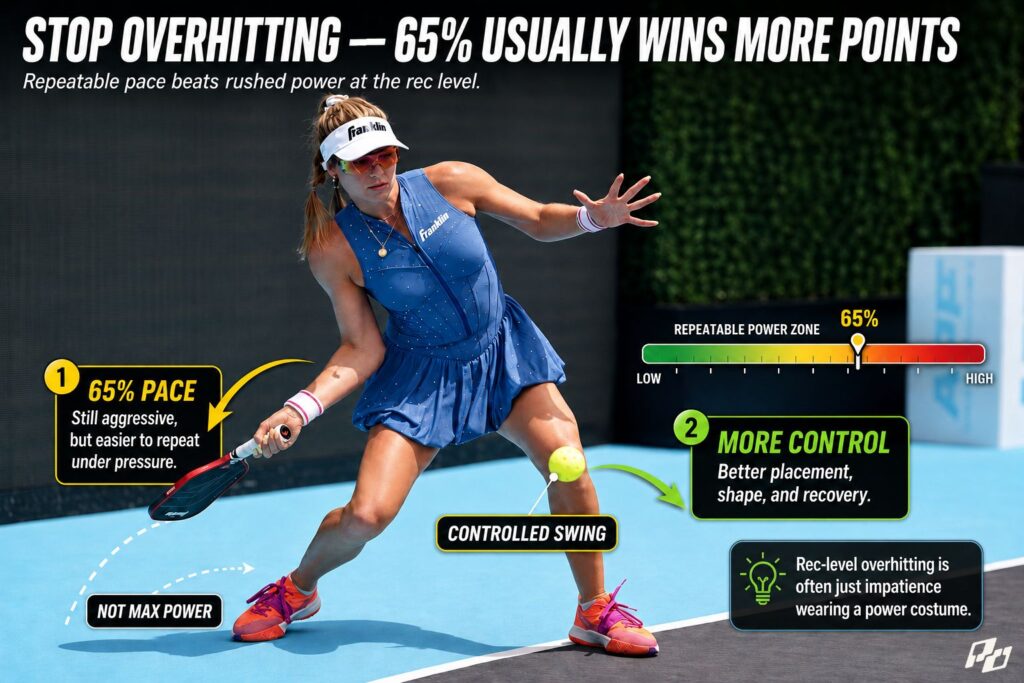
3. Stop Overhitting — 65% Usually Wins More Points
This one hurts because overhitting feels productive. But at the rec level, overhitting is often just impatience wearing a power costume.
The goal is not to baby the ball. The goal is to swing at a speed you can actually repeat under pressure.
For many 3.0–3.75 players, that is around 60–70% effort, especially on drives, speedups, returns, and transition shots.
Why 65% Works
At 100%, your contact window gets smaller.
Your timing has to be perfect.
Your paddle face has to be perfect.
Your balance has to be perfect.
Your recovery is usually worse.
Your partner has less time to react.
Your misses get bigger.
At 65%, you can still create pressure, but you keep more control over placement, shape, and recovery.
That matters because pickleball is not only about ball speed. It is about whether your shot creates a better next ball.
- A 65% drive at someone’s feet is usually more useful than a 95% drive shoulder-high into their paddle.
- A 65% speedup into the hip is usually better than a full rip that sails long.
- A 65% return deep middle is usually better than a huge return that misses by a foot.
In other words: Placement makes power matter.
The Science Supports the Control Point
Even on technical shots like the third shot drop, research modeling pickleball ball flight shows that successful execution depends on narrow ranges of launch speed and angle.
In plain English: small changes in speed and trajectory can decide whether a ball lands safely or becomes attackable. That supports what good coaches constantly tell rec players — control the shape first, then add pace.
For rec players, that means you should stop asking only, “Can I hit this hard?”
Ask: Can I hit this hard and still hit the spot?
If not, take something off.
The 65% Test
Try this in your next game. For one full game, do not hit any drive, return, or speedup above 70%.
Your goals:
✅ hit deeper returns
✅ miss fewer serves
✅ keep drives below chest height
✅ attack bigger targets
✅ recover after contact
✅ make opponents hit one more ball
You may be surprised by what happens. You will probably feel like you are doing less.
But your opponents may feel more pressure because the ball is landing in better places.
That is the funny thing about control: from your side it feels calmer, but from their side it often feels more annoying.
How These Three Habits Work Together
These are not separate tips. They stack.
- If you move with the ball, you are in better position.
- If you are in better position, you can read earlier.
- If you read earlier, you do not feel rushed.
- If you do not feel rushed, you do not overhit.
- If you stop overhitting, your shots become more intentional.
- If your shots are more intentional, your movement becomes easier again.
That is how a rec player starts looking more advanced.
Not because they suddenly hit a crazy shot. Because the game gets less random.
The Rec Player Pattern Upgrade
Here is what this looks like in real doubles.
Old version
❌ You hit crosscourt.
❌ You stay still.
❌ Opponent redirects middle.
❌ You are late.
❌ You swing hard.
❌ Ball flies long.
❌ You blame the shot.
Better version
✅ You hit crosscourt.
✅ You shade crosscourt.
✅ Partner shades middle.
✅ You see the middle ball earlier.
✅ You hit at 65% to a big target.
✅ Opponent has to hit one more.
✅ Now you are controlling the rally.
Same player. Same paddle. Better chain.
The Simple Match Cue
Use this between points: Move with it. Read early. Swing smooth.
That covers all three habits.
- Move with the ball you hit.
- Read your shot and your partner’s shot.
- Swing at a speed that lets you place the ball.
It is short enough to remember at 9-9, which is what makes it useful.
Common Mistakes When Trying This
1. Moving too much after every shot
Problem: You over-shift and expose space.
Fix: Make small adjustments with the ball instead of chasing it.
Cue: Shade, don’t chase.
2. Watching instead of reading
Problem: You admire your shot and react late.
Fix: Read ball quality and opponent setup right after contact.
Cue: Hit, then read.
3. Assuming your partner’s shot is fine
Problem: You move forward before knowing if their ball is actually good.
Fix: Read their contact, height, balance, and target.
Cue: Their ball changes my job.
4. Confusing 65% with playing soft
Problem: You take off too much pace and become passive.
Fix: Keep intent, target, and depth — just reduce max effort.
Cue: Controlled, not casual.
5. Hitting harder when late
Problem: You try to rescue bad spacing with paddle speed.
Fix: Choose margin when late; add pressure when balanced.
Cue: Late means larger target.
A 15-Minute Drill to Train All Three
You can do this with one partner.
Part 1: Direction + Movement
Hit one ball crosscourt and both players shift slightly with the ball. Hit one ball down the line and recover toward that line. Keep the ball controlled. The goal is not winners. The goal is feeling how direction changes position.
Time: 5 minutes.
Part 2: Partner Read
One player hits either a good ball, neutral ball, or slightly attackable ball. The other partner must call: “in,” “hold,” or “defend” based on ball quality.
Time: 5 minutes.
Part 3: 65% Rally Game
Play points where no one can swing above 70%. You can still win the point, but only through depth, placement, angle, and patience.
Time: 5 minutes.
This drill feels simple, but it trains the exact skills most rec players skip.
Best Use by Level
| Level | Main Problem | Best Focus |
|---|---|---|
| 3.0 | Hitting and staying still | Move after your shot |
| 3.25 | Reacting late | Read your shot quality sooner |
| 3.5 | Partner disconnect | Read your partner’s ball too |
| 3.75–4.0 | Overhitting under pressure | Use 65–70% pace with better targets |
Play Like You Know What Happens Next
Most rec players are not trying to make bad choices. They are just playing one shot at a time. But better doubles is not one shot at a time.
It is a chain.
⮕ Where you hit changes where you move.
⮕ Where your partner hits changes what you cover.
⮕ How hard you swing changes whether you can recover.
⮕ How early you read changes whether you feel rushed.
That is why these three habits are so powerful. They make you look smarter before you look flashier.
So next time you play, keep it simple:
- Move with your shot.
- Read both paddles.
- Swing smooth enough to place the ball.
That is not boring pickleball. That is the kind of pickleball that quietly wins more games.