
Most recreational players don’t realize how much court dynamics change depending on the time of day you play. The quality of games at your local courts often has less to do with the facility itself and more to do with who tends to play at certain times.
If you play at public parks, municipal courts, YMCA courts, or community open play sessions, the timing of your session can dramatically change:
- the average skill level
- the length of rallies
- the number of players waiting
- the quality of partners you get
So if your goal is simply getting exercise and meeting people, almost any time works. But if you want good competitive rec games with long rallies and thoughtful strategy, some time slots are clearly better than others.
And some are… let’s just say less ideal.
The Worst Time to Play Pickleball: Peak Evening Open Play
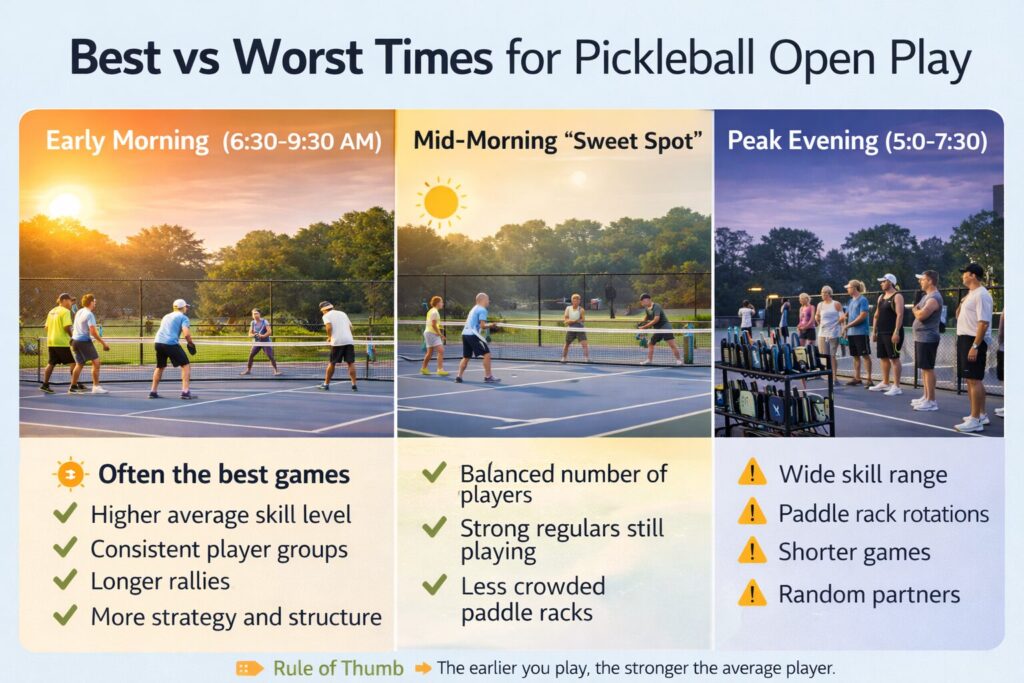
For most public courts and community facilities, the most chaotic time to play pickleball is early evening, roughly: 5:00 PM – 7:30 PM
Now before anyone gets upset, let’s be clear: this is often the most popular time to play. But popularity and game quality are not the same thing.
Why Evenings Get Chaotic
Evening sessions are when the largest and most diverse group of players arrives at the courts.
Think about who is available at that time:
- people coming straight from work
- beginners trying pickleball for the first time
- casual players who play once a week
- experienced players squeezing in a session
- families or younger players rotating in
In other words, the skill distribution becomes extremely wide.
At a typical public park during evening open play, a single game might include:
- one strong 4.0 player
- one improving 3.5 player
- one 2.5 beginner
- someone who bought a paddle two days ago
That combination doesn’t produce great rallies. It produces short points and awkward rhythm.
That’s not necessarily anyone’s fault—it’s just what happens when skill levels vary dramatically within the same game.
The Paddle Stack Problem
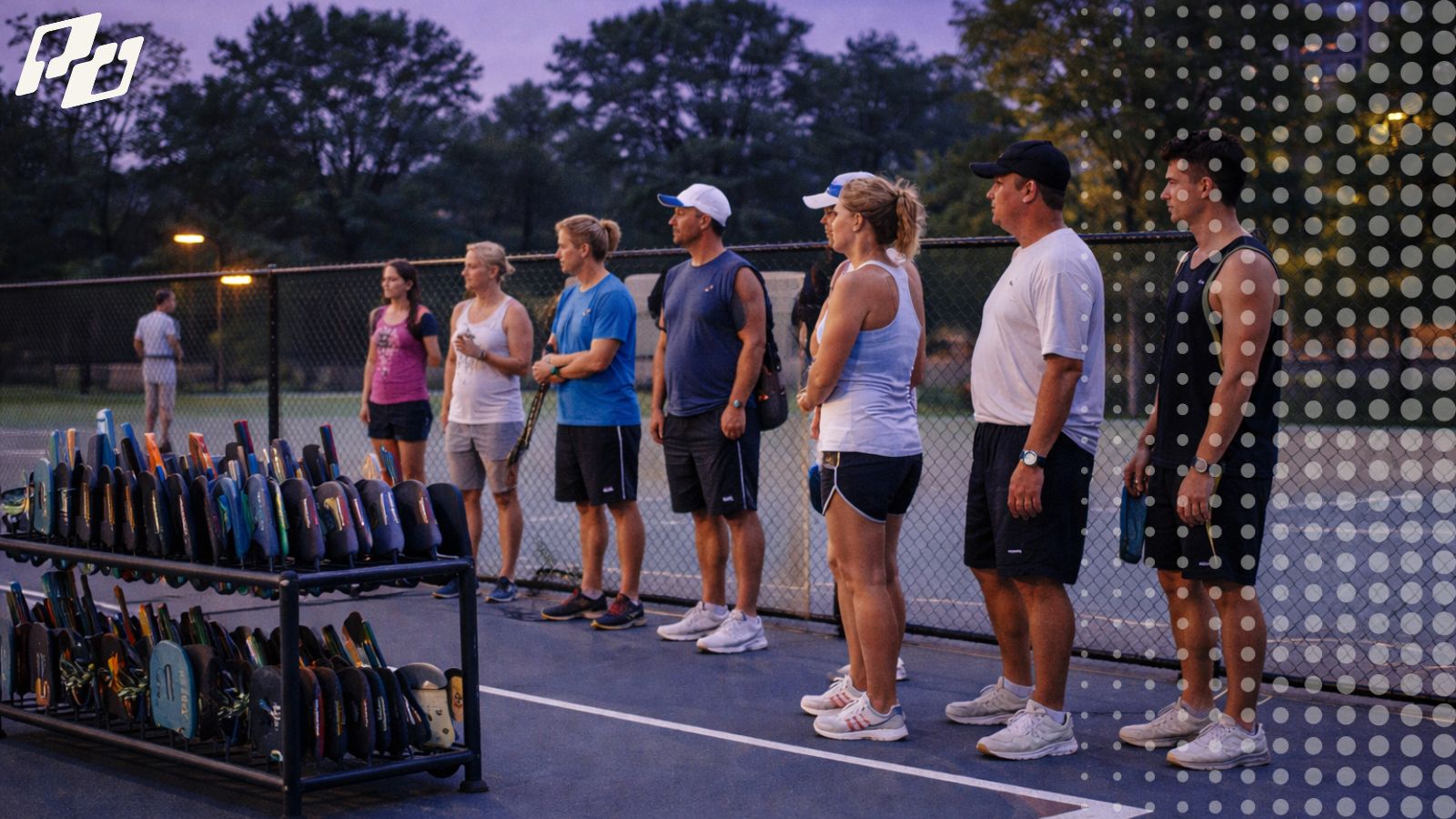
The second challenge with evening play is something every public court knows well: the paddle rack.
Many parks manage open play using paddle stacks or paddle racks to rotate players. When courts are full, rotations happen quickly. But that creates a subtle problem.
Instead of settling into a rhythm with players of similar level, you often experience:
- random partners every game
- rushed warmups
- quick matches because people are waiting
- little time to adjust strategy
When ten or twelve paddles are waiting in the rack, players naturally feel pressure to keep games moving.
That leads to shorter games and faster rotations, which reduces the overall quality of play.
You’re essentially playing a series of short, disconnected games, rather than building tactical momentum.
Decision Fatigue and Social Play
There’s another factor that rarely gets discussed: the social mindset of evening play.
Many players show up in the evening primarily to relax after work. That often changes the tone of the games.
You’ll often see more experimentation with shots, less structured strategy, and plenty of chatting between rallies as people catch up with friends.
And again—there’s nothing wrong with that. Pickleball is one of the most social sports in the world.
But if your goal is high-quality doubles strategy, evenings are often less structured. Think of evening pickleball as happy hour pickleball.
Fun, social, energetic… but not always the place where the best tactical games happen.
When the Best Players Actually Show Up
So if evening open play is chaotic, when do the stronger recreational players usually appear? Across thousands of courts, a consistent pattern emerges: early mornings.
Specifically: 6:30 AM – 9:30 AM
This is where many communities see the highest concentration of serious recreational players.
And there are several logical reasons for that.
Why Morning Pickleball Is Often Stronger
1. The “Serious Player Filter”
Morning sessions require commitment. Showing up at 7 AM isn’t casual.
Players who regularly arrive early tend to be people who:
- schedule their day around pickleball
- care about improvement
- play multiple times per week
In other words, morning sessions naturally filter out casual players and concentrate dedicated players.
It’s not uncommon to find the best rec players in a community quietly dominating the courts before breakfast.
2. Retired Competitive Players
Another major factor is retired players. Many retirees play during weekday mornings because they simply have the schedule flexibility.
And here’s the interesting part: many of them have strong racket-sport backgrounds.
Even though many of these players are in their 60s or 70s, they often bring excellent shot control, years of competitive experience, and strong tactical instincts to the court.
You’ll sometimes find that the toughest games at a park are happening at 8 AM with a group of players who have been showing up together for years.
3. Stable Groups Form
Morning sessions also tend to develop consistent groups of players. Unlike evening sessions where players rotate randomly, mornings often attract the same core group multiple days a week.
That creates several advantages. Players start to understand each other’s tendencies, partner positioning, attack patterns, and defensive habits. Over time, the games become more tactical.
Instead of chaotic points, you begin to see longer dink exchanges, more structured speed-ups, and coordinated doubles movement.
In other words, real pickleball strategy starts to appear.
The Mid-Morning “Gold Zone”
There’s another time window that often produces surprisingly good games: 9:30 AM – 11:30 AM
This period sits right between two major groups. The early grinders are still playing. But the casual afternoon crowd hasn’t arrived yet.
At many public courts, this creates a sweet spot of player density.
There are enough players for good rotations—but not so many that paddle racks overflow. Games during this period often feel more relaxed and strategic.
For many players, this becomes the hidden gem time slot.
The Weekend Wildcard
Weekends create a completely different dynamic. Saturday and Sunday mornings—especially between: 7:30 AM – 10:30 AM
often attract the highest overall skill concentration of the week.
Why?
Players who can’t attend weekday mornings finally show up.
The downside?
These sessions can also become extremely crowded. So while the average skill level rises, the paddle stack may get longer.
Still, if you want to test yourself against strong rec players, weekend mornings are often the best place to find them.
How the Day of the Week Changes the Games
The day of the week can also influence the quality of games at open play. Player turnout, skill mix, and overall competitiveness tend to follow predictable weekly patterns, especially at public parks and community courts.
| Day | What You’ll Usually See |
|---|---|
| Monday | Slower start to the week. Courts are often quieter, and games can feel a bit rusty as players shake off the weekend. |
| Tuesday–Wednesday | Often the best and most consistent games of the week. Regular players are back on schedule and strong groups begin forming. |
| Thursday | The atmosphere sometimes becomes more social as players ease toward the weekend. |
| Friday | Typically lighter and more relaxed. Some players travel or skip sessions, thinning out the strongest groups. |
| Weekend | The largest crowds arrive. Weekend mornings often bring strong competition, while afternoons tend to attract more beginners and casual players. |
Quick takeaway: If you’re looking for the most reliable competitive games, midweek sessions—especially Tuesday and Wednesday mornings—often provide the best balance of strong players, manageable crowds, and consistent rotations.
A Simple Rule of Thumb
If your goal is better games, a simple pattern often holds true: the earlier the session, the stronger the average player.
This isn’t universal, but it’s surprisingly consistent. The reason is simple.
Players who are most passionate about improving their game often structure their schedule around pickleball.
That means they show up when courts open, not just when it’s convenient.