
Not long ago, buying a pickleball paddle was pretty simple.
You picked something that felt good in your hand, maybe asked a friend what they were using, or copied a pro you liked—and headed to the courts.
Today? It’s completely different.
If you’ve looked at paddles recently, you’ve probably seen a flood of technical terms: raw carbon fiber, thermoforming, foam injection, Kevlar blends, swing weight, twist weight, dwell time, and of course the confusing “Gen” numbers trying to track paddle evolution. (Gen 5? Maybe? Honestly, there’s no real industry standard.)
If you would rather skip the theory, the paddle quiz turns your answers into three lab-scored picks in about 90 seconds.
At some point you start wondering if you’re shopping for a paddle or reading specs for a space satellite.
Trust me—I get it. As a paddle reviewer, even I sometimes feel overwhelmed by the endless specs, measurements, and marketing jargon brands throw at us.
And you’re not alone. Paddle technology has advanced incredibly fast, which is great for performance—but it also means more information than ever to sort through.
So with hundreds of paddles on the market, how do you actually compare them and make a smart choice?
That’s exactly the problem that led to the creation of Paddle Lab, a new testing platform from the team at JustPaddles.
We were curious too—so we took a deep dive for you.
Ten questions, three paddles matched to how you play, scored on lab data.
So What Exactly Is Paddle Lab?
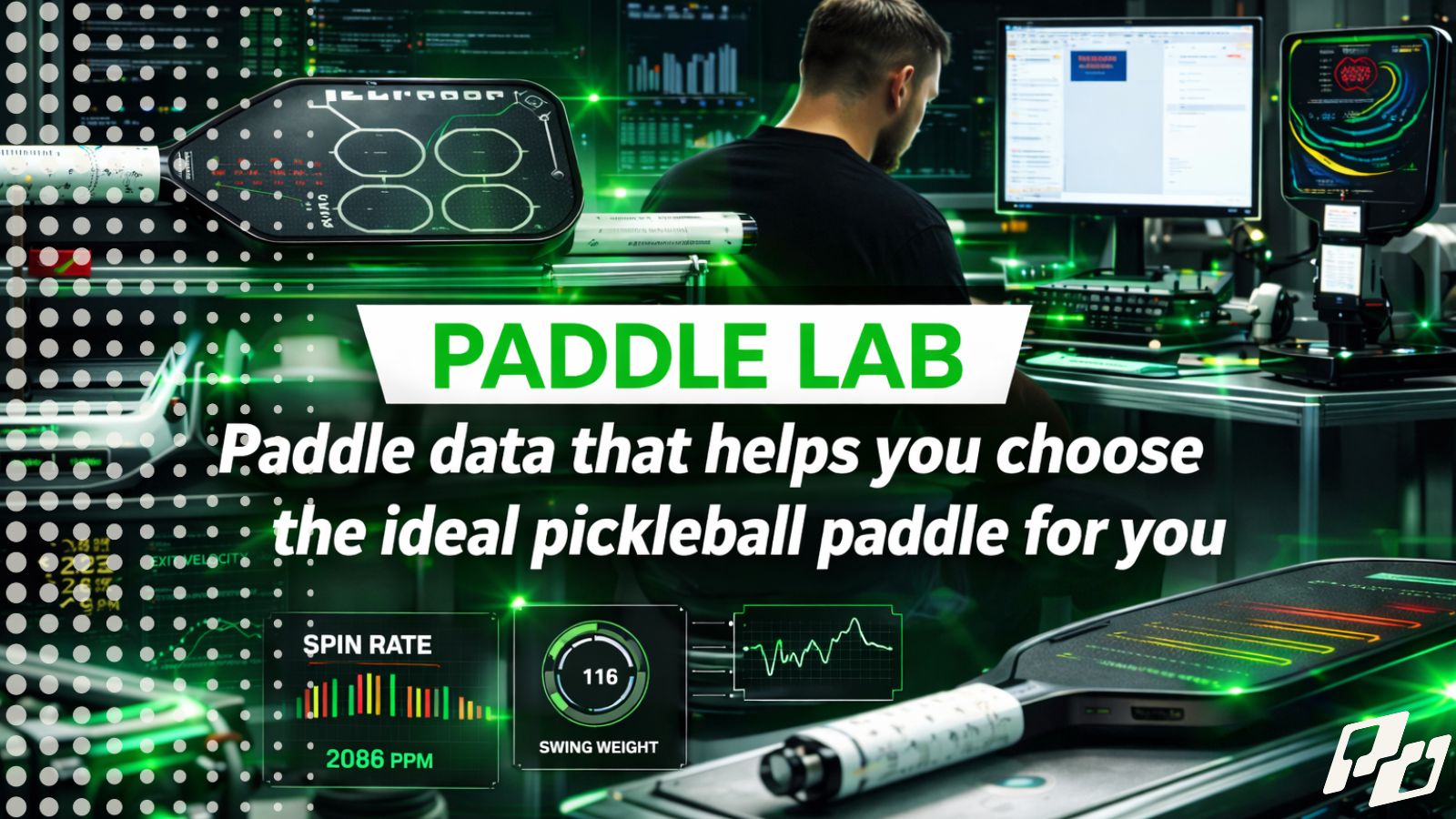
At its core, Paddle Lab is a paddle testing system designed to evaluate pickleball paddles using measurable performance data.
Instead of relying on marketing claims or subjective reviews, Paddle Lab uses specialized testing equipment to measure how paddles actually perform on the court.
One detail I really like: the testing is unbiased. Paddle Lab buys paddles directly from brands, which means manufacturers can’t hand-pick or send in special versions to be tested.
The goal is simple: give players clear, consistent data that explains how paddles perform and why.
This becomes even more useful when paired with the JustPaddles “Paddle Coach” tool, which helps players match paddle characteristics to their playing style. Together, it could be a real game changer for paddle selection.
Because let’s be honest, when there are hundreds of paddles on the market, having standardized information makes comparing them much easier.
Paddle Lab focuses on six key performance categories:
- Exit Velocity (Power)
- Swing Weight
- Spin Rate
- Twist Weight
- Consistency
- Balance Point
Together, these measurements help paint a clearer picture of how a paddle is designed to play, and the team breaks everything down so even non-gear nerds can understand it.
Check out how the JustPaddles team explains Paddle Lab in their own words:
How Paddle Lab Came to Be
As pickleball exploded in popularity, paddle options multiplied just as quickly. Brands introduced new materials, surfaces, and construction methods, giving players more performance options, but also more confusion when trying to compare paddles.
The team at JustPaddles saw this firsthand. As one of the largest online paddle retailers, they constantly hear the same questions from players:
Which paddle has more power?
Does this one actually create more spin?
How forgiving is it compared to another paddle?
Those questions are difficult to answer using product descriptions and marketing claims alone.
So they built a solution.
After more than two years of development, working with research experts and custom testing equipment, they launched Paddle Lab — a system designed to measure paddle performance in a consistent, repeatable way.
And importantly, every paddle they sell gets tested the same way — not just premium models, but all of them.
The goal is simple: replace marketing claims with objective data so players can better understand how paddles actually perform on the court.
What Exactly Does Paddle Lab Measure?
Let’s take a quick look at the key performance factors Paddle Lab tests and why they matter when choosing a paddle.
1. Exit Velocity (Power)
This is simply how fast the ball comes off the paddle. Higher exit velocity means you can generate more pace with less effort on drives, counters, and deep returns.
But more power isn’t always better—many players prefer control and touch, especially around the kitchen.
2. Swing Weight
Swing weight is how heavy the paddle feels when you swing it, which can differ from the actual weight.
- Higher swing weight = more stability and power.
- Lower swing weight = faster hand speed and maneuverability, which many players prefer in fast kitchen exchanges.
3. Spin Rate
Spin measures how well a paddle grips the ball and creates rotation—think topspin drives or slicing returns.
Modern raw carbon fiber and Kevlar blends have made spin one of the most talked-about paddle features.
4. Twist Weight
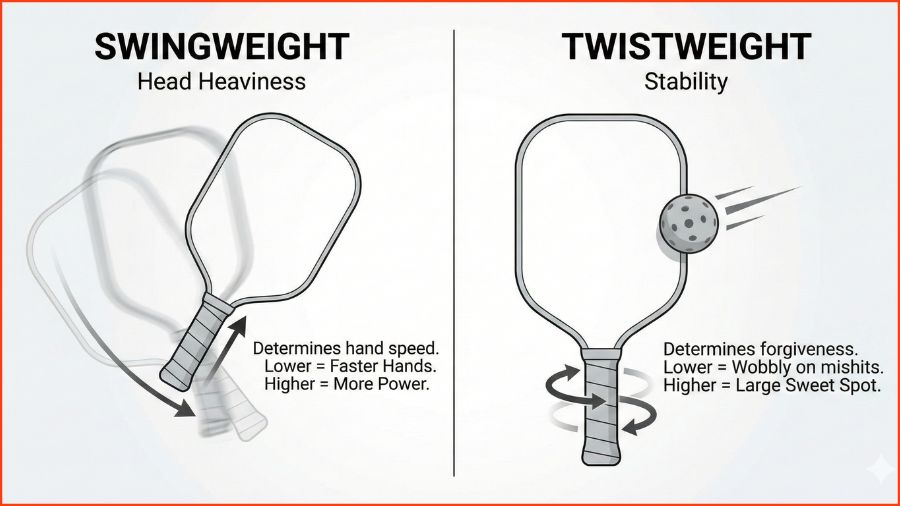
Twist weight tells you how stable the paddle is on off-center hits. A higher twist weight means the paddle resists twisting, helping mis-hits stay more controlled.
5. Consistency
Consistency measures how evenly the paddle performs across the face. Higher consistency means predictable results, even if you don’t hit the perfect sweet spot.
6. Balance Point
This shows where the weight sits in the paddle.
Head-heavy paddles tend to add power, while handle-balanced paddles feel quicker and easier to control.
Simplified Paddle Lab Metrics
| Metric | What It Measures | What It Affects |
|---|---|---|
| Exit Velocity | Ball speed off the paddle | Power and depth |
| Swing Weight | How heavy the paddle feels when swinging | Stability vs hand speed |
| Spin Rate | Ability to generate ball rotation | Topspin, slice, shot control |
| Twist Weight | Stability on off-center hits | Forgiveness and consistency |
| Consistency | Even performance across paddle face | Predictability on contact |
| Balance Point | Where the weight sits in the paddle | Power vs maneuverability |
Together, these metrics help explain how a paddle will actually feel and perform on court, beyond just marketing descriptions.
What Does This Mean for You?
At the end of the day, the best paddle is still the one that feels right in your hand and fits the way you play. No amount of technology or testing will ever replace that.
But having clear, objective performance data can make the search a lot easier.
Tools like Paddle Lab help players compare paddles using real measurements instead of just marketing claims. Pair that with the JustPaddles “Paddle Coach” quiz, and you can quickly narrow down paddle options that match your skill level and playing style. Our best paddles for intermediate players guide is built on this same lab data.
When you browse paddles on the JustPaddles site, you’ll also see Paddle Lab testing data directly on each paddle page, making it easier to compare options. And if you still have questions, their team is easy to reach for additional guidance.
Of course, data doesn’t replace on-court testing. But it does provide a helpful layer of insight in a paddle market that’s getting more crowded every year.
Because while paddle technology will continue to evolve, the goal stays the same: Find the paddle that helps you play your best game.
Pickle on, my friends… pickle on.