To hit a better third shot drop, don’t just aim for the kitchen. Shape the ball with a small arc so it peaks on your side, starts falling by the net, and reaches your opponent below knee height. A low, slightly deeper drop is usually safer than a high, short floater.
Collin Johns recently shared a third shot drop concept that rec players should take seriously: the drop is not successful just because it lands in the kitchen. The real goal is to make the ball arrive below net height, preferably around the opponent’s lower legs, so they cannot step in and attack it cleanly.
That distinction matters because a lot of recreational players judge their third shot drops by the wrong scoreboard.
They hit one that lands softly in the kitchen and think, Great drop.
Then the opponent steps forward, lets it bounce, attacks it at shoulder height, and suddenly the serving team is scrambling.
The better question is not, “Did it land in the kitchen?”
The better question is: Was the opponent forced to hit up?
That is the entire point of the third shot drop. You are not trying to win the rally with the third ball. You are trying to neutralize the return team’s early advantage, buy yourself time to move forward, and start the point on more even terms.
And because the pickleball net is only 34 inches high in the center and 36 inches at the sidelines, your drop does not need to be dramatic. It needs to be boringly disciplined: high enough to clear the net, low enough that it is already descending, and paced well enough that your opponent’s contact point stays below their best attacking zone.
Let’s break that down in a way that actually helps you on the court.
The mistake most rec players make: they confuse “soft” with “good”
Here is the classic 3.0–3.75 third shot drop problem:
You try to take pace off the ball.
You loosen your grip.
You lift it gently.
It clears the net.
It lands in or near the kitchen.
And then it gets crushed.
That happens because the ball had too much vertical float and not enough forward shape.
A drop that floats high and short gives your opponent time to move forward, set their feet, let the ball bounce up, and attack from above net height. From their perspective, that is not a defensive ball. That is a warm-up ball.
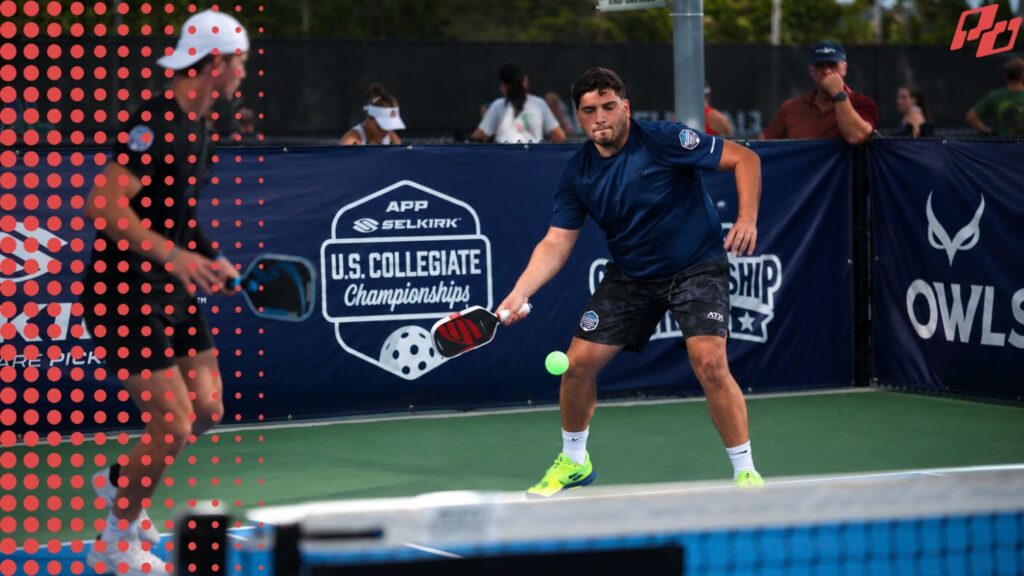
A better drop has a different personality. It still has arc, but it is moving forward. It crosses the net while already descending. It does not climb after the bounce into your opponent’s strike zone. It asks them to hit from low, uncomfortable contact — around the shins, ankles, or below the knees — instead of from the waist, chest, or shoulder.
That is why “low and a little deeper” is often safer than “soft and short.”
For rec players, this is a huge mindset shift. You do not need a perfect feathered drop that barely clears the tape and dies two feet into the kitchen. That shot is beautiful when it works, but it is also easy to over-lift, under-hit, or leave attackable.
A lower, more forward-moving drop that lands deeper in the kitchen or even near the kitchen line can be much more useful if it keeps the opponent’s paddle under the net.
The real target is not the kitchen. It is the opponent’s contact point.
Most players aim at a spot on the court. Better players aim at the quality of the next ball.
That means your third shot drop should be judged by what it forces your opponent to do:
- Do they have to bend?
- Do they have to hit up?
- Do they have to take pace off?
- Do they have to dink instead of attack?
- Do they contact the ball below the top of the net?
That is the heart of the shot.
A ball landing in the kitchen is useful only because it usually forces the opponent to let it bounce and hit from below net height. But if your drop lands in the kitchen and pops up high enough to be attacked, the location did not matter. You technically hit the area, but you missed the purpose.
Think of your target as a vertical window, not just a horizontal landing zone.
You are trying to send the ball through a flight path where:
- The peak happens on your side of the court or near the net.
- The ball is already falling as it crosses the net.
- The bounce does not rise into the opponent’s attack zone.
- The opponent’s best realistic contact point is below net height.
That last part is the money.
At the kitchen, anything above net height is dangerous because the opponent can hit down or forward. Anything below net height forces them to lift. And once they lift, you and your partner can keep moving forward instead of getting pinned at the baseline.
The ideal third shot drop shape: a “falling arc,” not a moonball
A good third shot drop is not flat, but it is also not a lob.
For most rec players, the best image is a soft arc with forward momentum. The ball should rise gently, peak before it reaches your opponent, then descend by the time it crosses the net.
If the ball is still rising as it crosses the net, you are in trouble. That usually means it will keep climbing after the bounce, giving the opponent a green-light attack.
If the ball is falling as it crosses the net, now your opponent has a problem. They may still attack if they are skilled, but they have to attack a lower ball, often while moving or reaching down. That is a much lower-percentage attack.
A useful rec-player cue: “Peak on my side, fall on their side.”
This cue keeps you from thinking only about landing the ball short. You want the high point of the shot to happen early enough that gravity is already helping you by the time the ball reaches the net.
Another good cue: “Over the net, under their paddle.”
That reminds you that net clearance is only half the job. The ball has to clear the net, but it also has to stay under the opponent’s comfortable swing path.
The “below net height” test
Here is the simplest way to evaluate your third shot drop during rec play:
Could my opponent hit down on it?
If yes, the drop was probably too high, too slow, or too short.
Did my opponent have to lift the ball?
If yes, the drop did its job, even if it was not perfect.
This matters because the kitchen is seven feet deep on each side of the net, which gives you more room than many players realize. You do not need to land every drop inches over the net. You can use that seven-foot space intelligently. A drop that lands deeper in the kitchen but stays low can be better than a drop that lands short and bounces up.
That is the part many rec players miss: depth is not automatically bad. Height is the real danger.
A deeper drop that stays below net height often produces a dink or reset.
A shorter drop that sits up often produces a speed-up, roll, or put-away.
The technical keys to keeping your third shot drop low
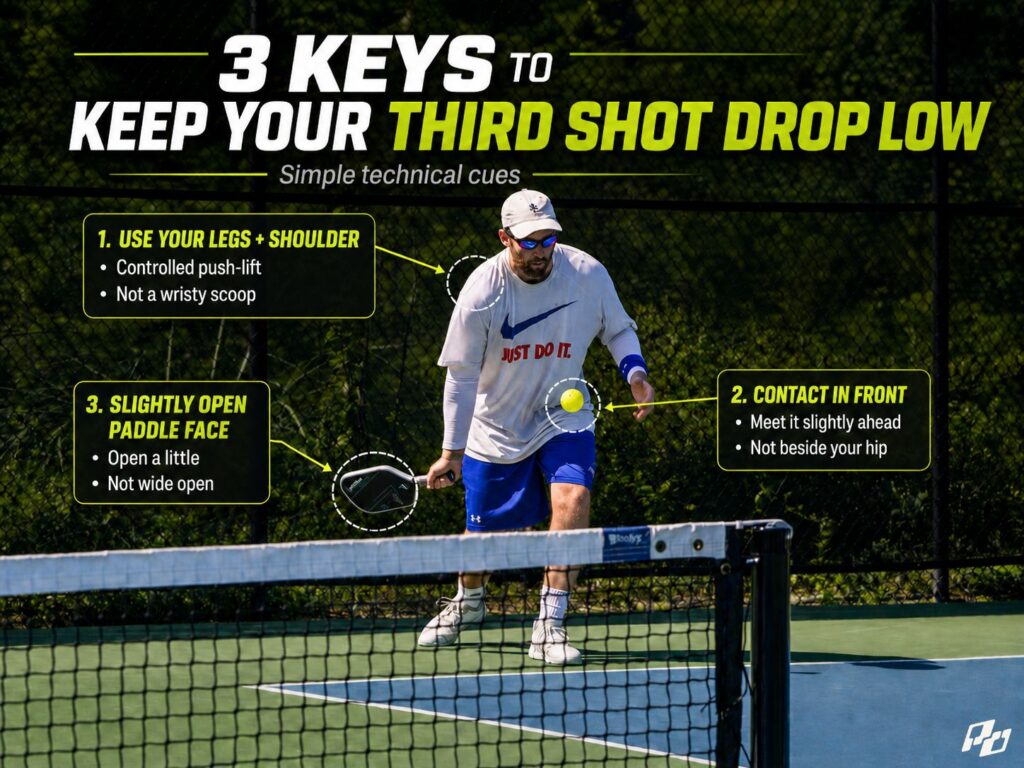
1. Use your legs and shoulder — not a wristy scoop
Most floating third shot drops come from the same mechanical error: the player panics and scoops with the wrist.
The paddle face opens too much.
The hand flips upward.
The ball climbs.
The opponent smiles.
Instead, think of the shot as a controlled push-lift from your body.
Your legs provide the lift.
Your shoulder guides the paddle.
Your wrist stays quiet.
Your paddle face stays stable through contact.
You do not want a jab. You do not want a flick. You want a smooth, compact motion where the paddle travels through the back of the ball and slightly upward, with the finish moving toward your target rather than straight up into the sky.
A good cue: “Lift with the legs, guide with the paddle.”
If your wrist is doing the work, the ball becomes unpredictable. If your legs and shoulder do the work, the shot becomes repeatable.
2. Contact the ball in front, not beside your hip
You cannot control height well if the ball gets too far behind you.
When contact drifts back beside your body, you have to compensate. Usually that means opening the paddle face and scooping upward. That creates the soft, floaty drop that looks nice for half a second and then gets attacked.
Try to contact the ball:
- slightly in front of your lead foot
- with your paddle face stable
- with your body moving calmly through the shot
This gives you room to send the ball forward, not just upward.
The best feeling is not “lifting the ball over the net.”
It is “carrying the ball forward with a small arc.”
3. Keep your paddle face slightly open — not wide open
Yes, the paddle face needs to be open enough to create lift. But many rec players overdo it.
A wide-open paddle face sends the ball up. A slightly open paddle face sends the ball forward with controlled arc.
Imagine the difference between tossing a ball gently to someone and flipping a pancake. The third shot drop should feel closer to a controlled toss. The paddle is open, but not so open that the ball shoots vertically off the face.
A helpful cue: “Show the sky a little, not the ceiling.”
That keeps the paddle from turning into a launch ramp.
4. Swing toward the opponent’s feet, not toward the kitchen line
This is subtle but important.
If you aim only at the kitchen line, your brain tends to calculate distance. That often produces a short, careful, decelerated stroke. Deceleration is poison for touch shots because the paddle face changes, the wrist gets involved, and the ball floats.
Instead, aim through the ball toward the opponent’s lower legs. That encourages a more confident forward swing.
You are not trying to blast the ball at their feet. You are giving the drop a destination that creates the right shape.
A good cue: “Send it to their shoelaces.”
For beginners and lower-intermediate players, “kneecaps or lower” is a practical target. You are not trying to paint a perfect spot. You are trying to avoid giving them anything above the net.
5. Let the ball descend before you hit when possible
This is one of the most underused third-shot skills at the rec level.
If you rush and hit the return at its highest bounce, you often have to control a ball with more energy. If you let it drop slightly into a comfortable strike zone, you can lift it more smoothly and shape the arc better.
That does not mean waiting forever or letting the ball jam you. It means resisting the urge to slap at the ball immediately after the bounce.
A good cue: “Wait, then carry.”
Let the ball settle. Get your feet behind it. Then carry it forward.
This is especially helpful against deep returns. If the return pushes you back, do not panic and try to drop from a stretched position. Create space, get balanced, and accept that your third shot may simply be a neutralizing drop, not a perfect one.
The flight-path checkpoint: where should the peak happen?
This is the part of Collin Johns’ concept that rec players should turn into a visual.
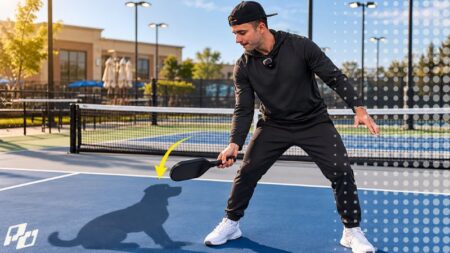
On a quality drop, the ball’s highest point should usually happen before it reaches the opponent’s side. Often, it happens on your side of the court, then the ball begins descending toward the net.
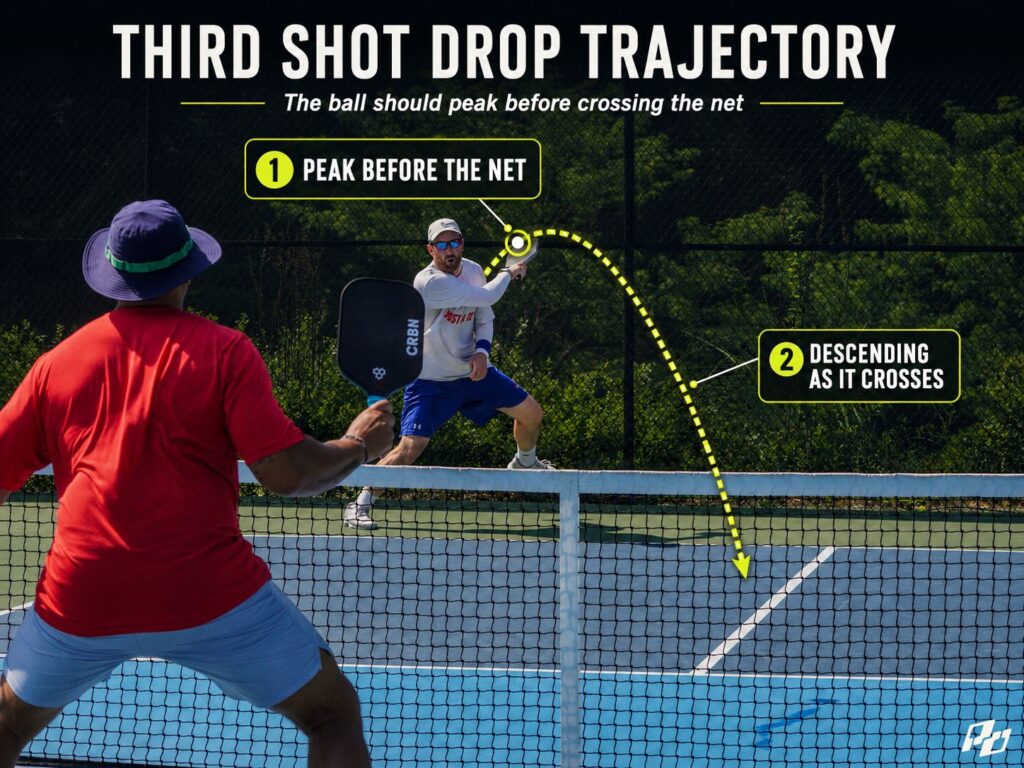
That does not mean every drop must peak in the exact same place. Your position changes the shape:
⮕ If you are near the baseline, you need a slightly longer arc because the ball has farther to travel.
⮕ If you are inside the court, you can use a lower, shorter arc because you are closer to the net.
If you are stretched wide, you may need more margin and should prioritize keeping the ball unattackable rather than perfect placement.
If the return is hard and deep, you may need to absorb pace and send a calmer ball.
But the general checkpoint remains: By the time the ball reaches the net, it should be starting to fall.
A practical way to self-diagnose:
- If your drops hit the net often, your arc may be too low or your contact too tense.
- If your drops land in the kitchen but get attacked, your arc is probably peaking too late.
- If your drops go long, you may be adding too much forward pace or contacting too low with a closed face.
- If your drops float short, you may be opening the face too much and not swinging through the ball.
Why the “perfect kitchen drop” is overrated in rec play
The perfect third shot drop — barely over the net, landing softly in the front half of the kitchen — is wonderful. But it is not the version most rec players should chase first.
The problem is that perfection has a tiny margin.
Too low? Net.
Too soft? Short sitter.
Too high? Attackable.
Too careful? You decelerate and pop it up.
For rec players, the smarter developmental goal is: Build a drop that cannot be easily attacked. Then refine location later.
This is why “low and deeper” is such a powerful training priority. It gives you more room over the net, more forward momentum, and a better chance of forcing low contact. You can still land in the kitchen. You are just not obsessing over making the ball die immediately.
Your first benchmark should be simple: Can you make the opponent hit up?
Once you can do that regularly, then you can start sharpening placement: crosscourt, middle, backhand foot, outside foot, short angle, and so on.
Pace: the missing ingredient in most third shot drops
A lot of players think the third shot drop should be as soft as possible.
Not quite.
It should be soft enough to make the opponent hit up, but firm enough to travel on a controlled, descending path.
If the ball has no forward momentum, it tends to float. A floating ball gives the opponent time. Time is dangerous.
A slightly firmer drop often works better because it does not sit in the air as long. It gets to the opponent lower and sooner. It is less likely to bounce up into their strike zone.
Think of it this way:
- Too soft and high = attackable.
- Too hard and flat = long or drive-like.
- Soft with forward shape = useful drop.
- Moderate pace with downward arc = often ideal for rec play.
The cue: “Not a lob. Not a drive. A guided landing.”
You want the ball to travel, not hang.
Spin: helpful, but not the main ingredient
Spin can improve your third shot drop, but it should not be the first thing you chase.
Topspin can help the ball dip, which is why advanced players often use a rolling drop. Backspin can help the ball skid or stay lower after the bounce, but it can also float if overdone. Sidespin can create awkward contact, but it is harder to control.
For most rec players, the order should be:
- Balance
- Contact point
- Paddle-face control
- Arc
- Depth
- Spin
Not the other way around.
If you are still popping the ball up, adding spin will not save you. In fact, it may make things worse because you will start brushing, cutting, or flicking at the ball instead of controlling its flight.
A little topspin is useful once you can already drop consistently. The feeling is a gentle roll through the back of the ball, not a big windshield-wiper swing. You are trying to help the ball dip, not hit a tennis forehand.
For rec players, a simple version is best: Brush slightly, but finish forward.
If your finish goes dramatically upward, the ball will probably float. If your finish goes forward with a small upward shape, the ball is more likely to travel and descend.
Footwork: your drop is only as good as your base
A third shot drop is not just a hand-skill shot. It is a footwork shot. When rec players miss drops, the paddle often gets blamed. But the real issue is usually the body:
- reaching instead of moving
- falling backward
- hitting while still running
- contacting too close to the body
- trying to move forward before finishing the shot
The drop gets much easier when you treat it like a sequence.
First, get behind the ball.
Second, set a balanced base.
Third, hit the drop.
Fourth, move forward based on the quality of the shot.
That last part matters. Do not sprint in automatically just because you hit a third shot drop. Move in behind good drops. Pause or prepare to defend behind bad ones.
A good movement rule: Hit, read, then move.
If your drop is low and falling, advance.
If your drop floats, stop and prepare to defend.
If your drop is short and attackable, stay balanced and expect speed.
If your drop forces a dink, keep closing.
This is one of the biggest differences between players who transition well and players who get crushed in the midcourt. The shot does not carry you to the kitchen by itself. Your read does.
The “transition zone” reality: one drop may not get you all the way in
At the recreational level, players often think the third shot drop has failed if they do not immediately reach the kitchen.
That is not true.
Sometimes the third shot drop only gets you halfway. Then you need a fifth shot reset. Then maybe a seventh shot reset. That is normal.
Modern pickleball has also seen more third shot drives and hybrid patterns, especially as players and equipment have become more powerful. But the drop remains essential because it gives the serving team a way to neutralize the return team’s kitchen advantage instead of simply blasting into two waiting paddles.
For rec players, the practical lesson is not “always drop” or “always drive.” It is this:
Use the shot that helps you get to neutral.
If the return is short, step in and drop.
If the return is deep and high, you may drive or hybrid-drop.
If the return pulls you wide, choose margin over perfection.
If your opponent struggles with low balls, keep dropping to the feet.
If your opponent attacks every floating drop, lower your arc and add forward momentum.
The third shot drop is not a magic trick. It is one tool in the transition game.
Common rec-player errors and the real fix
Error 1: The drop lands in the kitchen but gets attacked
This is the big one.
The issue is usually not location. It is height. Your ball is probably peaking too late, floating too long, or bouncing too high.
Fix it by aiming deeper and lower. Think “knees and below,” not “front kitchen.” Add a little forward momentum so the ball does not hang.
Cue: “Make them bend.”
Error 2: The ball keeps hitting the net
This usually means you are trying to be too perfect. You may be aiming for a tiny window over the tape instead of giving the ball a usable arc.
Fix it by adding a little more height, but do not turn it into a moonball. Your peak can be five or six feet high depending on your court position and pace, but it should happen early enough that the ball is falling near the net.
Cue: “Clear, then fall.”
Error 3: The ball floats high and short
This usually comes from a wrist scoop or a paddle face that is too open.
Fix it by stabilizing the wrist, contacting in front, and finishing more toward the target. You still need lift, but the lift should come from the body and paddle path, not a last-second flip.
Cue: “Forward, not floaty.”
Error 4: The ball goes long
This usually means you hit too flat, too firm, or too late. Sometimes it also happens because your paddle face closes while you are trying to add topspin.
Fix it by softening the grip pressure, adding a little more arc, and making sure the paddle face is slightly open at contact.
Cue: “Shape it, don’t shove it.”
Error 5: You hit a decent drop but still get attacked
Sometimes the problem is not the drop. It is your movement afterward.
If you rush forward without reading the ball, you may be caught moving when your opponent attacks. If your drop is only decent — not great — you may need to split-step in the transition zone and prepare for a reset.
Cue: “Earn the next step.”
Do not run to the kitchen just because you want to be there. Move forward because your shot gave you permission.
A practical way to train the right trajectory
Here is a simple progression that works well for recreational players.
Stage 1: The net-height challenge
Stand near the baseline or a few feet inside it. Hit drops crosscourt. Your only goal is to make the opponent contact the ball below net height after the bounce.
Do not obsess over whether it lands in the first half of the kitchen. Track whether the opponent can attack.
Score it like this:
- 2 points: opponent must hit up from below the knees.
- 1 point: opponent contacts around knee-to-thigh height.
- 0 points: opponent can attack from waist height or higher.
This teaches the real objective.
Stage 2: The falling-at-the-net checkpoint
Have a partner stand near the kitchen and watch your ball. Ask them one question:
Was the ball rising or falling when it crossed the net?
You will learn quickly. Many drops that feel soft are still rising too late. Once you can make the ball fall by the net, the shot becomes much harder to attack.
Stage 3: The low-and-deep target
Instead of placing cones near the front of the kitchen, place them deeper — around the middle or back half of the kitchen. Try to land the ball near those cones while keeping the bounce low.
This removes the unhealthy obsession with the perfect short drop.
Your goal is not “softest possible.”
Your goal is “low enough to prevent offense.”
The best cues to remember during actual games
When you are in a match, you do not have time to think about ten mechanical details. You need one or two cues.
Use these depending on your mistake pattern:
If you pop the ball up:
“Forward, not up.”
If you hit the net:
“Clear, then fall.”
If you leave it attackable:
“Below the knees.”
If you rush the shot:
“Set, then send.”
If you overthink placement:
“Big target, low contact.”
If you move in too early:
“Hit, read, move.”
My favorite all-purpose cue for rec players is:
“Peak early, land low.”
That captures the whole idea. The shot needs enough arc to clear the net, but the arc has to mature early. By the time the ball reaches the danger zone, it should be coming down.