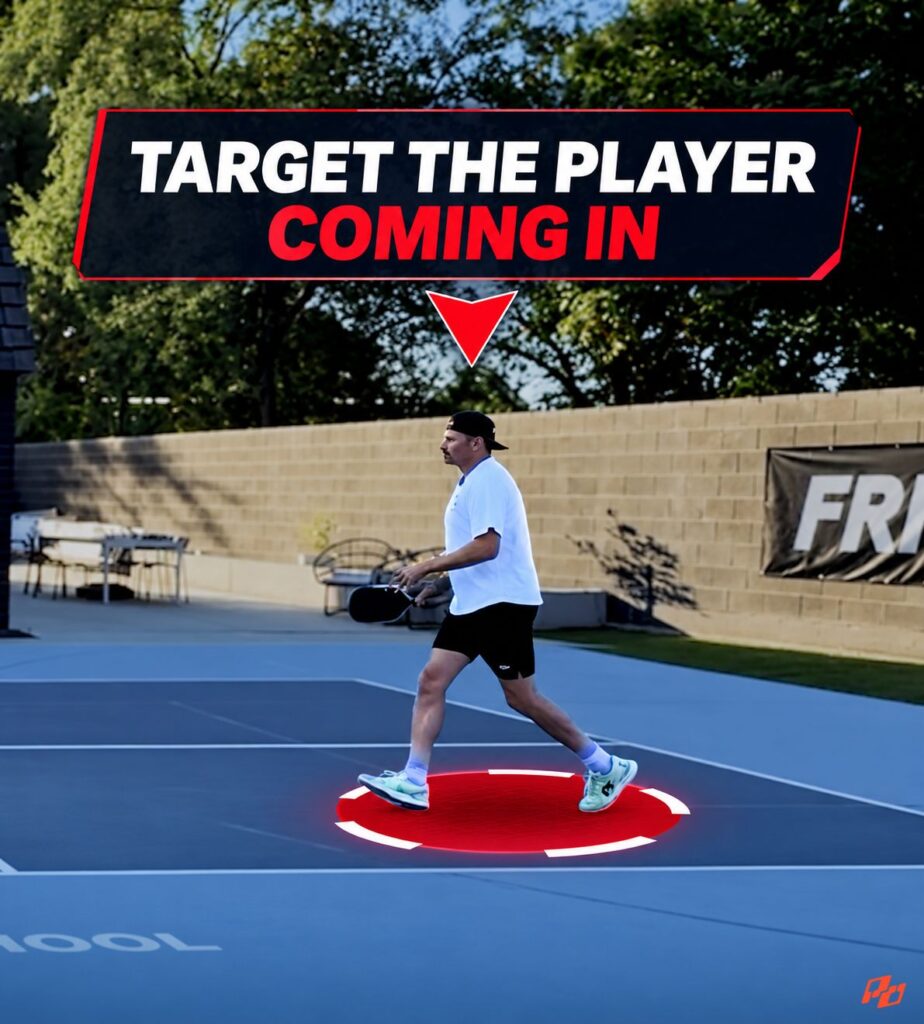
In pickleball doubles, the best target isn’t always the weaker player. Look for the opponent who’s moving, off balance, recovering, or caught in transition. Target their feet or awkward body zones with controlled pressure to force tougher next shots and more errors.
Two opponents.
One is already planted at the kitchen, paddle up, balanced and waiting.
The other is three steps behind, moving forward, trying to arrive.
Who gets the ball?
For a lot of rec players, the answer is still: “Hit to the weaker player.” Sometimes.
But there is often an even better target: The player who is moving.
A balanced 3.5 can defend a pretty good ball.
A 4.0 caught mid-step can suddenly look very ordinary.
That is why good targeting is less about asking “Who is worse?” and more about asking: “Who is least ready right now?”
Think in States, Not Ratings
Imagine the returning team after the serve. One player hits the return and starts moving toward the kitchen. Their partner is already established there.
You get a driveable third shot. If you attack the settled player, they are:
- balanced
- facing you
- paddle ready
- close to the net
- and able to volley the ball before it drops
Now look at the player advancing. They may be:
- changing speed
- between steps
- split-stepping late
- reaching forward
- or trying to decide whether to keep coming
That is a completely different defensive problem.
Popular coach Tony Roig describes targeting the player still in transition as simple probability: the moving player has more variables to manage and less stability.
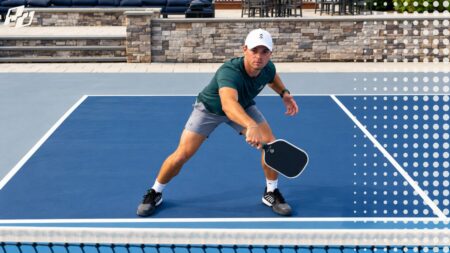
Players in transition are vulnerable to hard balls directed toward their feet and must learn to stop, balance and reset effectively.
So your first targeting question becomes: Who is stable—and who isn’t?
The Feet Are Usually Better Than the Body
Once you’ve identified the moving player, don’t automatically hit chest-high. The best target is often lower.
⮕ Aim at the feet—or just in front of them.
- A player moving forward wants to continue moving forward. A ball dipping at their shoes forces them to do the opposite:
- stop
- lower
- soften the hands
- and lift the ball
That’s hard. That gives you a very useful attacking pattern: Moving player + low contact = pressure.
You don’t necessarily need more speed.
A 70% drive dipping toward someone’s shoes can create more trouble than a 95% drive at the balanced player’s chest.
The Best Target Changes During the Rally
Here’s where intermediate players can make this tactic much smarter.
Don’t decide before the point: “I’m targeting Dave.”
Decide during the point: “I’m targeting vulnerability.”
Dave might be the weaker player overall. But if Dave is planted at the kitchen and his stronger partner is sprinting through transition, the stronger player may temporarily be the easier target.
Five seconds later, that can reverse. Think of targeting as a live ranking:
- Moving or off-balance — best target when you have a safe attack.
- Low paddle or awkward contact — even strong players are vulnerable here.
- Recovering from a wide ball — especially if you can hit behind them.
- Weaker technical side — often the backhand, but confirm it.
- Weaker player overall — useful as a pattern, not an automatic target.
Target weaker skills, the middle, players out of position, and body zones on speed-ups rather than hitting mechanically to the same person every time.
The “One Up, One Back” Situation Is Gold
This may be the easiest targeting read in recreational doubles. Opponents are staggered: one at the kitchen, one behind.
Don’t split the difference.
Pressure the back player.
Coach and PPR clinician Jeff Rausch teaches transition players to work forward under control specifically because the deeper player is vulnerable until they can establish a stable kitchen position.
Pro Roscoe Bellamy similarly describes the transition zone as a place players must learn to survive through resets rather than treating the kitchen as something they can simply sprint toward.
Your job on the other side?
Don’t make that transition comfortable. If they are still advancing, keep them hitting from below net height. Make them reset another ball. Then another.
Don’t invite them to the kitchen with an easy volley.
Anna Leigh Waters Uses the Same Read at the Kitchen
This concept isn’t limited to players running forward. World No. 1 Anna Leigh Waters has explained that when an opponent is dinking while moving and off balance, that’s a good time to attack them.
That’s the same principle in a different location.
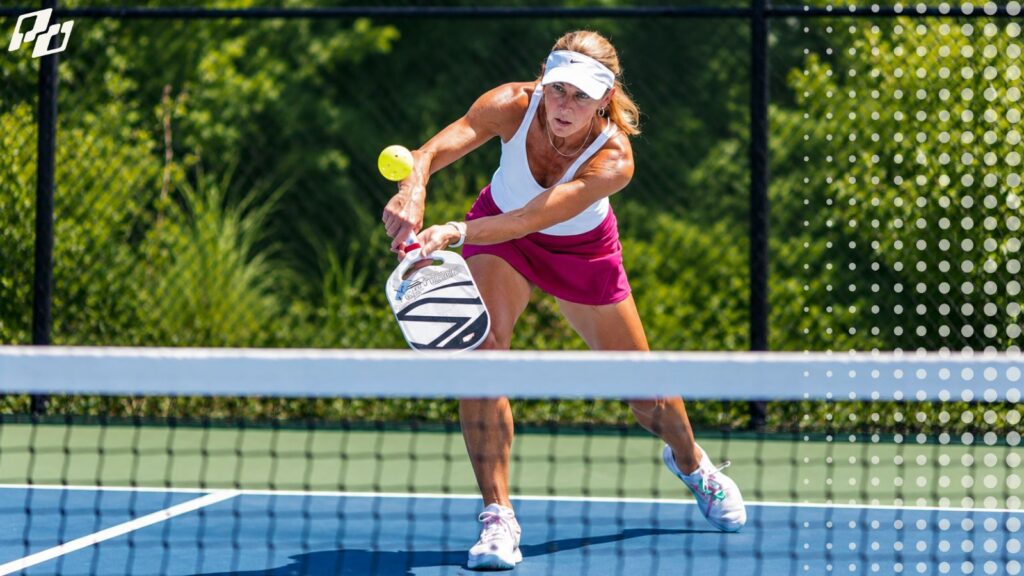
An opponent may already be standing at the kitchen, but if you’ve pulled them wide and their weight is still shifting, they are temporarily vulnerable.
Now the target may be:
- their body
- their exposed side
- the space behind their recovery
The important thing is that you’re attacking the moment of instability—not simply a name on the lineup.
Don’t Hit the Moving Player if the Ball Doesn’t Let You
This is the caveat that keeps the strategy from becoming reckless. Suppose the opponent is moving forward, but your incoming ball is:
- low
- below net height
- stretched wide
- or difficult to control
Do not force an attack simply because you’ve identified a good target. Ball quality comes first.
USA Pickleball’s basic attack/reset framework is useful here:
- Ball traveling downward toward you or below the net? Reset.
- Ball rising and attackable? Consider offense.
So the full decision isn’t: moving player = drive
It’s: attackable ball + vulnerable opponent = pressure
That is a much safer rule.
Don’t Confuse “Moving” With “Helpless”
Some players move through transition extremely well.
They split step correctly.
Paddle stays out front.
They stop before contact.
They can reset a hard drive from their shoelaces.
If you’ve hit three balls at that player and they’re comfortably neutralizing everything, adjust.
Maybe their partner struggles with pace. Maybe the middle creates confusion. Maybe the stronger play is forcing the moving player wide rather than drilling directly at them.
Strategic targeting should produce information. Every return tells you something.
If your “best target” keeps handling the ball easily, they’re probably not your best target.
Where Exactly Should You Aim?
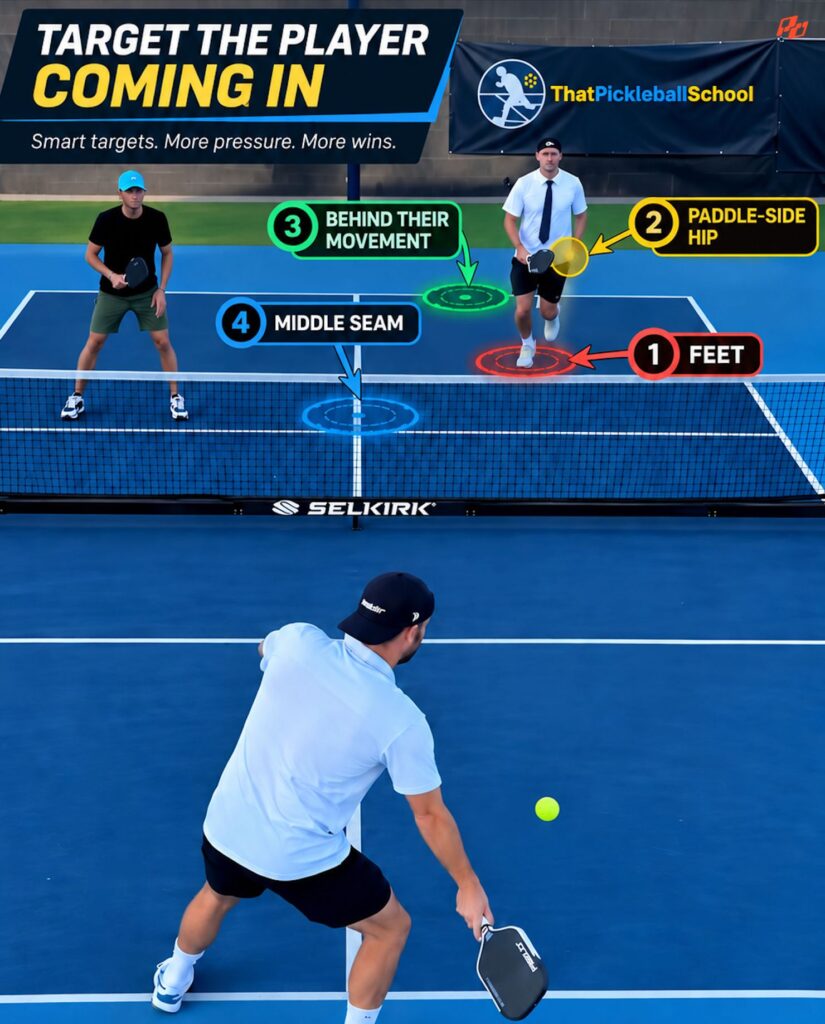
For the player moving forward, use this order.
1. Feet
Best default.
Especially if you can make the ball dip before contact.
2. Paddle-side hip
Useful if the ball sits higher.
It can jam the transition between forehand and backhand.
3. Behind their movement
If they are shifting laterally, hitting behind them forces another change of direction.
4. Middle seam
Especially when the moving player and established partner are no longer level. The staggered formation can create uncertainty about who should take it. What you generally don’t need is the sideline.
A narrow sideline target adds your own error risk when the opponent is already under positional pressure.
Make them hit the difficult ball. Don’t make yourself hit one first.
The 3-Second Targeting Scan
Here’s the practical system I’d give a 3.5 player. Before you strike, scan three things:
Feet: Who’s moving?
Paddle: Who looks ready?
Ball: Do I actually have permission to attack?
That’s it.
Feet → Paddle → Ball.
If one opponent is moving, paddle down, and you’ve received an attackable ball, you don’t need a complicated scouting report.
You have your target.
Try This Drill: Moving Target
Put one defender at the kitchen. Put the second defender at the baseline. The baseline player works forward toward the kitchen.
The attacking pair’s goal is not to win with one hard drive. Their goal is to keep directing controlled pressure toward the transitioning player until that player successfully reaches the kitchen.
Score it this way:
Attackers get 1 point if they force a pop-up, miss, or retreat.
Defender gets 1 point if they establish the kitchen under control.
Then switch.
This teaches both sides of the tactic:
The attackers learn to recognize instability.
The defender learns how much stopping and balancing before contact matters.
One More Rule: Don’t Target So Predictably That You Become Easy to Read
There is a downside to targeting someone relentlessly. You become predictable.
If every ball goes to the same opponent, that player can settle into rhythm and their partner can begin poaching aggressively.
Pro Zane Navratil’s coaching on breaking isolation highlights exactly this problem: once a targeting pattern becomes predictable, the targeted team can adjust positioning and use aggressive patterns to disrupt it.
So use targeting as pressure—not obsession.
Hit three balls at the vulnerable player.
Then notice if the other opponent starts cheating over.
Now the open space may be the better target.
Hit the player who has the hardest next ball.
Often, it’s the player moving through transition.
Sometimes, it’s the player stretched wide.
Sometimes, it’s the player with the low paddle.
Sometimes, it’s the weaker backhand.
Sometimes, it’s the middle between two confused partners.
The best target isn’t a person. It’s a temporary disadvantage. That is what better doubles players learn to see. And once you start seeing it, your attacks become much more efficient:
- less random pace
- fewer low-percentage sidelines
and many more balls aimed at opponents who are already struggling before your shot even arrives.