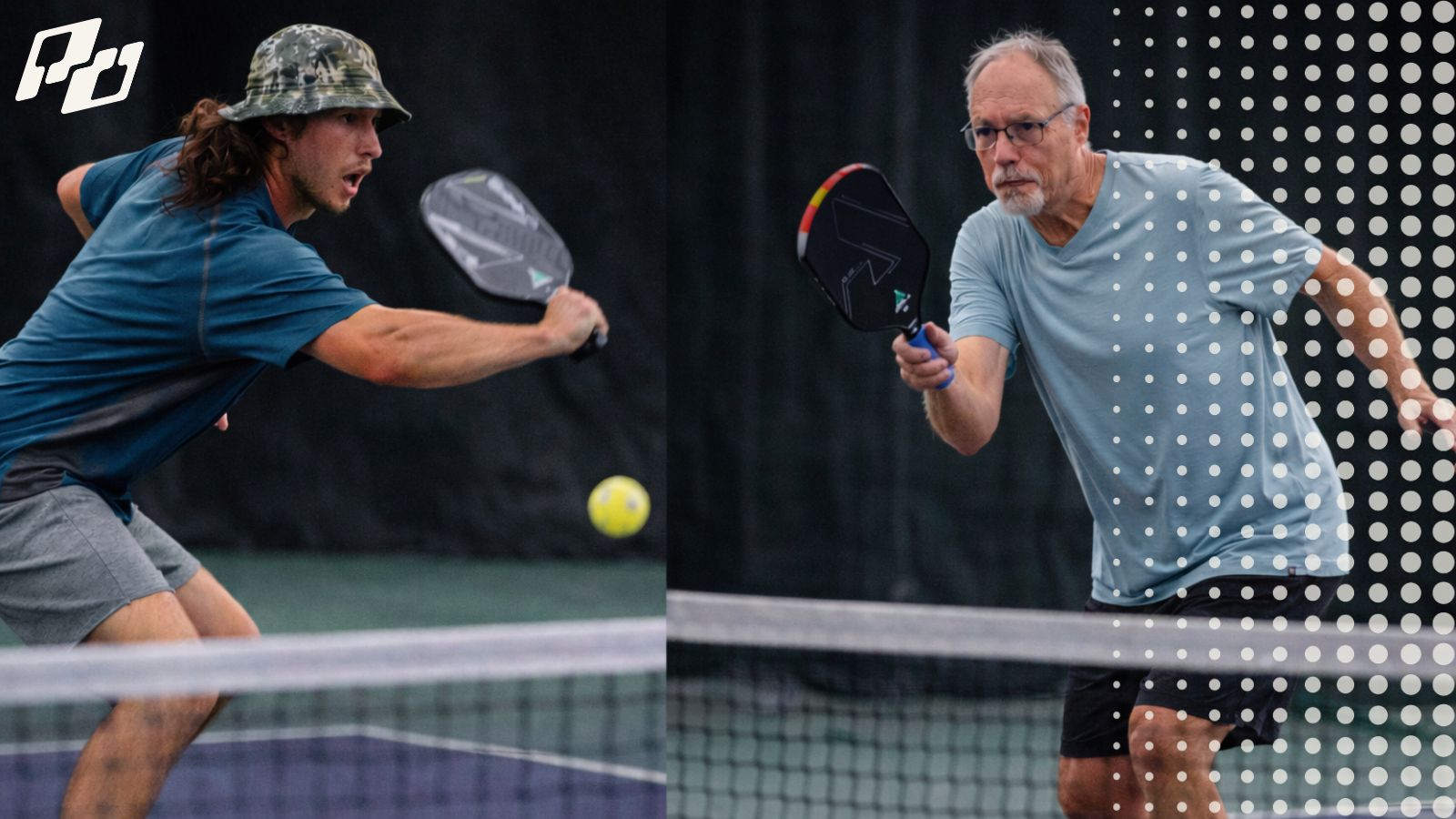
Yes—and if you’ve ever felt skeptical about that, you’re not crazy.
Here’s the reality: DUPR is an outcome rating, not an “athleticism score.” It’s built to reflect how you perform versus what the system expects in real matches (including how many points you score), not how fast you are in a footrace.
So two players can share the same DUPR while looking completely different:
- One wins with speed, hand battles, and athletic saves
- The other wins with positioning, patterns, placement, and low-risk offense
Same rating. Different “path.”
What matters is this: can you consistently win/score at that level? If yes, you belong there—age doesn’t disqualify you.
Why the “same DUPR” matchup feels unfair anyway
Because pickleball doesn’t punish physical differences evenly.
A younger player often gets “free” advantages in:
- explosive first step (closing gaps)
- hand speed (fast exchange wins)
- recovery (more reps, fewer aches)
But a 50+ player can get “free” advantages in:
- shot tolerance (fewer unforced errors)
- pattern recognition (seeing the next ball early)
- tempo control (forcing the rally into your preferred pace)
And in doubles, tempo and decision-making win a shocking number of points—especially in rec play.
The big mistake 50+ players make vs younger players
They try to “prove” they can play the same style. If you turn it into:
- sprint battles
- rapid-fire speedups
- scramble defense every point
…you’re choosing the one arena where youth tends to cash in the most.
Instead, your goal is simple: Make them play one more ball. But make it uncomfortable.
Your best game plan: “Low, wide, boring, repeatable”
Here are the highest-percentage adjustments that let a 50+ player beat (or go even with) a younger athlete at the same rating.
1) Stop feeding hand battles on their terms
✅ Win points by making them hit up, not by out-racing their hands.
Do more of this:
- third-shot drops to the backhand foot
- dinks that land tight + low
- resets that buy you the NVZ without panic
Do less of this:
- “I’ll just speed it up first”
- chest-high counters from awkward balance
- attacking anything below net height
2) Use “two-step pressure” instead of “one-shot winners”
A lot of younger rec players are fine with pace… until they have to hit the 2nd and 3rd good ball in a row.
Pattern that works:
- deep return →
- drop or soft drive to their feet →
- attack the next ball that pops up
It’s not flashy. It’s points.
3) Move less—but earlier
This is the sneaky advantage experienced players get. You don’t need more movement. You need better timing:
- split step earlier
- read the shoulders
- shade middle sooner
- hold the line instead of drifting
If you arrive early and balanced, you’ll “look faster” without actually running faster.
4) Make the court feel smaller for them
Young athletes love open space. So don’t give it to them:
- keep balls middle-heavy in transition
- dink to the outside hip (jam their extension)
- target the moving player, not the stationary one
That’s how you turn speed into rushed contact.
What actually doesn’t work (and why)
❌ Constant lobbing as a plan
Lobs can be great… but if it’s your whole identity, better athletes will punish it (overheads + angle finishes).
❌ Going for paint-the-line precision
Against faster defenders, low-percentage sidelines just become errors. Make them earn points through rallies, not your risk-taking.
❌ Trying to “match intensity” emotionally
If you get sped up mentally, you’ll speed up your decisions—and that’s when the unforced errors show up.
Real rec scenarios (and what to do)
Scenario A: “They speed up everything.”
Your response:
- expect the speedup (paddle up, stance lower)
- block down the middle to shrink angles
- reset and make them hit another speedup from lower contact
You’re not trying to win the first firefight—you’re trying to make their second one worse.
Scenario B: “They chase down every dink.”
Perfect. That means they’re moving a lot.
Do this:
- dink to a corner → then go behind them
- change height: soft → softer → then roll to feet
Movement isn’t free. Even for 20-somethings, repeated stop-start costs control.
Scenario C: “Your partner wants to bang every ball.”
Keep it real and keep it simple:
- “Let’s win the kitchen first—then we can speed up.”
- “If it’s below the net, we reset. If it’s above, we go.”
That one agreement prevents 80% of rec-team chaos.
The honest answer: “Same DUPR” does not mean “same strengths”
It means you’re producing similar match results. And DUPR’s newer “performance vs expectation” approach reinforces that idea: it cares about how the scoreline compares to what’s expected, not vibes.
So yes—a smart, efficient 50+ player can absolutely compete with a 20-something at the same DUPR, especially in doubles where positioning and decision quality matter a ton.
A simple mindset that keeps you dangerous
Don’t try to win the point with athleticism.
Win it with sequence.
- make them hit low
- make them hit one more
- take the pop-up you earned
That’s not “playing safe.” That’s playing adult pickleball.