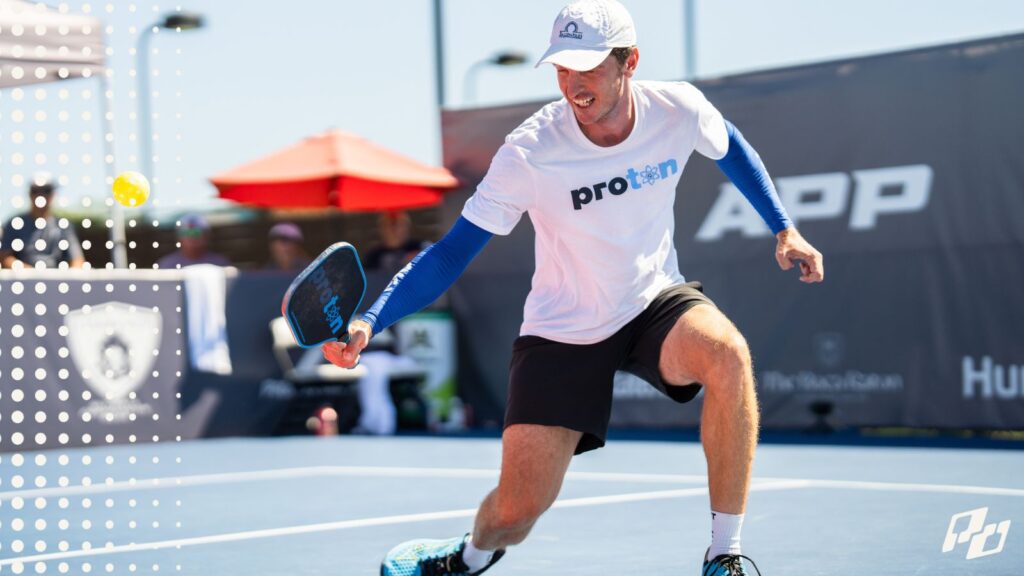
To return a slice in pickleball, read the bounce, move to the ball, and create space for contact in front. Neutralize low balls with a slightly open face, use compact topspin on higher balls, and re-slice when stretched or off balance.
A good slice is frustrating because it rarely looks as dangerous as it feels.
The ball floats toward you, appears to offer plenty of time, and then stays lower than expected after the bounce. You reach down, open the paddle face, and send an easy ball chest-high to the opponent.
Most players blame the spin.
The real problem is usually spacing. Slice changes where and when the ball enters your strike zone. Once it pulls you too close to the bounce—or forces contact beside your body—your paddle face starts making emergency corrections.
That is why the best response to slice is not simply “add topspin” or “slice it back.” Your return should depend on three things:
- Where you’ll contact the ball
- How much space you have to swing
- What shot you’re trying to hit
Here is how to make that decision against a slice serve, forehand slice, or backhand slice.
First, Understand What Slice Does After the Bounce
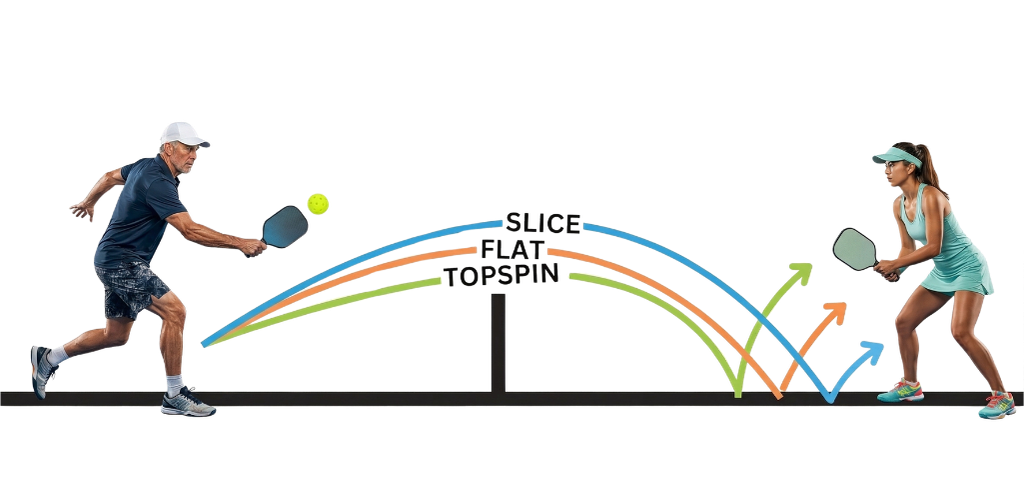
A sliced ball carries underspin. Instead of rotating forward in the direction of travel, it rotates backward.
That generally produces a ball that:
- travels with a slightly floating flight
- loses less height before reaching you than expected
- stays lower or skids forward after bouncing
- arrives at a different height and contact point than your eyes initially expect
The last point causes most of the errors.
Players see the slower flight and move forward too early. Then the ball skids into their body, leaving no room to swing.
A slice can also carry sidespin. This happens when the paddle travels across the ball rather than directly underneath it. The ball may curve in flight and kick sideways after the bounce.
Do not assume every forehand slice or backhand slice moves in one fixed direction. The kick depends on the opponent’s handedness, paddle path and contact point.
⮕ The better reading cue
Do not watch only where the ball is traveling. Watch which direction the opponent’s paddle travels through contact.
- Mostly high to low: expect underspin and a low bounce.
- High to low plus right to left: expect underspin with sideways movement.
- High to low plus left to right: expect the opposite sideways movement.
Cue: Read the paddle. Confirm the bounce.
The Most Important Adjustment: Create the Right Space
No matter what type of slice you’re facing—a sliced serve, forehand slice, backhand slice, or sliced dink—the biggest mistake is letting the ball dictate your contact point.
Slice stays low, often skids forward, and can kick sideways. If you simply wait for it, the ball crowds your body or drops into an awkward strike zone, forcing wrist flips and emergency paddle adjustments.
The goal isn’t to back up or move forward every time. It’s to use your feet to create the right spacing. Against a deep slice, that may mean moving behind the ball. Against a slice serve or shorter slice, it often means moving through the bounce and taking the ball earlier before the spin has more time to work.
When the ball is going to bounce:
- Split-step as your opponent makes contact.
- Read the bounce before committing.
- Move behind the ball’s new path.
- Contact it in front of your outside hip.
- Keep enough space for a natural swing.
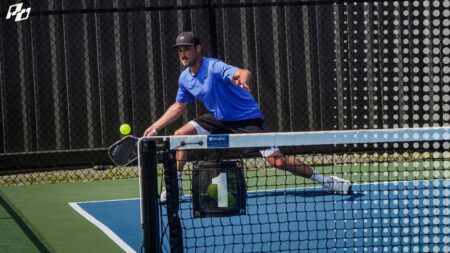
Volleys are different because there’s no bounce to read. Keep your paddle out front and use small adjustment steps to maintain space instead of letting the ball jam your body.
Cue
Read the bounce. Move to the ball. Create space with your feet.
Choose the Return From the Contact Height
Players often decide on topspin or slice before the ball bounces. That is backwards.
Let the contact height choose the shot.
If the ball stays below your knee: Neutralize it
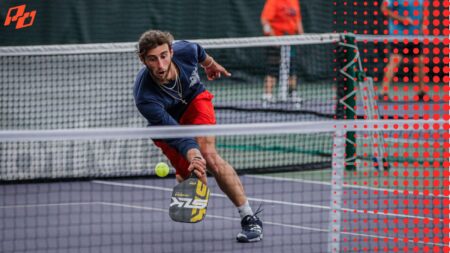
A very low slice is a poor ball to attack aggressively with topspin. You would need to lift it steeply while still keeping enough forward pace to reach your target.
Instead, use a compact neutral return:
- Set the paddle slightly open
- Keep the wrist stable
- Lower from the legs rather than dropping the paddle with your hand
- Swing primarily forward with a small upward component
- Aim deep through the middle with comfortable net clearance
The mistake is trying to “help” the low ball by scooping under it. That creates height without dependable depth.
Think of carrying the ball forward rather than lifting it into the air.
Cue: Low ball, long target.
If the ball reaches mid-thigh or waist height: Use compact topspin
This is the best height for reversing the pattern and producing a controlled topspin return.
You do not need a large loop. The incoming slice already gives you time, but its low bounce punishes an oversized backswing.
Set the paddle below the ball, keep the face close to neutral, and accelerate forward and upward. Contact the back of the ball, not the bottom.
The upward path provides net clearance. The forward component prevents the return from becoming a soft sitter.
A slice return creates a strong opportunity for the serving team to use a third-shot drive. Coach Tanner Tomassi explains why a third-shot drive is often the best response to a slice return:
Cue: Brush forward-up, not straight up.
If you are stretched, late or off balance: Re-slice it
Trying to create topspin while reaching outside your base is usually an unnecessary gamble.
A defensive slice requires less vertical clearance under the ball and can give you time to recover. Use a short, controlled high-to-low path and send the ball deep through the middle.
Returning slice with slice is not automatically passive. A deep, low slice can make the opponent’s next drop more difficult and can buy you extra time to establish your position.
The key is not to carve aggressively across the ball. Excess sidespin reduces your target window and makes depth harder to control.
Cue: When stretched, cut less and place more.
How to Return a Slice Serve
A slice serve presents a unique challenge because you’re required to let it bounce before making contact. That gives the underspin—and often sidespin—time to influence the ball’s path.
Your goal isn’t to eliminate the spin. It’s to stop the spin from dictating where you make contact.
1. Don’t Give the Slice More Time Than Necessary
Many recreational players make the mistake of waiting for the ball to come to them.
The longer a sliced serve travels after the bounce, the more time it has to stay low, skid forward, or move sideways.
On shorter or moderate-depth slice serves, let the ball bounce, read its path, then move through it and take it on the rise whenever possible. Against very deep slice serves, give yourself enough room to create the same comfortable contact point.
You’re not charging the serve blindly. You’re simply preventing it from dropping into an uncomfortable strike zone:
If the serve is exceptionally deep, starting a step farther behind the baseline can still be the better option. The important part isn’t your starting position—it’s creating a comfortable contact point after you’ve read the bounce.
Cue: Read the bounce. Then go to the ball.
2. Track the Server’s Paddle Path
A sidespin slice may curve in the air and continue moving after the bounce. Don’t commit to the original flight line.
Read the bounce first, then use small adjustment steps to move behind the ball’s new path.
3. Return Deep Through the Middle
Against a quality slice serve, depth is usually more valuable than trying to hit an aggressive angle.
A deep return through the middle gives you a larger target, limits the server’s attacking angles, and buys you time to establish the kitchen.
4. Keep Your Swing Compact
Slice serves often force late adjustments.
A long backswing makes those adjustments much harder.
Prepare early, keep the paddle close to your body, and make the final face-angle adjustment after you’ve seen the bounce.
Serve-return cue: Read. Move through it. Swing compact.
Returning a Forehand Slice
The most common mistake against a forehand slice is following the ball sideways with the paddle instead of repositioning the body.
When you see the opponent cut across the ball:
- Identify the likely lateral kick.
- Split before the bounce.
- Move outside the projected contact point.
- Plant far enough from the ball to preserve arm extension.
- Swing toward your target—not in the direction the ball kicked.
That final distinction is important.
The ball’s sideways movement can pull your stroke across the court. Unless you deliberately redirect the paddle through your target, the return often leaks wide.
For a right-handed forehand return, keep the hitting shoulder behind the ball and avoid opening your torso too early. Early rotation drags the paddle across contact and exaggerates the incoming sidespin.
Cue: Move with the kick; swing through the target.
Returning a Backhand Slice
The backhand side becomes difficult when players allow the ball to reach the body.
A slice that skids into the backhand hip leaves almost no room for the paddle to accelerate. The player then chops down, flips the wrist or opens the face to escape.
Create separation early. For a one-handed backhand:
- Turn the shoulders before the bounce.
- Use the non-dominant hand to help set the paddle.
- Release that hand as you establish spacing.
- Contact in front of the lead hip.
- Drive through the ball with a stable wrist.
For a two-handed backhand:
- Lower the body enough to place the paddle below the ball.
- Let the non-dominant hand supply much of the upward acceleration.
- Keep the swing compact.
- Avoid standing up before contact.
When the ball remains too low for a clean topspin backhand, use a controlled backhand slice rather than forcing a roll from below your knees.
Cue: Make room first. Choose spin second.
Three Adjustments Intermediate Players Often Miss
1. Match the Paddle Face to the Shot
One mistake I see is players deciding to use the same paddle angle against every sliced ball.
If your goal is to neutralize a low slice—such as a return, reset, or drop—a slightly open paddle face with a gentle lift and forward push is often the highest-percentage option. It lets the paddle work with the incoming underspin instead of fighting it.
But if you’re trying to drive or roll the ball with topspin, that same open paddle face will usually send the ball too high. In that case, keep the paddle closer to neutral and create the lift with your swing path instead.
The key isn’t choosing one paddle angle. It’s matching the paddle face to the shot you’re trying to hit.
2. Take the Ball Early—But Still in Front
Against slice, do not stand back and wait for the ball to finish skidding toward you. The longer it travels after the bounce, the lower and more awkward it can become.
Instead, read the bounce, move toward the ball, and take it early—often on the rise—while it is still in a comfortable strike zone.
Early does not mean rushed. You still want contact in front of your hip with enough space for a natural swing.
Cue: Go to the bounce. Meet it in front.
3. Separate height from depth
Many players try to hit a low return and accidentally land it short.
A low ball over the net is only useful when it also travels deep enough to pressure the opponent.
Give yourself reasonable net clearance and aim for the final three to four feet of the court. Do not shave the tape merely to make the ball look dangerous.
A Better Drill Than Mindless Slice Feeding
Have a partner alternate among three feeds:
- a low slice below the knee;
- a higher slice near the waist;
- a slice that pulls you laterally.
Do not ask the feeder to announce which one is coming. Your job is to call your decision immediately after the bounce:
- “Neutral”
- “Topspin”
- “Slice”
Then play the corresponding return:
- Low ball: compact neutral lift, deep middle.
- Waist-high ball: compact topspin, deep to a chosen target.
- Stretched ball: controlled slice, deep middle.
Score one point for choosing the correct response and one point for landing the ball beyond an imaginary line three feet inside the baseline.
This trains the skill that actually matters: matching the stroke to the ball you receive.
The Mindset Shift That Helped Me Most
For a long time, I thought good players were simply better at handling spin. The more I watched advanced players, the more I realized they weren’t reacting to the spin itself—they were reacting to the contact point it created.
That’s a subtle but important difference.
Instead of asking, “How do I return this slice?” they instinctively ask, “Where is the best place to contact this ball?”
Everything else follows from that answer.
If the ball stays low, they neutralize it. If it rises into a comfortable strike zone, they roll it with topspin. If they’re stretched or late, they simplify the shot and recover for the next one. They aren’t committed to one technique—they’re committed to making the highest-percentage decision.
The next time you play someone who slices everything, don’t judge yourself by whether you hit the perfect return. Judge yourself by whether you arrived at the ball early enough to have a choice.
In my experience, that’s the real skill. Once you consistently control your spacing and contact point, slice stops feeling like a tricky shot and starts feeling like just another ball.