Learn how to hit the forehand slice drop in pickleball and when to use it. This guide explains the grip, swing path, spacing, and common mistakes, plus how intermediate rec players can use the shot to keep balls lower, slow the rally, and get to the kitchen more comfortably.
Some shots in pickleball look flashy. The forehand slice drop is not one of them.
It is not the shot people brag about after rec play. It is not the one that gets the biggest “oohs.” But when you learn to hit it well, it can quietly change your game. It helps you keep the ball low, take pace off the rally, make your opponent hit up, and work your way to the kitchen with a lot less drama. That is exactly why players and coaches keep coming back to it: when done right, the forehand slice drop is one of the simplest ways to make your drops tougher to attack.
And that matters, because a lot of intermediate rec players do not actually lose third-shot drops because they “cannot drop.” They lose them because their drops sit too high, travel too fast, or bounce up into easy attack zones. The forehand slice drop gives you another way to solve that problem.
It is not a magic shot. It is a control shot. But for the right player, in the right situations, it can be a really useful one.
What the forehand slice drop actually is
At its simplest, the forehand slice drop is a softer forehand drop hit with an open paddle face and underspin. Instead of driving through the back of the ball with a flatter or topspin shape, you brush under and slightly through it to create a lower, softer, more skidding flight.
The goal is not to “carve” the ball as much as possible. The goal is to send a controlled ball that lands in the kitchen and stays difficult to attack.
⮕ To put it simply: open, slice, keep it soft. That is the heart of the shot.
That last part is important. A lot of rec players hear “slice” and think they need to chop hard at the ball. That is usually where the trouble starts. Good slice drops are not violent. They are controlled.
Why this shot helps so many rec players
The big advantage of the forehand slice drop is that it helps you slow the rally down without completely floating the ball. It creates a ball that tends to stay lower, land softer, and ask your opponent to hit up instead of down.
Mari Humberg’s breakdown in the video below makes that exact point: the shot can neutralize aggressive opponents, slow the pace, and help you transition to the kitchen line more comfortably.
That is a big deal in rec doubles.
A lot of points at the 3.0–4.0 level are decided by whether the serving team can get to the kitchen without feeding the other side an easy fourth-shot attack. A good slice drop can help with that because it gives you:
- more control than trying to muscle a topspin drop
- a softer landing ball
- a shot that is often easier to shape when you are under moderate pressure
- a lower bounce that can make the next contact awkward for your opponent
It is not always the best drop. But it is a very practical one.
What makes the forehand slice drop different from a regular drop
A normal forehand drop can be flatter or slightly topspin-based, depending on the player. The forehand slice drop has a different feel and different intention.
With a slice drop, you are usually using:
- a slightly more open paddle face
- a smoother, softer low-to-high path
- a more controlled contact
- and a more stable wrist position
That is why many players find it repeatable once they understand the shape. You are not trying to create power. You are trying to create a soft, skidding path.
The grip: keep it simple
A continental grip is a very good starting point for the forehand slice drop. It makes it easier to keep the paddle face slightly open and create underspin without forcing awkward wrist action.
For many rec players, that is the cleanest answer:
- continental if you already use it comfortably
- possibly a very slight forehand variation if that helps you feel more stable
But I would not overcomplicate this part. The grip’s job is simply to help you present a calm, slightly open paddle face. That is what matters most.
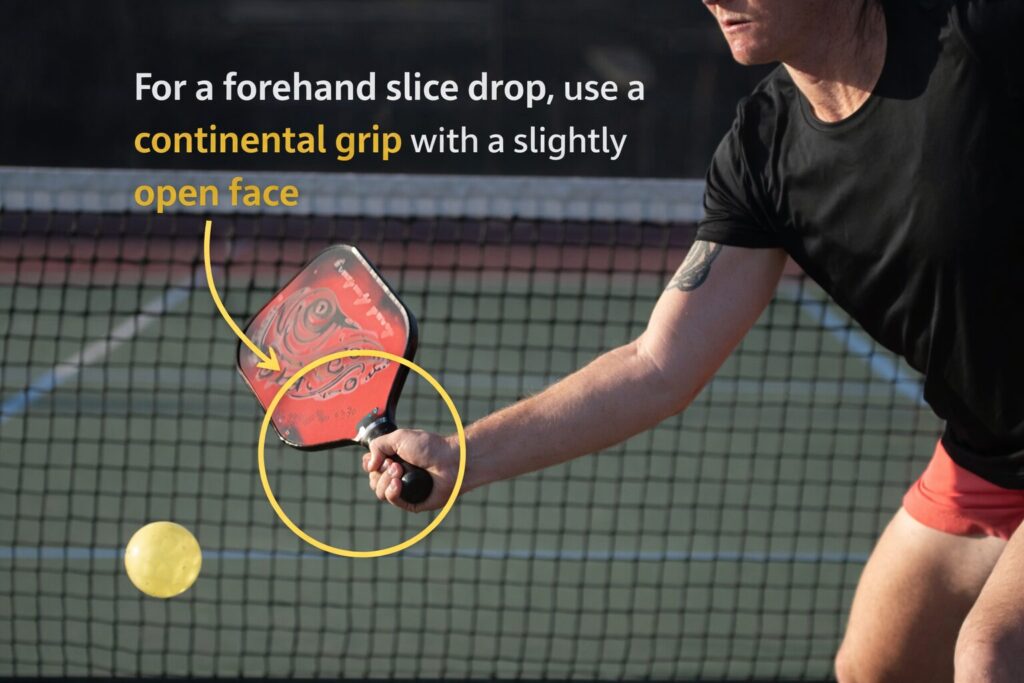
A relaxed grip is just as important as grip choice. The combination you want is simple: relaxed hand, slightly open face, contact under the ball. That is what gives the shot its softness and control.
If you squeeze too hard, the ball tends to jump. And once it jumps, your “drop” starts looking a lot more like a sitter.
The body position: this is where many players go wrong
The forehand slice drop is not just a hand shot. It works best when your body is organized. Your starting position should be athletic:
- knees bent
- balanced base
- shoulders turned
- body set slightly behind the ball
- contact point out in front
Players get into trouble when they let the ball get too close, reach awkwardly, or try to slice from a jammed position. You want to stay slightly behind the ball and keep your shoulders turned so the shot feels more stable, controlled, and repeatable.
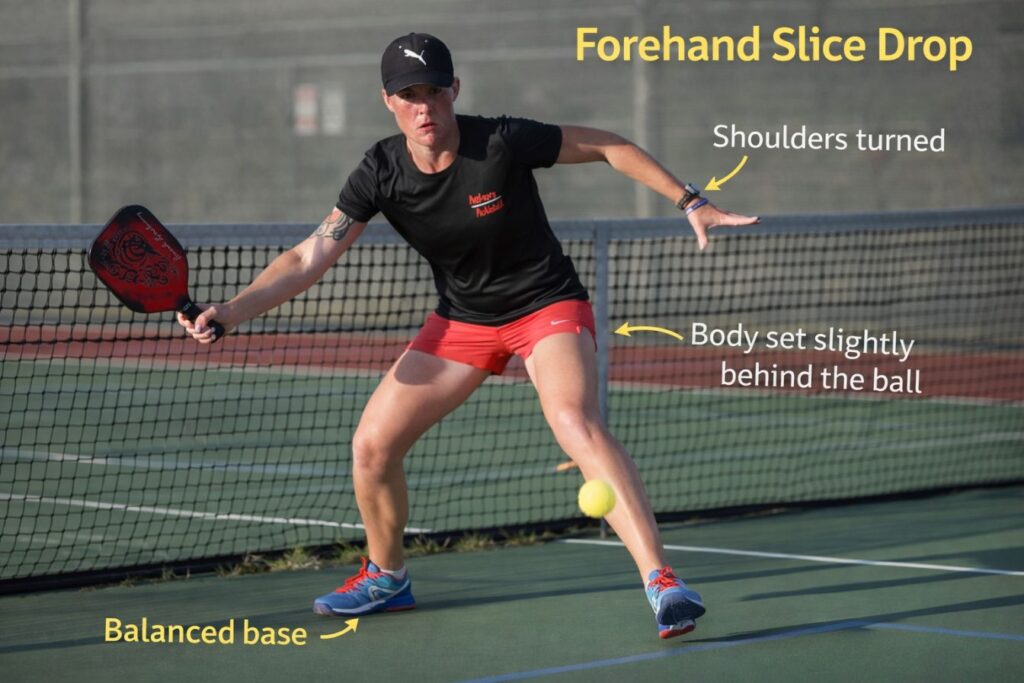
That matters more than many people realize. The forehand slice drop needs space.
That does not mean huge space. But you need enough room to let the arm swing freely and contact the ball in front instead of on top of your body.
The swing path: soft, smooth, slightly lifting
This is probably the biggest clarification intermediate players need.
⮕ A forehand slice drop is not a downward chop.
Yes, there is underspin. Yes, the face is a little open. Yes, you are contacting under the ball more than on a flatter drive. But the motion is still controlled and slightly lifting: low to high, soft and smooth, with slice.
That surprises some players, because they assume slice must mean all down and across. But if you swing too flat or too sharply downward, one of two things usually happens:
- you dump the ball into the net
- or you pop it up because the paddle face is too open and the swing is too handsy
The better image is:
- open the face a bit
- come under and through the ball
- keep the motion smooth
- and let the finish stay controlled
The slice is part of the shot. It is not the entire shot.
When to use the forehand slice drop
This is where the shot gets interesting.
You do not want to use it blindly just because you learned it. Like any shot, it works best in the right situations.
1. On third shots when you want more control than your normal drop gives you
This is the most obvious use. If your normal forehand drop tends to come in a little too hot or sit up, the slice drop can help you take pace off and land the ball softer.
This is especially helpful if:
- the return is not driving you way off the court
- you have enough time to set up
- and you want a higher-margin route into the kitchen
2. On transition drops when you need to neutralize pace
Sometimes you are in the transition zone and the ball is not really attackable, but you still need to soften the point and work forward.
The slice drop can be great here because it helps absorb and reshape the ball instead of trying to do too much.
3. Against aggressive opponents who love attacking anything that sits up
Mari Humberg’s notes specifically mention this advantage: the shot helps neutralize aggressive opponents.
If the other side is eager to jump on your normal drops, a better-shaped slice drop can make them hit from below net height more often.
4. When you are more comfortable slicing than rolling
This is a big one for rec players. Some players simply feel more natural touch on slice than on topspin.
If that is you, the forehand slice drop may be a better real-match tool than the “textbook” drop you are trying to force.
5. When you want a lower bounce and a softer landing
This is one of the nicest parts of the shot. A good slice drop does not just clear the net and land in the kitchen. It often lands in a way that makes the next contact less comfortable.
That is the whole point.
When not to use it
The forehand slice drop is useful, but it is not the answer to everything.
1. When you are badly late
If the return is pushing you way back or you are sprinting and reaching, you may not have enough structure to shape a good slice drop.
In that case, a more forgiving reset shape or even a different third-shot choice may be smarter.
2. When you keep floating it
If your slice drop consistently sits up, do not keep telling yourself it is “tough spin.” A high slice drop is often a very attackable ball.
If you cannot keep it low enough yet, it may need more practice before becoming a match pattern.
3. Into strong wind or tricky outdoor conditions
Slice can behave differently outdoors, especially in wind. Sometimes the ball floats more than you expect. That does not mean never use it, but it does mean you need to understand the conditions.
4. As a crutch for poor footwork
This one matters. Some players fall in love with slice because it helps them survive sloppy positioning. That is not the same as using it well. The shot works best when paired with good spacing, balance, and movement.
The most common mistakes
A few bad habits show up over and over.
⮕ Hitting with a stiff grip
This is one of the biggest ones. Stiff grip usually makes the ball springier and less touchable. The notes explicitly warn against this.
⮕ Swinging too flat
If you swing too flat, you tend to lose the softness and shape that make the shot useful.
⮕ Chopping too much
This is the opposite mistake. Players get obsessed with “slice” and end up knifing down on the ball too aggressively.
⮕ Letting the ball crowd the body
That usually leads to weak, jammed, floaty contact.
⮕ Trying to use it on every forehand drop
You do not need to become a one-shot player. This is a tool, not a religion.
Practical cues that actually help
Here are the cues I think are most useful for rec players:
✔ Open, slice, soft.
That is still a great overall cue, and it comes straight from your notes.
✔ Relax the hand.
If the hand tightens, the ball usually gets jumpy.
✔ Shape it, don’t chop it.
This helps stop the common over-slice mistake.
✔ Catch it out front.
Great for spacing and cleaner contact.
✔ Low over the net, soft into the kitchen.
A simple target-based cue.
✔ Use the slice to arrive, not to show off.
A good reminder that the shot’s job is to help you get in.
How to use it in real rec doubles
The best way to apply this shot is not to think, “I need to hit a slice drop now.”
The better thought is: What kind of drop gives me the best chance to get in cleanly here?
Sometimes the answer will be your normal drop.
Sometimes it will be a drive.
Sometimes it will be a fifth-shot drop.
And sometimes the forehand slice drop will be the cleanest, smartest choice.
That is the mature way to use it.
For many intermediate rec players, the slice drop becomes especially valuable in matches where:
- the other team is attacking your standard drop too easily
- your forehand touch is better on slice than on topspin
- or you need one more reliable transition tool
That is where it earns its keep.