If you’re an experienced player, you already know how to block, reset, and survive at the kitchen.
But if your volleys are always neutral — floating back to the middle of the court, giving opponents another swing — it’s time to upgrade.
The next step isn’t just faster hands; it’s offensive intent.
You need to learn how to hit a punch volley that finishes points — not just extends them.
This is how advanced intermediates turn defense into dominance at the net.
The Difference Between a Neutral and Offensive Volley
A neutral volley keeps the ball alive. An offensive volley takes time away.
The difference is contact and direction. Most intermediates meet the ball too close to the body — reacting instead of attacking. That softens contact and forces the paddle to absorb pace instead of adding it.
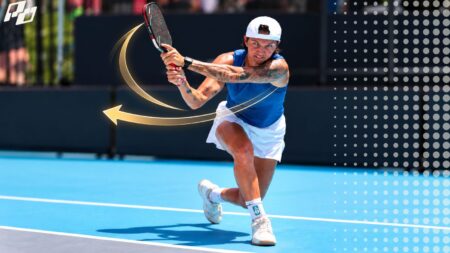
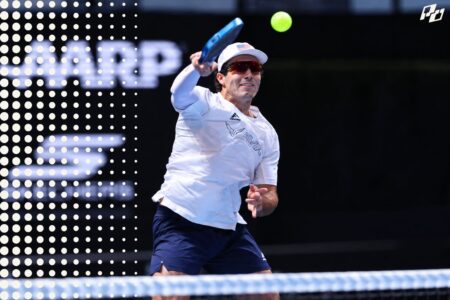
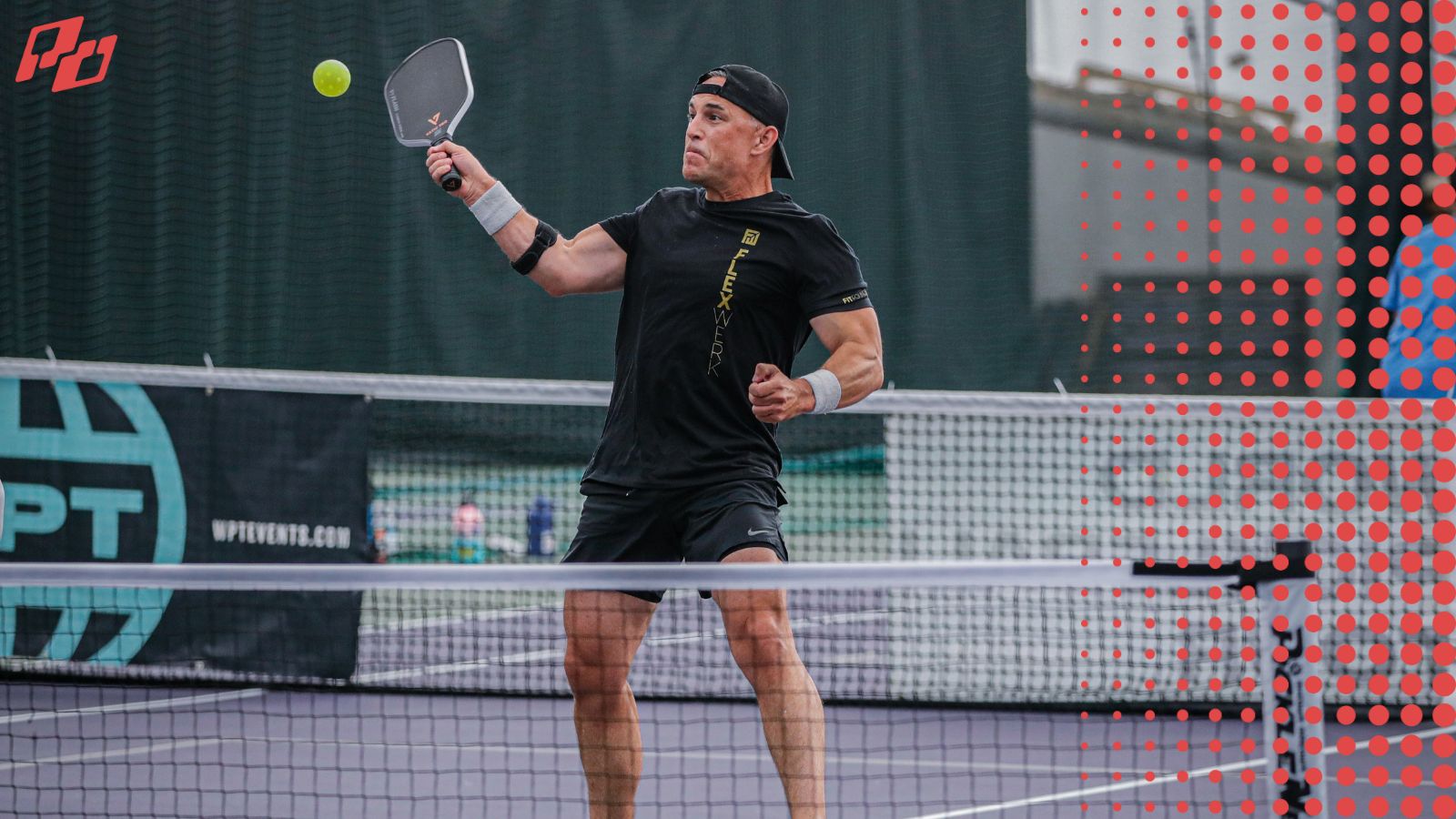
An offensive punch volley meets the ball out in front — at the peak of your reach, with your paddle traveling slightly forward and down. The motion is short, but decisive. You’re not swinging at the ball — you’re driving through it.
Think of it as “catch and jab.”
The moment you feel the ball’s energy, you send it right back before your opponent resets.
Step 1: Lead With Your Shoulders, Not Your Wrist
Here’s where 3.5+ players often lose efficiency. You already know not to swing big, but your power source may still be wrong.
The strongest punch volleys come from your shoulder and torso, not your hand. Imagine your shoulder blade sliding forward as you hit — that’s where the force originates.
Your wrist? It stays firm and quiet. Too much wrist and your volley becomes unpredictable. Too little shoulder and it dies in the net.
Pro cue: Riley Newman says, “It’s not a hit — it’s a shove. You’re driving through the ball with your body weight, not your arm speed.”
Try shadowing your motion with no ball: short, sharp shoulder push, body staying balanced. You’ll feel the leverage difference instantly.
Step 2: Attack Early, Not Hard
At this level, timing beats power. If you can contact the ball earlier than your opponent expects, you don’t need extra force — the timing creates pressure for you.
The ideal contact point is 12–18 inches in front of your chest, with your paddle already moving forward at impact.
If you’re catching the ball beside your body, you’ve already lost the advantage.
So, practice reading the incoming ball sooner.
The key: watch your opponent’s paddle face — not the ball — as they hit. If the paddle is open, prepare to drive. If it’s closed or down, get ready to reset.
Early recognition gives you that split-second edge to punch first.
Step 3: Drive Through, Not Up
Advanced players often mis-hit volleys because they try to “lift” the ball. But at the kitchen line, the best volleys actually travel slightly downward — firm, flat, and through.
You’re not brushing or scooping; you’re compressing the ball into the court.
Mechanically, that means:
- Paddle face is slightly closed (tilted 5–10° forward).
- Swing path is straight through the line of the ball, not upward.
- Follow-through ends right in front of your shoulder — no high finish.
Pro player Callie Smith demonstrated the proper technique in action:
@calliejosmith_pickleball Want to know a secret? 🤫 A successful punch volley doesn’t involve a big, out-of-control backswing. 🔑 The key to a great punch volley is keeping your swing compact and tight in front of your body! This gives you both power and control. Should I share a side-by-side comparison? Let me know! • • • • • • • #pickleball #pickleballaddict #pickleballer #pickleballwarmup #pickleballtips #pickleballshots #pickleballtechnique #pickleballaddiction #pickleballusa #pickleballislife #pickleballtiktok #pickleballtiktoks #pickleballtok ♬ bambam – babyspoon & Melo Nada
That combination produces a driving volley that dips just after crossing the net — low bounce, fast skid, no mercy.
If your opponent half-volleys it back, you’re already dictating.
Step 4: Placement Beats Pace
At this level, the margin for error is razor-thin — the goal isn’t just hitting hard, it’s hitting smart.
The best offensive volleys don’t blast through — they pin opponents in awkward positions.
Here’s where to aim:
- At the paddle-side shoulder – the toughest spot to defend in a firefight.
- Down to the feet – especially when your opponent’s momentum is forward.
- At the backhand hip – the “jam zone” that forces a weak block.
And here’s a subtle secret: Aim for your opponent’s non-dominant shoulder in doubles.
That tiny directional choice disrupts their ready position and opens space for your partner to clean up.
Step 5: Train Explosive Control
You can’t fake a powerful punch volley — it’s built through repetition. But it’s not about strength. It’s about coordination and compression.
Try this progression:
- Stand at the NVZ with a partner feeding medium-paced volleys.
- Focus only on hitting short, firm drives to their midsection — no backswing, no wrist.
- As you improve, mix direction: shoulder, feet, hip.
- Finally, step in from midcourt and punch through short floaters to simulate real finishing balls.
Film it from the side — your paddle should never swing past your body line. The entire stroke happens within 12 inches of contact.
Bonus: Learn the “Snap Block”
At the pro level, the line between a block and a punch disappears. They’re essentially the same shot — just with intent.
A “snap block” is when you firm up the paddle at the last instant and drive slightly through the ball instead of absorbing it. It’s your go-to move in fast hands exchanges.
To train it, face a wall and volley balls repeatedly, focusing on quiet feet, still paddle, and short, explosive contact. When you start hearing that crack instead of a thud, you’ve found the sweet spot.
Here’s a simple, effective way to practice your volleys — all you need is a wall:
The Confidence Shot
The offensive punch volley isn’t about raw power — it’s about belief in your timing. Once you trust that a short, firm motion can produce big pace, everything changes.
You stop reacting. You start anticipating. And suddenly, the net feels like home base, not a danger zone.
The first time you punch a ball clean past your opponent without overswinging, you’ll know: you didn’t hit harder — you hit smarter.
That’s the difference between volleying and volleying with purpose.