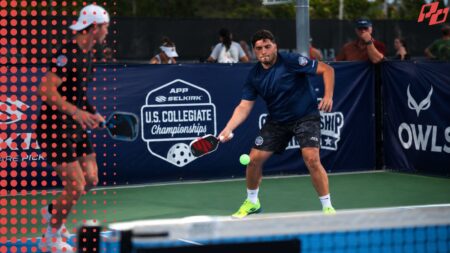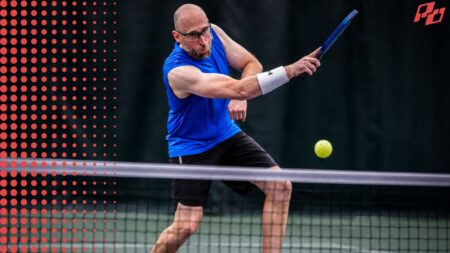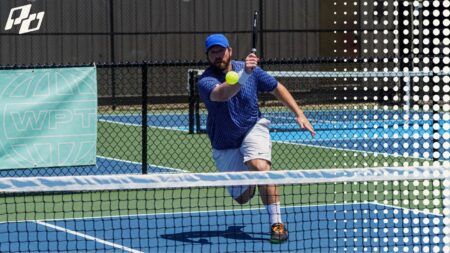
Pickleball has a rule of thumb that’s mostly right… until it isn’t: “get to the kitchen and stay there.”
At the rec level, that advice helps players stop camping in no-man’s land. But once rallies speed up and third-shot drops get better, staying glued to the NVZ line can actually make you less aggressive—not more.
Because aggression isn’t about standing as close to the net as possible. It’s about balance, options, and contact quality.
That’s why you’ll see high-level players deliberately take a small step back from the kitchen line when receiving a good drop. That space lets the ball rise, allows the body to load, and creates a strike zone where you can actually do something with the ball—without reaching, popping it up, or getting jammed.
Done right, stepping back against drops isn’t passive. It’s one of the most aggressive choices you can make.
What “stepping back” really means
This is not retreating.
It’s not giving up the line.
And it’s definitely not backing up out of fear.
A step-back is usually one controlled adjustment—sometimes a drop step—that buys you:
- a cleaner contact point
- time to load hips and shoulders
- better disguise and shot selection
- a stable base instead of a reactive poke
Staying glued to the line forces you to react. Creating a little space lets you choose.
The real problem it solves: getting handcuffed at the kitchen
You know the feeling. A good drop lands near your feet. If you try to volley it:
- contact is too low
- paddle face opens
- ball floats up
- opponents attack
When you stay glued to the line and reach for the ball, everything starts to fall apart—your posture breaks, leverage disappears, and your options vanish. That’s exactly where stepping back changes the point.
Letting the ball bounce and taking it on the rise gives you a higher strike zone, puts your body back behind the shot, and flips you from merely surviving the rally to actively shaping it.
Pro Collin Johns breaks down and supports this approach:
When stepping back is the aggressive move
The drop that lands at your shoelaces
You’re at the kitchen. The opponent hits a solid drop that’s dipping and low. Staying on the line forces a defensive volley or a pop-up. Stepping back lets you:
- let it bounce
- contact it knee-to-waist high
- roll, redirect, or pressure with intent
➡️ You’ll feel the difference immediately. The ball isn’t rushing you anymore—you’re controlling it.
The ball is too low to attack in the air
Trying to speed up a volley below net height isn’t aggression—it’s impatience. Stepping back creates a usable strike zone so you can:
- roll a topspin dink
- attack middle safely
- keep opponents honest
➡️ You’re not giving up offense. You’re rebuilding it.
You’re getting jammed at the hip
Drops or dinks drifting into your body—especially the backhand hip—are brutal if you stay pinned to the line.
A small step back gives you:
- space to clear the hip
- room to rotate
- contact out in front
➡️ That space is what turns a jammed poke into a real shot.
When you should not step back
1. True floaters
If the ball is above net height and not dropping fast, volley it. Take time away. That’s free offense.
2. Deep drops
If the ball is landing deeper and pushing you back anyway, stepping back is fine—but don’t stay back. Strike clean and recover forward.
3. Habitual stepping back
This is where rec players overcorrect. If you step back every time:
- opponents see it coming
- you give up the line
- you’re late re-entering
Stepping back is a tool, not a default position.
The footwork detail that makes or breaks it
A step-back only works if your feet are set at contact.
Think: Read → step → set → strike → recover
Not: Drift → swing → hope
If you’re still moving backward while hitting, ball quality drops fast. The moment you feel rushed, you waited too long.
What stepping back unlocks offensively
This is why high-level players do it. That small pocket of space lets you:
- roll the ball instead of poking
- attack middle with your body behind it
- disguise direction
- choose pace and height
You go from “don’t pop this up” to “what do I want to do here?” That’s real aggression.
Using this in rec games without confusing your partner
Stepping back shouldn’t create chaos. Two simple rules keep it clean:
If you step back, your partner stays disciplined.
No random widening or lunging. Protect the middle.
Step back is temporary. Recover quickly.
Strike clean, then work your way back to the line when the ball quality allows.
Think of it as a gear change—not a retreat.
Common mistakes (and quick fixes)
“I stepped back and still popped it up.”
You likely stepped too late, hit while drifting, or opened the paddle face.
Fix: step earlier, set your feet, and think “shape” instead of “save.”
“I stepped back and got dinked forward.”
You stayed back too long or stepped back on a ball that wasn’t forcing you.
Fix: step back only when balance or contact is compromised—and recover immediately.
“Now I step back all the time.”
Classic overuse.
Anchor rule: if it’s attackable in the air, take it. If it’s not, step back and make it attackable.
The bottom line
Aggression isn’t about how close you stand. It’s about staying in a position where you can:
- strike with balance
- choose your shot
- apply pressure without donating pop-ups
Sometimes the most aggressive move at the kitchen is one controlled step back—so you can hit a ball that actually threatens your opponents.
Not flashy. Not passive. Just smart offense.