Down the line = hit the back of the ball. Crosscourt = hit the outside edge.
That advice is surprisingly useful… as long as you understand what it’s really saying. Because you’re not literally “aiming for a specific spot” on a wiffle ball like it’s billiards. What you’re actually controlling is:
- paddle face angle at contact
- contact point out in front
- swing path direction (where your paddle “finishes”)
Coach Sarah Ansboury makes this point over and over: direction changes come from small paddle-face changes, not big body moves—and you want to be able to disguise direction from the same position.
Let’s make this practical for rec doubles.
What “back of the ball” vs “outside edge” really means
Down the line: “hit the back of the ball”
Think: push the ball forward on a straight rail.
In doubles, a down-the-line ball works best when your paddle face stays quiet and your follow-through finishes toward the sideline target, not across your body. If you swing across, the ball naturally wants to travel crosscourt.
The real feel cue:
- contact out front
- paddle face points where you want it to go
- finish through the line, not around it
Crosscourt: “hit the outside edge”
Think: wrap the ball slightly to the outside and send it on an angle.
This “outside edge” cue helps players stop steering the ball straight forward. It encourages a swing path that finishes diagonally and a paddle face that’s angled slightly more to the crosscourt window.
For crosscourt dinks, think “extension” (finishing toward target), and for down-the-line redirects, the change is smaller than people think—no big swing needed.
Does This Work the Same on Forehands and Backhands?
The idea is the same—but the margin isn’t.
- Forehand: more forgiving, easier face control
- Backhand: less margin, easier to leak the face open or swipe
That’s why “hit the back of the ball” is especially helpful on backhand down-the-line shots. It keeps things compact and stable.
Simple rec-doubles rule:
- Forehand → you can change direction if you’re balanced
- Backhand → change direction only when the ball is slow, high, and clearly in front
If you feel rushed on the backhand side, don’t force direction. Send it back where it came from and live to play the next ball.
The Follow-Through Confusion (Soft Shots vs Drives)
This is where players get tripped up, so let’s make it crystal clear.
Soft shots (dinks, drops, resets)
- Cutting across your body at contact when going down the line
- Trying to “steer” the ball with the wrist
These shots don’t have enough pace to forgive paddle-face errors. For soft shots down the line, the cue “finish through the line” is very useful.
Drives (especially forehands)
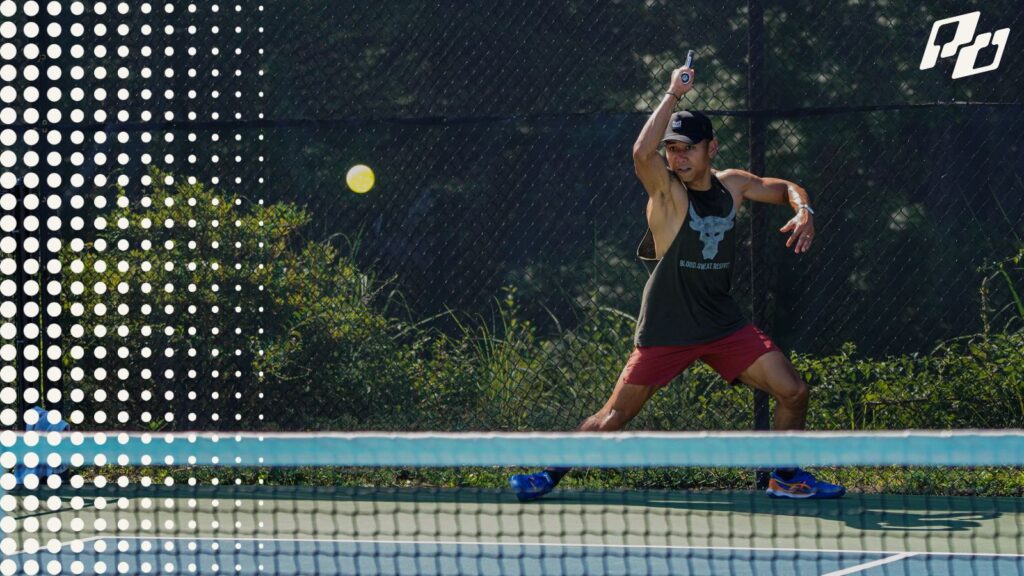
- Contact through the target, out in front
- Paddle face square at contact
- Follow-through can naturally wrap after contact
The key distinction:
- ❌ Cutting across at contact = ball leaks wide
- ✅ Wrapping after contact = totally fine
Direction is decided at contact, not at the finish.
The doubles rule: don’t change direction unless you’ve earned it
Changing direction is harder than sending the ball back where it came from—so the cost of missing is higher.
A great rec-doubles filter: only change direction when you have time, balance, and contact out front. That’s exactly the kind of situation coaches call out when trying to reduce unforced errors.
So if you’re stretched, late, or jammed? Go back where it came from. Live to play the next ball.
Where this matters most in rec doubles (high-leverage moments)
1) Dink rallies: crosscourt until you get a “gift”
Most rec doubles points are decided by one of two things:
- someone changes direction too early
- someone changes direction too late
- Default: dink crosscourt (bigger margin, lower net)
- Green light to change: you get a ball that sits up OR lands a bit high/short AND you’re stable.
And when you do change direction, do it with a small change—don’t “swing harder.”
2) Resets in transition: direction change is a luxury
If you’re resetting from midcourt, your job is height control first. Trying to get cute with direction here is how players donate points.
Rule: reset back where it came from unless the ball is slow and you’re set.
3) Speed-up counters: “back of the ball” is your friend
When pace is coming at you, “hit the back of the ball” becomes a great cue because it prevents the most common rec error: side-swipe counters that fly wide.
A counter that goes down the line isn’t about being brave—it’s about having the paddle face stable and meeting the ball in front.
The 3 mistakes that make this advice fail
Mistake 1: trying to “aim” instead of setting the face
If you try to steer the ball with your wrist, your face opens/closes randomly. Direction becomes inconsistent.
Fix: set your paddle face earlier, then swing smoothly.
Mistake 2: contact drifting beside your body
Late contact forces your shoulders to open—and that unintentionally sends balls crosscourt (and telegraphs your intent).
Fix: move your feet so contact is in front. If you can’t, simplify and send it back where it came from.
Mistake 3: changing direction under pressure
This is the #1 rec doubles donation.
Fix: earn the change with time and balance (the “feet underneath you” idea).
A simple way to practice it (that actually transfers)
Next open play, don’t “practice direction.” Practice the decision:
- If you’re balanced and the ball is in front → you may change direction
- If you’re stretched/jammed/late → you may not
That one rule will clean up more errors than any fancy cue.
The Simple Truth Behind Clean Direction Changes
“Back of the ball” vs “outside edge” is a shortcut for a deeper truth:
Direction change is mostly paddle-face angle + contact out front + swing path.
Not a bigger swing. Not a wrist flip. Not extra body rotation.
Get those three right, and you’ll start moving the ball like you meant to—without gambling points or spraying unforced errors.