Let me start with something I hear every coach tell an average 3.5 player: you’re not losing kitchen rallies because you lack aggression. You’re losing them because one neutral ball sits just a little too high.
Not a disaster.
Not a wild mistake.
Just enough height for your opponent to think, “That’s attackable.”
That’s the level most recreational kitchen battles are decided on — inches, not highlights.
And this is exactly where the two-handed backhand topspin dink becomes valuable. Not as a flashy pro shot. Not as a spin experiment. But as a margin tool that quietly shifts leverage in your favor.
If you understand it that way, you’ll practice it differently. And you’ll use it differently.
What’s Really Happening in Your Kitchen Exchanges
Watch a typical 3.0–4.0 doubles game.
➡️ Crosscourt dink.
➡️ Crosscourt dink.
➡️ Another neutral ball.
Then someone stands up slightly. The paddle face opens just a hair. The ball drifts higher than intended. And suddenly there’s a speed-up and a hands battle.
It doesn’t feel dramatic. It just feels… inevitable. That inevitability usually comes from one thing: unstable paddle face under pressure.
Flat dinks are fine — until they’re not.
Open-face dinks feel safe — until they float.
Forward pushes feel controlled — until they carry too deep.
The issue isn’t touch. It’s geometry.
And geometry is exactly what the two-handed topspin dink fixes — when it’s taught correctly.
The Real Advantage Isn’t Spin. It’s Contact Height.
Let’s clear up the biggest misconception first. This shot is not about “adding more spin.” It’s about lowering your opponent’s contact point.
When you hit a proper two-handed topspin dink:
- The ball clears the net with comfortable margin.
- It dips more sharply on the other side.
- It bounces lower and slightly accelerates forward.
That bounce profile forces your opponent to contact below net height more often.
And here’s the key: when players contact below the net, their speed-up window shrinks dramatically.
➡️ They have to lift.
➡️ They can’t drive flat.
➡️ Their attack angles compress.
You haven’t attacked. You haven’t taken risk. You’ve simply improved the geometry of the rally. That’s smart kitchen play.
Why Two Hands Make a Difference for Rec Players
Let’s talk about something that rarely gets explained clearly. Under kitchen pressure, your wrist wants to “help.”
It wants to make last-second adjustments. It wants to flick. It wants to open slightly if you feel late. And those micro-adjustments are exactly what create floaters.
Two hands stabilize the system. When both hands are on the paddle:
- The face becomes harder to manipulate accidentally.
- The swing path becomes more unified.
- The paddle tracks more predictably through contact.
✔️ The top hand drives the brushing motion.
✔️ The bottom hand anchors and stabilizes.
For many recreational players, this alone increases confidence on the backhand side. Not because they suddenly produce massive topspin — but because the paddle face stops wobbling under pressure.
That stability is the foundation. Spin is the byproduct.
The Geometry You Must Understand (Or It Won’t Work)
When pickleball coaches teach this concept, they don’t overload players with ten different cues.
They usually narrow it down to three key anchors — and build everything else around those.
First: Close the Face Slightly — and Keep It There
“Slightly” is important.
You’re not dramatically shutting the paddle. You’re just tilting it forward enough that, if you pushed straight ahead, the ball would hit the net.
Now here’s the part most players get wrong. They set that face angle correctly… and then right before contact, they panic and open it.
Why?
Because a closed face feels like it’s going into the net. That’s where trust comes in.
If you close the face but maintain the correct swing path (we’ll get to that next), the ball will clear and dip.
If you close the face and then push forward — yes, it will hit the net. The face angle and swing path must work together.
Second: The Swing Must Be More Up Than Forward
This is where the shot either works beautifully or falls apart. Most rec players think “topspin” means rolling forward.
It doesn’t.
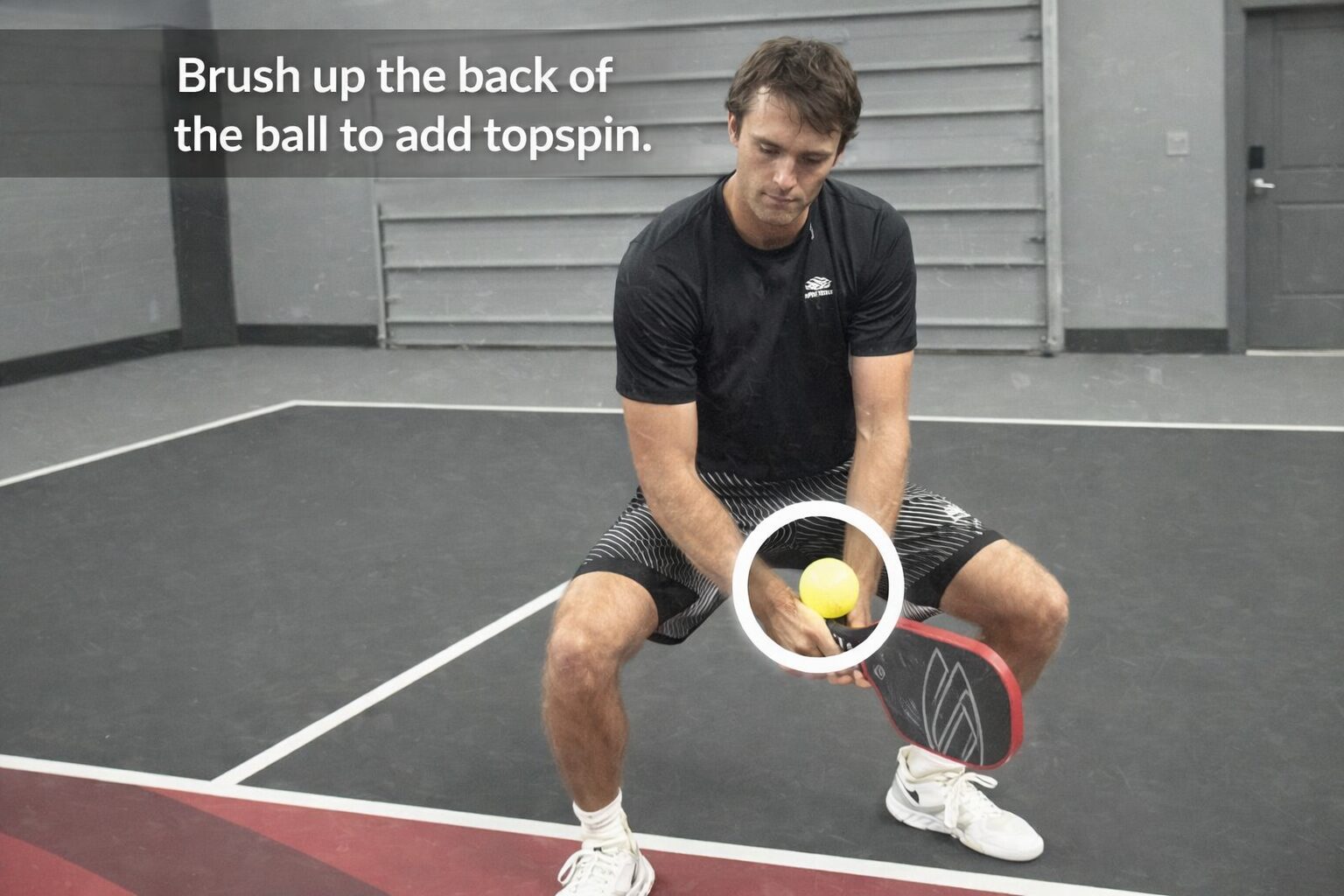
It means brushing up the back of the ball. If your swing path is mostly forward, you are pushing.
➡️ Push + slightly open face = floater.
➡️ Push + closed face = net.
The feel I use is this: “climb the back of the ball.”
Or even more specific:
“Lift the back of the ball toward their shoulder.”
That cue naturally increases your upward path and your net clearance. It also reduces the instinct to shove the ball forward.
You are shaping the ball up and over, not driving it through your opponent:
Third: Aim Higher Than You Think You Should
This is the non-intuitive part — and the one that unlocks consistency. When players close the paddle face, they subconsciously aim lower to compensate.
That’s the mistake.
If you aim tight to the tape with a closed face, you will hit the net. Instead, you must aim higher and trust the dip. The topspin will bring the ball down. That’s its job.
Your job is to give it space to work.
Once players truly trust this relationship — closed face, upward brush, higher aim — their error rate drops dramatically.
What This Looks Like in Real Match Situations
Let’s move away from mechanics and into application.
Imagine you’re in a crosscourt dink exchange on your backhand side. The pattern is neutral. Neither player is gaining ground.
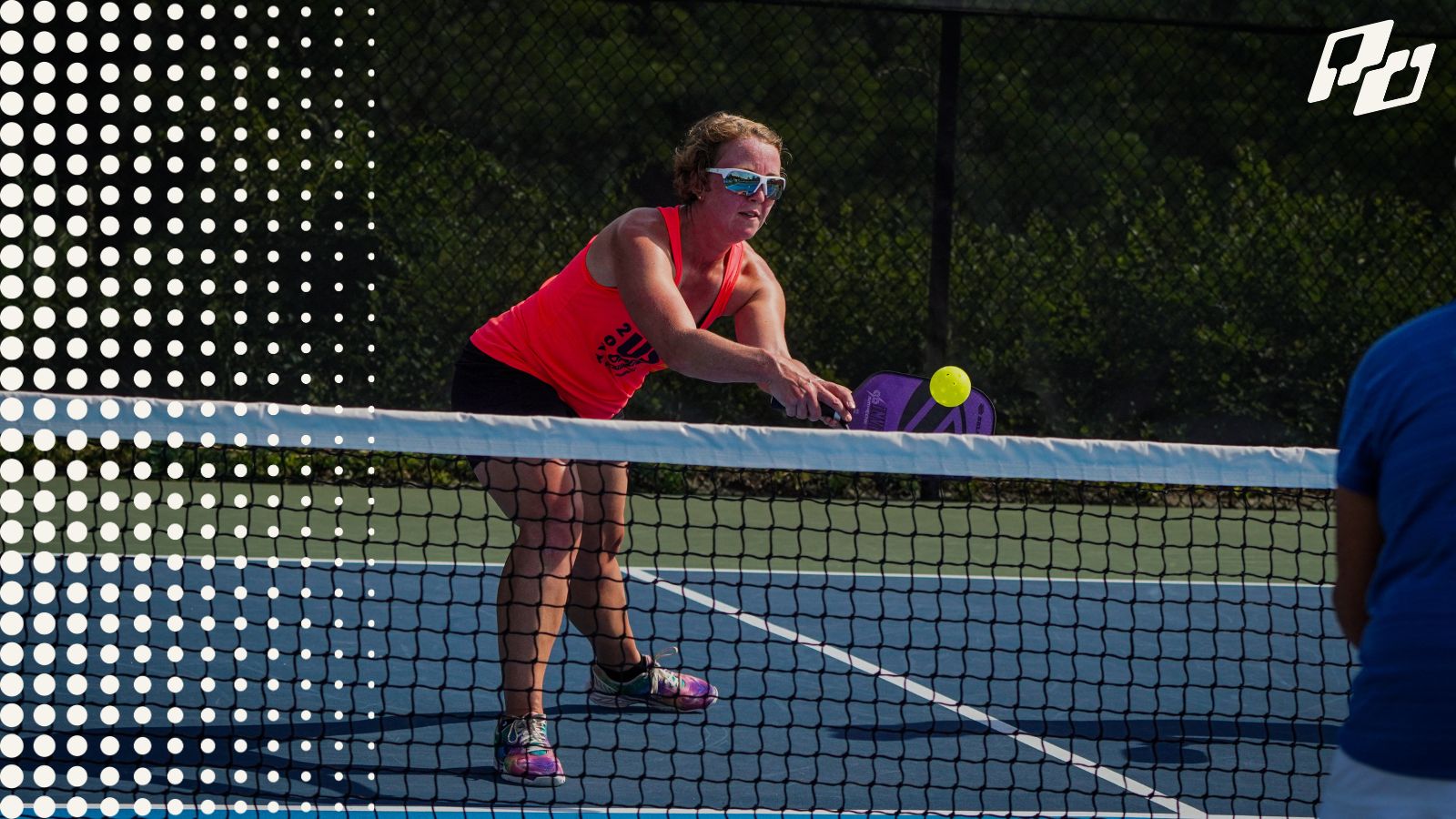
- You switch to two hands and shape a topspin dink crosscourt.
- The ball arcs slightly higher over the net. It drops faster. It bounces lower.
- Your opponent now contacts from just below net height instead of at chest level.
That small change alters the rally. They are less likely to speed up confidently. If they do, it’s often off a lower contact point, which increases their risk.
You didn’t escalate.
You improved leverage.
When It’s the Right Choice — and When It’s Not
This shot works best when:
- You have time.
- You are balanced.
- The incoming ball is neutral or slightly slow.
- You’re not stretched wide or jammed.
It is not a panic shot. If you are late or reaching, a simple one-handed neutral dink may be more stable.
Part of becoming a stronger rec player is knowing when to use the right tool. The two-handed topspin dink is a leverage tool, not a bailout.
A Few Subtle Details Most Players Overlook
There are small refinements that make a big difference.
First, grip pressure. Your top hand should feel slightly more active than your bottom hand. If both hands squeeze equally hard, you lose brush sensitivity.
Second, posture. If you stand tall, your shoulders lift and your swing flattens. Stay low enough that the paddle can move upward naturally without shoulder manipulation.
Third, contact point. Slightly in front of your body is critical. If contact drifts back toward your hip, the paddle face becomes harder to control and the ball tends to float.
These are not dramatic changes. They are quiet refinements that stabilize the geometry.
How to Measure Progress with the Two-Handed Backhand Topspin Dink
Early development of the two-handed backhand topspin dink should not focus on sharp angles or sideline precision. That comes later. Progress is measured by geometry and ball behavior.
Start with three checkpoints:
- Is the ball clearing the net with visible margin?
If it’s barely skimming the tape, the upward component isn’t strong enough. - Is the ball visibly dipping after it crosses the net?
A proper topspin trajectory should rise, then drop. If it floats flat, the face angle or brush path is inconsistent. - Is your opponent contacting from a lower position than before?
This is the real indicator. If their contact point drops below net height more often, the shot is doing its job.
When those three markers are consistent, the geometry is stabilizing. Only after that should placement be tightened.
➡️ Margin first. Precision second.