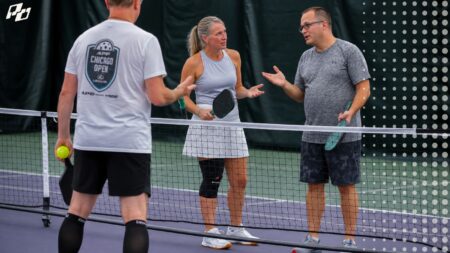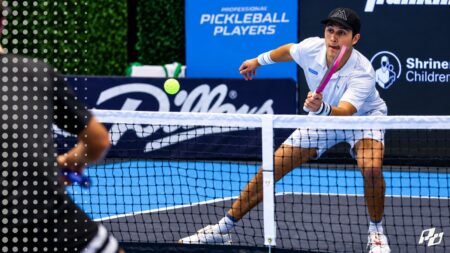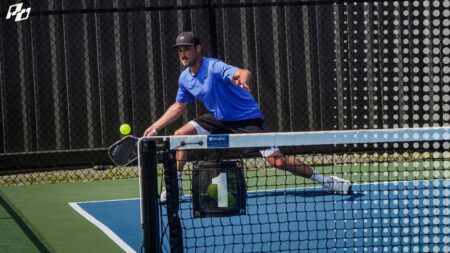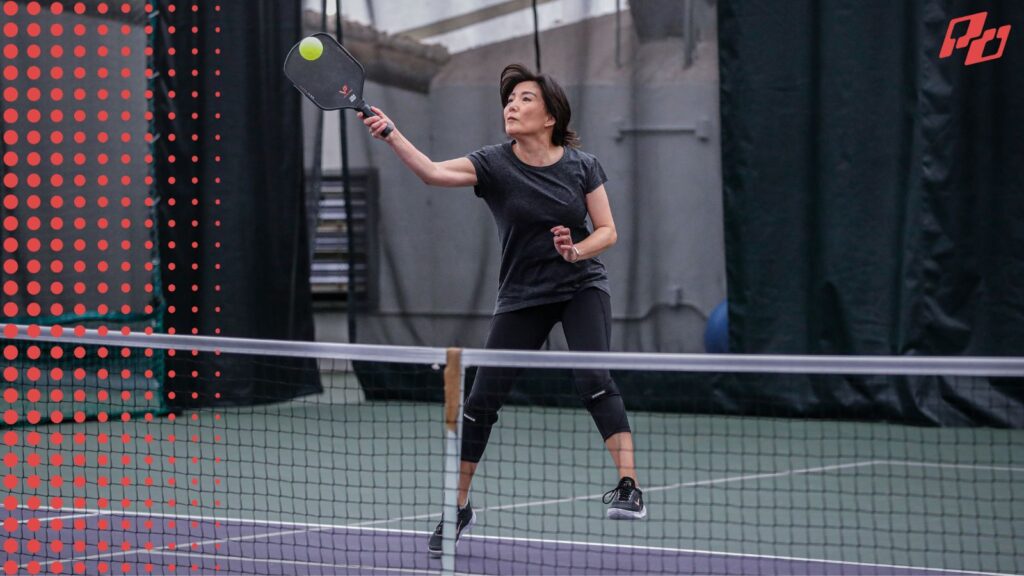
A lot of rec players struggle with this exact situation. The ball floats up a little too high — maybe off a weak dink, a hanging reset, or a soft drop that sits up — and you know you should attack it. But it is not high enough for a full overhead. So now you are stuck in that awkward middle zone where a lot of players either:
- force the ball into the net
- slap it long
- get too wristy
- or hit it hard but with no real control
That is why this shot matters so much.
If you can learn to attack shoulder-high or head-high balls efficiently, without over-swinging, you win a lot more easy points. You also stop wasting some of the best attack opportunities rec pickleball gives you.
And the key is not swinging harder. The key is understanding what kind of shot this actually is.
First, let’s define the ball we are talking about
This article is not about a full overhead. It is about the in-between ball — the one that sits around shoulder height, maybe a little above, but is still too low or too close to your body for a classic overhead motion.
This is often:
- a high dink that sat up
- a floaty reset
- a drop that bounces too high
- a popped-up volley
- or a high transitional ball you can step into
These are attack balls, but they are not always overhead balls. That distinction matters.
Why rec players struggle with this shot
Most intermediate players miss this ball for one of three reasons.
They try to hit an overhead on a ball that is too low
This usually creates awkward contact, poor spacing, and a rushed, jammed swing. An overhead needs:
- more space
- more height
- more time
- and a different contact window
When the ball is down around shoulder or head height, the full overhead motion often does not fit.
They try to drive it like a normal forehand
This can work sometimes, but many players drop the paddle too low, over-swing, or try to “lift and rip” from a contact point that really needs a more compact attack shape.
That usually leads to balls sprayed long or pulled into the net.
They get too tight
This may be the biggest issue of all. Players see a high ball and think, “I have to crush this.” So they tense the arm, tighten the wrist, grip too hard, and force the shot.
Ironically, that usually kills the power.
The advice you shared gets this exactly right: efficient power comes from looseness, not from muscling the ball.
What this shot actually is
Think of this shot as a compact high forehand attack.
✖️ Not an overhead.
✖️ Not a full groundstroke.
✖️ Not a wrist flick.
It is a short, controlled attack motion where:
- the paddle starts closer to ball height
- the shoulders turn only a little
- the wrist stays loose
- and the body helps drive through the ball
That is why the technique looks simpler than a big forehand or overhead. It has to be.
You often do not have time for a big preparation, and you do not need one anyway. The ball is already high enough that you can attack it with a compact motion.
Why starting higher matters
If the ball is shoulder-high or head-high, and you start your paddle way down low, you are creating extra work for yourself. Instead, start the paddle more at the level of the ball.
That does not mean the paddle has to be frozen high and stiff. It just means your setup should match the contact point.
This is a simple rule that helps on a lot of shots in pickleball: start closer to where you plan to contact the ball.
For this ball, that usually means a more compact takeback and a higher starting position than you would use on a low drive.
The real source of power: loose arm, loose wrist, connected body
This is where a lot of players get confused. When coaches say “loose wrist,” they do not mean:
- floppy,
- uncontrolled,
- or snapping wildly at contact.
They mean the arm and wrist are not tense. That looseness lets the paddle move faster and more naturally through the ball.
For this shot, the power should come from:
- a loose but organized arm
- a short shoulder turn
- some chest and upper-body rotation
- and smooth acceleration through the target
That is very different from just swatting at the ball with the hand.
Grip: why continental or slight eastern forehand works
You should use a continental or slightly eastern forehand grip, and that makes sense. Why?
Because this shot lives in a kind of middle ground.
You want enough support to:
- keep the paddle face stable,
- contact the ball out front,
- and drive through it without opening the face too much.
A continental grip works well for players who like versatility and fast hand adjustments.
A slight eastern forehand can make it easier to keep the paddle face a little more closed, which can help if you tend to float these attacks.
For most rec players, the simplest advice is:
- use your normal neutral attacking grip if it is already comfortable,
- but if you keep leaving this ball too open, a slight eastern forehand grip may help you drive through it more cleanly.
The important part is not hunting for a fancy grip change. It is making sure the grip helps you present a stable, slightly closed or neutral paddle face at contact.
The setup: smaller than you think
This is one of the biggest clarifications intermediate players need. You do not need a full unit turn on this ball. In fact, too much backswing is usually a problem.
When the ball is sitting up at shoulder height and the opportunity happens quickly, the best setup is often:
- a slight shoulder turn
- a short paddle set
- and then a compact forward swing
That is what makes the shot efficient.
Big swings are usually too slow for kitchen attacks and midcourt put-aways. They also make it harder to control direction.
This is especially true in rec play, where many players lose these balls by trying to hit a highlight-reel winner instead of a compact, repeatable attack.
So think: set early, turn a little, swing short, accelerate smoothly.
The contact point: out in front, not beside you
This shot gets much easier when you contact it in front. If the ball drifts too far beside your body or starts to crowd you. This is why spacing matters so much.
If possible:
- move your feet,
- create a little room,
- and let the ball sit in front of your hitting shoulder line.
That gives you a much cleaner path through the ball.
A lot of rec players think they missed because their swing was wrong, when the real problem was that they let the ball get too close.
What the follow-through should feel like
The follow-through on this shot should not be huge. It should feel like you are:
- driving through the ball,
- extending toward your target,
- and finishing in a natural, controlled area around chest or shoulder height.
A good cue is: finish through the ball, not around it.
That helps keep the shot cleaner and more direct.
When not to use this shot
Do not force this shot when:
1. The ball is too low
If the ball is below comfortable attack height, trying to hammer it usually creates errors. Choose a different attack or keep the rally under control.
2. You are badly off balance
If your feet are still tangled and your body is drifting, you may not be able to hit this cleanly. A compact shot still needs some structure.
3. The ball is too close to your body
If you are jammed, this becomes much harder to execute well.
4. You actually have a real overhead
If the ball is clearly high enough and spaced well enough for an overhead, use the overhead motion instead. Do not turn every overhead into this in-between shot.
5. Your opponent is already baiting a reckless attack
Some high balls are attackable, but not necessarily attackable to every location. If the middle is crowded or the counter is sitting there waiting, attack smarter, not just harder.
Best targets for rec players
A lot of players think the goal is to hit this as hard as possible.
Usually, the better goal is to hit it clean enough and to the right place. Good targets include:
- at the opponent’s body
- down at their feet if they are in transition
- through the middle if there is confusion
- or into open space if it is clearly available
For rec players, the body and middle are often the most reliable. Why?
Because they require less precision than a sideline laser, and they still create a lot of pressure.
If you can hit this shot firmly at someone’s right shoulder, hip, or transition feet, you will win a lot of points without trying to paint lines.
Why this shot matters so much for intermediate players
This may seem like a small skill, but it wins a lot more points than most rec players realize.
At the 3.0–4.0 level, players miss a ton of attack chances not because they are too slow or not strong enough, but because they read the ball wrong.
When you clean this shot up, the payoff is immediate. You finish more of the balls that should be put away. You stop overhitting attackable sitters. You become much more dangerous whenever a dink, drop, or reset floats a little too high. And just as important, your opponents stop getting away with balls that used to survive simply because you did not know how to punish them efficiently.
Learn to recognize this ball, stay loose, and attack it with a compact, efficient motion, and you will start winning points that used to slip away.