
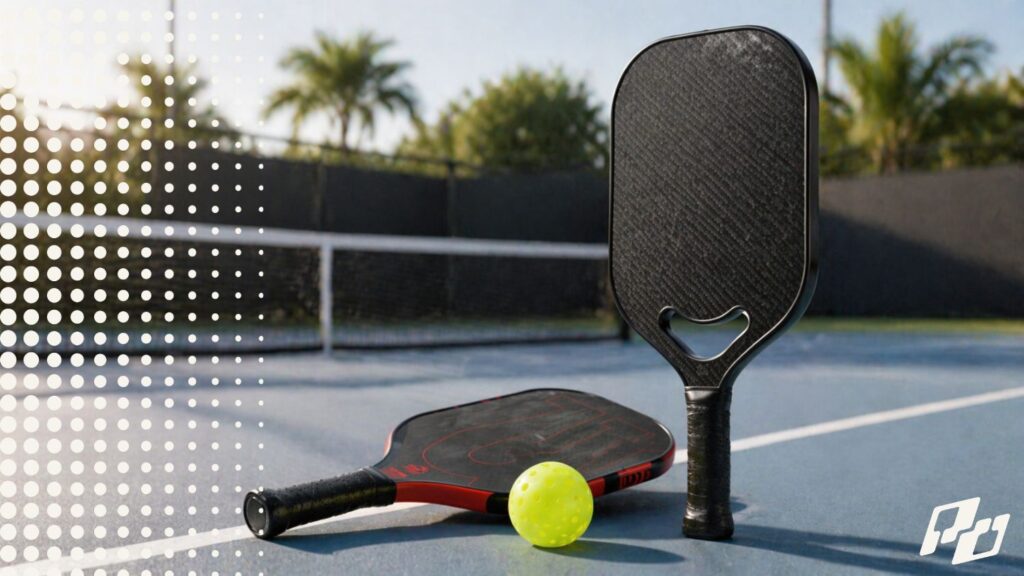
Edgeless pickleball paddles can feel quicker, cleaner, and less bulky around the perimeter, which some players love in fast hands battles. But they usually offer less built-in edge protection than traditional paddles, so they make the most sense for players who value speed and feel over durability.
Edgeless paddles have one of the best reputations in pickleball marketing.
Before you spend a dollar on this, take the paddle quiz: ten questions, three paddles matched to how you actually play.
They sound sleek. They look fast. They promise a cleaner paddle face, fewer edge-guard mishits, and a more modern feel. And if you have ever clipped the edge guard on a volley and watched a very makeable ball die for no good reason, the pitch makes immediate sense.
But edgeless paddles are also one of those gear categories where the conversation gets fuzzy fast.
Some players talk about them like they are automatically more advanced. Others act like they are fragile vanity projects. The truth, as usual, is more interesting: edgeless paddles can be excellent, but they are not automatically better. They just make a different set of tradeoffs. Retailers and brands consistently frame the category around a larger uninterrupted face, cleaner aerodynamics, and maneuverability, while also warning that edge-guard-less designs can need extra protection from scrapes or wear.
So if you are a rec player trying to decide whether an edgeless paddle is actually a smart buy, the real question is not, “Are edgeless paddles good?”
It is: “What do I gain, what do I give up, and does that match how I actually play?”
Ten questions, three paddles matched to how you play, scored on lab data.
What is an edgeless pickleball paddle?
The simplest definition is this: an edgeless paddle does not use a traditional attached edge guard around the perimeter.
That does not mean the paddle has no edge at all. It means the edge is sealed or finished as part of the paddle construction instead of having the classic protective bumper wrapped around it. Pickleball Central explicitly says “edgeless” is not a perfect term and that “edgeguard-less” would be more accurate, because modern construction can seal the edge without a separate edge guard.
That distinction matters because a lot of rec players imagine edgeless paddles as somehow unfinished or exposed. They are not. They are simply built differently around the perimeter.
In practical terms, the two broad categories are:
- Traditional edged paddles: paddle face plus attached edge guard
- Edgeless paddles: paddle face with sealed edge and no attached guard
That one construction change affects a lot more than people expect.
Why do players like edgeless paddles?
Because the benefits are real. The biggest selling points usually come down to four things:
- cleaner feel at contact
- slightly more usable face area
- faster handling
- and fewer weird edge-guard interactions
Selkirk says edgeless paddles provide a bigger paddle face and therefore a larger sweet spot, while Pickleball Central highlights the larger hitting surface and reduced mishits as major reasons players like them.
Now, some of that language is brand-forward and optimistic, so it is worth translating it into normal-player terms.
What rec players often actually notice is this:
- the paddle can feel a little faster through the air,
- the outer face feels cleaner and more uninterrupted,
- and edge clips can feel less intrusive when you catch a ball near the perimeter.
That does not mean every edgeless paddle suddenly has a magic sweet spot. It means the design can make the paddle feel a little cleaner and quicker in the hand.
The biggest pros of edgeless paddles
1. They often feel quicker and more maneuverable
This is one of the main reasons people try them.
Removing a traditional edge guard can help keep the perimeter lighter and cleaner, which can contribute to faster handling. Retail paddle guides broadly connect lower swing demand and cleaner construction with easier maneuverability, and many edgeless paddles are marketed toward players who want speed in hands battles and quick reactions.
For rec players, that usually shows up in:
- faster exchanges at the kitchen
- easier hand speed on counters
- and a paddle that feels less bulky around the edges
If you are the kind of player who values quick hands and reactive volleying, that is a real plus.
2. The face can feel more uninterrupted
This is a subtle benefit, but a lot of players care about it.
With a traditional edge guard, some players feel like they are always aware of the paddle’s border. With edgeless paddles, the paddle face can feel visually and functionally cleaner. That can be psychologically helpful too, especially for players who hate clipping the edge on blocks or reflex volleys.
This is one reason brands and retailers keep using terms like “larger face” or “more usable hitting area.” Even if the dimensional difference is not dramatic, the feel of the outer zone can be more continuous.
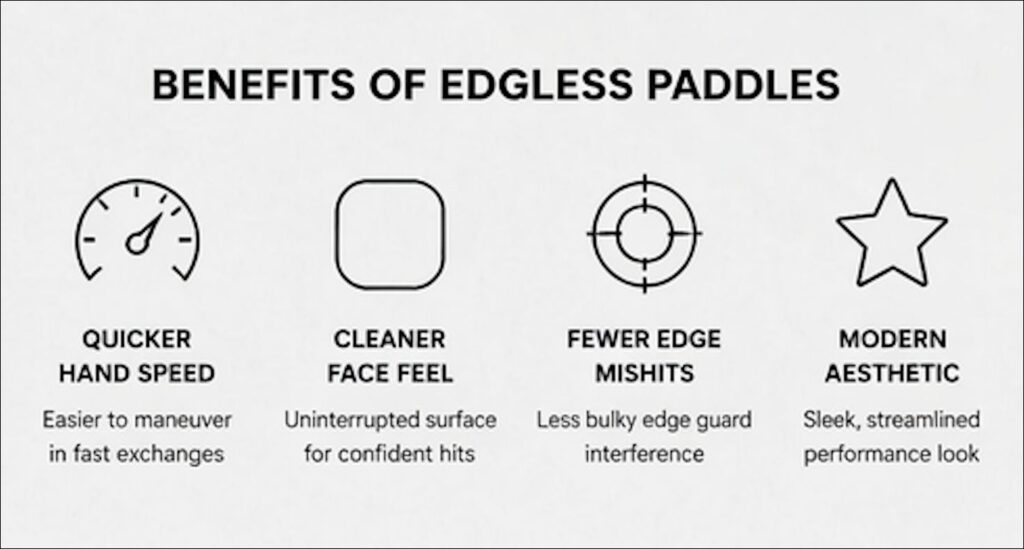
3. Fewer edge-guard mishits
This is a very real rec-player complaint.
With traditional edged paddles, there are times when the ball catches that outside edge guard area in a way that feels dead, clunky, or just unfortunate. Edgeless paddles reduce that kind of interaction because there is no bulky bumper there to interfere.
That does not mean every near-edge contact suddenly becomes beautiful. But it can reduce the specific annoyance of obvious edge-guard catches.
4. They look and feel modern
This is not performance science. It is just true.
A lot of players like edgeless paddles because they look sleek, aggressive, and high-tech. That may sound superficial, but gear confidence is a real thing. If a paddle makes you want to play with it, that matters.
It just should not be the only reason you buy one.
The biggest cons of edgeless paddles
1. They are usually less protected
This is the big one.
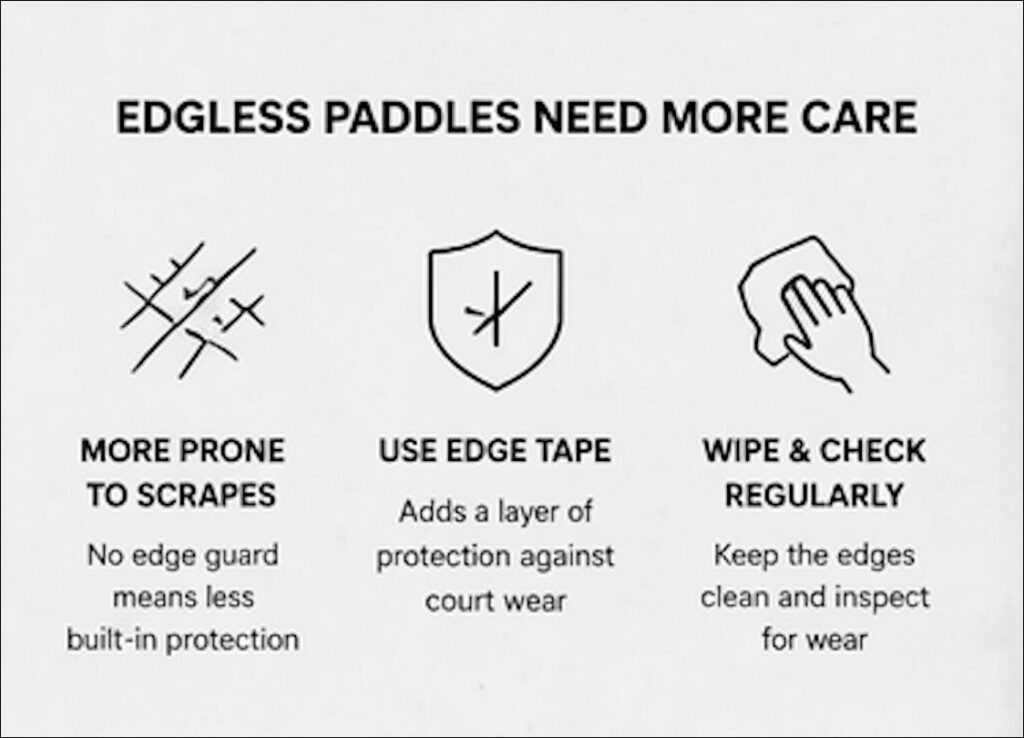
Traditional edge guards are not just decoration. They protect the paddle’s perimeter from scraping the court, clipping shoes, banging against fences, and all the dumb little things that happen in real play. edge guards help protect the paddle core and edges from damage and delamination.
Selkirk even recommends applying edge tape to protect edgeless paddles from scrapes. That is one of the clearest signals in the market that yes, edgeless paddles often need more perimeter care.
So if you are a rec player who:
- scrapes the court a lot
- dives or reaches low often
- tosses your paddle in a bag carelessly
- or just tends to be rough on gear
this matters.
2. Durability can feel more stressful
Even if the paddle is structurally solid, a lot of players worry more about visible wear on edgeless paddles.
Why? Because damage on the perimeter can feel more personal when there is no edge guard there to absorb it. You notice every scrape. Every chip feels like a bigger deal.
Some players can live with that. Others hate it.
3. The “bigger sweet spot” claim is not universal magic
This is where people sometimes get carried away.
Yes, some edgeless paddles feel more forgiving near the edge. Yes, brands emphasize larger usable face area. But forgiveness is also heavily shaped by:
- shape
- core construction
- twist weight
- overall balance
- and face consistency
In other words, an edgeless paddle is not automatically more forgiving than an edged paddle. Plenty of edged paddles are extremely forgiving, and some edgeless paddles can still feel demanding depending on how they are built.
Broader paddle-buying guides make this point indirectly all the time: control, forgiveness, and stability come from the whole paddle design, not one construction buzzword.
4. Some players simply prefer the protected feel of an edge guard
This is more subjective, but it is real.
A traditional edged paddle can feel more solid, more protected, and more worry-free. Some rec players like knowing the perimeter is guarded, especially if they are not gear nerds and do not want to baby a paddle.
That preference is valid.
So who should actually buy an edgeless paddle?
This is where the conversation gets practical.
Edgeless paddles are a strong fit for:
- players who value quick hands and maneuverability
- players who like a cleaner, faster-feeling paddle
- players who spend a lot of time in fast kitchen exchanges
- players who do not mind using edge tape
- and players who take decent care of their equipment
If you are a reactive doubles player who wants the paddle to feel quick and uncluttered, edgeless can make a lot of sense.
Edgeless paddles are probably a weaker fit for:
- players who scrape the court a lot
- beginners who are hard on gear
- players who want maximum protection and low-maintenance durability
- and players who do not care about subtle handling differences
If you are rough on paddles, there is a very good chance you will enjoy an edge guard more than you enjoy the “clean” look of edgeless.
Quick Cheat Sheet: Should You Buy an Edgeless Pickleball Paddle?
If you want the fastest way to decide whether an edgeless paddle actually fits your game, use this cheat sheet.
| If this sounds like you… | Edgeless paddle? | Why |
|---|---|---|
| You want quicker hands and a faster-feeling paddle | Probably yes | Edgeless paddles often feel a little cleaner and more maneuverable in fast exchanges. |
| You hate clipping the edge guard on volleys | Probably yes | A cleaner perimeter can reduce that bulky edge-guard feel. |
| You love sleek, modern paddle designs | Probably yes | Edgeless paddles usually have that fast, streamlined look and feel. |
| You scrape the court a lot | Probably no | Traditional edge guards usually protect the paddle better from wear and scrapes. |
| You are rough on your gear | Probably no | Edgeless paddles often need more care, or at least some edge tape. |
| You want low-maintenance durability | Probably no | A standard edge-guard paddle is usually the safer, easier choice. |
| You mostly care about comfort, forgiveness, and control | Maybe | Edgeless alone does not guarantee any of those — the full paddle build matters more. |
| You play a lot of fast kitchen doubles | Probably yes | This is the kind of player most likely to notice the handling benefits. |
| You are a newer rec player buying your first serious paddle | Usually not first priority | Start with fit, weight, control, and forgiveness first — then decide if edgeless helps. |
Are edgeless paddles better for beginners?
Usually not as a default recommendation.
That does not mean beginners can never use them. It just means “edgeless” is not the first feature most new rec players should prioritize.
For most beginners, the bigger priorities are:
- grip comfort
- weight
- forgiveness
- and overall control
If the best paddle for those things happens to be edgeless, fine. But I would not tell a new player, “Start with edgeless because edgeless is better.”
That is too simplistic.
Are edgeless paddles better for advanced players?
Sometimes, yes.
More advanced players are more likely to notice and benefit from:
- quicker hand speed
- subtle perimeter feel
- and slightly cleaner paddle aerodynamics
They are also more likely to understand what they are trading away in durability and protection.
That is why edgeless designs often show up in premium, performance-oriented paddle lines. They appeal to players who are tuned in to feel and handling.
Still, “advanced” does not automatically mean “should buy edgeless.” Plenty of strong players still prefer traditional edged paddles because they value durability, stability, or simply familiar feel.
How do edgeless paddles compare to paddles with edge guards?
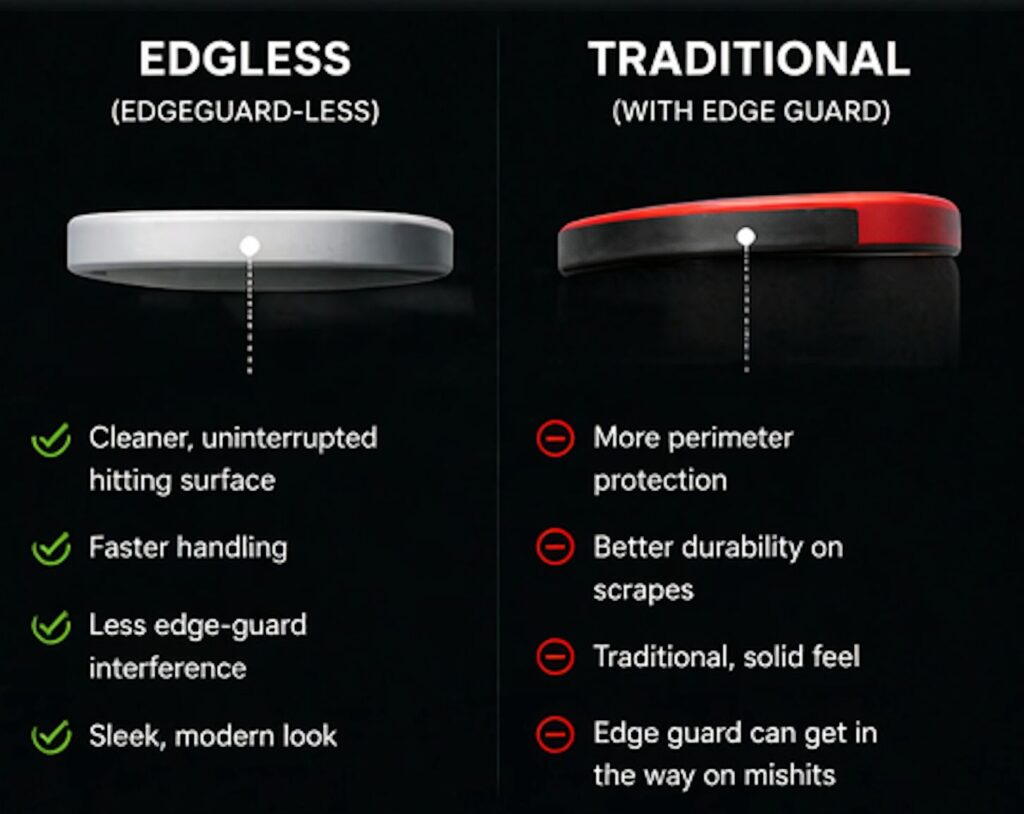
Here is the cleanest way to think about it:
Edgeless paddles usually offer:
- cleaner feel
- faster look and handling
- less bulky perimeter
- fewer annoying edge-guard catches
- but less built-in edge protection
Edged paddles usually offer:
- better perimeter protection
- more peace of mind on scrapes and abuse
- often a slightly more traditional, protected feel
- but with a more obvious border and sometimes a bit more bulk at the edge
This is not really “new tech beats old tech.”
It is more: speed and feel vs protection and forgiveness of abuse.
That is a much more honest framing.
What should rec players watch out for when shopping?
Do not let “edgeless” be the whole story.
If you are comparing paddles, you still need to look at:
- shape
- core thickness
- swing weight
- twist weight or stability clues
- grip comfort
- and overall control vs power profile
Pickleball Central’s buyer guide and JustPaddles’ educational content both make the broader point that construction type is only one part of paddle fit. Weight distribution and total paddle build matter a lot.
That means a smart rec-player question is not: “Should I buy edgeless?”
It is: “Do I want this paddle, and is edgeless one of the reasons it fits my game?”
That is a much better shopping mindset.
Do edgeless paddles need edge tape?
Often, yes — or at least they benefit from it.
This creates one of the funniest little truths in pickleball gear: some players buy an edgeless paddle for the clean edge, then add protective tape to it.
That is not wrong. It just means they want the construction and feel of edgeless without fully trusting their local court surfaces or their own habits.
For rec players, the practical takeaway is simple: if you buy edgeless, plan to think about protection more than you would with a traditional edge-guard paddle.
What kind of player tends to love edgeless paddles?
Usually the player who says things like:
- “I want my paddle to feel quick.”
- “I like a clean, fast look.”
- “I hate clipping the edge guard.”
- “I care about hand speed.”
- “I don’t mind taping the edge if needed.”
What kind of player tends not to love them?
Usually the player who says:
- “I’m rough on paddles.”
- “I want worry-free durability.”
- “I scrape the court all the time.”
- “I care more about longevity than sleekness.”
- “I don’t notice subtle feel differences much.”
That is the personality split more than the rating split.
The bottom line
Edgeless pickleball paddles are not hype. They offer real benefits.
They can feel faster, cleaner, and less cluttered around the perimeter, and a lot of players genuinely like the way they move and respond. But they also give up some built-in protection, and they are not automatically better just because they look more modern.
Brands and retailers are pretty consistent on this tradeoff: edgeless can mean more usable face feel and speed, but it also usually means you should pay more attention to edge wear and protection.
So for rec players, the smartest answer is:
⮕ Buy an edgeless paddle if you want speed, clean feel, and quick handling and you are okay with more care and less perimeter protection.
⮕ Stick with an edged paddle if you want durability, simplicity, and less stress about scraping your gear.
That is the real trade.
And once you see it that way, edgeless paddles get a lot less mysterious.