Grunting in pickleball is not automatically wrong, but loud, constant grunting can become distracting. A controlled exhale may help rhythm, looseness, and power, but rec players should keep it proportional. If the sound shows up on every dink, reset, and routine volley, it is probably too much.
This is one of those pickleball questions that sounds ridiculous right up until it starts affecting actual games: Should you grunt when you hit the ball?
Not “do weird noises happen sometimes when you lunge for a net-cord dribbler.”
Not “do you naturally exhale on a hard serve.”
I mean the real thing: audible grunting, on purpose or semi-on-purpose, as part of your shot rhythm.
And this is worth talking about because the honest answer is not just, “That’s annoying,” and it is not just, “Pros do it, so it must help.”
The truth is more useful than either extreme:
A controlled exhale can help.
A loud, constant grunt is usually a bad trade for rec pickleball.
Why Some Players Feel Better When They Grunt
Let’s start with the part that surprises people: there is a real reason some players think grunting helps.
Sports research on tennis and other striking sports suggests that a grunt or forceful exhale can be associated with more force output and can affect how opponents perceive the shot. One tennis study found grunting increased groundstroke velocity, while another found louder grunts changed how opponents judged shot depth; earlier work also found grunts could slow reaction and reduce accuracy in an opponent’s judgments.
That does not mean “the louder you are, the better you play.”
It means something narrower:
- forceful exhaling may help some players stay loose
- it may help with rhythm and timing
- and it may create a small performance effect in explosive movements
That part is believable.
If you have ever hit a hard drive or serve and felt better when you breathed out sharply instead of holding your breath, you already know this intuitively.
And honestly, a lot of rec players do not have a grunting problem. They have a breathing problem.
They get tight.
They brace.
They hold their breath during fast exchanges.
Then they wonder why their hands feel slow and their body feels robotic.
So yes, there is something real here. But that is not the same as saying:
“Therefore, loud grunting is a good idea in pickleball.”
That leap is where people get into trouble.
Why Pickleball Is Different From Tennis Here
Even if grunting has some legitimate sports-performance logic behind it, pickleball is not tennis.
The court is smaller.
The reaction windows are shorter.
The players are closer.
The social context is tighter.
And the sound lands much differently when everyone is packed near the kitchen line.
A tennis baseline grunt has a completely different feel than a loud noise in a dink exchange when your opponent is standing a few feet away and trying to track a fast redirect.
That is why something that feels normal in one racket sport can feel over the top in another. It is also why experienced rec players tend to make a distinction between:
- natural effort noises
- and performative, constant, or disruptive grunting
That distinction matters a lot.
Because a short breathy “tss” on a hard drive is one thing. An “UUUHHH!” on every reset, volley, and routine dink is another.
What the Rules Actually Say
This is where the conversation gets more serious.
USA Pickleball’s 2026 rulebook defines a distraction as a physical action “not common to the game” that interferes with an opponent’s concentration, and the examples explicitly include making loud noises. The rulebook also says a player must not distract an opponent when the opponent is about to hit the ball, and in tournament play the referee decides whether that distraction occurred.
The USA Pickleball Sportsmanship Guide also leans hard on courtesy and respect, which matters because this is not just a technical rules issue. It is also a community issue.
So if you were hoping for a clean rule that says:
- “All grunting is illegal,” or
- “All grunting is fine,”
you are not going to get it.
The real rulebook answer is more like this: If your noise crosses into distraction, it can become a fault.
That is not super satisfying because it leaves room for judgment. But honestly, that is probably correct. Because there is a huge difference between:
- a natural exhale on a full-extension speed-up
- and a long theatrical yell in a hands battle
The rules leave room for that difference on purpose.
The Social Answer Is Usually Simpler Than the Rulebook Answer
Here is the practical truth for rec play: If multiple people notice your noise, your noise is probably too much.
That is not a legal standard.
It is a social one.
And for open play, leagues, community centers, church gyms, and rec groups, the social standard usually matters more than the abstract philosophical one.
Because even if you could argue:
“Technically this is just my natural hitting process,”
if three people are visibly uncomfortable, the game quality is dropping and the vibe is getting weird, you are losing the bigger battle.
And rec pickleball is still rec pickleball.
You are not at Arthur Ashe Stadium.
You are trying to get invited back.
That matters.
The Better Distinction: Exhale vs. Grunt
A lot of players do not actually need to “grunt.”
They need to exhale on time.
Those are not the same thing.
A good exhale:
- keeps you from holding your breath
- helps you stay looser through contact
- can improve rhythm
- feels proportional to the effort
- usually does not bother anybody
A bad grunt:
- is louder than the shot requires
- shows up on routine balls
- feels theatrical or habitual instead of functional
- can mask contact cues
- can distract or irritate opponents
- makes you memorable for the wrong reason
That is why one of the smartest rec-player cues is:
Exhale, don’t perform.
If your noise helps your breath and timing without making you sound like you are trying out for a tennis parody, great.
If it sounds like a character choice, that is usually the moment to back off.
When Noise Is Most Defensible
Let’s be fair. There are absolutely shots where sound is more understandable:
- lunging at a net-cord trickler
- digging a low emergency ball
- ripping a full-speed drive
- serving hard with intent
- finishing an overhead on the run
- extending into a difficult passing shot
In those moments, a little audible effort is normal.
Most rec players will not care much, but if someone makes the same loud sound on routine dinks, casual volleys, slow resets, every serve, and basically every shot, people often start seeing it as gamesmanship or attention-seeking — fair or not.
The Kitchen-Line Reality Test
Here is a simple test I would use: Would this sound still feel reasonable if your opponents were standing three feet away?
Because at the kitchen, you do not get the same acoustic forgiveness you get in tennis.
The whole exchange is tighter.
Faster.
Closer.
More intimate, in the least romantic way possible.
That is why a lot of players who can tolerate baseline noise get much more annoyed by loud grunting in volley exchanges and dink rallies.
At the kitchen, even a small sound feels bigger.
So if your noise is surviving the “kitchen-line reality test,” you are probably fine.
If it is not, that is usually your answer.
Does Grunting Give You an Unfair Advantage?
Sometimes, yes. At least potentially.
That is part of why this topic gets so touchy.
Some researchers and players argue that noise can interfere with an opponent’s ability to read the shot, whether by distraction, masking timing cues, or simply disrupting concentration. The existing racket-sport research does support the idea that sound can affect an opponent’s judgments and response.
That does not mean every grunt is some evil act of psychological warfare.
But it does mean this is not purely a “mind your own business” issue either.
If your opponent’s noise is actually making it harder to track, react, or concentrate — especially right before contact — you are no longer just in etiquette territory. You are drifting toward distraction territory, which the rulebook explicitly covers.
So the right standard is not:
“Do I personally think this is annoying?”
It is more like:
“Is this proportionate, normal, and non-disruptive in this setting?”
That is a much better question.
What I’d Tell Rec Players to Actually Do
Here is the practical advice.
If you currently grunt:
Do not start with shame. Start with awareness.
Ask yourself:
- Is it happening only on big-effort shots?
- Or is it showing up on everything?
- Is it short and natural?
- Or long and dramatic?
- Does it feel like a breath cue?
- Or has it become part of your identity on court?
Then try this:
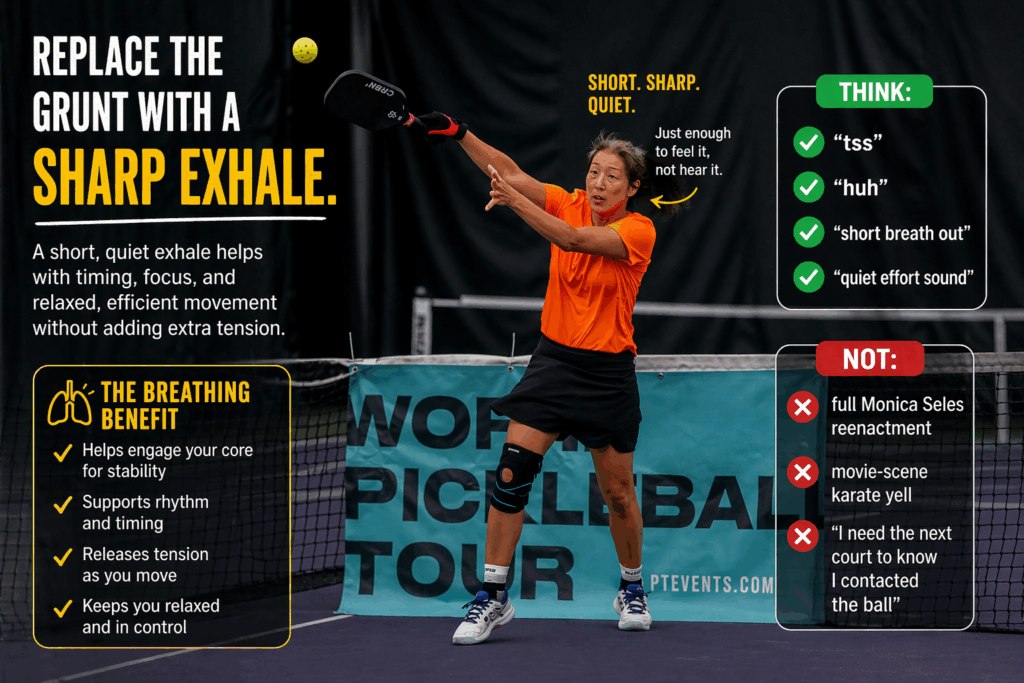
Replace the grunt with a sharp exhale.
Think:
- “tss”
- “huh”
- short breath out
- quiet effort sound
Not:
- full Monica Seles reenactment
- movie-scene karate yell
- “I need the next court to know I contacted the ball”
If you can keep the breathing benefit while lowering the volume and drama, you usually get the best of both worlds.
Match the sound to the effort.
This is a great rule.
Hard shot? Some sound is normal.
Routine ball? Keep it smaller.
Soft dink? Probably almost nothing.
That one rule alone cleans up a lot.
Use it as a cue, not a costume.
The purpose of the sound should be:
- release tension
- breathe out
- connect effort to contact
The purpose should not be:
- intimidation
- personality
- imitation of tennis pros
- making yourself feel more impressive
That difference shows up fast.
If Someone Else Is Doing It and It’s Driving You Nuts
Now let’s talk real-life rec pickleball. What if someone on the other side — or even on your own side — is doing way too much?
Do not start with the rulebook speech. Start human.
Something like:
“Hey, can I ask you something? The noise on some of your shots is pretty distracting up close. Would you mind toning it down a bit?”
That is much better than:
- eye rolls
- muttering
- copying them sarcastically
- passive-aggressive counter-grunting
- saving your frustration until you explode
If the person is reasonable, that usually solves it.
If they are not reasonable and the noise is genuinely affecting play, then yes, the rulebook does give you some support around distraction and loud noises.
But in non-officiated rec play, enforcement is messy, and the better move is often to handle it through direct conversation and group norms before it becomes a courtroom drama with paddles.