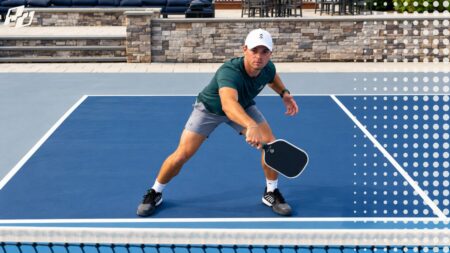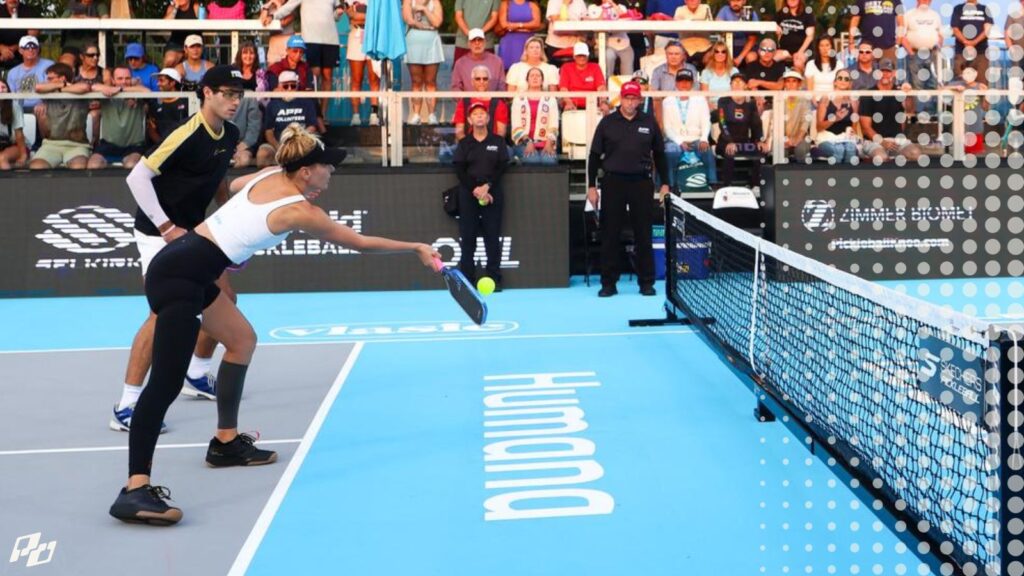
You can volley a dink below net height when you can reach it comfortably, stay balanced, and still make the reply bounce. Taking it early can steal time and preserve kitchen position. If you’re reaching, late, or likely to pop it up, let the ball bounce instead.
One of the oldest kitchen-line rules sounds simple: if the ball is below the net, let it bounce.
For newer players, that is not bad advice. But it is not how advanced pickleball is actually played.
Pros routinely take dinks out of the air below net height. James Ignatowich specifically teaches this shot, and Zane Navratil has emphasized how aggressively high-level players look to intercept dinks before they bounce. The reason is tactical: taking the ball early preserves your kitchen position and takes recovery time away from your opponent.
The important clarification is this:
Below the net does not mean “attack.” It can still mean “volley.”
Sometimes the smartest shot is a soft volley dink from six inches below net height. Other times, letting the ball bounce is clearly better.
The skill is knowing which situation you have.
First: Why Take a Low Ball Out of the Air at All?
If you cannot attack downward, why not simply let it bounce?
Because allowing the bounce changes the rally. Suppose your opponent sends a good crosscourt dink toward you.
If you let it bounce:
- the ball travels farther
- you may need to move backward or sideways
- your opponent gets more recovery time
- your contact may happen deeper behind the kitchen line
Take that same ball early and you can hold your position while sending it back before your opponent has fully recovered.
James Ignatowich describes volley dinking as a way to take control of the kitchen precisely because the earlier contact reduces the opponent’s time.
This is not necessarily offense through speed.
It is offense through time.
Yes, Pros Do This—A Lot
This is not an obscure trick.
Ignatowich and Ryan Fu specifically teach one-handed backhand dinks out of the air when the ball is below net height, emphasizing a firm wrist, very little motion, and using the incoming pace instead of adding a big swing:
Zane Navratil has also encouraged players to expand the range of dinks they take out of the air rather than automatically allowing them to bounce.
And pro-oriented coaching increasingly treats the volley dink as part of normal kitchen control rather than an emergency technique. Selkirk coach Dominic Catalano recommends taking the ball out of the air whenever it sits inside your comfortable reaching “bubble”—provided you can remain balanced and avoid overextending.
The reason pros can do this more often is simple: they recognize the ball earlier. That gives them time to move first and hit second.
The Shot Is Usually a Volley Dink, Not a Speed-Up
This distinction is crucial.
If the ball is clearly below the net, you generally cannot hit aggressively downward. You have to send it upward enough to clear the net. That makes a hard speed-up risky.
The normal response is therefore a soft volley dink:
- compact stroke
- controlled paddle face
- enough lift to clear the net
- enough softness that the ball still bounces in the opponent’s kitchen
Think: intercept and redirect, not attack and finish.
A good low volley dink may feel almost like catching the ball with the paddle and sending it back.
Cue
Take time away—not margin away.
The Real Green Light: Can You Stay Balanced?
This is more important than whether the ball is technically reachable.
If the ball is comfortably inside your reaching radius, take it out of the air. If you have to fully stretch, distort your swing, or risk falling into the kitchen, let it bounce.
That gives intermediate players a very practical test:
Take it out of the air when:
✔️ You recognize it early
✔️ You can shuffle behind the ball
✔️ Your arm remains comfortably in front
✔️ You can lean in without losing balance
✔️ You can make the return bounce
Let it bounce when:
✔️ You are reaching at full extension
✔️ The ball is already dropping near your shoes
✔️ You are late identifying it
✔️ Your momentum would carry you into the kitchen
✔️ You cannot control the height
That is the real decision.
Not:
“Can my paddle physically touch it?”
But:
“Can I touch it without losing control?”
Why the Feet Have to Move First
Players pop up low volley dinks when they try to solve poor spacing with the hand.
The ball heads toward the left.
The player reaches left.
Their shoulder drops.
The paddle face changes.
The ball floats.
Instead, shuffle so your body gets behind the path of the ball first.
Coaching expert Tony Roig makes a similar point about volley errors generally: footwork often determines whether the shoulder and paddle stay organized at contact. Your feet create the easy swing.
Cue
Move the body to the ball before moving the paddle to the ball.
Then Lean Into the Kitchen
Once your feet are set, use the space over the non-volley zone.
You are allowed to reach over the kitchen and volley the ball as long as your feet remain outside the non-volley zone and your momentum does not carry you into it after contact.
That reach is valuable. It lets you contact the ball earlier without physically stepping closer.
Keep:
- knees flexed
- hips behind your base
- chest slightly forward
- paddle comfortably ahead of your torso
You are reaching into the kitchen. You are not falling into it.
Should the Paddle Head Go Below the Ball?
Usually, yes—but only slightly.
If the incoming ball is below net height and you need to send it softly upward, your paddle must generally approach from underneath the ball enough to create clearance.
That does not mean dropping the paddle dramatically and scooping. The paddle head should get below the incoming ball, while the face remains controlled.
Then the lift comes mostly from:
- your shoulder
- a small forward/upward arm path
- possibly a little leg extension
Not from a last-second wrist flick.
Coach Preston Engel shows exactly how to control a ball below the net by shuffling into position, reaching forward, and using the shoulder to guide the paddle instead of flicking with the wrist:
@prestons.playbook Learn to Control the Ball from Below the Net ✅ #pickleball #propickleball #pickleballtips #pickleballrules #pickleballstrategy @CRBN Pickleball @clairemalone ♬ original sound – Preston’s Playbook
Cue
Below the ball, not underneath the ball.
That small wording difference helps prevent the scoop.
Why a Soft Grip Matters
The ball still has more energy before it bounces. That is one reason taking a dink out of the air can be surprisingly difficult.
An airborne dink arrives with more energy than a ball you let bounce, so you usually need very little backswing.
A relaxed grip helps absorb some of that energy. For a soft volley dink, think roughly 3–4 out of 10 grip pressure.
Not floppy.
Not squeezing.
Firm enough to stabilize the paddle face while still allowing the paddle to soften the incoming pace.
If you grip at 8/10 and then add a forward swing, the “soft” volley becomes a popup or a ball that travels too deep.
When Taking It Early Is Especially Valuable
⮕ When your opponent is recovering
Suppose you just pulled them wide. They send a decent dink back while moving toward the middle.
If you let it bounce, they regain their position.
If you take it early, they may still be moving when your next ball arrives.
That is a major tactical advantage.
⮕ When letting it bounce would push you backward
Some deep dinks land near the back third of the kitchen. Letting them bounce can force you to back away from the line.
Volleying them lets you protect your preferred court position.
⮕ When the ball is coming toward your comfortable backhand window
Many strong players use the backhand volley dink because the paddle can stay in front and the motion remains compact.
⮕ When you can redirect without reaching
Sometimes you can take a crosscourt ball early and send it middle before the opponent has recovered.
Again, the pressure comes from timing, not pace.
The Real Test: Can You Take It Early and Still Make It Bounce?
This may be the best rule in the entire article:
Take a below-net ball out of the air only when you can comfortably control it and still make your reply bounce.
If your volley dink stays low and lands at your opponent’s feet, you have taken away time without giving away attackable height.
But there is a limit. Let the ball bounce when:
- it has dropped around your knees or lower
- you need full arm extension to reach it
- you are falling or leaning excessively into the kitchen
- you are moving laterally through contact
- the angle makes clean contact awkward
- you are not confident you can keep the reply low
Afterward, ask one simple question:
Did my opponent have to let it bounce?
If yes, taking it early probably maintained or increased your pressure. If your opponent could comfortably attack your volley, the early contact did not accomplish much.
The best players don’t take every possible ball out of the air. They take the ones they can intercept without sacrificing balance, height control, or margin.
Is This an Advanced Shot?
Yes—but not an elite-only shot. I would divide it roughly this way:
| Player Level | Recommendation |
|---|---|
| 2.5–3.0 | Mostly let clearly below-net balls bounce and build reliable dink fundamentals |
| 3.5 | Start taking comfortable below-net volley dinks inside your natural reach |
| 4.0 | Make early volley dinking a regular part of kitchen pressure |
| 4.5+ | Actively expand reach, disguise direction, and use early contact to manipulate recovery |
That is not a rating rule. A coordinated 3.25 player may handle the shot better than a 4.0 with limited reach or mobility.
But below roughly 3.5, I would prioritize quality after the bounce before aggressively expanding the volley-dink range.
If taking the ball early creates more popups than pressure, you are not gaining anything.
The Two Mistakes That Create Most Pop-Ups
The original advice identifies the big ones.
1. Recognizing the shot too late
You realize at the last moment:
“I can volley this!”
Now you lunge and rush the paddle.
Early recognition solves most of the problem.
2. Using the wrist to rescue the shot
The ball is low, so you flip the wrist upward. That changes the paddle face dramatically and launches the ball.
Instead:
- move early
- get the paddle slightly below the ball
- keep the wrist quiet
- lift from the shoulder
- extend gently toward the target
The shot should feel boring.
That is a compliment.
A Drill That Teaches the Decision
Stand crosscourt at the kitchen with a partner. Dink cooperatively, but alternate balls that are:
- easy to volley
- marginal
- too low or far away
Your goal is not to volley everything. Call “air” or “bounce” before contact.
For every volley dink, score yourself on two things:
- Did you stay balanced?
- Did your ball bounce before the opponent could attack it?
If either answer is no, you probably should have let it bounce.
That is a far better drill than simply trying to volley 50 consecutive dinks.
How I’d Decide in a Real Game
Yes, you should sometimes take a ball out of the air even when it is below net height. Pros do it constantly.
But they are usually not trying to blast that ball. They are stealing time and court position with a controlled volley dink.
For intermediate players, use three filters:
Can I reach it comfortably?
Can I stay balanced?
Can I make my reply bounce?
If all three are yes, take it early. If you are reaching, rushing, or trying to flick a ball from your shoelaces, let it bounce.
Taking a low dink out of the air is not advanced because it looks flashy. It is advanced because the best version barely looks like anything happened at all.