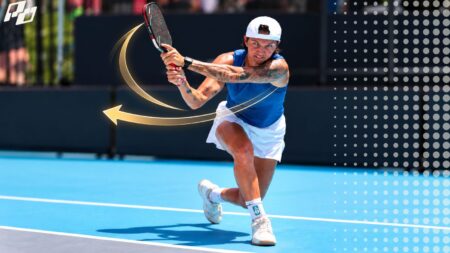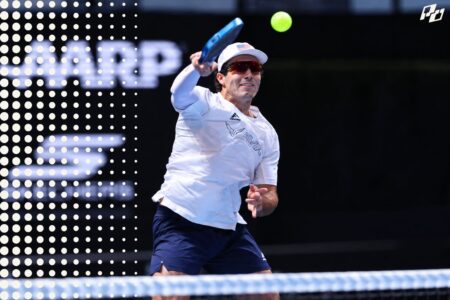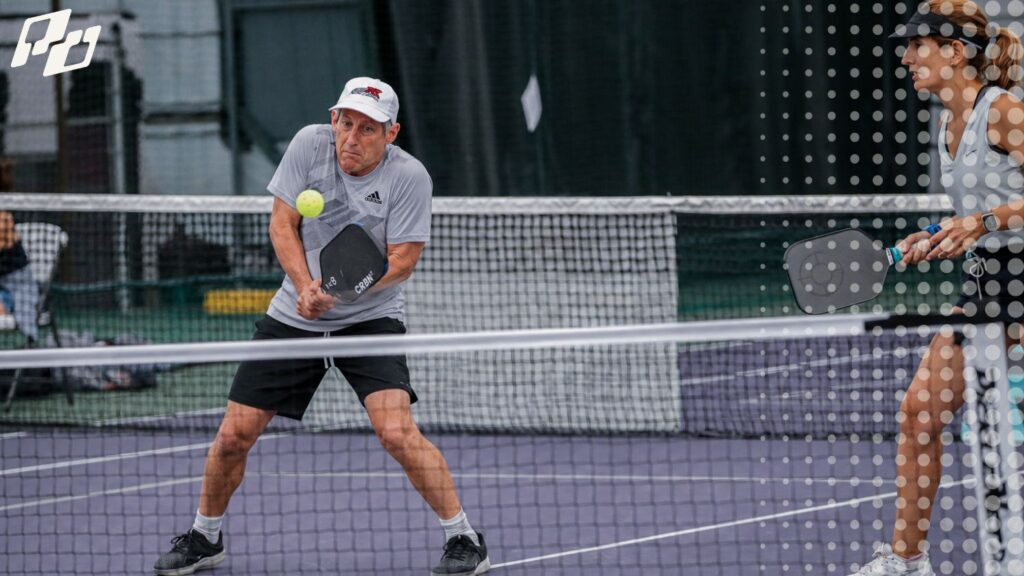
A better pickleball contact point starts before the ball arrives. Keep your paddle spaced slightly away from your body, elbows forward, wrist stable, and chest engaged. This gives you room to counter, block, or reset instead of getting jammed when opponents speed the ball up at the kitchen.
If you keep losing hands battles at the kitchen, it may not be because your hands are too slow. It may be because your paddle is starting too close to your body.
That sounds almost too simple, but it is one of those small technical details that changes everything. When your paddle is jammed into your chest or hanging too tight to your ribs, you have no working space. So when someone speeds the ball up, you are forced to react late, flick with your wrist, or block from a cramped position.
And that is when the ugly stuff happens.
The ball pops up.
Your counter floats.
Your elbow gets trapped.
Your wrist breaks.
You feel like the ball is “on you” before you can do anything.
And suddenly your opponent thinks, “Yep, I’m speeding up at this player again.”
At intermediate rec levels, especially 3.5–4.0, this is a huge difference-maker. A lot of players are working on bigger swings, better counters, faster hands, and more aggressive volleys. But the real fix often starts before the ball is even hit:
Create space between your paddle and your body.
Not too much. Not a stiff, locked-out arm. But enough space that your paddle can punch, absorb, redirect, or counter without getting trapped.
Most players focus on the swing. Better players focus on the starting position. So let’s break down what “better contact point” actually means — and how to fix it.
The Real Problem: You’re Letting the Ball Enter Your Body
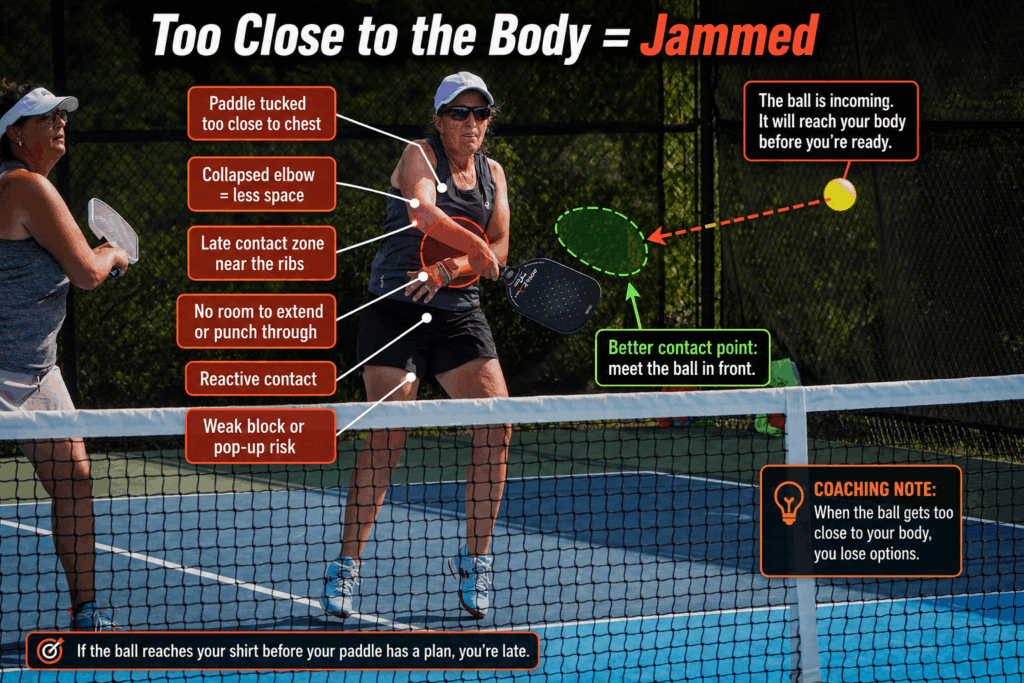
When people talk about contact point, they usually mean where the paddle meets the ball. But at the kitchen, your contact point is not just a hitting detail. It is a survival skill.
If the ball gets too close to your body, you lose options. You cannot extend. You cannot stabilize the paddle face. You cannot punch through the ball. You cannot decide forehand or backhand cleanly. Everything becomes reactive.
That is why players get jammed. A jammed player usually looks like this:
- paddle tucked too close to the chest
- elbows pinned or collapsed
- paddle face late
- wrist flipping at the last second
- contact near the ribs, hip, or shoulder
- no room to move through the ball
- weak block or pop-up
The ball did not beat them only because it was fast. It beat them because they had no space to work.
At the kitchen, the ball should not feel like it is invading your body before you respond. You want to meet it in front of you, with enough paddle spacing to either soften it or send it back with pressure.
A simple way to think about it: If the ball reaches your shirt before your paddle has a plan, you are late.
Why Paddle Space Makes Your Hands Feel Faster
Fast hands are not just fast hands. Fast hands are usually a combination of:
✓ good ready position
✓ quiet feet
✓ stable wrist
✓ paddle out front
✓ early recognition
✓ small movement
✓ and the right contact window
That is why some players look like they have ridiculous reflexes. They are not always reacting faster. They are starting from a better place.
If your paddle is already out front, you only need a short move. If your paddle is close to your body, you need to move the paddle farther, solve the angle later, and often use the wrist to save the shot.
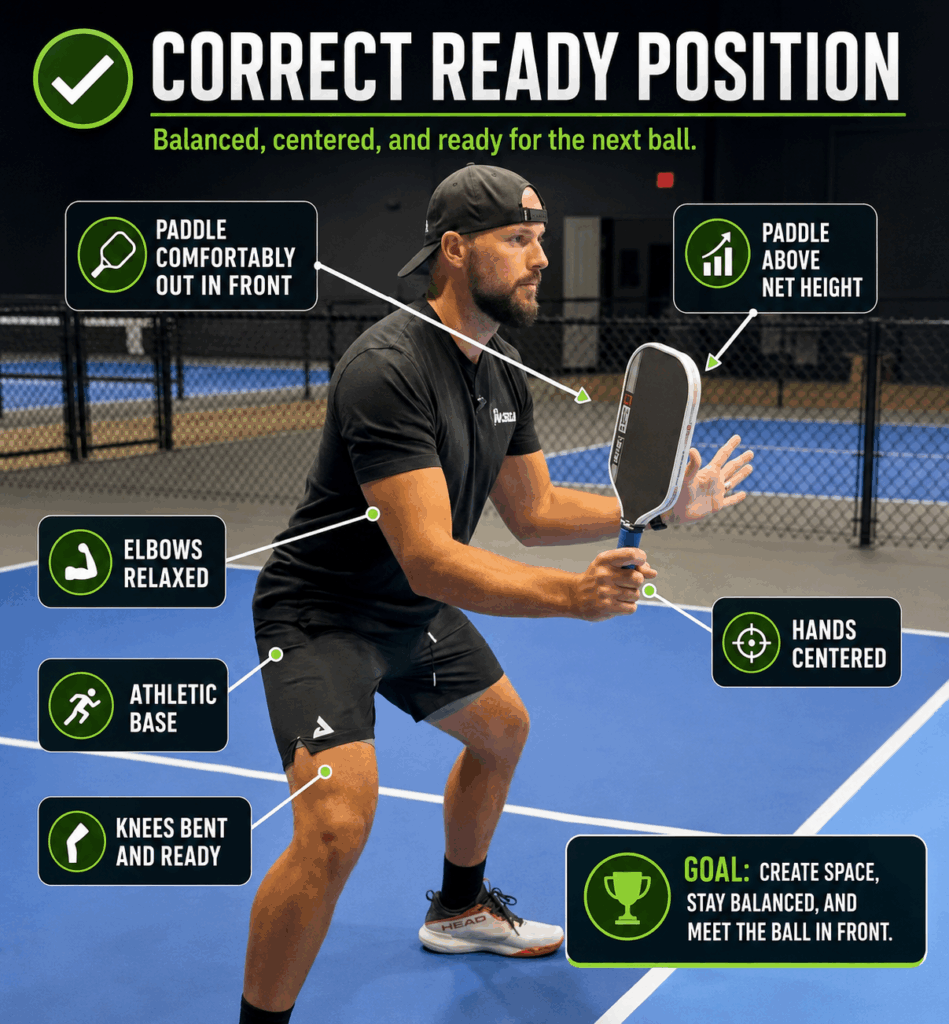
That extra movement costs time.
Volleys and counters become cleaner when the paddle stays out front, the motion stays compact, and the player avoids big swings or wristy last-second saves.
For rec players, that means the fix is not “try harder to react.”
The fix is: Make the reaction shorter.
And the easiest way to shorten the reaction is to start with your paddle in the right space.
The Sweet Spot: Not Jammed, Not Reaching
Here is the mistake on both ends. Some players hold the paddle too close to the body. Other players overcorrect and stick the paddle way out in front with locked arms.
Neither is ideal.
If the paddle is too close, you are jammed.
If the paddle is too far away, you lose touch, tension builds in the shoulders, and you may get stretched or late on body balls.
The ideal position is somewhere in the middle:
✓ paddle in front of your chest or upper stomach
✓ elbows slightly bent
✓ hands away from the body
✓ shoulders relaxed but engaged
✓ paddle face organized
✓ enough room to punch forward
✓ enough softness to absorb if needed
Think of creating a small “work zone” in front of your body.
Not a giant reach. Not a collapsed paddle.
A useful cue: Own the space in front of your chest.
That is your counter zone. If the ball enters that zone, your paddle should be ready to act.
The “Chest Engagement” Cue
One of the best cues for this fix is to engage your chest and upper body.
That does not mean puffing your chest out or getting stiff. It means your upper body is active enough to hold the paddle in a strong position instead of letting it collapse inward.
A lot of players set up passively. The paddle is technically “up,” but the body is not engaged. The elbows are lazy. The shoulders are soft in the wrong way. The paddle drifts toward the torso.
Then the speedup comes and the player has to manufacture strength from a bad position.
Instead, feel like your chest, shoulders, and upper back are quietly supporting the paddle out in front of you.
A good ready position should feel athletic, not tense.
Try this:
Stand at the kitchen line. Hold your paddle in front of your sternum. Now move it two to four inches away from your body without locking your elbows. Keep your shoulders relaxed, but feel your chest and upper back “hold” the paddle there.
That is closer to the position you want.
The cue: Chest active, elbows soft, paddle alive.
Why This Fix Helps Counters
A counter is not a panic block. A counter is when you take an opponent’s speedup and send it back with pressure.
To do that, you need space.
If your paddle is jammed into your body, you can only absorb or flick. You cannot really drive through the ball.
But when the paddle has room, you can:
- stabilize the face
- keep the wrist quiet
- extend slightly through contact
- redirect to the feet
- counter through the middle
- or punch behind the attacker
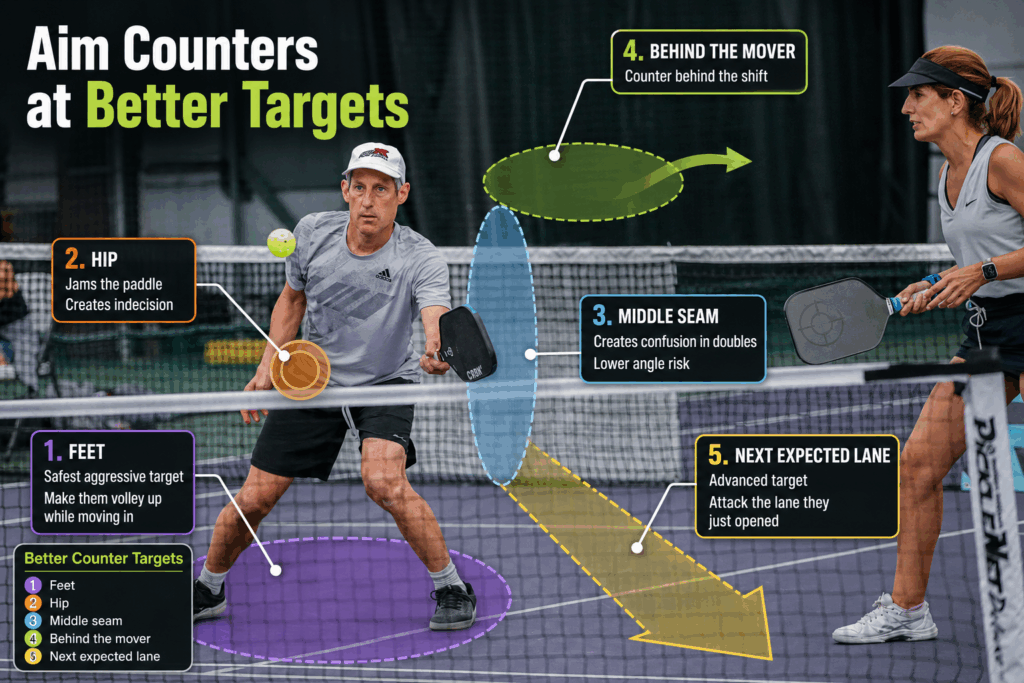
That is why the starting position matters so much.
A good counter is not a big swing. It is a short, firm move through the ball. But even a short move needs space. The paddle has to travel somewhere.
If there is no space between your paddle and your body, that “somewhere” becomes a cramped wrist flick.
And that is exactly what gets you in trouble.
Why This Fix Helps Resets Too
This is where it gets interesting.
Most people think paddle spacing is only about attacking or countering. But it also helps your resets.
When the ball comes fast and your paddle is too close to your body, you tend to react late. Your paddle face opens suddenly. The ball pops up. Or you stab downward and dump it.
With better space, you can absorb earlier.
You can soften your hands before the ball jams you. You can keep the paddle face calmer. You can decide whether the right answer is a block, reset, counter, or let-it-go.
That extra half-second matters.
At the kitchen, good defense is not always about being softer. Sometimes it is about being earlier.
Better spacing gives you earlier contact. Earlier contact gives you better choices.
The Difference Between Blocking and Countering
This is important because the ideal contact point changes slightly depending on the shot.
A block absorbs pace. You are taking speed off the ball.
A counter sends pace back. You are applying pressure.
If you are blocking, the ball may come a little closer to the body because you are cushioning it. You are using the paddle like a soft wall.
If you are countering, you need more space because you have to move through the ball.
That is why “paddle out front” does not mean the same thing on every shot.
For a block: Soft hands, stable face, absorb.
For a counter: Stable wrist, small extension, punch through.
Both require a good ready position. But the counter requires a stronger work zone.
If your opponent keeps speeding you up and all you can do is block weakly, your contact point is probably too close.
You are surviving instead of punishing.
The Contact-Point Rule for Intermediate Players
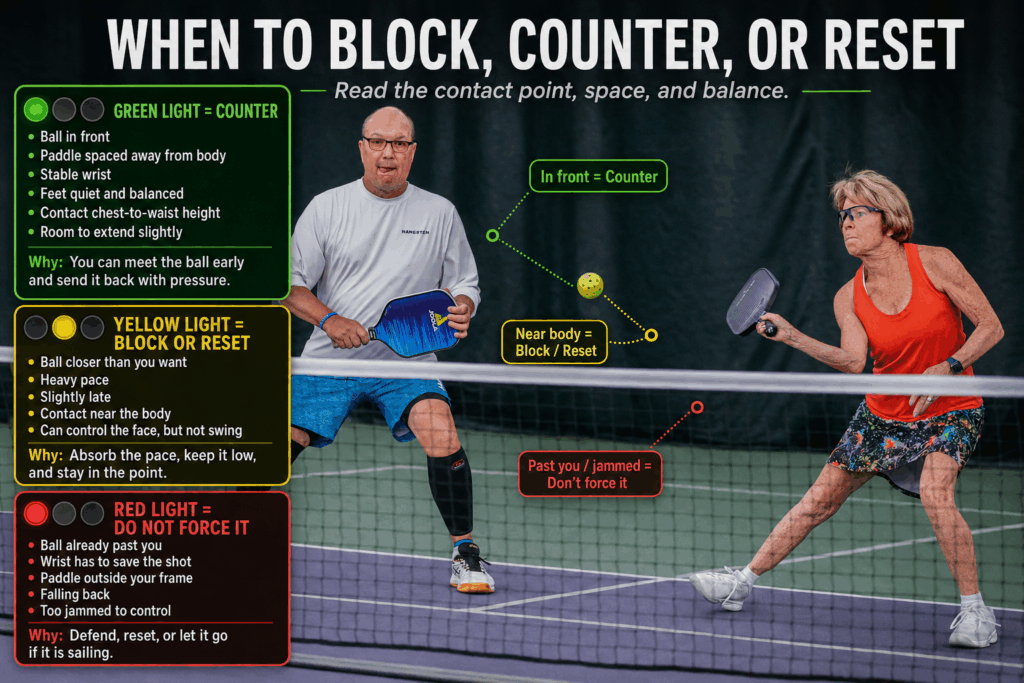
Here is the rule I would give most 3.5 players:
If you are balanced and the ball enters your front work zone, counter.
If the ball gets into your body, block or reset.
If the ball gets past your body, defend or let it go.
That rule alone can clean up a lot of bad decisions.
Too many rec players try to counter from jammed positions. They get attacked into the hip or shoulder and try to slap the ball back. That usually creates a pop-up or an error.
Instead, recognize the contact window.
| Read | What It Looks Like | Best Response | Why |
|---|---|---|---|
| 🟢 Green light | Ball is in front of you | Counter | You can meet the ball early and send it back with pressure. |
| 🟢 Green light | Paddle is already spaced away from your body | Counter | You have room to punch through the ball instead of getting jammed. |
| 🟢 Green light | Wrist is stable | Counter | A stable wrist keeps the paddle face controlled under pace. |
| 🟢 Green light | Feet are quiet and balanced | Counter | A still base lets your hands work faster. |
| 🟢 Green light | Contact is chest-to-waist height | Counter | This is a strong counter window for most rec players. |
| 🟢 Green light | You can extend slightly through the ball | Counter | You have enough space to add pressure without taking a big swing. |
| 🟡 Yellow light | Ball is closer than you want | Block or reset | You are not fully jammed, but you may not have room for a clean counter. |
| 🟡 Yellow light | Pace is heavy | Block or reset | Absorbing the ball may be smarter than trying to punch it back. |
| 🟡 Yellow light | You are slightly late | Block or reset | A counter may float or miss if your contact point is late. |
| 🟡 Yellow light | Contact is near the body | Block or reset | Control the paddle face first; do not force offense from a cramped spot. |
| 🟡 Yellow light | You cannot swing, but can control the face | Block or reset | Keep the ball low and stay in the point. |
| 🔴 Red light | Ball is already past you | Do not force it | You are late; defend, reset, or let it go if it is sailing. |
| 🔴 Red light | Wrist has to save the shot | Do not force it | Last-second wrist flicks usually create pop-ups or errors. |
| 🔴 Red light | Paddle is outside your frame | Do not force it | Reaching makes the contact weak and unstable. |
| 🔴 Red light | You are falling back | Do not force it | Your balance is moving away, so a counter is low percentage. |
| 🔴 Red light | Contact is too jammed to control | Do not force it | You do not have enough space to counter cleanly. |
This is what better players do. They do not try to make every ball an attacking counter.
They counter from strength and defend from trouble.
Your Elbow Position Matters
One reason players get jammed is poor elbow position.
If your elbows are too close to the ribs, your paddle gets trapped.
If your elbows fly way out, your motion gets slow and disconnected.
You want a connected-but-free position.
Think: Elbows in front of the ribs, not glued to them.
That gives you room to move the paddle while keeping the arm strong.
A good cue: Elbows forward, paddle free.
This helps especially on body speedups. Instead of letting the ball jam your shoulder or hip, you can make a short backhand or forehand move with the paddle already in front.
How Far Away Should the Paddle Be?
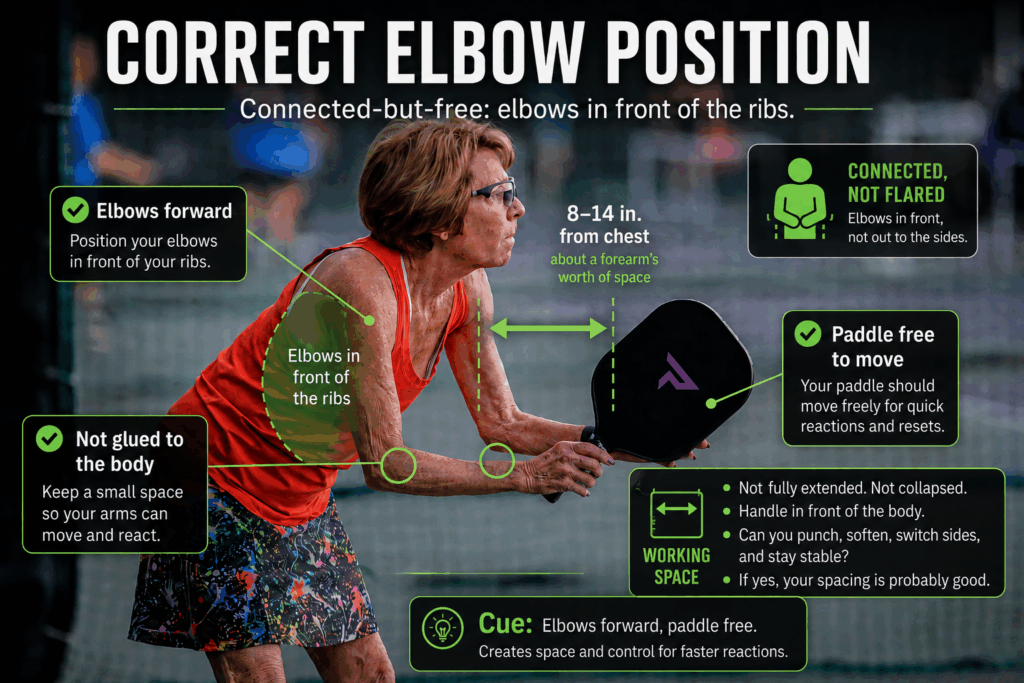
You do not need an exact measurement, but here is a useful feel: About a forearm’s worth of working space.
Not fully extended. Not collapsed.
For many players, that means the paddle handle is somewhere in front of the body, with the paddle face roughly 8–14 inches away from the chest, depending on arm length, body type, and shot situation.
The point is not the number.
The point is whether you can move through the ball.
Test it:
Can you make a short punch without your elbow getting trapped?
Can you soften the paddle without collapsing?
Can you switch from backhand to forehand without a giant move?
Can you keep your wrist stable?
Can you meet the ball before it reaches your torso?
If yes, your spacing is probably good. If no, the paddle is probably too close or too far.
Paddle Height: Don’t Confuse “Out Front” With “Too High”
One subtle mistake: players hear “paddle out front” and hold it too high near the face.
That can create problems too.
If the paddle is too high, you may be late to lower balls, dinks, resets, or attacks at the hip. You may also swat balls that were going out.
A good kitchen-ready height is usually around upper stomach to chest, depending on the situation. Many coaches suggest a balanced ready position around belly-button to chest height because it gives you equal access up and down, especially in fast exchanges.
For intermediate players, I like this cue: Paddle in front of the sternum, eyes above the paddle.
You should be able to see the court clearly, move the paddle up or down quickly, and protect your body without blocking your own vision.
Forehand or Backhand? Let the Contact Point Decide
When the ball comes fast at the kitchen, you do not always have time to choose your favorite shot.
The contact point chooses for you.
A lot of players want to use their forehand because it feels stronger. But when the ball comes into the middle of the body, the forehand can actually be slower and more awkward.
Why?
Because your elbow gets jammed. Your paddle has to travel around your body. Your wrist opens. The ball wins.
For many body balls, a compact backhand counter or block is cleaner.
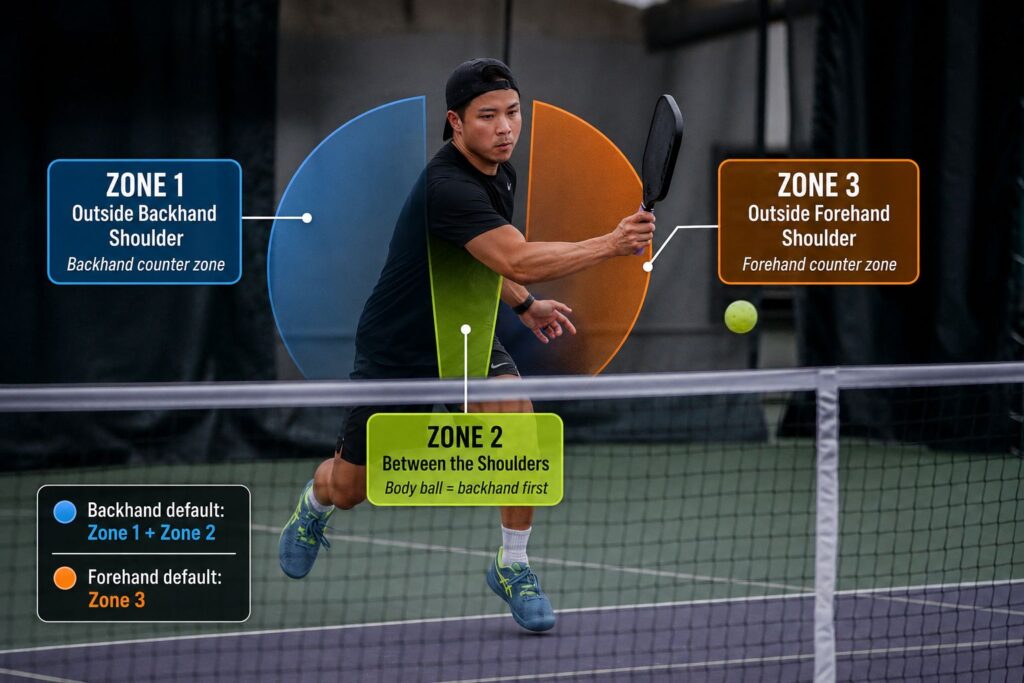
A simple zone system:
- Ball outside forehand shoulder: forehand counter.
- Ball between shoulders: backhand block/counter is often safer.
- Ball outside backhand shoulder: backhand or two-handed backhand if you use one.
This is not a law. But it is a very useful default for rec players. The goal is to avoid forcing the wrong side from a bad contact point.
Your favorite shot is not always your fastest shot.
Common Mistakes When Fixing This
Mistake 1: Locking the arm straight
You are trying to create space, not become a statue.
Fix: Soft bend in the elbows.
Mistake 2: Getting tense in the shoulders
If your shoulders rise toward your ears, your hands slow down.
Fix: Chest engaged, shoulders relaxed.
Mistake 3: Holding the paddle too high
This makes you vulnerable to balls at the hip and can trigger bad swats at out balls.
Fix: Paddle in front, around upper stomach to chest height.
Mistake 4: Still using the wrist to counter
Spacing helps, but you still need a stable paddle face.
Fix: Firm wrist through contact.
Mistake 5: Forgetting the feet
If your feet are moving when the speedup comes, your paddle has to do too much.
Fix: Split, settle, then counter.
Mistake 6: Trying to counter every ball
Better spacing gives you options. It does not mean every ball is attackable.
Fix: Counter from strength. Reset from trouble.
How This Looks in Real Rec Play
Imagine you are at the kitchen. You dink crosscourt. Your opponent sees a slightly high ball and speeds it up at your body.
Old version:
Your paddle is close to your chest. The ball gets on you. Your elbow traps. You flick late. The ball pops up. They finish.
New version:
After your dink, your paddle returns to the work zone. It is in front of your sternum, elbows slightly forward, chest engaged. The speedup comes into your body, but now your paddle is already there. You make a short backhand counter through the middle or at their feet.
Same speedup.
Different starting position. Different result.
That is why this matters.
You are not trying to become superhuman. You are trying to stop giving the ball permission to jam you.
The 10-Second Self-Test
Next time you are on court, test this during warmups.
Ask yourself:
- Is my paddle touching or almost touching my body?
- Are my elbows behind my ribs?
- Can I make a short punch without taking the paddle back?
- Can I switch forehand/backhand without a big move?
- Can I meet a body ball before it reaches my chest?
- Do I feel stable, or do I feel jammed?
If you fail two or more, your ready position is probably costing you hands battles.