To reach 5.0 pickleball faster, stop relying only on power. Train resets, pace control, fifth-shot patterns, transition defense, and smarter attack decisions. Open play alone usually is not enough; combine drilling, competitive games, video review, and targeted practice against stronger players.
A lot of 4.0 pickleball players are dangerous.
They can drive.
They can speed up.
They can punish pop-ups.
They can beat weaker players all day.
They look athletic, aggressive, and confident.
Then they play true 5.0s and suddenly the game feels different.
The drive comes back at their feet.
The speedup gets countered.
The “winner” turns into a reset.
The hard third gets blocked low.
The attack they used to win with becomes the ball that starts their own problems.
That is the uncomfortable jump from 4.0 to 5.0. It is not that power stops mattering. Power absolutely matters. But at 5.0+, power without control becomes predictable. The players on the other side are no longer impressed that you can hit hard. They are waiting for you to hit hard from the wrong ball.
So if you want to reach 5.0+ as fast as realistically possible, stop asking how to hit bigger and start asking how to become harder to rush, tougher to attack, and disciplined enough to earn offense instead of forcing it.
Here are the five less-obvious things that move a strong intermediate toward 5.0+ fastest.
First, What Actually Separates 4.0 From 5.0?
A 4.0 can often win with weapons.
A 5.0 can win when their weapons are neutralized.
That is the difference.
At 4.0, you can often bang through people, attack predictable balls, and win because your opponent misses first. At 5.0, opponents do not panic as easily. They reset. They counter. They keep the ball low. They make you hit one more shot. They punish your impatience.
That is why dinks, drops, resets, and soft shots matter so much in pickleball. A dink is specifically used to deny the opponent an attackable ball, and drop shots are commonly used to help the serving team move forward and neutralize the return team’s kitchen advantage.
The 5.0 jump is not about becoming “soft.” It is about becoming complete. You need offense. But you also need the ability to remove offense from your opponent.
1. Build a Reset Obsession
This is the most important one, and it is also the least glamorous.
If you are a 4.0 trying to reach 5.0, you probably already have enough offense to scare people. What you may not have is the ability to reset under pressure again and again without panicking.
At 5.0+, reset quality is not optional. It is survival.
Because better players will attack your feet. They will speed up into your body. They will roll at your paddle-side hip. They will drive through the middle. They will make you volley from the transition zone instead of giving you clean kitchen balls.
And if your answer is always “hit it back harder,” you will get exposed.
Why resets are the real shortcut
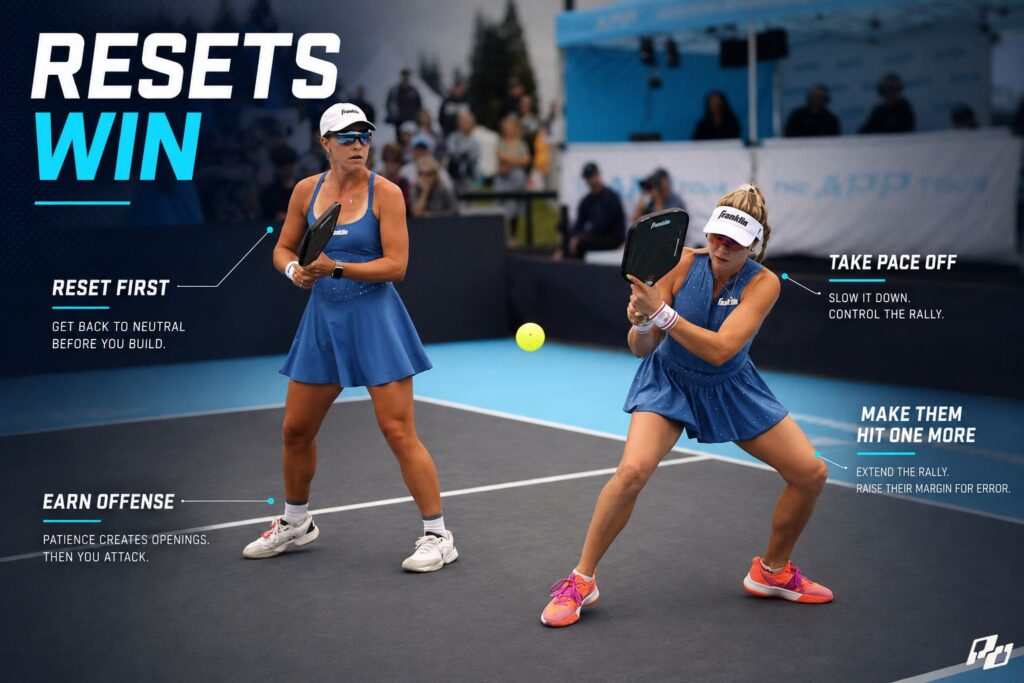
A reset does three things:
- It takes pace off the ball.
- It makes the opponent hit up.
- It gives you time to get back into position.
That sounds boring until you play a player who never gives you a clean attack. Suddenly, boring feels like torture.
At 5.0, “make them hit one more ball” is not passive. It is pressure. You are forcing the opponent to prove they can create offense from a low, controlled ball instead of feeding them pace they can counter.
What to train
Do not just practice easy resets from perfect feeds. Practice the ugly ones:
- transition-zone resets off hard drives
- backhand resets at the feet
- forehand resets while moving sideways
- body-ball resets when jammed
- fifth-shot resets after a mediocre third
- resetting after your own drive gets blocked
- resetting from the kitchen when the speedup catches you late
The big goal is not “get it over.”
The goal is: Can I make the ball land low enough that they cannot attack down?
A practical benchmark:
| Reset Test | 4.0 Goal | 5.0-Track Goal |
|---|---|---|
| Stationary transition resets | 7/10 in kitchen | 8–9/10 low and unattackable |
| Moving transition resets | 5/10 controlled | 7/10 neutralizing pressure |
| Resets off hard drives | 5/10 playable | 7/10 low enough to stop attack |
| Fifth-shot resets | 5/10 | 7–8/10 with forward recovery |
Cue
Reset like your job depends on it.
Because if you want to play 5.0s, it kind of does.
2. Learn to Remove Pace Before You Add Pace
This is the thing power players hate hearing.
If you come from tennis, racquetball, table tennis, baseball, or just general athletic dominance, you may be used to solving problems with speed. At 3.5 and 4.0, that can work beautifully.
At 5.0, it gets dangerous.
Why? Because better players use your pace. A hard ball gives them energy. If the ball is attackable and predictable, they do not need to swing big. They block, counter, redirect, and put it at your feet.
So the faster path to 5.0 is not just learning when to hit harder. It is learning when to take speed away.
The high-level skill: pace control
Pace control means you can choose the temperature of the point.
- You can drive when the ball deserves it.
- You can slow down when you are in trouble.
- You can speed up only when your contact point gives permission.
- You can reset instead of countering from panic.
- You can dink low instead of “winning” the rally from below net height.
That is the hidden skill: you decide how fast the rally gets.
Most 4.0 players are reactive. They match pace. Someone hits hard, they hit hard back. Someone speeds up, they speed up faster. Someone drives, they swing.
5.0 players are selective. They know when speed is useful and when speed is a trap.
The “pace-off” drill
Play games where you are not allowed to win the point with a speedup until you have successfully reset or dinked three balls first.
Yes, you will lose some rec games.
Good. That is the point.
You are training the muscle most 4.0 players avoid: patience under temptation.
Cue
Take pace off until offense is earned.
3. Train the “Fifth Shot Problem,” Not Just the Third Shot
Most intermediate players obsess over the third shot.
That makes sense. The third shot drop is a core pickleball skill because it helps the serving team neutralize the return team and move toward the kitchen.
But here is the problem: at 5.0, your third shot will not always be good enough.
Your drop will be slightly high.
Your drive will be blocked low.
Your hybrid will get returned at your feet.
Your opponent will not give you a free kitchen walk-in.
That means the real separator is often the fifth shot.
Why the fifth shot matters so much
A 4.0 thinks: “If I hit a good third, I get in.”
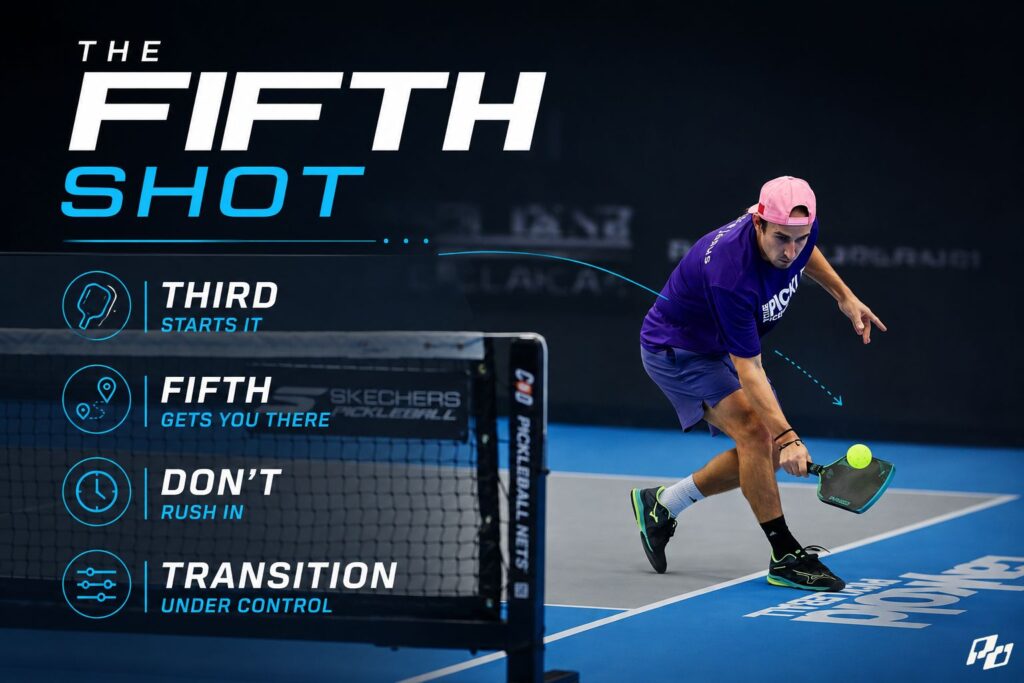
A 5.0 thinks: “My third starts the transition. My fifth and seventh finish it.”
That mindset is huge.
You do not need one perfect third shot. You need a repeatable transition plan.
- If your third is excellent, move in.
- If your third is decent, move halfway and split.
- If your third is attackable, hold your ground and defend.
- If your drive is blocked, reset the fifth.
- If your drop is lifted back, keep coming.
- If your fifth is low, earn the kitchen step by step.
This is where many athletic 4.0s get crushed. They hit a decent third, sprint forward, and get attacked while moving. Better players do not run in just because they want to be at the kitchen. They move in because the ball gives them permission.
The fifth-shot training block
For every third shot drill, add the next two balls.
Instead of: third shot drop → stop
Do: third shot drop → opponent pushes/attacks → fifth shot reset → move
Or:
third shot drive → opponent blocks low → fifth shot drop/reset → move
Or:
third shot hybrid → opponent counters middle → fifth shot absorb → move
That is real pickleball.
Training benchmark
| Pattern | 5.0-Track Goal |
|---|---|
| Third drop + fifth reset | 7/10 sequences reach neutral |
| Third drive + fifth drop | 6–7/10 sequences create kitchen progress |
| Bad third + defensive fifth | 7/10 stay alive without popping up |
| Fifth shot from moving feet | 7/10 low and controlled |
Cue
The third shot starts the trip. The fifth shot gets you there.
4. Stop Measuring Skills by “Can I Do It?” and Start Measuring by “Can I Do It Under Consequence?”
A lot of 4.0 players are good in drills. But 5.0 pickleball is not about whether you can perform a shot in isolation.
It is about whether you can perform it when:
- the ball is lower than expected
- your partner is shifting
- the opponent is baiting your speedup
- you are down 8-9
- your legs are tired
- the last two counters got punished
- the opponent knows your favorite pattern
This is where training has to become more honest.
The consequence gap
Open play often hides this gap because players avoid uncomfortable repetition. You might get a few resets per game, a few drops, a few hand battles. That is not enough volume to transform.
You need drills where missing has a consequence.
For example:
If your reset pops up, your partner attacks the next ball.
If your dink floats, the opponent must speed it up.
If your third is too high, you must stay back and defend.
If your speedup is below net height, you lose two points.
If your return is short, the other team starts the rally at the kitchen.
This makes practice feel less comfortable — and far more useful.
Why open play is not enough
Open play is great for reps, social pressure, and seeing random balls. But it is usually not enough to get from 4.0 to 5.0 quickly because it lacks repetition, feedback, and intentional constraint.
You need open play, but you also need drilling, coached feedback, video review, and matches against stronger players.
DUPR and similar systems reward actual match performance, including opponent strength and match context, but your training has to create the skills before the rating reflects them.
The blunt truth:
Open play tests your game. Drilling builds your game. Tournament-style matches expose your game.
You need all three.
Cue
Do it when it matters, or you do not own it yet.
5. Build Pattern Discipline, Not More Shots
This may be the most unexpected one. A lot of 4.0 players think getting to 5.0 means adding more tools.
New speedup.
New serve.
New roll dink.
New ATP.
New Erne.
New two-handed backhand flick.
Fun? Yes. Fastest path? Usually no.
The fastest path is often doing fewer things with more discipline.
What pattern discipline looks like
Pattern discipline means you stop playing every rally like a blank canvas.
You know your best serve location.
You know your return pattern.
You know when your drive is a setup, not a winner.
You know which balls you reset automatically.
You know your safe dink target under pressure.
You know which opponent you are building the point through.
You know what your partner expects after your speedup.
You know which balls you refuse to attack.
That last one is enormous.
5.0 players are not just better because they hit more impressive shots. They are better because they hit fewer stupid ones.
The “red ball” list
Make a personal list of balls you are no longer allowed to attack.
Examples:
❌ below-net speedups while falling backward
❌ low dinks from the sideline
❌ body balls that jam your elbow
❌ transition balls at your feet
❌ third-shot drives from stretched contact
❌ counters while drifting backward
❌ high-risk line attacks at 9-9
This is not cowardice. This is maturity.
Your goal is not to become less aggressive. Your goal is to become less generous.
The best pattern for most 4.0s
For 30 days, play like this:
- Serve deep with purpose.
- Return deep and get in.
- Drop or drive based on the ball, not ego.
- If the third is not good, reset the fifth.
- At the kitchen, dink low until a real attack appears.
- Attack big targets: hip, shoulder, middle, feet.
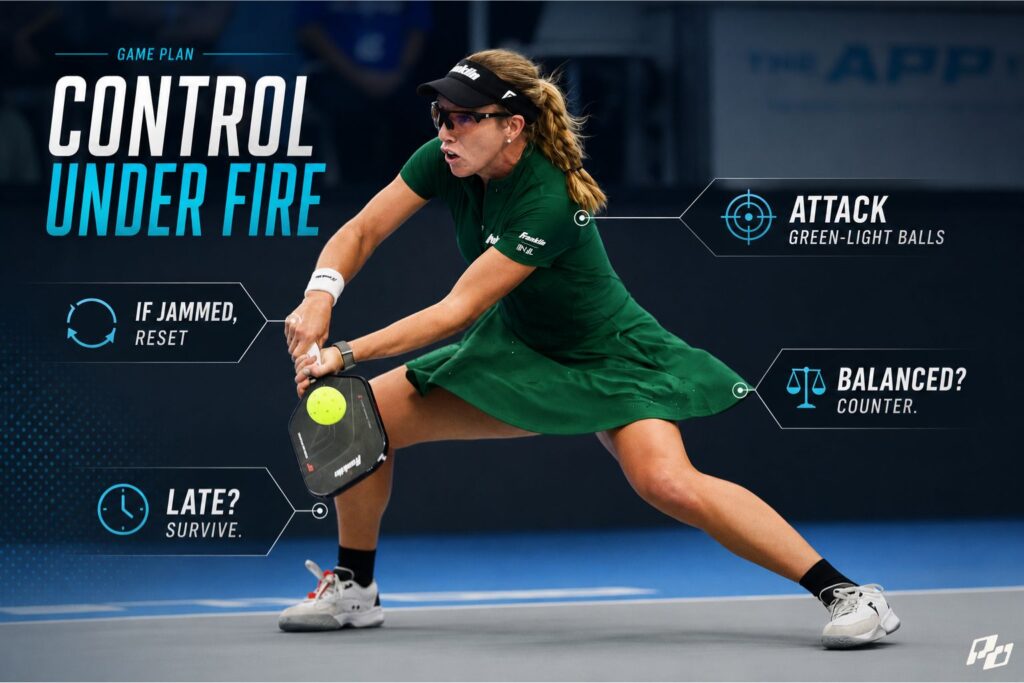
- If jammed, reset.
- If balanced, counter.
- If late, survive.
That sounds simple. It is not.
It is exactly the discipline most 4.0s lack.
Cue
Fewer inventions. Better decisions.
The 5.0 Fast-Track Training Timeline
Let’s be realistic. Going from 4.0 to 5.0 is not a weekend project.
For an athletic 4.0 with good hand-eye coordination, access to strong players, and consistent training, a serious jump might take 6–18 months. For many rec players, it may take longer.
The timeline depends on age, athletic base, injury history, coaching access, partner quality, tournament volume, and how honest the player is about weaknesses.
But here is a practical aggressive plan.
If You Can Train 3 Days Per Week
This is the minimum serious plan.
| Day | Focus | Time |
|---|---|---|
| Day 1 | Reset + transition drilling | 90 minutes |
| Day 2 | Pattern games + third/fifth work | 90 minutes |
| Day 3 | Competitive games against equal/better players | 2 hours |
Weekly split:
✅ 40% resets/transition
✅ 25% third/fifth patterns
✅ 20% kitchen pattern discipline
✅ 15% competitive play/video review
This can improve you, but it may be slow if your only match play is the same local group.
If You Can Train 4–5 Days Per Week
This is the sweet spot for a serious 4.0 trying to climb.
| Day | Focus | Time |
|---|---|---|
| Day 1 | Reset lab: drives, feet, body balls | 90 minutes |
| Day 2 | Third/fifth/seventh transition patterns | 90 minutes |
| Day 3 | Kitchen games: dink pressure, counters, speedup decisions | 90 minutes |
| Day 4 | Competitive DUPR/league/tournament-style games | 2 hours |
| Day 5 | Video review + targeted open play or coached lesson | 60–120 minutes |
Weekly split:
✅ 30% resets
✅ 20% transition patterns
✅ 20% kitchen decision-making
✅ 15% competitive games
✅ 10% serves/returns
✅ 5% video/mental review
This is where you start changing fast.
If You Want the Fastest Realistic Path
This is the “I actually want 5.0” schedule.
| Training Block | Weekly Volume |
|---|---|
| Dedicated drilling | 4–6 hours |
| Competitive games | 3–5 hours |
| Coached feedback or video review | 1 hour |
| Strength/mobility/footwork | 2–3 sessions |
| Tournament/league play | 2–4 times per month |
That is a lot.
But 5.0 is not just “pretty good rec player.” It is a serious level. If ratings are intended to group players by meaningful skill differences, then climbing into 5.0 means your game must hold up against significantly stronger opponents, not just your familiar Tuesday-night group.
The 12-Week Reset-to-5.0 Accelerator
Here is a structured version.
Weeks 1–4: Reset Base
Main goal: stop losing points from pace.
Train:
- transition resets off drives
- kitchen blocks
- body-ball resets
- backhand resets
- reset-and-recover footwork
Benchmark by end of Week 4:
✔️ 7/10 resets low from controlled feeds
✔️ 6/10 resets low from live drives
✔️ fewer panic counters in games
Weeks 5–8: Third + Fifth Shot System
Main goal: stop treating the third shot as the whole transition.
Train:
- third drop + fifth reset
- third drive + fifth drop
- bad third + defensive fifth
- midcourt split-step timing
- partner movement behind transition balls
Benchmark by end of Week 8:
✔️ 7/10 transition sequences become neutral
✔️ fewer attacks while moving
✔️ more kitchen arrivals without chaos
Weeks 9–12: Decision Pressure
Main goal: make your new skills survive real games.
Train:
- games where you cannot attack below net height
- games where every pop-up costs two points
- games where you must reset three balls before attacking
- games starting at 8-8
- video review of every lost rally
Benchmark by end of Week 12:
✔️ fewer unforced attacks
✔️ better shot selection under pressure
✔️ more wins against 4.5s
✔️ closer games against 5.0s
Is Open Play Enough to Reach 5.0?
Usually, no. Open play can help if:
⮕ the level is high
⮕ players punish bad decisions
⮕ you track patterns
⮕ you play with intention
⮕ you get honest feedback
⮕ you regularly face better opponents
But most open play is too random and too comfortable. You will get better at playing your local people. You may not get better at solving 5.0 problems.
The 5.0-track version of open play is different. You enter with one constraint:
- Today I reset every transition ball.
- Today I only attack from green-light height.
- Today I return deep middle 90% of the time.
- Today I track every missed third.
- Today I play two games without speeding up first.
That turns open play into practice. Without that, it is mostly exercise with a paddle.
The Weekly 5.0 Scorecard
Track this for one week. Be brutally honest.
| Category | Target |
|---|---|
| Missed serves | 0–1 per game |
| Missed returns | 0–1 per game |
| Third shots that are attackable | Under 30% |
| Fifth shots that neutralize | 60–70%+ |
| Transition pop-ups | Under 3 per game |
| Bad attacks below net height | 0–1 per game |
| Resets attempted instead of panic swings | Increasing weekly |
| Points lost from impatience | Decreasing weekly |
You do not need perfect numbers. You need trend lines.
If your resets improve, your 5.0 path opens. If your impatience stays the same, your ceiling stays the same.
The Fastest Path Is Control Under Fire
The quickest way to 5.0+ is not chasing more highlight shots. It is learning to stay calm when the rally gets uncomfortable.
- Take pace off.
- Reset balls.
- Make opponents hit one more.
- Build the fifth shot.
- Stop attacking from bad spots.
- Earn the putaway.
Power gets you noticed.
Control under fire gets you promoted.
And once you have both? That is when the 5.0 door actually starts to open.