
Inner knee pain after pickleball can come from MCL stress, especially after quick cuts, wide lunges, planted-foot pivots, or sudden side-to-side stops. Unlike outside knee pain, it often points to medial knee overload and needs different prevention: better knee tracking, hip strength, lateral deceleration, and smarter footwork.
Inner knee pain is one of those pickleball issues that can confuse players fast.
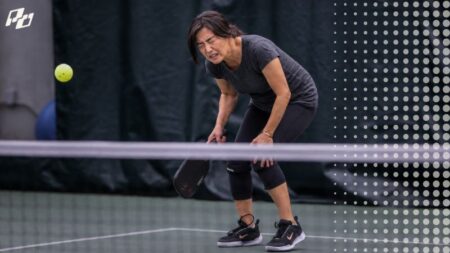
You finish a session and feel a sharp, tender, or nagging pain along the inside of your knee. Not the outside. Not the kneecap. Not the whole joint. The inside.
So you start guessing.
Maybe it is arthritis.
Maybe it is “just age.”
Maybe it is the meniscus.
Maybe it is your shoes.
Maybe you twisted something.
Maybe you should stretch your IT band because everyone talks about outside knee pain.
But inside knee pain has its own story — and in pickleball, one of the most overlooked culprits is the medial collateral ligament, or MCL.
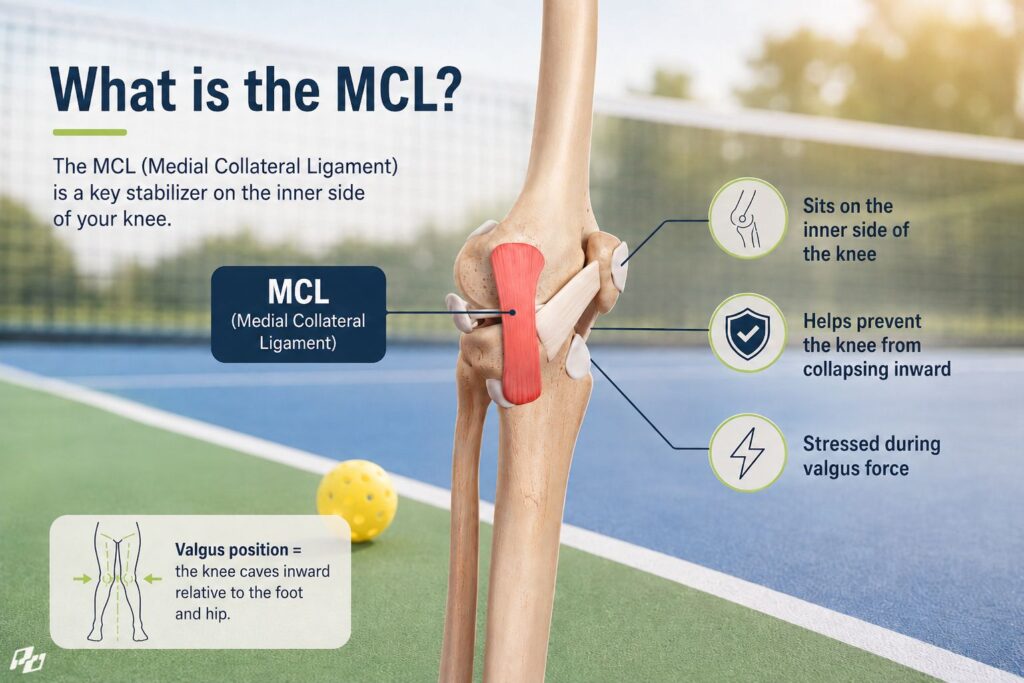
The MCL sits on the inner side of the knee and helps prevent the knee from collapsing inward. It is especially stressed when the knee gets pushed into a valgus position — basically when the knee caves inward relative to the foot and hip. Medical descriptions of MCL injury consistently link it to twisting, cutting, direct blows from the outside of the knee, and valgus stress.
And if that sounds like pickleball footwork, it should.
Quick direction changes. Emergency lunges. Late split steps. Wide dinks. Sudden stops. Reaching for a ball while your foot stays planted. That is the kind of movement environment where the inner knee can get angry.
This article is not a diagnosis, and persistent, sharp, swollen, unstable, or worsening knee pain should be checked by a medical professional. But if you are a rec pickleball player wondering why the inside of your knee hurts, this will help you understand what may be going on, what is different about MCL-type pain, and how to reduce the risk of it happening again.
First: Inner Knee Pain Is Not the Same as Outer Knee Pain
Most players talk about “knee pain” like it is one thing.
It is not.
Where the pain shows up matters.
Pain on the outside of the knee is often discussed in relation to lateral knee structures, such as the iliotibial band, lateral meniscus, LCL, or lateral compartment irritation. IT band syndrome, for example, is classically felt on the outside of the knee and is more associated with repetitive running or cycling mechanics than with a classic MCL sprain pattern.
Pain on the inside of the knee points you toward a different set of suspects:
- MCL irritation or sprain
- medial meniscus irritation or tear
- pes anserine bursitis or tendon irritation
- medial knee osteoarthritis
- medial joint-line overload
- less commonly, other conditions that need medical evaluation
That distinction matters because the prevention and rehab focus is not identical.
If the issue is medial knee stress, you are usually thinking more about cutting mechanics, knee collapse, hip control, adductor/hamstring support, deceleration, and side-to-side stability — not just generic knee strengthening.
The MCL: The Inner-Knee “Seat Belt”
The MCL is one of the key stabilizing ligaments on the inside of your knee. Its job is to help resist the knee opening up on the inside and collapsing inward under valgus stress. The valgus stress test, commonly used clinically to assess MCL integrity, stresses the medial side of the knee; at around 30 degrees of knee flexion, the MCL is the primary stabilizer being tested.
That matters for pickleball because many of our “bad positions” happen with the knee slightly bent.
Not fully straight.
Not deeply squatted.
But in that athletic, semi-bent position where we split step, shuffle, reach, brake, and change direction.
When your foot is planted and your body keeps moving sideways, the knee can get forced inward. If the hip, glute, foot, and trunk do not control that motion well, the MCL may take more stress than it wants.
A small overload may feel like tenderness or irritation.
A bigger overload may feel like a strain.
A significant sprain may involve swelling, instability, difficulty bearing weight, or a clear moment where the knee felt like it bent inward too far.
Why Pickleball Creates Inner-Knee Stress
Pickleball looks gentle from far away.
Then you play three hours of doubles and realize your knees just performed 200 small emergency decisions.
The sport is full of movement patterns that can stress the inside of the knee:
- lateral shuffles to cover dinks
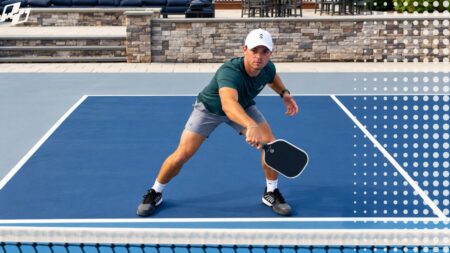
- wide lunges at the kitchen
- quick direction changes after a speedup
- split-step-and-push movements
- late recovery after being pulled off court
- backpedaling or twisting for lobs
- sudden stops after chasing a short ball
- reaching while the foot stays stuck
Healthcare and sports-medicine discussions of pickleball injuries often point out that the sport is popular among older adults and that injuries include sprains, strains, fractures, tendinopathies, and lower-extremity problems. One summary cited estimates around 19,000 annual U.S. pickleball-related injuries, with a large proportion occurring in players over 50.
That does not mean pickleball is “dangerous.” It means the sport is more physically demanding than it looks — especially for rec players who play often but do not train deceleration, hip strength, and single-leg control.
The Classic Pickleball MCL Moment
Here is the situation I see all the time:
- You are at the kitchen.
- Your opponent dinks wide.
- You take a big side step or lunge.
- Your outside foot plants.
- Your upper body keeps reaching.
- Your knee collapses slightly inward.
- You push back to recover.
- The inside of the knee says, “Nope.”
That is the pickleball version of a valgus stress moment.
It can also happen when you get pulled wide, stop hard, and try to change direction back toward the middle before your foot and hip have caught up. The foot stays glued to the court, the body rotates, and the knee becomes the twist point.
A useful way to picture it:
The foot says stop.
The body says go.
The inner knee gets stuck in the argument.
That is exactly the kind of situation where the MCL can get irritated.
What MCL Pain Often Feels Like
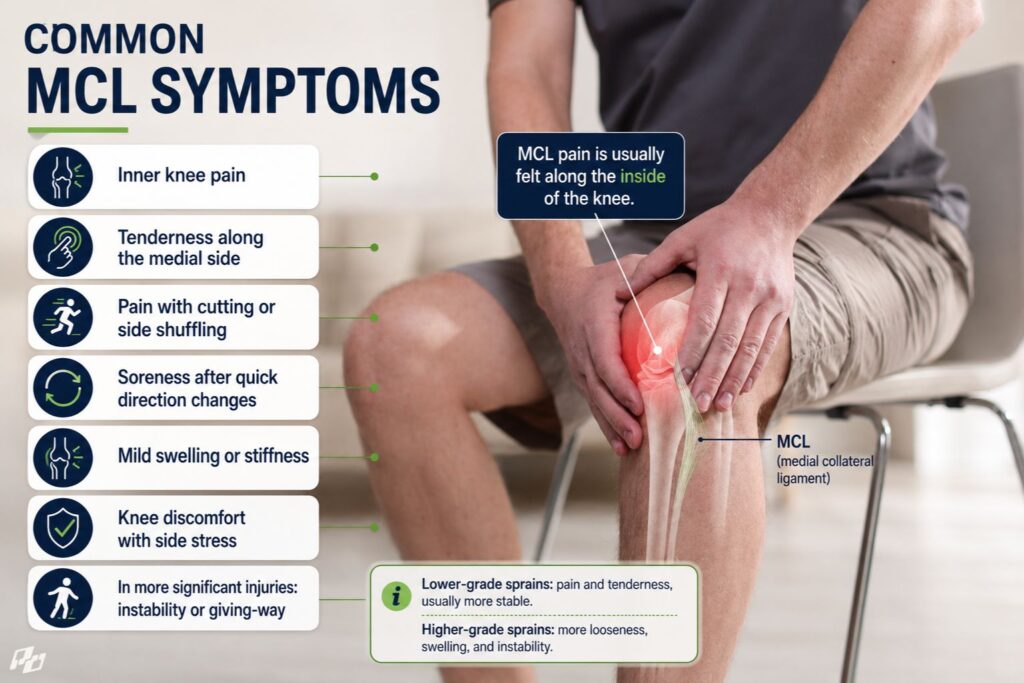
MCL-related pain is usually felt along the inside of the knee, often close to the joint line or slightly above/below it. It may feel tender to touch, sore with side-to-side movement, or uncomfortable when you cut, pivot, or push off laterally.
Common signs can include:
- pain along the inner knee
- tenderness when pressing the medial side
- pain with cutting or side shuffling
- soreness after quick direction changes
- mild swelling or stiffness
- a sense that the knee does not like side stress
- in more significant injuries, instability or giving-way
MCL sprains are commonly graded by severity. Lower-grade injuries may involve pain and tenderness but relatively stable ligaments; higher-grade injuries can involve more looseness, swelling, and instability.
Treatment is often conservative, especially for many grade I and II injuries, while more severe or combined injuries may need specialist care.
But Inner Knee Pain Is Not Always the MCL
This is important. Not every inside-knee pain is an MCL sprain.
The medial meniscus is another big one. Meniscus injuries often involve pain along the joint line and can happen with twisting on a bent knee. Mechanical symptoms — catching, locking, clicking, or inability to fully straighten the knee — raise more suspicion for meniscus involvement.
Pes anserine bursitis or tendon irritation can also cause pain on the inner side of the knee, typically a bit below the joint line. Medial knee osteoarthritis can create aching, stiffness, swelling, and pain that may worsen with activity or after sitting. Medical references commonly list MCL injury, medial meniscus problems, pes anserine bursitis, and osteoarthritis among causes of inner knee pain.
So the smart question is not:
“Is this definitely my MCL?”
It is:
“Does this behave like a ligament stress problem, a joint-line/meniscus problem, an overuse tendon/bursa problem, or something that needs medical evaluation?”
That is why persistent or significant pain should not be guessed at forever.
Red Flags: When to Stop Playing and Get Checked
Pickleball players are famous for saying, “I’ll just play one more game.”
Sometimes that is fine.
Sometimes it is dumb.
Get medical evaluation promptly if you have:
⮕ a pop or snap at the time of injury
⮕ rapid swelling
⮕ significant bruising
⮕ knee instability or giving way
⮕ inability to bear weight normally
⮕ locking or inability to fully straighten the knee
⮕ severe pain on the inside of the knee
⮕ pain that does not improve with rest
⮕ pain that keeps returning every session
⮕ night pain or pain at rest
⮕ a fall, collision, or clear traumatic twist
Knee instability is commonly associated with ligament injury, and twisting/side-to-side giving-way symptoms deserve proper evaluation rather than “walking it off” for weeks.
Why MCL-Type Pain Needs a Different Prevention Plan
If your inner knee pain is related to MCL stress, the prevention target is not simply “make the knee stronger.”
That is too vague.
The real goal is to reduce uncontrolled inward collapse and twisting during pickleball-specific movement.
That means training:
- hip control
- glute strength
- adductor strength
- hamstring support
- single-leg balance
- deceleration mechanics
- lateral push-off control
- footwork that avoids planting and twisting
- better split-step timing
- shoe/court awareness
This is why generic knee advice can miss the point. If the problem happens when you lunge wide and push back, then sitting on a leg-extension machine is not enough. You need the body to control the knee in the exact positions pickleball keeps putting you in.
The Biggest Technique Mistake: Reaching Instead of Moving
A lot of inner-knee stress starts before the knee ever hurts. It starts with being late.
You see the wide dink or angle. Instead of moving your feet early, you reach. Your upper body leans. Your plant foot sticks. Your knee falls inward. Your paddle barely gets to the ball.
That reach may save one rally.
Do it 50 times per week and the inside of the knee may not love you.
A better cue: Move the hip, not just the hand.
When you move your center of mass with your feet, your knee has a better chance to stay stacked. When your paddle reaches while your body trails behind, the knee often becomes the hinge that absorbs the mess.
The “Knee Stack” Rule
For pickleball, one of the simplest prevention ideas is this: Hip over knee. Knee over foot.
Not perfectly every second, but as a general movement goal.
When you lunge or push off, look for the knee tracking roughly over the middle of the foot. If the knee dives inward toward the big toe while the hip drops, that is the pattern you want to clean up.
This is especially important on:
- wide dinks
- side shuffles
- split-step landings
- recovery steps
- transition-zone stops
- backhand dinks from a stretched position
- scrambles toward the sideline
A simple cue: Knee follows toes.
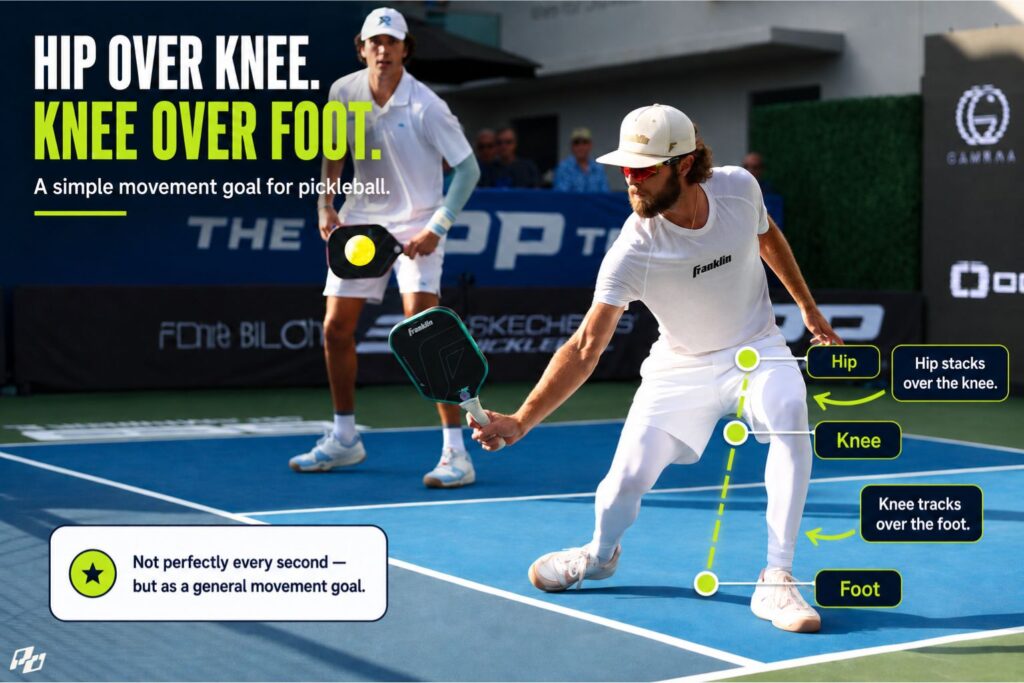
If your toes point one way and your knee collapses another way, the inside structures may get more stress.
Treatment: What to Do When the Inside Knee Gets Angry
This depends on severity, and medical care matters if symptoms are significant. But for mild, non-traumatic inner knee irritation after pickleball, the early plan is usually about calming symptoms and avoiding the movements that keep irritating it.
A sensible first step:
- reduce or stop play temporarily
- avoid aggressive cutting and wide lunges
- ice if it helps symptoms
- use compression if comfortable
- elevate if swollen
- consider over-the-counter pain relief only if safe for you
- walk normally before returning to court
- progress back gradually
RICE-style early care — rest, ice, compression, elevation — is commonly discussed for MCL sprains, along with bracing, physical therapy, and progressive strengthening when appropriate. NSAIDs may help some people but are not safe for everyone, especially those with certain stomach, kidney, heart, blood pressure, or medication issues.
The big mistake is returning to full-speed pickleball as soon as it feels “a little better” during daily life.
Walking pain-free is not the same as cutting pain-free.
Stairs pain-free is not the same as lunging pain-free.
Rec play pain-free for 15 minutes is not the same as tournament play pain-free for three hours.
Why Bracing Can Help — But Is Not the Whole Fix
A hinged knee brace can sometimes help protect the knee from side-to-side stress, especially after an MCL sprain or during return to play under medical guidance. Bracing is commonly used for more significant MCL injuries because it can help protect the ligament while allowing controlled motion.
But a brace does not fix:
- late footwork
- weak hips
- poor balance
- bad deceleration
- reaching habits
- playing too many sessions too soon
Think of a brace as a seat belt, not a driving lesson.
Useful? Yes.
A replacement for better movement? No.
Prevention: The 5 Areas Rec Players Should Train
1. Lateral Deceleration
Most players practice moving sideways. Fewer practice stopping sideways. That is a problem because many MCL-type moments happen during braking.
Try this simple pattern off court:
- Shuffle two steps right.
- Stop with control.
- Hold for two seconds.
- Check knee position.
- Repeat left.
Your goal is not speed first. It is control.
Cue: Stop quiet. Knee stacked.
If your foot slaps, hip drops, or knee caves inward, slow down.
2. Single-Leg Balance With Rotation Control
Pickleball often puts you on one leg for a split second. If you cannot control that position, the knee takes extra stress.
Try:
- single-leg stand
- slight knee bend
- rotate shoulders gently left and right
- keep knee tracking over foot
This trains the knee to stay stable while the upper body moves — exactly what happens when you reach for dinks and volleys.
Cue: Quiet knee, moving torso.
3. Glute Medius and Hip Strength
The hip helps control where the knee goes. If the hip collapses inward, the knee often follows.
Useful exercises include:
- lateral band walks
- side-lying leg raises
- single-leg sit-to-stand
- step-downs
- lateral step-downs
- controlled side lunges
Inner knee pain prevention is often a hip-control story disguised as a knee problem.
Cue: Strong hip, calmer knee.
4. Adductor and Hamstring Support
The inner thigh and hamstrings help stabilize the leg during lateral movement and deceleration. Pickleball players who only train quads may miss this.
Good options:
- Copenhagen side plank regressions
- adductor ball squeezes
- hamstring bridges
- single-leg bridges
- Romanian deadlifts
- controlled lateral lunges
Start gently. The goal is progressive strength, not soreness competition.
Cue: Inside thigh helps protect inside knee.
5. Pickleball-Specific Footwork
This is the one that matters most on court.
Use smaller adjustment steps before big reaches. Split step before the opponent hits. Avoid planting and twisting on a locked foot. Turn your feet when changing direction. Let your body follow the paddle instead of leaving the knee behind.
Best cues:
Small steps before big reaches.
Turn the foot before the knee twists.
Move first, reach second.
Do not brake and swing from the same stuck foot.
That last one is huge.
The Warm-Up That Actually Makes Sense
If you are prone to inner knee pain, your warm-up should prepare you for lateral movement and deceleration — not just raise your heart rate.
Try this 7-minute court-side warm-up:
Walking pain-free is not the same as cutting pain-free.
Stairs pain-free is not the same as lunging pain-free.
Walking pain-free is not the same as cutting pain-free.
Stairs pain-free is not the same as lunging pain-free.
✓ 1 minute brisk walk or light jog
✓ 1 minute side shuffles
✓ 1 minute backward/forward steps
✓ 1 minute gentle lateral lunges
✓ 1 minute single-leg balance with small reaches
✓ 1 minute split-step-and-hold practice
✓ 1 minute easy dinks with intentional footwork
This warms up the exact system you are about to use.
Do not go from car seat to first-point sprint. That is how many rec knees get surprised.
Shoe and Court Factors
Inside knee pain is not always “your shoes,” but footwear can influence how much your foot sticks, slides, or twists.
Court shoes matter because pickleball involves lateral movement. Running shoes are built more for forward motion and may not provide the same lateral stability. If your foot slides too much, you may compensate. If it sticks too aggressively, your knee may twist over a planted foot.
How to Return to Pickleball After Mild Inner Knee Pain
Again, significant symptoms need medical care. But for mild cases that settle quickly, do not jump straight into full open play.
Use a staged return:
Stage 1: Pain-free daily movement
Walk, stairs, light squats, and easy single-leg balance should feel okay.
Stage 2: Controlled court movement
Try shuffles, split steps, and gentle dinks without hard lunging.
Stage 3: Half-speed drilling
Add controlled lateral movement, drops, resets, and kitchen footwork.
Stage 4: Limited rec play
Play shorter games, avoid tournament intensity, and stop if symptoms build.
Stage 5: Full play
Return only when cutting, stopping, lunging, and recovery steps feel stable.
A simple return rule: If pain increases during play or is worse the next morning, you did too much.
Why Seniors Should Pay Extra Attention
Many pickleball players are 50+, 60+, and 70+, which is one reason the sport is so great — and one reason knee issues matter.
With age, players may have more baseline stiffness, slower recovery, osteoarthritis, reduced balance, less hip strength, or previous knee injuries. That does not mean you should stop playing. It means your preparation matters more.
For senior players, the big priorities are:
- longer warm-up
- strength twice per week
- balance work
- court shoes with lateral support
- smarter scheduling
- avoiding fatigue-based “one more game” decisions
- not ignoring swelling or instability
A 25-year-old may get away with sloppy recovery for a while.
A 65-year-old rec player usually benefits from being more strategic.
The Pickleball Movement Fix: Play Lower, But Not Later
A lot of coaches tell players to “get lower.”
That is good advice — but incomplete. If you get lower too late, you still reach and collapse.
The better cue is: Get lower before you need it.
When you are already in a low, athletic base before the ball comes, your first step is cleaner. Your knee tracks better. Your hip helps more. You are less likely to lunge desperately at the last second.
The Bottom Line
Inside knee pain is not just “knee pain.”
In pickleball, inner knee soreness can come from several sources, but MCL irritation is easy to overlook because players often focus more on outside knee pain, general arthritis, or meniscus worries.
The MCL gets stressed when the knee collapses inward, twists under a planted foot, or absorbs sudden side-to-side force — exactly the kind of thing that can happen during wide dinks, quick cuts, emergency lunges, and late recoveries.
The fix is not simply rest forever or slap on a brace and hope.
The real answer is smarter movement:
⮕ move before you reach
⮕ keep the knee stacked
⮕ train lateral stopping
⮕ build hip and adductor strength
⮕ warm up for side-to-side play
⮕ return gradually after pain
Most importantly, do not ignore instability, swelling, locking, or pain that keeps coming back.
Pickleball should challenge your legs. It should not make your inner knee feel like it is negotiating a contract every time you change direction.