Players over 70 win more pickleball by moving less and thinking earlier. The key habits: own the kitchen line, return deep, reset under pressure, control the middle, and use placement to create movement. Experience beats athleticism in this sport — and the soft game, patience, and pattern recognition compound with every year you play.
There is a funny thing that happens in pickleball once you have been around the game long enough.
You stop being impressed by the player who runs for everything.
At first, that player looks amazing. They sprint, lunge, recover, chase lobs, dive for wide dinks, scramble through the transition zone, and somehow keep the ball alive.
But after a while, especially if you are an experienced player in your 70s, you start noticing something else.
The best players are not always the ones moving the most.
They are the ones moving the least at the right time.
They are already leaning toward the next ball. They know which shots are worth chasing and which ones are traps. They do not try to cover the whole court with their legs. They cover it with positioning, anticipation, patience, and shot selection.
That is the real 70+ advantage.
Not pretending you are 35 again.
Not trying to out-sprint younger players.
Not playing scared either.
The goal is to build a game that wins with less scrambling and more control — a game where your experience becomes the weapon.
And honestly, your best pickleball years can still happen in your 70s if you stop measuring your game by how much ground you can cover and start measuring it by how often you make opponents hit the ball you wanted them to hit.
The Big Shift: Stop Playing Like You Have to Prove You Can Still Move
A lot of strong 70+ players are still competitive. That is a good thing.
You want to win. You want to play well. You want to hold your own against younger teams. You want to feel dangerous at the kitchen and not like someone opponents are “being nice” to.
But here is where some experienced players get stuck: they try to prove they can still chase everything.
That mindset is exhausting.
It also creates bad pickleball.
You reach for balls you should let go. You take giant recovery steps instead of small adjustment steps. You get pulled wide and try to rip a low-percentage ball back. You chase lobs that are not worth chasing. You cover your partner’s side too much because you do not want to look slow. You play one more game when your legs are already giving you warning lights.
The smarter mindset is different: I do not need to chase everything. I need to make opponents hit worse balls.
That is the game.
At 70+, you win by forcing extra shots, shrinking your movement demands, making smart resets, protecting the middle, and choosing offense when the ball actually gives you permission.
You are not trying to survive younger players.
You are trying to make them play your kind of point.
Why 70+ Players Can Still Be Brutal to Play Against
Younger players often bring speed, reach, power, and recovery. No argument there. But experienced 70+ players can bring something that is just as frustrating:
⮕ pattern recognition.
You have seen the impatient banger. You have seen the lobber. You have seen the soft-game grinder. You have seen the tennis player who drives every third. You have seen the player who speeds up whenever the dink lands near their forehand. You have seen the partner who overpoaches when nervous. You have seen the team that starts blaming each other after three long rallies.
That matters.
Pickleball rewards players who can recognize what is coming before it happens. If you know the likely shot, you do not need to be as fast. You need to be earlier.
That is why some 70+ players feel impossible to beat. They are not flying around the court. They are waiting in the right place.
They let younger players do the rushing. Then they make them hit one more ball.
The 70+ Doubles Blueprint
If you are an experienced rec player in your 70s, your doubles game should be built around four priorities:
- Control the middle.
- Reduce emergency movement.
- Make opponents hit upward.
- Choose pressure over panic.
That is the whole blueprint.
Notice what is not on the list:
❌ Run more.
❌ Swing harder.
❌ Cover everything.
❌ Win every hand battle.
❌ Chase every lob.
❌ Attack every ball that looks tempting.
Those are not strategies. Those are energy leaks.
The strongest 70+ doubles teams usually win because they are organized. They do not give away huge holes. They communicate early. They reset instead of over-fighting. They use placement to create movement instead of doing all the moving themselves.
1. Own the Middle Without Overcrowding It
In doubles, the middle is where many points quietly turn.
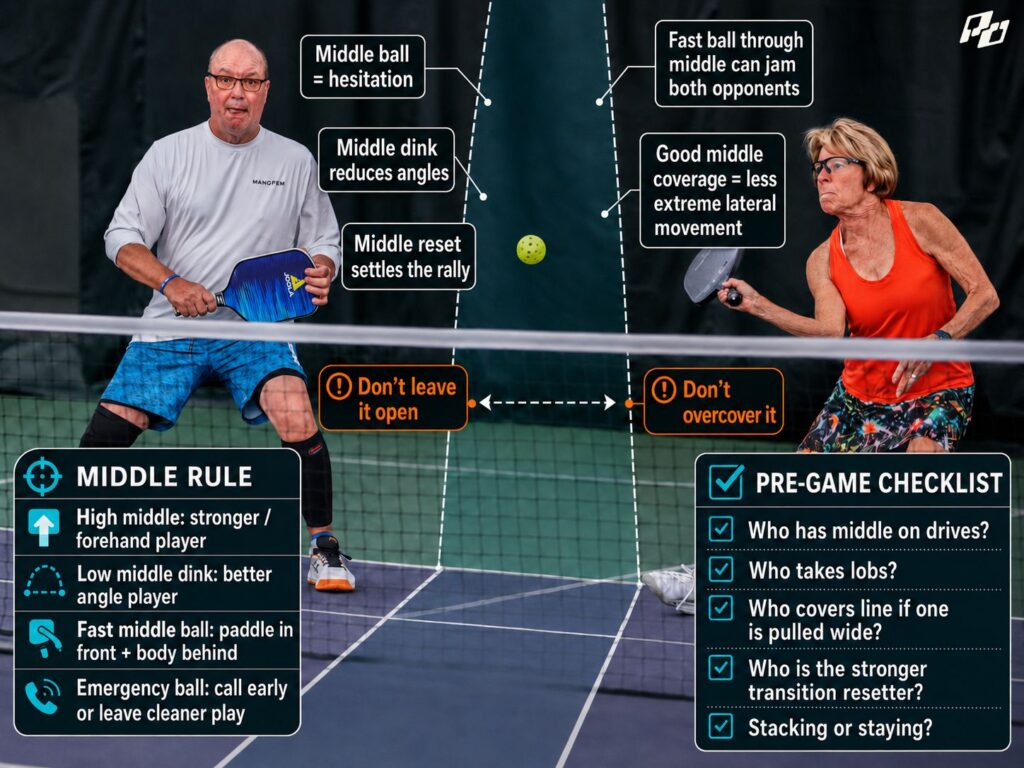
A ball through the middle can create hesitation. A dink to the middle can reduce angles. A reset to the middle can calm the rally. A speedup through the middle can jam both opponents. A partner who protects the middle well can make the court feel smaller.
For 70+ players, the middle matters even more because it helps reduce extreme lateral movement.
If you and your partner leave the middle open, you will spend the whole game reacting. If you overcover the middle, you expose sidelines and create confusion.
⮕ The goal is not to stand in the middle. The goal is to have a middle rule.
Try this:
High middle ball: stronger or forehand player takes it.
Low middle dink: player with better angle takes it.
Fast middle ball: whoever has paddle in front and body behind it takes it.
Emergency middle ball: call early or leave it if your partner has the cleaner play.
That may sound simple, but most rec teams never discuss it. They just say “yours” after the ball has already passed.
A smart 70+ team should decide before the game:
“Who has middle on drives?”
“Who takes lobs?”
“Who covers the line when one of us is pulled wide?”
“Who is the stronger resetter in transition?”
“Are we stacking or staying?”
Those little conversations save steps. And saved steps matter.
2. Stop Chasing Wide Dinks Like They Are Moral Tests
Wide dinks are one of the biggest traps for experienced players.
The opponent pulls you wide. You feel like you have to get there. You lunge, reach, flick something back crosscourt, and suddenly you are outside the sideline with your partner exposed in the middle.
Sometimes you make the shot. But the point is still worse.
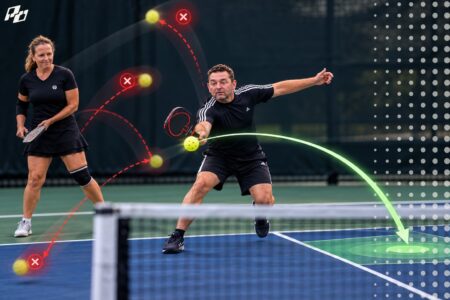
A smarter 70+ response is not always to win the wide dink back. It is to neutralize it. When you are pulled wide, your first question should be:
Can I attack from balance, or do I need to make this boring?
If you are balanced, go ahead and pressure the ball. Roll it crosscourt. Dink behind movement. Aim at the outside foot. Use your skill.
But if you are stretched, late, or reaching, do not try to be a hero.
Use a neutral shot:
✅ middle dink
✅ middle reset
✅ soft chip
✅ safe crosscourt with margin
✅ or a controlled dink that buys recovery time
The goal is to stop the angle before it turns into a full-court scramble.
A great cue for 70+ players: Do not chase the angle. Kill the angle.
That means if the opponent pulls you wide, do not automatically try to hit an even sharper reply. Often, the smarter play is middle. Middle makes the rally less diagonal, gives your team time, and makes the opponent create again.
3. Play Earlier, Not Faster
This might be the most important concept in the whole article. The best 70+ players do not necessarily play slower.
They play earlier.
They split before the opponent contacts. They read paddle position. They notice if the opponent is late. They see when a player is off balance. They know when a dink is going crosscourt before it crosses the net. They recognize the banger’s backswing before the drive arrives.
That is not magic. That is experience plus attention.
Most rec players react to the ball after it leaves the opponent’s paddle. Better players react to the setup before contact.
Start watching these clues:
Is the opponent reaching?
Is their paddle face open?
Are they leaning backward?
Is their contact point low?
Are they taking a bigger backswing?
Are they off the kitchen line?
Did your shot pull them wide?
Is your partner’s ball attackable?
Is the opponent’s body closed or open?
The more clues you read, the less you have to chase.
A simple rule: If you cannot move faster, read sooner.
That one idea can transform a 70+ doubles game.
4. Use Depth as Your First Form of Defense
When players talk about defense, they often think about blocking speedups or resetting drives.
But in doubles, your defense starts much earlier. It starts with your return.
A deep return gives you time. It keeps the serving team back. It makes their third shot harder. It lets you and your partner get established at the kitchen. For 70+ players, that is massive.
A short return creates the opposite problem. Now the opponent can step in, drive, drop, or attack with more comfort. You have to defend sooner. The point becomes faster than it needs to be.
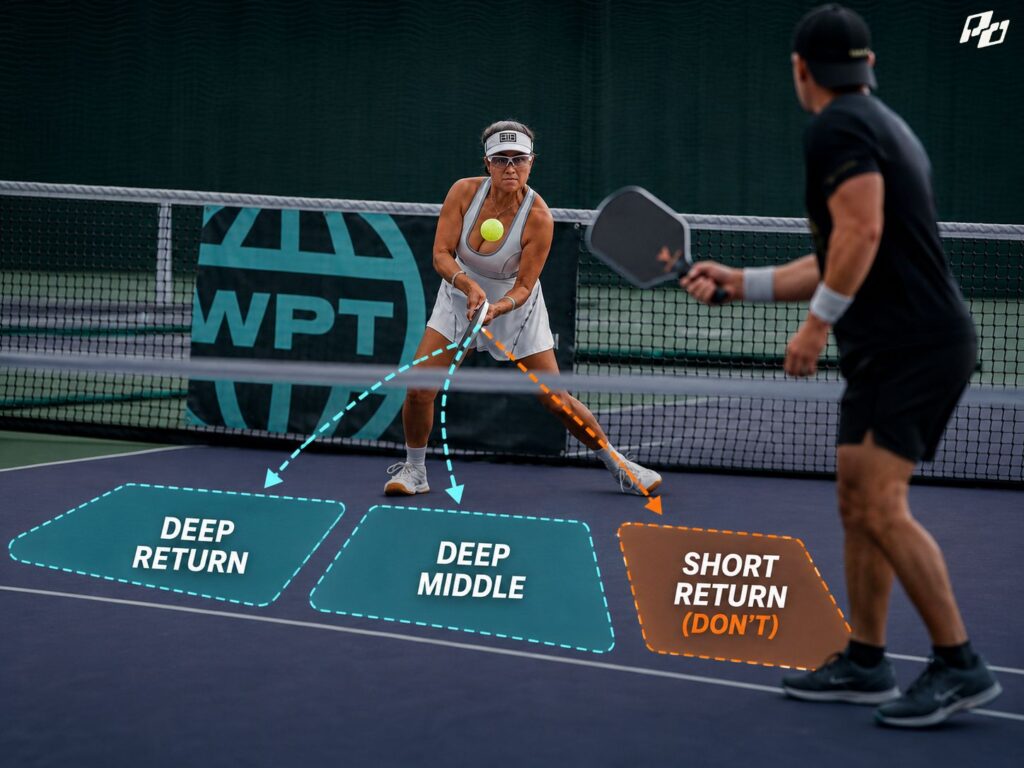
So if you are trying to reduce scrambling, start here: Return deep, then move with control.
Do not aim for perfect sidelines. Aim deep middle or deep backhand. Make the serving team hit one more quality ball from farther away.
A deep return may not feel exciting, but it prevents chaos.
And preventing chaos is winning pickleball.
5. Stop Turning Every Speedup Into a Reflex Contest
Hand speed still matters in your 70s, but the bigger skill is choosing which exchanges deserve your hands.
At higher levels, a speedup is not just a fast ball. It is an invitation into a pattern. If you speed up from the wrong ball, you are not attacking — you are giving your opponent timing, pace, and a predictable contact window.
That is why some younger players love playing against impatient senior opponents. They are not worried about the first speedup. They are waiting for it. The moment you attack from below net height, off balance, or with your paddle dropping, they counter into your feet, hip, or open middle.
The smarter 70+ player thinks less about “Can I speed this up?” and more about:
If I speed this up, what ball am I inviting back?
That question changes everything.
A good speedup should come from a position where you can handle the next ball. That means your feet are set, your paddle is already in front, your partner is alert, and your target creates trouble rather than chaos. If your attack leaves you leaning, reaching, or admiring the shot, you probably started a hand battle you were not organized to finish.
Here is the deeper rule: do not speed up unless your recovery position is part of the shot.
For 70+ players, that is huge. You may still have excellent hands, but you probably do not want to turn every rally into a five-ball firefight against a player who lives for pace. Instead, use speedups as a controlled pattern starter, not an emotional release.
Aim at targets that reduce their clean counter:
✓ paddle-side hip
✓ dominant shoulder pocket
✓ inside elbow
✓ middle seam
✓ backhand-side rib cage
✓ feet when they are moving
Avoid speedups that feed their strengths:
✕ flat balls straight to a ready backhand counter
✕ shoulder-high balls to a player already sitting on the attack
✕ speedups from below net height with no topspin or shape
✕ attacks while your partner is still recovering
✕ line attacks that open your own sideline if they block well
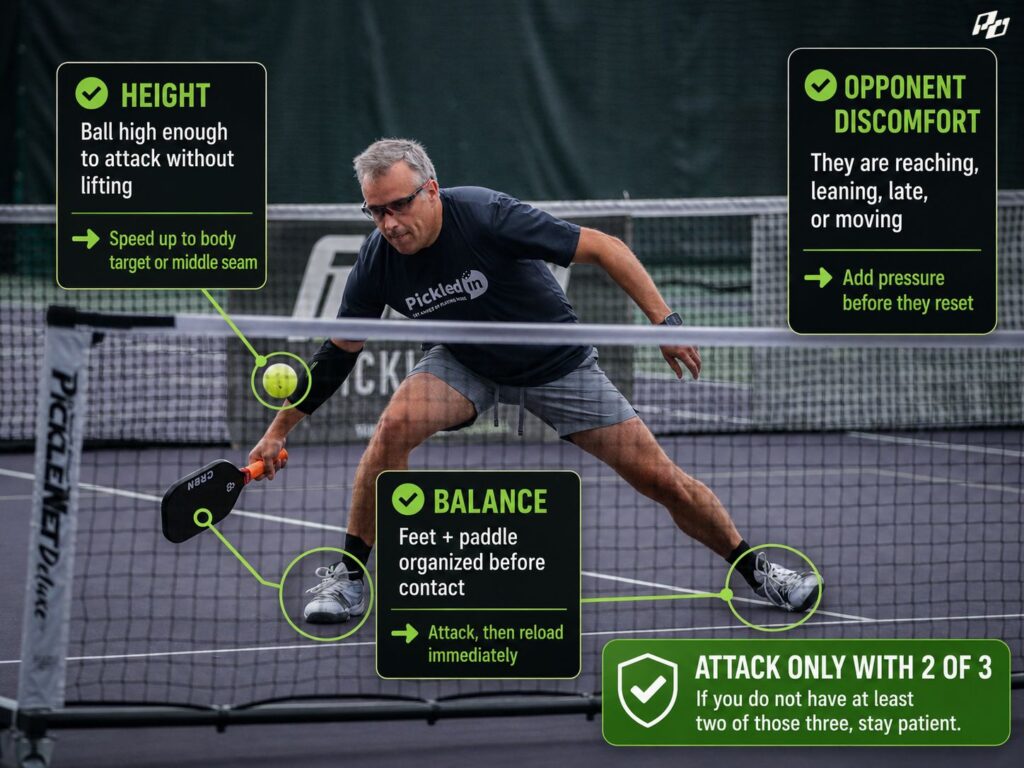
The best 70+ attackers often look patient because they are waiting for one of three green lights:
| Green Light | What It Means | Best Response |
|---|---|---|
| Height | The ball is high enough that you can attack without lifting | Speed up to a body target or middle seam |
| Balance | Your feet and paddle are organized before contact | Attack, then reload immediately |
| Opponent Discomfort | They are reaching, leaning, late, or moving | Add pressure before they reset |
If you do not have at least two of those three, stay patient.
A low dink, middle reset, or boring ball to the feet may feel less exciting, but it often does something better: it makes the opponent attack from a worse position first. That is how you win the hands battle without volunteering for one.
The cue is: Start the fight only when you can finish the next punch.
6. Build a “No Scramble” Shot Menu
One of the best things 70+ players can do is build a default menu for trouble. Not every ball needs creativity. In fact, under pressure, creativity often becomes panic.
Your trouble menu should be simple:
| Situation | Simple Response |
|---|---|
| Pulled wide | Dink middle. |
| Aggressive dink pulls you wide | Set the paddle, chip middle, recover. |
| Late in transition | Reset soft and low. |
| Hard drive at you | Block middle. |
| Ball at your feet | Lift safely into the kitchen. |
| Partner pulled wide | Cover the middle gap. |
| Opponent lobs | Decide early: chase, switch, or leave it. |
| Low ball below net | Do not speed up. |
| High ball while balanced | Attack a big target. |
This is how you stop wasting energy. You decide your emergency responses before you need them.
When the point gets messy, you do not have to invent. You execute.
7. Use Placement to Create Extra Steps, Not Just Open Court
At 70+, the best placement is not always the widest angle. It is the ball that makes your opponent stop, restart, bend, or change direction.
That is a more advanced way to think about moving younger players.
A young player may love sprinting to a wide ball. What they usually hate more is having their momentum interrupted. Hit behind their recovery. Put the next dink at their feet after they step forward. Use a soft middle ball after pulling them wide. Change height and speed so they cannot settle into one rhythm.
The goal is not simply “make them run.” The goal is to make their first step wrong.
A good pattern looks like this:
- Pull them wide, then go middle.
- Make them move forward, then reset low to their feet.
- Give them pace, then take pace away.
- Let them lean one direction, then play behind the lean.
That kind of placement saves your legs and taxes theirs.
Cue: Make them restart, not just run.
8. The Partner System: Less Guessing, More Rules
A lot of 70+ doubles frustration is not physical. It is organizational. Two experienced players can still look messy if they have no system.
Before the game, agree on a few simple rules:
✅ Who takes lobs?
✅ Who takes high middle balls?
✅ Who calls switches?
✅ What is the return target?
✅ Are we attacking the weaker player or weaker shot?
✅ If one player gets pulled wide, what does the other cover?
✅ If we are under pressure, where is our safe reset target?
You do not need a full team meeting. You need clarity.
9. Protect Your Body Without Playing Scared
There is a difference between playing efficiently and playing afraid.
Efficient means you use better positioning, better targets, and smarter recovery.
Afraid means you stop moving, stop attacking, and start hoping the opponent misses.
The goal is not to become cautious. The goal is to become selective.
That matters because pickleball still requires movement. You still need warmups. You still need balance. You still need strength. You still need enough conditioning to play the way you want.
For 70+ players, the body-management piece is part of the strategy.
- Warm up before serious games.
- Wear court shoes, not running shoes.
- Avoid going from sitting in the car to full-speed play.
- Build in recovery days.
- Do not play your worst movement patterns when exhausted.
- Train balance and lateral strength off court.
- Stop treating “one more game” as a personality test.
Longevity is not the opposite of competitiveness.
It is what lets you keep competing.
10. Why Your Best Years Can Still Happen in Your 70s
This is the part I really believe.
Your best pickleball years can absolutely happen in your 70s — not because your body is the same as it was at 40, but because your game can become more intelligent than it has ever been.
You may not chase as much — and that is not a weakness. It means your patterns need to do more of the work.
You may not win every sprint — and that is fine. It means anticipation becomes your first step.
You may not want endless hand battles — good. It means you learn how to deny them instead of joining every firefight.
You may need more recovery — smart. It means you become more intentional about when you play, how hard you play, and which points are actually worth spending energy on.
The 70+ player who accepts these realities does not become weaker. They become sharper.
They stop trying to win the game everyone else wants and start forcing opponents into a game built on patience, placement, and control.
And at the rec level, that is brutally effective.
The 70+ Doubles Checklist
Use this before your next serious game:
✅ Are we returning deep enough?
✅ Do we have a middle rule?
✅ Are we moving together or separately?
✅ Are we attacking from balance?
✅ Are we over-chasing wide dinks?
✅ Are we letting younger players use our pace?
✅ Are we making them hit one more ball?
✅ Are we choosing smart lobs or panic lobs?
✅ Are we staying calm in transition?
✅ Are we playing our game or theirs?
If you can answer those questions honestly, you are already ahead of most rec teams.
The Best Cues to Remember
| Cue | What It Reminds You To Do |
|---|---|
| Play earlier, not faster. | Read the rally sooner instead of trying to outrun every ball. |
| Do not chase the angle. Kill the angle. | Use middle resets and safer targets when pulled wide. |
| Neutral is the win. | Stop trying to attack from trouble. Reset the point first. |
| Cover your job, not your ego. | Trust positioning and partnership instead of overreaching. |
| Make them hit one more ball. | Let patience create mistakes instead of forcing the finish. |
| Place first, pace second. | Use accuracy and depth before adding speed. |
| Neutralize from trouble. Attack from balance. | Defend when stretched, pressure when organized. |
| Win with patterns, not panic. | Build points with intention instead of reacting emotionally. |
The 70+ Game Can Be Smarter, Cleaner, and More Dangerous
The best 70+ pickleball players are not trying to prove they can play like younger players.
They are building a game younger players hate dealing with.
They return deep. They own the middle. They move as a team. They reduce scrambling. They reset when stretched. They attack only when the ball is right. They make opponents hit one more ball than they wanted to hit.
That is not “old-person pickleball.” That is smart pickleball. And if you are in your 70s, that should be exciting.
Because your game does not have to be built around what you used to do. It can be built around what you now see better than almost everyone else on the court.