
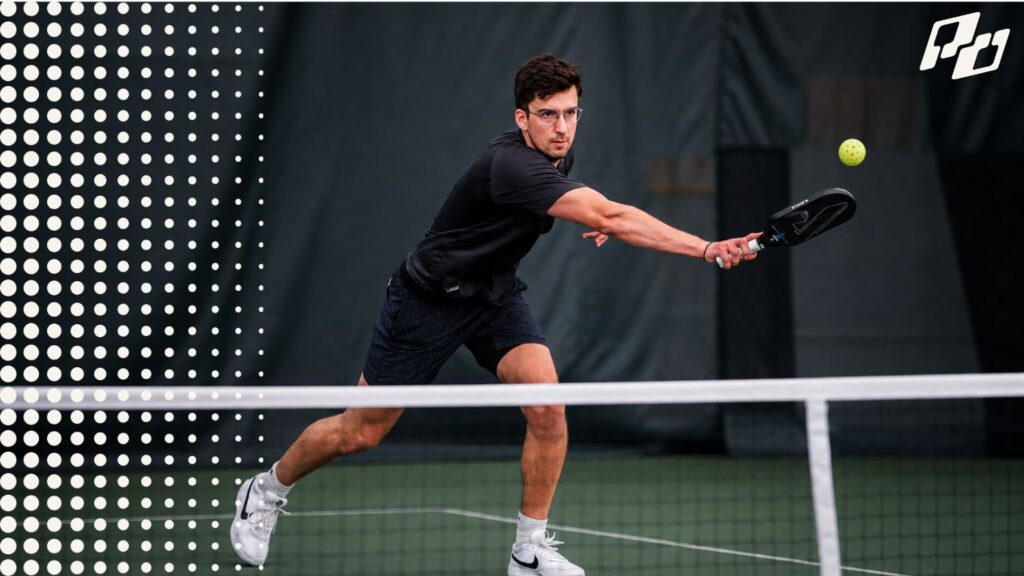
A forehand crosscourt roll is a topspin pressure shot that makes your dink game more dangerous. Hit it from balance, contact out front, stay low, brush across and up, and aim crosscourt to move opponents wide, force pop-ups, and create attacking chances without overhitting.
The forehand crosscourt roll is one of those shots that gets described too casually. Players hear “roll it” and think it means one of three things:
Hit a soft dink with a little topspin.
Flick the wrist across the ball.
Swing harder, but somehow make it dip.
That is why so many intermediate players either avoid the shot completely or turn it into a pop-up, a net ball, or a wild speedup that misses by three feet.
But when it is done well, the forehand crosscourt roll is not just a “spinny dink.” It is a controlled pressure shot. It lets you attack without fully attacking. It lets you move an opponent without overhitting. It gives your crosscourt dink game more shape, more disguise, and more bite.
And in doubles, especially at the 3.5–4.0 level, that matters a lot.
The modern forehand roll shows up in several forms: the crosscourt roll dink, the rolling speedup, the rolling fourth, and the soft topspin pressure ball. Coaches increasingly teach it as a way to stay aggressive inside the soft game, not just as a flashy topspin trick.
So let’s break it down properly.
What Is a Forehand Crosscourt Roll?
A forehand crosscourt roll is a topspin forehand shot hit diagonally across the court, usually from the kitchen or transition area, where the paddle brushes across and slightly up the back/inside of the ball to create shape.
It is not a flat drive.
It is not a slice dink.
It is not a wristy slap.
It is a controlled rolling motion that makes the ball travel with topspin, dip sooner, and often jump or pull away after the bounce.
The simplest version is this:
A forehand crosscourt roll is a pressure dink or soft attack that uses topspin to move the opponent wide while keeping the ball low enough to avoid an easy counter.
That is why intermediate players should care. You are not trying to hit a winner every time. You are trying to make the next ball harder for your opponent.
Why the Shot Is Often Misunderstood
The word “roll” creates confusion because players focus on the paddle finish instead of the purpose of the shot.
They think:
“I need more wrist.”
“I need a bigger windshield-wiper motion.”
“I need to brush dramatically around the outside of the ball.”
“I need to make it look like tennis topspin.”
That is where things go wrong.
A good pickleball roll is compact. The paddle works across and up, yes, but the body still supports the shot. The contact is out front. The legs load and transfer. The paddle face stays organized. The swing path is controlled.
The motion should not be a wild side-to-side windshield-wiper wrist twist; it should move forward and slightly upward, with the paddle starting open and closing through the ball. That same warning applies to the crosscourt roll. The “wiper” image can help some players understand spin, but if it turns into a wristy swipe, the shot falls apart.
So yes, there is brushing.
Yes, there is spin.
But the shot should still feel connected, balanced, and controlled.
The Big Advantage: You Can Pressure Without Overcommitting
This is the main reason I like the forehand crosscourt roll for intermediate players. At the kitchen, many players think they only have two choices:
Soft dink.
Hard speedup.
The roll gives you a third option.
You can hit a ball with enough shape and intent to pressure your opponent, but not so much risk that you are gambling the rally. Instead of floating a passive dink or forcing a low-percentage attack, you roll the ball crosscourt with topspin and make your opponent handle a dipping, moving ball.
That can create:
✓ late contact
✓ weaker dinks
✓ pop-ups
✓ awkward backhand reaches
✓ rushed speedups
✓ opened middle space
✓ better chances for your partner to attack
That is the point. The roll is not always the finishing shot. Often, it is the shot that creates the finishing shot.
Why Crosscourt Is the Natural Direction
Crosscourt gives the roll more room to work.
The diagonal court is longer. You can use more shape. You can create a wider angle. And because the ball travels farther, the topspin has more time to pull the ball down into the kitchen.
That is why the crosscourt forehand roll is usually more practical for rec players than trying to roll everything straight ahead or down the line.
Crosscourt also helps you move your opponent. If you can roll to the outside foot or wide kitchen corner, you force them to reach, lower their contact point, and hit from a less comfortable position. Coaches who teach purposeful crosscourt dinking often emphasize moving the opponent rather than just trading passive balls; one common crosscourt dink drill divides targets around the opponent’s legs to create movement and eventually force attackable balls.
That is exactly where the forehand crosscourt roll fits.
It is not just “spin for spin’s sake.” It is spin with a tactical job.
When to Use the Forehand Crosscourt Roll
The best time to use it is when you are balanced, the ball is in front of you, and the contact point is high enough that you can shape the ball without lifting it.
For most intermediate players, that means the ball is around knee-to-waist height, sometimes slightly higher, and you are not scrambling.
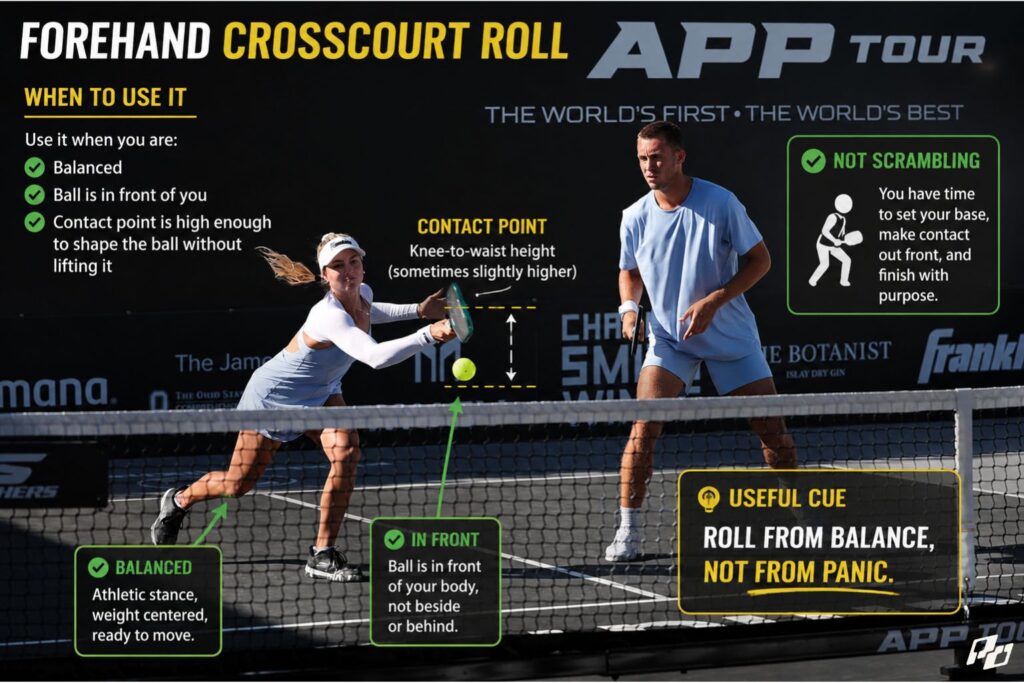
Use it when:
✓ you are in a crosscourt dink rally
✓ the ball sits up slightly but is not high enough to smash
✓ your opponent is leaning middle
✓ your opponent has a weaker backhand dink
✓ you want to move someone wide without overhitting
✓ you want to make your dink more aggressive
✓ you want to disguise a possible speedup
✓ you are balanced enough to brush and recover
This is a “from control” shot.
It works best when you have time to set your base, contact out front, and finish with purpose.
A useful cue: roll from balance, not from panic.
When Not to Use It
Do not use the forehand crosscourt roll just because you like the idea of it.
This shot becomes risky when the ball is too low, too fast, too close to your body, or too wide for clean contact.
Avoid it when:
✕ you are late
✕ you are falling backward
✕ the ball is below your comfortable contact window
✕ you are stretched outside your frame
✕ your wrist has to save the shot
✕ the opponent is sitting on the crosscourt roll
✕ the safer reset or dink is clearly better
✕ you cannot recover after the shot
This is where many 3.5 players get into trouble. They try to “roll” a ball that should simply be reset.
If the ball is low and uncomfortable, a roll can turn into a lifted sitter. If the ball is too close to your body, the paddle path gets cramped. If you are off balance, the spin becomes unreliable.
A good rule: if you cannot control the height, do not add spin first.
Control comes before shape.
The Three Versions of the Forehand Crosscourt Roll
Not every roll is the same. For rec players, it helps to separate the shot into three versions.
1. The Soft Roll Dink
This is the safest and most useful starting point.
The soft roll dink is still a dink, but it has topspin and direction. You are not trying to win the point. You are trying to make the ball dip and pull your opponent wide.
This is great when the rally is neutral and you want to add pressure without creating a speedup exchange.
Use it when:
✓ the ball is low-to-medium height
✓ your opponent is stable
✓ you want to move them wide
✓ you want to keep the ball unattackable
✓ you are building the point
Cue: shape it, don’t shove it.
2. The Pressure Roll
This is firmer than a dink but not quite a full speedup.
It travels with more pace, more topspin, and more intent. It is designed to rush the opponent’s contact point, especially if they are leaning or recovering.
This is useful when the ball sits up just enough and you can roll it to the opponent’s hip, outside foot, or backhand side.
Use it when:
✓ the ball is slightly attackable
✓ the opponent is leaning middle
✓ you have room to brush forward and up
✓ you want to create a weak reply
✓ you are ready for the counter
Cue: firm roll, big target.
3. The Roll Speedup
This is the aggressive version.
A roll speedup uses topspin to attack while still giving the ball shape. It is often aimed crosscourt toward a hip, shoulder, or open lane, but it has to be used carefully.
The shot is misunderstood because players focus on power without understanding when, where, and how to use it. The roll speedup is only good when the ball is actually attackable and your target is smart.
Use it when:
✓ the ball is above net height or at least high enough to shape safely
✓ your opponent is off balance
✓ you can keep the motion compact
✓ your target is big enough
✓ your partner is ready for the next ball
Cue: attack with shape, not hope.
The Mechanics: How to Hit the Forehand Crosscourt Roll
1. Contact the Ball Out Front
This is non-negotiable.
If the ball gets too close to your hip, your paddle path gets jammed. If the ball gets behind you, you either scoop it or slap it. Neither creates a reliable roll.
Contact out front lets you control direction, height, and spin. It also gives your paddle room to brush across and up through the ball.
For most rec players, “out front” does not mean fully extended. It means the ball is in front of your lead hip or front knee, with the paddle face stable and the arm still connected.
Cue: see it early. Meet it in front.
2. Load the Back Leg and Stay Low
The roll is not just a hand shot. You need your lower body.
Load slightly into the back leg, stay low, and let your weight transfer forward through the ball. This gives the shot stability and prevents the wrist from doing all the work.
If you stand tall and try to roll with only the arm, you will usually lift the ball, pull across too sharply, or lose control of the paddle face.
A low base also helps you get under the ball enough to create topspin without popping it up.
Cue: load low, roll forward.
3. Brush Across and Up
This is the spin piece.
The paddle should work across the back/inside of the ball and slightly upward. The motion feels a bit like brushing from low to high while sending the ball diagonally.
The phrase “windshield wiper” can be useful if it reminds you to create topspin and shape, but do not turn it into a big wrist-only swipe. Think of the paddle path as compact and forward, with the forearm and shoulder helping the paddle accelerate through the ball.
Cue: brush up, finish through.
4. Keep the Paddle Tip Working Around the Ball
On a good crosscourt roll, the paddle does not just push straight through the middle of the ball. It works slightly around the inside/back of the ball so the shot travels crosscourt with spin.
But again, do not overdo it.
If you carve around the ball too much, you may send it wide. If you go too vertical, you may float it. If you go too flat, it becomes a drive or push.
The sweet spot is: across enough to shape. Up enough to dip. Forward enough to control.
5. Finish in the Direction of the Shot
One of the biggest mistakes is brushing up and then stopping.
The finish still matters.
After contact, your paddle and body should continue toward the crosscourt target. This keeps the ball from floating straight up or dragging wide.
Cue: spin it, then send it.
Why This Shot Helps in Doubles
The forehand crosscourt roll is especially useful in doubles because it changes the geometry of the point without requiring a reckless attack.
It Moves the Opponent Wide
A good crosscourt roll can pull the opponent off their base. That matters because once they reach, they often give you a weaker ball.
If they dink back short, you can step in.
If they pop it up, you or your partner can attack.
If they overcorrect middle, the next angle opens.
It Creates Middle Balls for Your Partner
This is one of the biggest doubles benefits.
When you roll crosscourt and move the opponent wide, their easiest reply may float back middle. If your partner is alert, that middle ball can become the real opportunity.
This is why the roll is not just an individual shot. It is a partner setup.
A great crosscourt roll might not win the point.
It might give your partner the ball that wins the point.
It Keeps You Aggressive Without Over-Speeding
Intermediate players often speed up too early because they feel like neutral dinking means they are not doing enough.
The roll gives you a way to pressure while staying patient.
Instead of forcing a speedup from below net height, you can roll a heavy dink crosscourt and keep building the rally.
That is smarter pickleball.
It Disguises Your Speedup
If your soft roll and your roll speedup share the same early setup, your opponent has a harder time reading you.
This is a major advantage. One of the biggest problems in rec play is that players telegraph attacks by changing their grip, paddle height, or backswing. The more your dink and speedup look similar early, the harder you are to defend.
That is why the forehand roll pairs so well with disguise.
It Attacks the Backhand Dink
Many rec players are less comfortable dinking with their backhand, especially when stretched wide. A crosscourt forehand roll can target that weakness without needing a reckless line attack.
You are not just hitting away from them. You are making them hit from a position they do not like.
Where to Aim
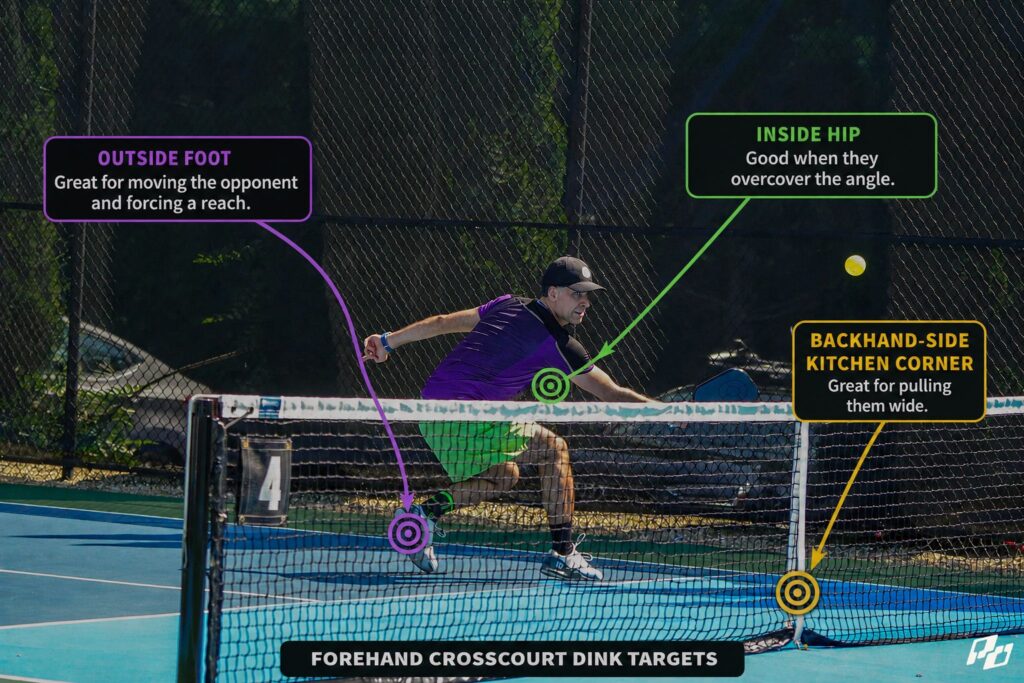
Do not aim at the sideline unless you love donating balls. Aim for zones.
Outside foot: Great for moving the opponent and forcing a reach.
Backhand-side kitchen corner: Great for pulling them wide.
Inside hip: Good when they overcover the angle.
Middle seam: Useful if the opponent is leaning wide or your partner is ready.
Deep kitchen crosscourt: Good for pressure without over-risking.
For most intermediate players, the safest aggressive target is the outside foot or deep crosscourt kitchen. It gives you room, creates movement, and does not require perfect line painting.
Cue: aim at a body part, not a stripe.
Common Mistakes
1. Rolling with only the wrist
A wristy roll changes the paddle face too much. One ball looks great, the next three miss.
Fix: Use legs, shoulder, and forearm. Keep the wrist athletic, not floppy.
Cue: Stable wrist, active forearm.
2. Standing too tall
Straight legs force the paddle to manufacture lift and spin, which often creates pop-ups.
Fix: Get low before contact.
Cue: Low body, low ball.
3. Contacting too late
Late contact kills direction and leads to pulls, scoops, or floaters.
Fix: Prepare early and meet the ball out front.
Cue: Front contact, clean shape.
4. Swinging too big
At the kitchen, big swings get exposed fast.
Fix: Keep it compact and accelerate through contact.
Cue: Small swing, heavy ball.
5. Trying to roll every dink
If you roll everything, opponents adjust and your errors climb.
Fix: Mix rolls with neutral dinks, resets, and occasional speedups.
Cue: Use it as a changeup, not a personality.
6. Attacking from below net height
Topspin helps, but it does not erase bad contact height.
Fix: Roll softly or reset when the ball is low.
Cue: Low ball, soft shape. High ball, pressure.
The Difference Between a Roll and a Flick
These two shots get mixed up.
A roll is usually smoother, more shaped, and more connected to the body. It often happens in a dink rally and uses topspin to create pressure.
A flick is usually quicker, more sudden, and more explosive. It is often used as a speedup from the wrist/forearm with a compact strike.
Both can use topspin. Both can go crosscourt. But they are not the same.
For intermediate players:
Use the roll when you want shape and pressure.
Use the flick when you have a higher ball and a clear attack window.
If you try to flick every roll, you will over-attack. If you try to roll every flick, you may miss chances to finish.
The Best Cues to Remember
Contact out front.
Direction and control start here.
Load low.
Your legs create stability.
Brush across and up.
This creates the roll shape.
Finish through.
Spin still needs a destination.
Soft roll first.
Do not start by blasting.
Move them, then attack.
The first roll often creates the second ball.
Shape before speed.
If the shape is bad, more pace only makes it worse.
So, Should Intermediate Players Learn the Forehand Crosscourt Roll?
Yes — but they should learn the soft version first.
This shot is a great upgrade for 3.5–4.0 rec players because it adds pressure without requiring constant speedups. It helps you turn neutral dinks into uncomfortable balls. It gives you a way to move opponents wide, attack weak backhands, create pop-ups, and set up your partner.
The forehand crosscourt roll is not magic. It will not save bad footwork. It will not fix late contact. It will not turn a low, desperate ball into a free winner.
But when you use it from the right ball, with the right shape, it gives your soft game teeth.
And that is the real point.