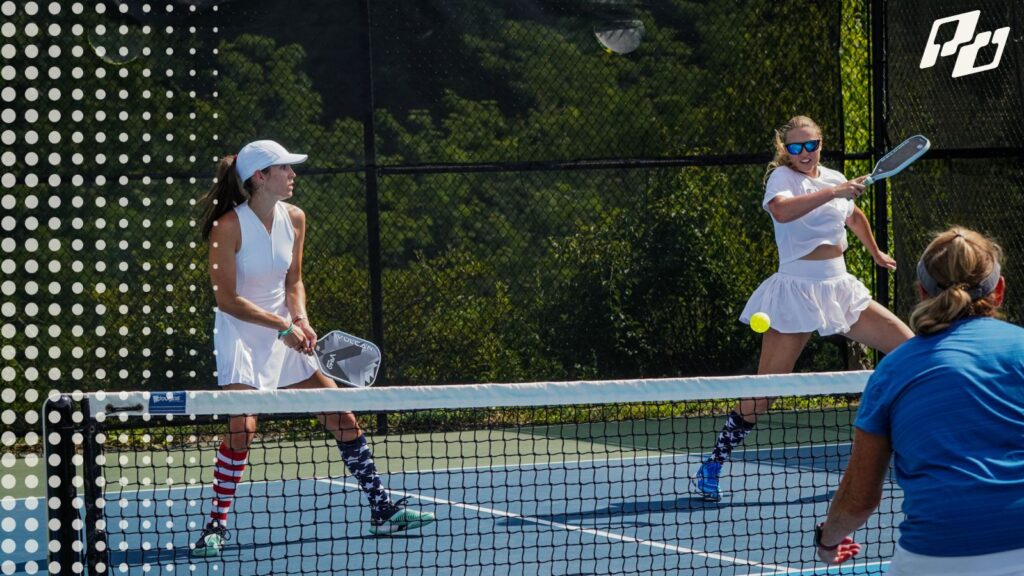
If opponents keep targeting your pickleball partner, the fix isn't poaching — it's geometry. Play more balls through the middle to reduce angles, shade earlier before opponents swing, and stop hitting shots that create difficult next balls for your partner. Make the isolation pattern harder to run cleanly, and your team becomes much harder to beat even with a skill mismatch.
There is a specific kind of frustration that hits improving pickleball players around the 3.5–4.0 level.
You are not just losing.
You are losing while barely touching the ball.
Your partner is getting 70% of the traffic. Opponents have figured out the mismatch. Every return, dink, speedup, and reset seems to go away from you. You stand there ready, paddle up, feet active, reading the point perfectly… and then another ball goes to your partner’s outside foot.
That is when a lot of rec players start spiraling.
They poach too much. They force bad attacks. They sigh. They coach. They get visibly annoyed. And ironically, they become less useful with every point.
Here is the truth: if opponents are freezing you out, you cannot just wait for them to “play fair.” You need to change the geometry of the rally.
Not by stealing every ball.
Not by embarrassing your partner.
Not by turning open play into a personal grievance session.
You control the game by making it harder for opponents to isolate your partner cleanly. That is a real 4.0 skill.
The Mistake: Standing in Your “Correct” Spot While Your Partner Gets Picked Apart
Most intermediate players are taught basic court responsibility: cover your side, respect the middle, move with your partner, do not overreach.
That is good advice in balanced doubles.
But when your partner is clearly weaker, “normal” positioning often becomes too passive.
If you stand in your textbook spot while opponents repeatedly attack your partner, you are technically correct but tactically irrelevant. You are guarding space the ball is not going to.
In uneven rec games, your job is not to cover your perfect half.
Your job is to cover the next likely ball.
That means you need to shade, squeeze, and influence the rally before the ball gets to your partner.
Step 1: Identify How Your Partner Is Being Targeted
Do not just think, “They keep hitting to my partner.” Get more precise.
- Are opponents targeting your partner’s backhand dink?
- Are they driving through their transition zone?
- Are they speeding up at their right hip?
- Are they pulling them wide, then attacking the middle?
- Are they lobbing over them because they crowd the kitchen?
Each pattern requires a different answer.
- If your partner is missing soft balls, you need to reduce angles.
- If your partner is losing hands battles, you need to stop feeding opponents attackable height.
- If your partner is getting pulled wide, you need to protect middle earlier.
- If your partner cannot transition, you need to slow the fifth and seventh balls down.
The stronger player’s first job is diagnosis.
Not frustration. Diagnosis.
Step 2: Use the Middle to Shrink the Court
The most underrated answer to being frozen out is not poaching. It is middle pressure.
When you hit sharp angles, you often give opponents sharp angles back — and those angles usually expose your partner. But when you play more balls through the middle, you reduce their ability to pull your partner wide.
A controlled middle dink, middle reset, or middle roll does three useful things:
- It reduces opponent angle.
- It creates communication pressure.
- It gives you more chances to step into the next ball.
This is especially useful when your partner is unstable laterally. Do not make them defend the whole sideline-to-middle corridor if they are already late. Compress the court first.
When your partner is under attack, stop opening the court for the other team.
Middle does not mean passive. It means you are taking away their easiest isolation pattern.
Step 3: Shade Before You Poach
Bad poaching is late and emotional.
Good poaching starts before the opponent swings.
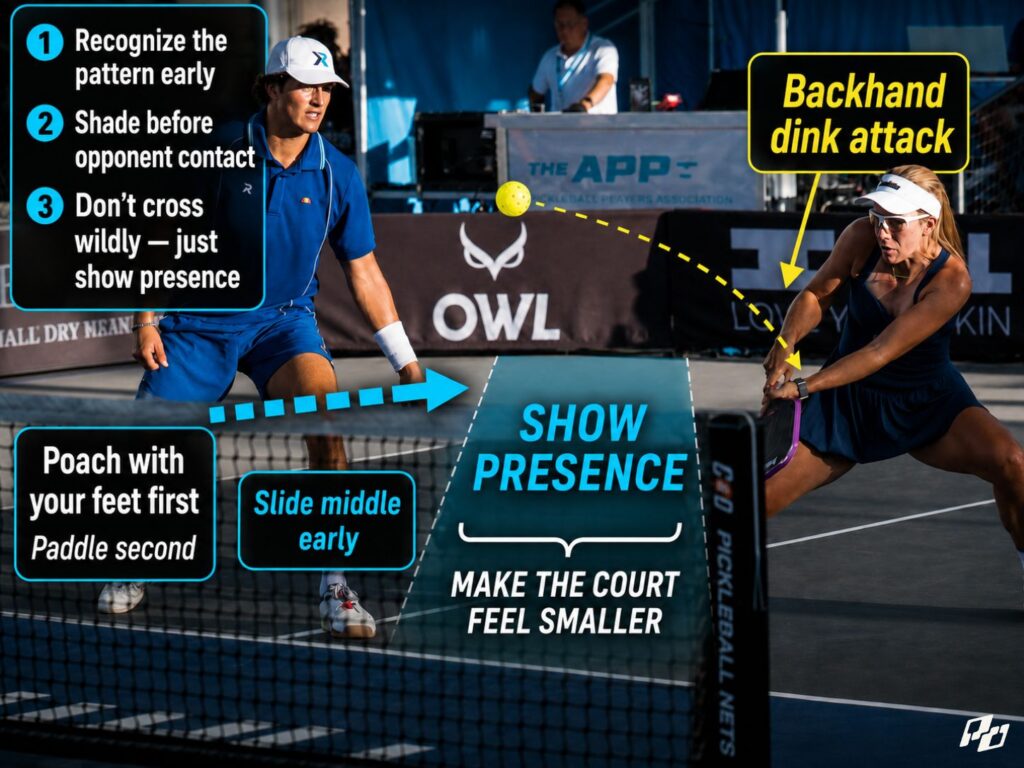
If you wait until the ball is already headed toward your partner, you are guessing. But if you recognize the pattern early, you can shade toward the next likely lane and make the court feel smaller.
For example, if your partner is being attacked on the backhand dink, slide slightly middle before the opponent contacts the ball. Do not cross wildly. Just show presence. Make the opponent see you.
That small movement can change their decision. They may go behind you, miss wider, hit safer, or send a ball you can actually take.
Your goal is not always to intercept.
Sometimes your goal is to make the opponent uncomfortable targeting the same spot again.
Poach with your feet first, paddle second.
If your feet are not already building the poach, your paddle is probably arriving late.
Step 4: Give Your Partner Easier Next Balls
A lot of stronger players accidentally feed their partner hard decisions.
They hit a nice-looking crosscourt dink, but it pulls the opponent into an angle that comes back to the weaker partner’s outside foot. They drive hard, but the block comes back fast to their partner. They speed up from a low ball, but the counter goes straight into their partner’s chest.
Then they blame the partner for missing.
But the stronger player created the pattern.
In asymmetric doubles, every shot should be judged by the next ball it creates for your team.
If your partner struggles with fast hands, do not speed up unless you can finish or force a weak counter.
⮕ If your partner struggles wide, avoid shots that open sharp angles.
⮕ If your partner pops up low dinks, stop leaving them with low dinks under pressure.
This is not “playing down.” This is advanced doubles management.
Do not hit the shot that looks best. Hit the shot that gives your team the easiest next problem.
Step 5: Attack Through the Stronger Opponent, Not Always the Weaker One
This sounds counterintuitive, but in messy open play it often works.
If the other team is freezing you out by targeting your partner, one way to re-enter the point is to make the stronger opponent play more balls under pressure.
Attack their paddle-side hip. Roll middle at their feet. Dink into their movement path. Make them handle enough quality that they cannot just sit there calmly picking on your partner.
The goal is not ego. The goal is disruption.
When the stronger opponent becomes busy, they have less time to run the entire isolation pattern.
This is especially useful against players who are not actually better technicians but are simply better at targeting. Make them hit uncomfortable balls instead of letting them play traffic cop.
Step 6: Use Controlled Overload, Not Desperate Court-Stealing
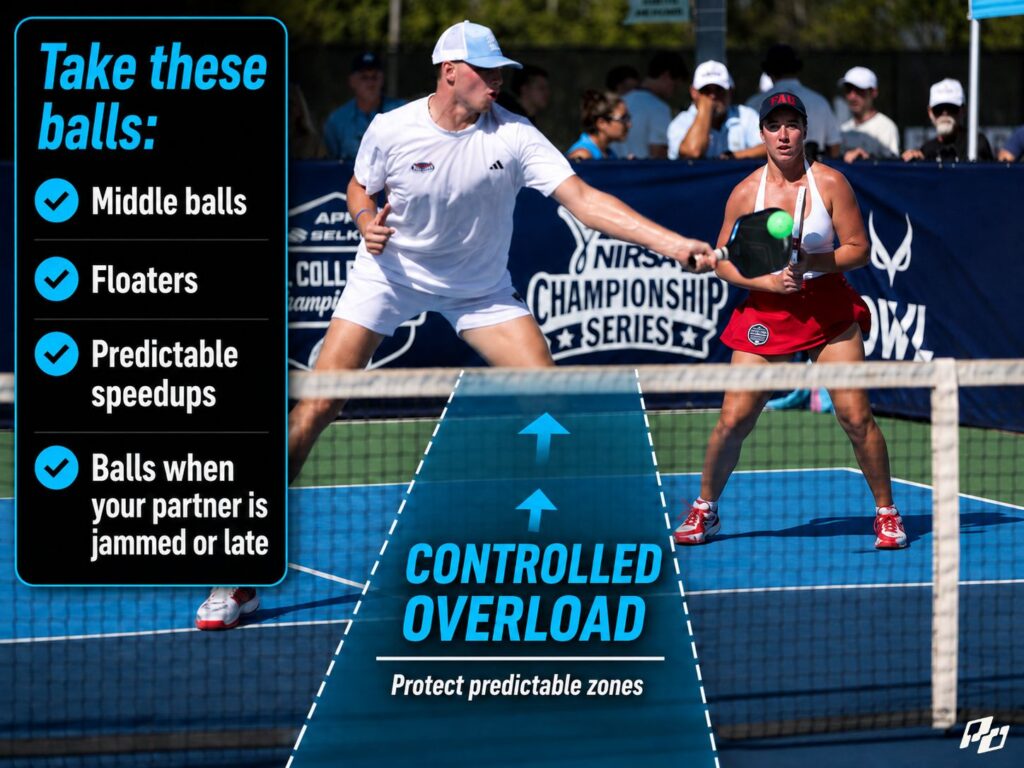
Sometimes you do need to take more court. But do it systematically.
- Take middle balls.
- Take floaters.
- Take predictable speedups.
- Take balls where your partner is jammed or late.
Do not take balls that force you across their body with no recovery plan.
A good overload feels calm. Your partner understands you are protecting predictable zones. A bad overload feels frantic. Your partner stops knowing which balls are theirs, and now both of you are worse.
A useful agreement is simple: “I’ll take middle if they speed up.”
That gives your partner clarity without a lecture. Now you have permission to protect the most dangerous lane, and your partner can focus on their outside ball.
Step 7: Stop Trying to Win Every Point Immediately
When you are frozen out, the temptation is to do something dramatic the moment you finally touch the ball. That is usually the trap.
You finally get one ball and think, “I need to make this count.”
- So you overattack.
- You speed up from below the net.
- You drive at a player who is already set.
- You try a hero angle.
Now you have touched the ball once and given it right back. Instead, your first touch after being frozen out should often be a stabilizer.
- A deep reset.
- A middle dink.
- A heavy roll at the feet.
- A controlled counter to the safe zone.
Make the point continue. Make opponents hit one more ball. Make them prove they can keep targeting your partner without eventually giving you something better.
When you finally get the ball, do not release frustration through your paddle.
That one cue saves a lot of games.
What to Say to Your Partner Without Coaching Them to Death
You usually do not need a speech. You need one useful agreement.
Try:
✅ “I’ll cover middle speedups.”
✅ “Let’s return deep middle.”
✅ “If they pull you wide, I’ll slide middle.”
✅ “Make them hit one more. We don’t need winners.”
That is enough.
Do not diagnose their whole game mid-match. Do not tell them everything they are doing wrong. Do not turn every lost rally into a lesson. The more nervous your partner gets, the easier they are to target.
Good stronger partners create calm. Bad stronger partners create pressure from both sides of the net.
The Real Goal: Make Targeting Your Partner Less Profitable
You may not fully stop opponents from hitting to your partner.
That is fine.
Your goal is to make the pattern less clean.
- Reduce their angles.
- Shade earlier.
- Protect middle.
- Avoid feeding your partner impossible next balls.
- Use your touches to stabilize, not vent.
- Attack when your feet and the ball both say yes.
If you do those things, you may still lose some open play games. But you will become much harder to freeze out, and your partner will usually play better because they are no longer drowning alone.
That is the part many intermediate players miss.
Playing with a weaker partner is not just a patience test. It is a geometry test.
And if you can learn to control the geometry when the match is messy, you are building a skill that actually travels — to leagues, tournaments, challenge courts, and every tight game where your team is under pressure.