
Dehydration can make pickleball players react late, move sloppily, and take more injury-risky steps before they ever cramp. The fix is to start hydrated, sip during breaks, add electrolytes for long or hot sessions, and watch for warning signs like heavy legs, late reactions, headaches, or dark urine.
Most pickleball players understand dehydration in the obvious way.
You get thirsty.
You sweat.
You cramp.
You feel tired.
You play worse.
That is all true.
But it is also incomplete.
The bigger problem is that dehydration does not just make you feel bad. It can change the way you move, react, brake, reach, recover, and make decisions.
That is where injuries sneak in.
Pickleball is full of short bursts: split steps, lunges, lateral shuffles, sudden stops, awkward reaches, backpedals, pivots, and fast hands battles. When you are underhydrated, those movements do not disappear. You still try them.
You just do them with worse timing, slower reactions, more fatigue, and less control. That is the part players ignore.
Hydration is not just about avoiding cramps.
It is about keeping your body sharp enough to handle the ugly, off-balance, late-contact moments where pickleball injuries usually happen.
Sports-medicine guidance from the American College of Sports Medicine and the National Athletic Trainers’ Association emphasizes that dehydration can compromise exercise performance, increase heat-illness risk, and requires planned fluid replacement before, during, and after activity rather than relying on thirst alone.
The Problem: Pickleball Makes Dehydration Easy to Miss
Pickleball does not always feel like a “real workout” while you are playing.
You are chatting between points.
You are waiting for the next court.
You are playing doubles.
You are not running miles.
So it is easy to think hydration is less important.
But pickleball has a sneaky workload: long sessions, repeated accelerations, hard courts, sun exposure, indoor heat, tournament delays, and “just one more game” decisions.
That is especially true for rec players who play for two or three hours, rotate through open play, or stack multiple games without a real break.
You may not feel dehydrated all at once. You just start arriving late.
Your feet get heavier.
Your paddle gets slower.
Your knees stop bending.
Your balance gets worse.
Your resets pop up.
Your decision-making gets impatient.
Then you reach for a ball you normally move for. That is the injury window.
What Dehydration Actually Does to Your Game
Dehydration is often discussed like a fuel problem. But for pickleball, it is better to think of it as a control problem.
When your body loses fluid through sweat, several systems become harder to manage: temperature regulation, blood volume, cardiovascular strain, electrolyte balance, perceived effort, and neuromuscular function.
ACSM’s fluid replacement guidance says the goal during exercise is to prevent excessive dehydration — commonly described as more than about 2% body-weight loss from water deficit — and avoid large electrolyte shifts that can compromise performance.
For pickleball, that shows up in five practical ways.
| What Changes | What You Feel on Court |
|---|---|
| Reaction time | You see the ball, but the paddle arrives late |
| Balance | Lunges, reaches, and recoveries feel less clean |
| Muscle endurance | Legs feel heavy earlier than expected |
| Decision-making | You attack bad balls or stop moving through resets |
| Heat control | Your effort level spikes and recovery between points slows |
This is why dehydration can make a 3.5 player look like they forgot how to play. The shots did not vanish. The system supporting the shots got worse.
The Hydration Mistake: Waiting Until You’re Thirsty
Thirst is useful, but it is not a perfect sports strategy.
The National Athletic Trainers’ Association notes that both underhydration and overhydration can compromise performance and health, and that athletes need access to water while also being aware of overdrinking and hyponatremia risk.
Older NATA guidance also emphasizes that athletes often do not voluntarily drink enough to prevent dehydration during activity, and that drinking behavior can be improved through education, accessibility, and palatability.
For pickleball, the practical rule is: Do not wait for thirst to be your first reminder. Use the changeovers.
Drink small amounts regularly between games or during longer breaks. You do not need to chug. You need to avoid falling behind.
Water vs. Electrolytes: What Rec Players Actually Need
Not every pickleball session requires a fancy electrolyte drink. For a short, easy indoor session, water and normal meals may be enough.
But electrolytes matter more when:
- you sweat heavily
- you play in heat or humidity
- you play longer than 60–90 minutes
- you see salt marks on clothing or hats
- you feel wiped out despite drinking water
- you are playing tournaments or multiple sessions
- you are prone to cramps or headaches after play
Sodium is the big one because it helps retain fluid and replace sweat losses. ACSM’s guidance discusses fluid and electrolyte replacement as part of maintaining hydration and avoiding excessive electrolyte shifts during exercise.
A good rec-player approach:
⮕ Water for short/easy play.
⮕ Water plus electrolytes for long, hot, sweaty, or repeated play.
⮕ Food plus fluids after play for recovery.
The mistake is thinking hydration only means water.
The other mistake is thinking electrolytes give you permission to ignore pacing, heat, sleep, or recovery.
The Simple Sweat-Rate Test
This is the most useful “data” a rec player can collect.
- Weigh yourself before and after a typical pickleball session.
- Do it without obsessing. Just test once or twice in different conditions.
- If you lose 2 pounds, that is roughly about 1 quart/liter of fluid deficit.
You do not need to replace all of it during play, but it tells you how much you are losing.
If you lose weight during a session, most of that loss is fluid. Afterward, drink a little more than you lost because your body will keep losing some fluid through sweat and urine.
A practical rule: for every pound lost, aim to drink about 20–24 ounces of fluid over the next few hours.
For rec players, the point is not perfection.
The point is awareness.
If you are losing multiple pounds every session and barely drinking, your late-session mistakes are not a mystery.
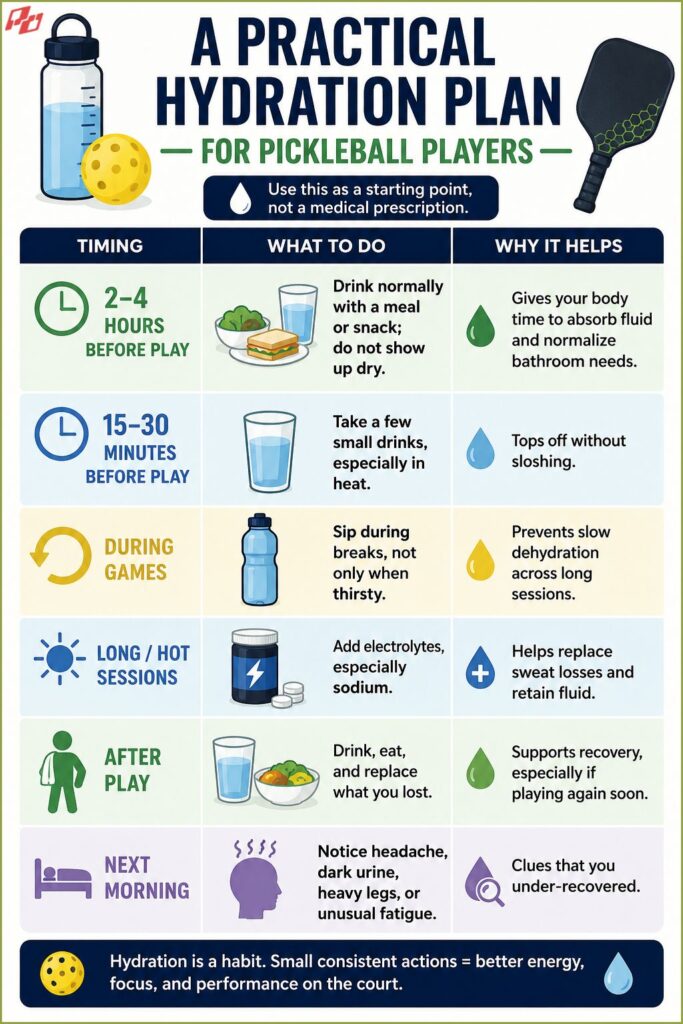
A Practical Hydration Plan for Pickleball Players
Use this as a starting point, not a medical prescription.
| Timing | What to Do | Why It Helps |
|---|---|---|
| 2–4 hours before play | Drink normally with a meal or snack; do not show up dry | Gives your body time to absorb fluid and normalize bathroom needs |
| 15–30 minutes before play | Take a few small drinks, especially in heat | Tops off without sloshing |
| During games | Sip during breaks, not only when thirsty | Prevents slow dehydration across long sessions |
| Long/hot sessions | Add electrolytes, especially sodium | Helps replace sweat losses and retain fluid |
| After play | Drink, eat, and replace what you lost | Supports recovery, especially if playing again soon |
| Next morning | Notice headache, dark urine, heavy legs, or unusual fatigue | Clues that you under-recovered |
The key is consistency. You do not need a complicated hydration ritual. You need a plan that survives open play chaos.
The On-Court Warning Signs Players Ignore
Thirst is only one signal. Watch for these instead:
⮕ Your feet stop adjusting before contact.
This is a big one. Late feet often show fatigue before you consciously feel tired.
⮕ You start missing more balls into the net.
Tired legs make players hit from too low or too upright.
⮕ Your reaction feels delayed in hands battles.
That may be fatigue, hydration, heat load, or all three.
⮕ You become impatient in dink rallies.
Poor hydration and heat stress can raise perceived effort, which makes neutral rallies feel annoying.
⮕ You feel a headache building.
Do not ignore that, especially in heat.
⮕ You get unusually clumsy.
Trips, stumbles, or awkward plants are warning signs.
⮕ You stop sweating or feel chilled in heat.
That is more serious. Stop playing and cool down.
If symptoms are severe — confusion, faintness, chest pain, severe headache, vomiting, heat illness signs — stop and get medical help.
What Not to Do
Do not overdrink plain water for hours
Overhydration can be dangerous too, especially if you drink large amounts of plain water without electrolytes over long sessions. NATA specifically warns that both hypohydration and hyperhydration can increase health risks.
Do not treat cramps as only a hydration problem
Cramps can involve fatigue, heat, conditioning, workload, sodium loss, and individual tendency. Hydration helps, but it is not the only factor.
Do not use caffeine as your only pre-game fluid
Coffee is not automatically forbidden, but “coffee and nothing else” is not a hydration plan.
Do not copy a marathon plan for pickleball
Pickleball has starts, stops, breaks, and different sweat demands. Your plan should match your session length, temperature, and sweat rate.
Do not ignore medication and health factors
Blood pressure medications, diuretics, kidney issues, heart conditions, diabetes, and heat sensitivity can all change hydration needs. For those situations, follow medical guidance.
The “Hydration Is Injury Prevention” Checklist
Before you play, ask:
Did I drink anything today besides coffee?
Am I starting with normal-colored urine, not dark yellow?
Do I have fluid courtside?
Is today hot, humid, indoors without airflow, or a long session?
Do I need electrolytes today?
Am I playing again tomorrow?
Did I lose weight last time I played in these conditions?
During play, ask:
Are my feet getting lazy?
Am I reacting late?
Am I getting unusually impatient?
Am I reaching instead of moving?
Do I need a real break, not just a sip?
After play, ask:
Do I feel recovered or cooked?
Do I have a headache?
Did I cramp or feel twitchy?
Is my urine still dark hours later?
Am I sore in a way that feels like fatigue-based bad movement?
This is not about becoming obsessive. It is about noticing the early warning signs before your body makes the decision for you.
Hydration Is Boring Until It Costs You a Point — Or a Month
Nobody wants hydration to be the answer.
It is not as fun as a new paddle.
It is not as technical as a better third shot.
It is not as satisfying as blaming your partner for leaving the middle open.
But hydration is one of those boring habits that quietly raises your floor. You may not notice it when it is working. You notice it when it is missing.
The last 30 minutes of play are where hydration habits show up. That is when your feet either keep moving or start cheating. That is when you either reset the ball or stab at it. That is when you either make the safe recovery step or reach across your body and hope.
So do not think of hydration as “drink so you do not cramp.”
Think of it this way: Hydration helps protect the version of your game that makes good decisions when you are tired.
That is the real injury connection. Not magic. Not fear-mongering.
Just better movement quality, better reaction time, better heat control, and fewer desperate positions where rec players tend to get hurt.