
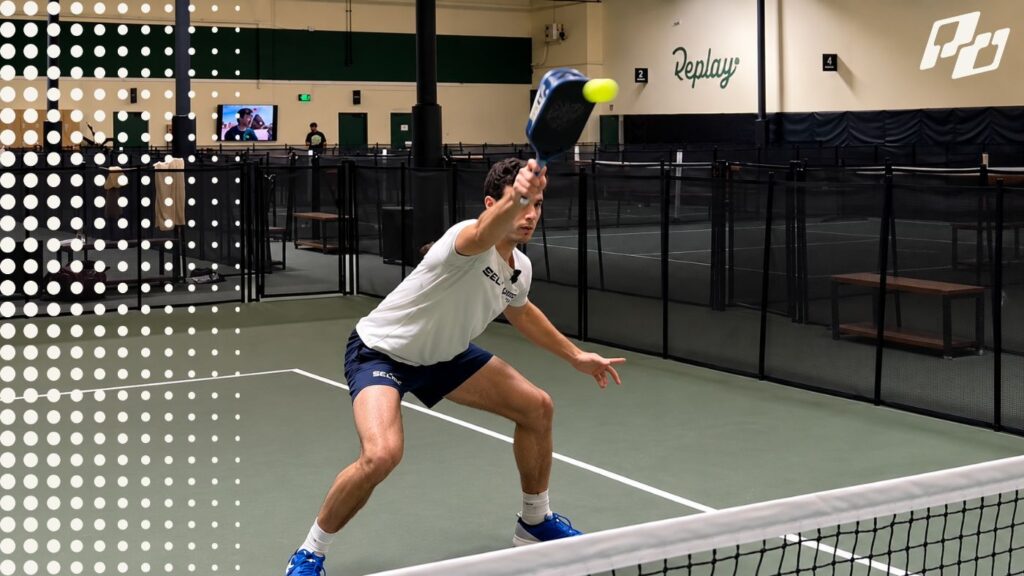
The pancake counter in pickleball helps defend fast, rising body attacks at the kitchen. Use it when an opponent attacks from low and the ball rises toward your chest or shoulders. Rotate the forehand face flat across your body, drop your base, meet the ball out front, and block to the feet.
The pancake counter looks a little strange the first time you see it.
Instead of staying in a normal ready position and choosing a traditional forehand or backhand counter, you rotate the paddle so the forehand face is open and flat, almost like you are holding a frying pan in front of your chest.
It is not pretty.
It is not traditional.
But in fast kitchen exchanges, it solves a very real problem for rec players: high body attacks can be awkward to handle with a normal counter.
When an opponent attacks from low, the ball usually has to travel upward. That often sends it toward your chest, shoulders, or upper body. A regular backhand counter can get awkward there because the ball gets too high or too jammed. A normal forehand counter can also be late if the ball is coming straight into the body.
The pancake gives you a simpler option: use the forehand face across the front of your body to block, redirect, or counter the rising ball.
The key is knowing what this shot is for. The pancake is not your everyday ready position.
It is a specialized counter for specific attacks.
What the Pancake Counter Actually Does
The pancake counter turns your paddle into a wide, flat shield across the front of your body.
Instead of trying to decide, “Is this a forehand or backhand?” while the ball is already on you, you simplify the problem:
High ball coming at my chest or shoulders? Show the forehand face and meet it out front.
That gives you three advantages.
| What It Helps | Why It Matters |
|---|---|
| Body protection | You cover more of the chest/shoulder zone without getting jammed. |
| Less decision lag | You do not have to flip between forehand and backhand as much. |
| Cleaner counters on rising balls | You can block or press down on balls that are coming up at you. |
This is why the shot matters more as opponents improve.
At lower levels, many speedups are slow, high, or predictable enough to handle with a normal block.
At 3.5 and above, players start attacking faster, lower, and more often into the body. At 4.0+, the difference between blocking late and countering cleanly can decide the point:
The pancake helps when the ball is coming fast enough that you do not have time for a big swing, but high enough that your normal counter options feel trapped.
When to Use the Pancake Counter
The pancake is best when the opponent is attacking from below net height or from a low contact point.
Why?
Because if they attack from low, the ball usually has to rise. That rising path often puts the ball into your upper-body strike zone.
That is pancake territory.
| Situation | Pancake Counter? | Why |
|---|---|---|
| Opponent attacks from low and the ball rises toward your chest | Yes | You can use the flat forehand face to block or press it down. |
| Ball comes shoulder-high through the middle | Yes | This is where normal counters often get jammed. |
| Fast speedup at your paddle-side shoulder | Often yes | The pancake can cover it without a big grip change. |
| Low ball at your knees | Usually no | A backhand block/reset is often cleaner. |
| Wide ball outside your reach | No | The pancake is not a rescue lunge. |
| Ball is above your head | No | That is more likely a volley/overhead problem. |
| You have time for a normal counter | Maybe no | Use the simpler shot you already own. |
A good rule: Use the pancake when the ball is too high or too jammed for a comfortable backhand, but too fast to swing at normally.
That is the window.
The Setup: How to Hit the Pancake Counter
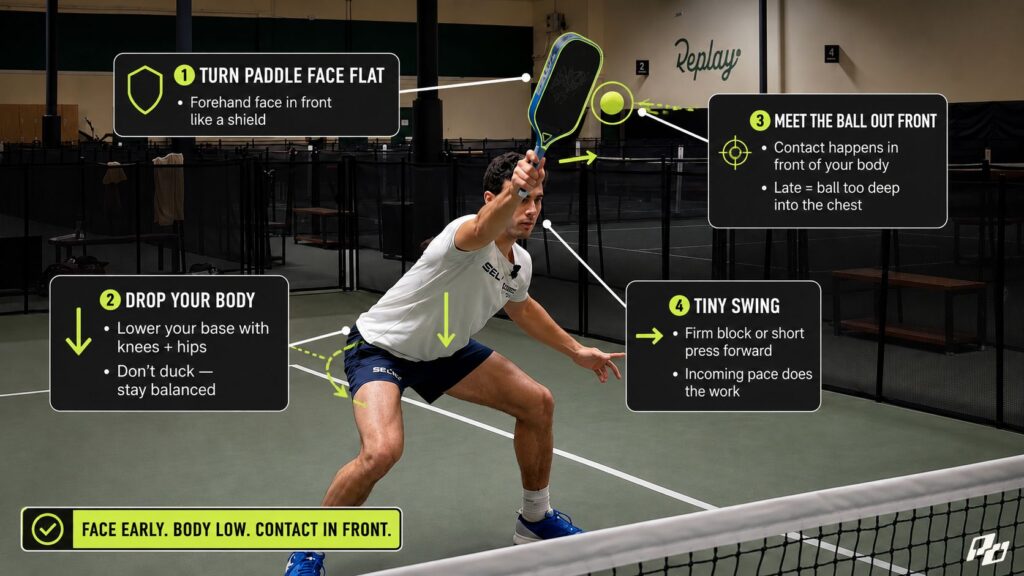
Think of the shot in four pieces.
1. Recognize the low attack
You do not pancake every fast ball. You pancake the attack that is likely to come up at you.
Look for this clue: Your opponent is hitting from below the net and trying to speed it up.
That ball usually has to rise before it can hurt you.
2. Turn the paddle face flat
Rotate the paddle so the forehand face is available in front of your body. The paddle should feel like a shield, not a backswing.
You are not trying to slap the ball. You are trying to present a stable surface.
3. Drop your body
This is what makes the shot playable.
Bend through the knees and hips just enough that your paddle can meet the ball around chest/shoulder level without your arm getting jammed.
Do not collapse. Do not duck your head wildly. Just lower your base.
4. Meet the ball out front
The contact should happen in front of your body.
If the ball gets deep into your chest, you are late. If your paddle is behind your body line, the counter becomes a survival block.
The swing is tiny.
A firm block is enough. A short press forward is enough. The incoming pace does most of the work.
A useful cue: “Face early. Body low. Contact in front.”
That is the whole shot.
Why It Works: You Get Lower So the Ball Gets Higher
This sounds backwards, but it is the secret.
The pancake counter gets much easier when you drop your body.
If you stay tall, the ball may arrive near your upper chest or face, and now your paddle is cramped. But when you squat slightly, you change your relationship to the ball. The same attack now feels more like it is arriving in your strike zone instead of jamming your neck and shoulders.
That is the part rec players often miss. The pancake is not just a paddle trick. It is a body-height adjustment.
Bad version: stand tall, flip the paddle late, poke at the ball.
Good version: get lower early, show the face, meet the ball in front.
The Pancake Is a Counter, Not a Swing
The biggest mistake is trying to hit the pancake like an attack.
❌ Do not wind up.
❌ Do not chop down.
❌ Do not slap across the ball.
The paddle face is already doing the job if it is stable and early. Your job is to control the angle.
With the pancake, the shorter motion is the feature. You want the ball to feel like it hits a wall that happens to be angled toward a smart target.
Where to Aim It
The pancake counter is not just about getting the ball back. Once you get comfortable, you can aim it.
| Target | When to Use It |
|---|---|
| Opponent’s feet | Safest attacking target; makes them hit up. |
| Middle seam | Great when both opponents freeze or crowd the center. |
| Opponent’s paddle-side hip | Useful when they attacked and are still recovering. |
| Short block into the kitchen | Good when you are slightly late or off balance. |
| Behind the attacker | Higher risk, but useful if they overcommit forward. |
My favorite target for rec players is simple: counter down through the middle or at the attacker’s feet.
Do not try to be too cute early. The pancake already gives you an advantage because it steals time. You do not need a perfect sideline.
When Not to Use It
This shot becomes dangerous when players fall in love with it. The pancake is useful, but it is not universal.
Do not use it when:
❌ The ball is low at your knees.
That is usually a reset, backhand block, or soft volley.
❌ You are stretched wide.
The pancake works best in front of the body. Wide balls require reach and shape.
❌ You are guessing before the opponent hits.
If you open the pancake too early, better players will dink behind it or attack the open space.
❌ The ball is slow and attackable with normal mechanics.
Use your regular forehand or backhand counter.
❌ You cannot stay balanced.
If you are falling backward, lunging sideways, or drifting into the kitchen, the pancake will turn into a pop-up.
That is the real danger: the shot feels like a magic fix, so players use it from bad positions.
It is not magic.
It is a solution for a specific contact zone.
The Level-Up: Why It Helps 3.5–4.0 Players
The pancake counter is not the first counter a beginner needs. A newer player should first learn a stable ready position, a simple backhand block, and controlled volleys.
But for 3.5–4.0 rec players, this shot can be a real upgrade because body attacks become more common. Players start speeding up from the kitchen, attacking the hip, testing the shoulder, and trying to jam you through the middle. That is where the pancake helps you level up.
It gives you a plan for a ball that used to feel awkward: high, fast, and at your body.
Instead of flinching, chicken-winging, or guessing forehand/backhand, you present one simple forehand face and make the attacker deal with the next ball.
That changes the psychology of the exchange.
When opponents realize their body speedup is not bothering you, they lose confidence in it. They either attack smaller targets, which creates errors, or they stop speeding up so freely.
That is the hidden value.
The pancake does not just block one ball. It makes opponents question a pattern they wanted to use against you.
Pancake vs. Backhand Counter vs. Forehand Counter
Use this comparison to decide what belongs where.
| Counter Type | Best Ball | Main Advantage | Main Risk |
|---|---|---|---|
| Backhand counter/block | Waist-high or lower body balls | Compact, fast, and reliable for most kitchen exchanges | Can get awkward when the ball rises toward the chest or shoulder |
| Forehand counter | Ball clearly on your forehand side | Stronger press and easier acceleration | Can be late if the ball is jammed into the body |
| Pancake counter | Fast, rising ball into the chest/shoulder zone | Uses the forehand face across the body to simplify high body defense | Poor choice for low balls, wide balls, or balls you read too early |
This is why the pancake is not a replacement for your normal counters. It fills a gap.
A good counter game has multiple answers.
The Drill That Teaches the Shot
Start slow. Do not begin with full-speed fireballs.
Stand at the kitchen. Your partner stands across from you and feeds controlled speedups from below net height toward your chest and shoulders.
Your job: Get lower. Show the flat forehand face. Meet it in front. Block to the feet.
Start with 20 balls at 50% speed.
Then increase to 70%.
Then make it random: your partner can dink, speed up low-to-high, or attack your body. You only pancake the rising body attack.
That random step matters because the real skill is not just hitting the pancake. It is knowing when the pancake is the right answer.
A good practice rule: If you guessed pancake before the ball was hit, you are training the wrong skill.
Read first. Then respond.
Quick Troubleshooting
| What Happens | Likely Cause | Fix |
|---|---|---|
| Ball pops up | Paddle face too open or contact too late | Meet it earlier and aim through the ball, not up |
| Ball goes into net | You chopped down or closed the face | Use a firmer, flatter block |
| You get jammed | You stayed tall or paddle changed late | Lower earlier and show the face sooner |
| You miss wide | Arm is swinging across your body | Keep the motion compact and target middle/feet |
| You feel stuck after contact | Too much lunge, not enough base | Squat and recover, don’t dive |
| Opponent dinks behind it | You showed pancake too early | Wait for the speedup cue |
The Cues That Actually Help
“Pancake the rise.”
Use it when the opponent’s low attack is coming up into your body.
“Drop first, block second.”
Your body height makes the paddle angle easier.
“Shield, don’t swing.”
A stable face beats a rushed slap.
“Contact in front of the chest.”
Late contact turns the pancake into panic.
“Counter to feet, not fences.”
You win by making the next ball hard, not by over-hitting.
Add It, But Don’t Become a Pancake Person
The pancake counter is a great tool. But I would not build your whole hands game around it.
Use it like a specialty tool. When the ball is high, fast, and rising into your body, it can make you feel shockingly calm. It turns a jammed defensive moment into a clean counter. That is worth learning.
But if you start showing pancake on every fast exchange, better players will notice. They will go low. They will go wide. They will dink behind your open face. They will make you prove you still have other counters.
So the goal is not to become “the pancake player.”
The goal is to remove one awkward weakness from your kitchen game.
When your backhand counter is good, your forehand counter is organized, and your pancake handles the high body ball, opponents have a much harder time finding a safe place to speed up.
That is when the shot becomes valuable.
Not because it looks clever.
Because it closes a door opponents were using to win points.