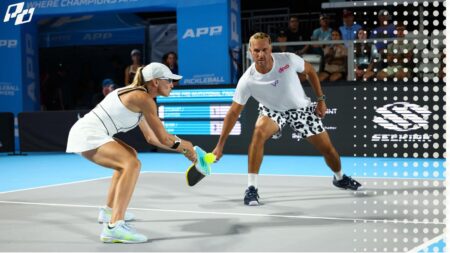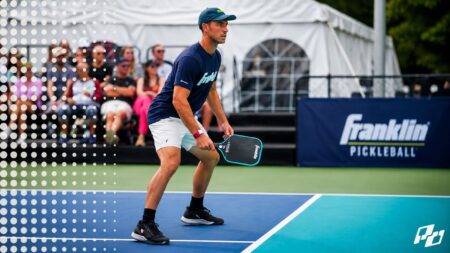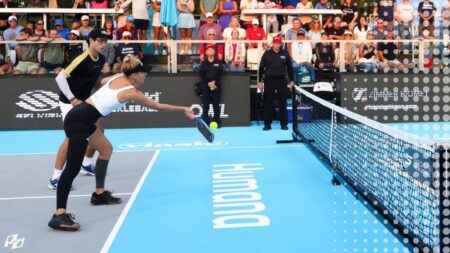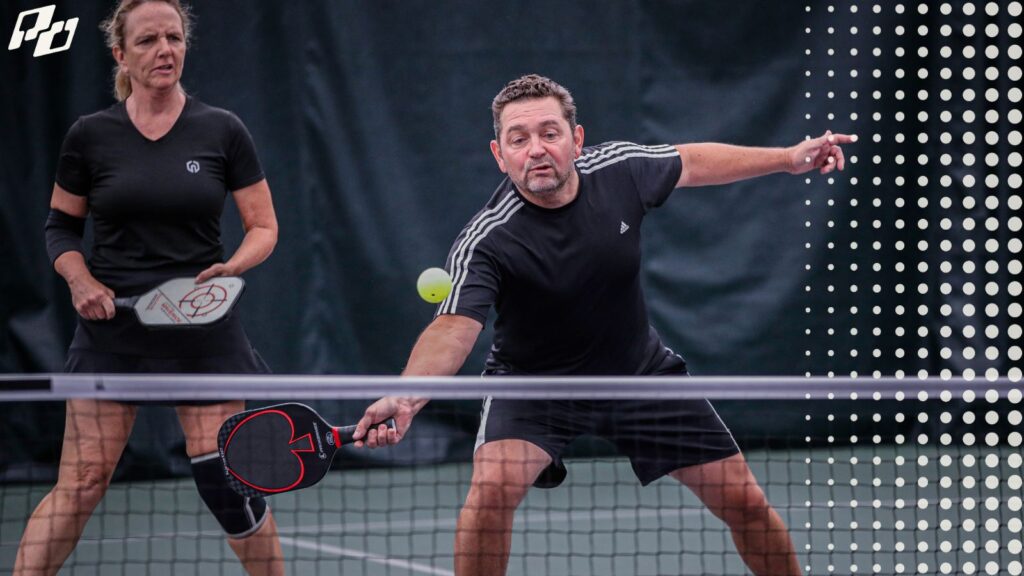
To handle an inside-foot dink, create space with a small drop step instead of reaching. Stabilize before contact, use a compact swing, then recover forward to the kitchen line. The goal is to move your body away from the bounce just enough to create a clean contact point.
One of the hardest dinks to handle is not necessarily the widest one. It is the ball that lands too close to your inside foot.
Instead of pulling you off the court, it crowds you.
That is why recreational players often make the same mistake: they keep both feet planted at the kitchen line, let the ball get underneath them, then try to rescue the contact with the wrist.
The better solution is much simpler:
Create space with your feet before you create the shot with your paddle.
But that does not mean backing three feet away from the kitchen.
It means using a small drop step or spacing step, loading the back leg, hitting from a balanced position, then recovering to the line.
What Do We Mean by an Inside-Foot Dink?
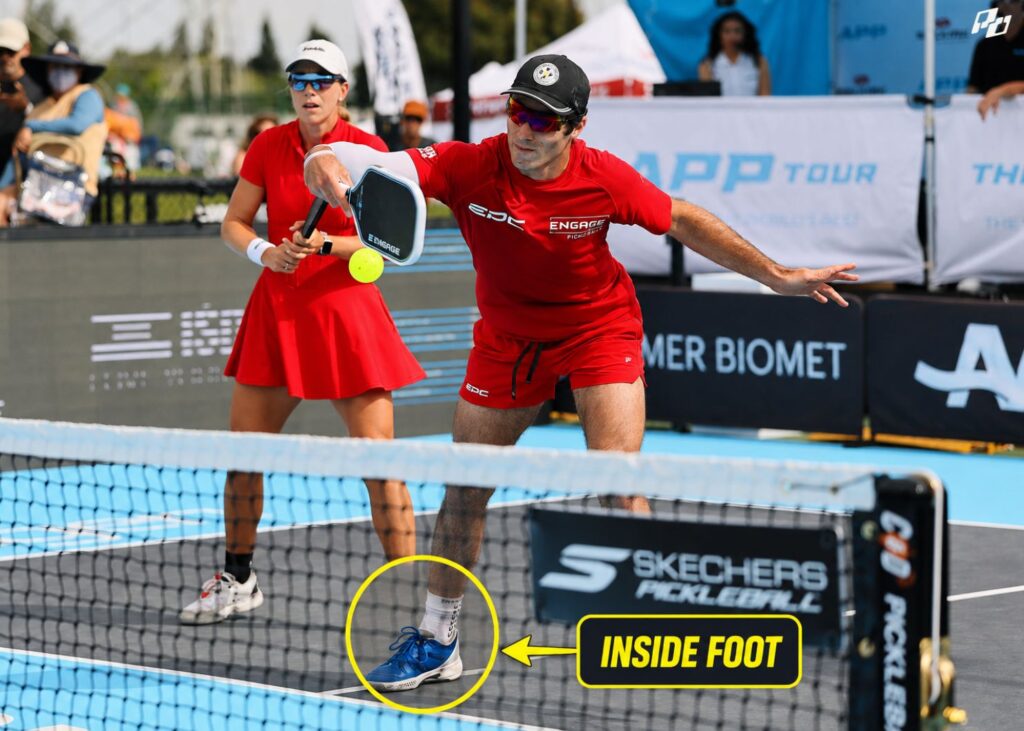
Here, when we say inside-foot dink, we mean a dink directed toward the foot on your paddle-hand side.
For a right-handed player, that means a ball coming toward the right foot. For a left-handed player, it’s the left foot.
This can be an awkward ball because it crowds the space you normally need to make a clean dink. If you leave your feet planted, the ball can get too close to your body and force you into a cramped contact.
That often leads to:
- a late wrist adjustment
- an awkward, shortened swing
- poor paddle-face control
- contact too close to the body
- a dink that pops up or misses its target
Instead of trying to rescue the shot with your hand, create space with your feet first. A small step back can move your body away from the bounce, give the paddle a cleaner path through the ball, and let you make contact from a much more comfortable position.
The important part is that this is a small spacing adjustment, not a retreat from the kitchen. Create the room you need, hit from a stable base, then reclaim your position at the line.
Why Standing Still Creates the Problem
Imagine the dink is dropping directly in front of your inside shoe. Your normal backswing now has nowhere to go.
Your paddle is trapped between: your leg → the ball → the kitchen line.
Players usually compensate by:
- lifting the elbow
- flipping the wrist
- leaning sideways
- stabbing down at the ball.
That increases variables in what should be a very simple shot. Keep in mind that the objective is not “move backward.”
It is:
Put the ball back into your comfortable strike zone.
The Correct Move: Drop, Set, Then Hit
For a bouncing inside-foot dink, the most useful pattern is usually a small drop step into a semi-closed stance.
Think of three stages.
1. Read the bounce early
Decide before the ball reaches your shoes that you are going to let it bounce.
Late recognition causes rushed footwork.
2. Create room
Move the appropriate foot back slightly so your hips open and the ball is no longer directly underneath you.
Current advanced dink coaching often describes this as a drop step of roughly 45 degrees, rather than keeping both feet completely parallel to the kitchen line.
3. Stabilize before contact
Once you have created the room, let your weight settle into the rear leg.
Now your arm has a clean path through the ball. The rear leg is not there so you can lean backward.
It is there to give you a stable platform.
Cue
Drop. Set. Swing.
Not: Reach. Flick. Hope.
Coach Jordan Briones shows you exactly how to handle inside-foot dinks:
What “Stabilize on the Back Foot” Actually Means
This phrase can easily be misunderstood. You do not want all your weight falling backward while you dink.
Instead, the small drop step creates room, and the rear leg briefly accepts enough weight to stop your body from drifting through contact.
From there, you can gently transfer pressure forward as the paddle moves toward the target.
Think: load enough to stabilize → hit forward → recover.
If your shoulders are leaning behind your hips at contact, you have backed up too much.
The Paddle Should Become Boring
Once the feet create space, the stroke becomes much easier.
You do not need:
- a large backswing
- a wrist flick
- a sweeping cut
- a dramatic lift
For a basic neutral dink, keep the wrist relatively stable, start the paddle low enough to work through the bottom-back of the ball, and send the paddle toward the target.
The footwork should do the complicated part. That is the whole reason to create space.
Cue
Busy feet. Quiet paddle.
How Far Should You Actually Back Up?
Usually less than recreational players think. You are often creating inches, not feet. A small drop step may be enough to turn a jammed contact into a comfortable one.
If you back up two or three feet every time an opponent dinks inside, you are solving one problem by creating another.
Backing away from the kitchen unnecessarily:
- gives opponents more time
- creates more court for you to defend
- lets balls fall lower
- makes the next volley harder
Coaches routinely warn against habitual retreat from the kitchen for exactly this reason. So distinguish these two movements:
| Movement | Good or Bad? |
|---|---|
| Small drop step to create contact space | Good |
| Repeatedly drifting backward from the kitchen | Usually bad |
| One controlled recovery step after a deep dink | Fine |
| Backing up because you feel rushed by every ball | Problem |
The best kitchen players give up just enough ground to solve the contact, then take it back.
When You Should Step Into the Kitchen Instead
Not every inside-foot dink requires backing up. If the opponent lands the ball short, it may be better to step into the kitchen after the bounce.
Remember: you are allowed to enter the non-volley zone to hit a ball after it bounces.
If the dink lands close to the net, backing up would move you farther away from the ball.
Instead:
- let it bounce
- step forward into the kitchen
- contact it comfortably
- recover behind the line
So the decision depends on where the bounce is going.
Short bounce → Step in.
Deep bounce at your feet → Drop step. Create space.
Comfortable volley → Take it early. Skip the bounce.
That is the full decision tree.
When a Shuffle Is Better
The drop step is not the answer to every ball.
Use a small shuffle when the ball mainly requires lateral movement but does not jam your contact point.
Use a drop step when the bounce comes into your body or inside foot and you need more room behind the ball.
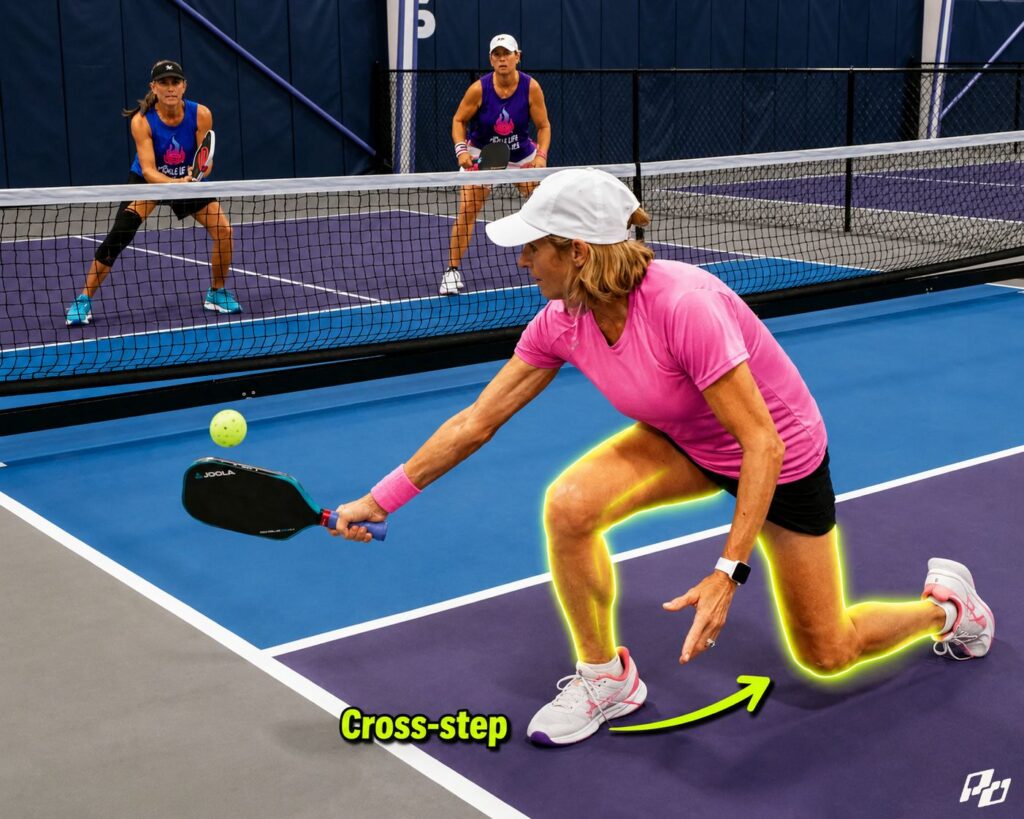
Use a cross-step only when the opponent has pulled you far enough that a normal shuffle will not cover the distance comfortably. Current coaching generally treats the cross-step as a bigger recovery tool, not the default for normal kitchen movement.
A simple way to remember it:
Shuffle for distance. Drop step for space.
The Recovery Is Part of the Shot
This is where recreational players often stop thinking. They make a beautiful dink after stepping backward—but stay there. Now the opponent has successfully pushed them off the line.
As soon as your ball leaves the paddle:
- finish balanced
- bring the rear foot forward
- regain your normal kitchen position
- reset the paddle in front
The spacing step is temporary. Your kitchen position is home.
The Best Drill for This Problem
Have a partner dink repeatedly toward three spots:
- outside foot;
- inside foot;
- short into the kitchen.
Do not attack.
Your only goal is choosing the correct footwork.
Outside / lateral ball
Shuffle.
Deep inside-foot ball
Drop step, stabilize, dink, recover.
Short ball
Step into the kitchen after the bounce, dink, recover. After ten minutes, randomize the feeds.
That teaches the real skill: recognizing which footwork pattern the ball requires.
A useful progression is to practice only the backhand side first, then add forehand and middle balls once the movement becomes automatic.
The Mistake I’d Fix First
If an inside-foot dink keeps jamming you, do not start by changing your paddle technique. Watch your feet.
If they are still perfectly parallel to the kitchen line while the ball is bouncing underneath you, the paddle is being asked to rescue a spacing problem.
- Create a little room.
- Settle on the rear leg.
- Let the arm swing freely.
- Then recover forward.
The best cue is simple:
Back up enough to hit well—not enough to give up the kitchen.
That is the difference between intelligent spacing and retreating.