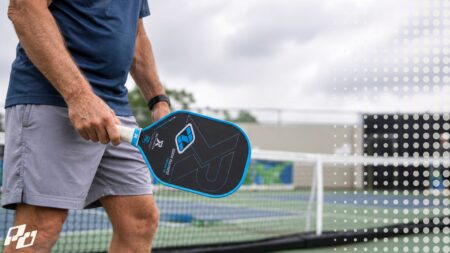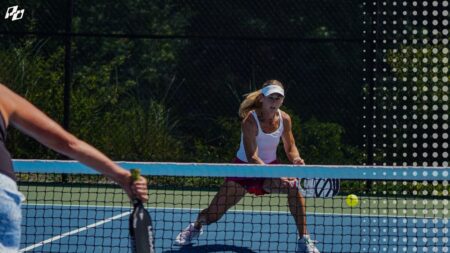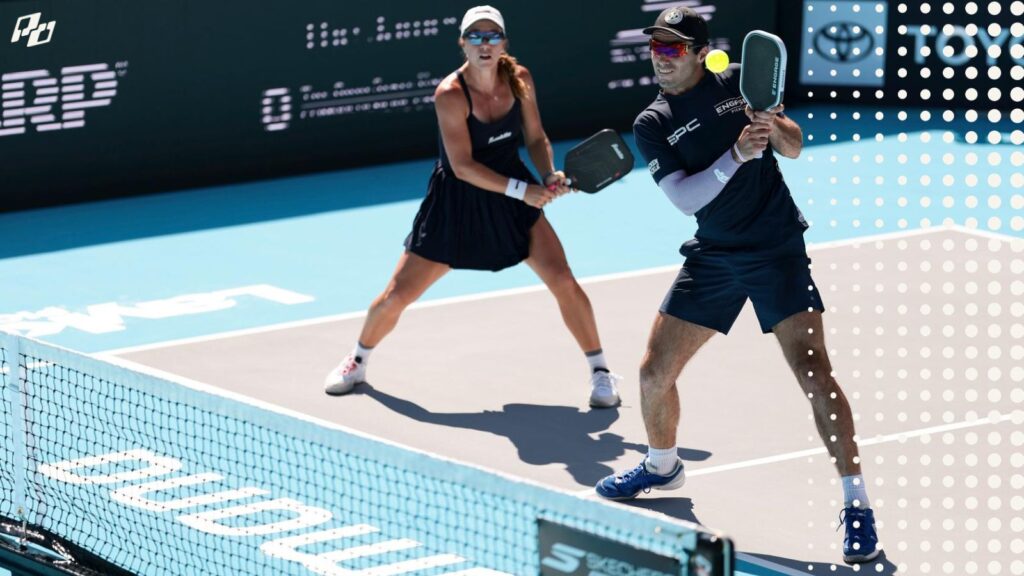
A two-handed backhand putaway is ideal for high balls outside your backhand shoulder. Turn your hips and shoulders, create space, let the non-dominant hand help drive the paddle, and contact in front for more power, stability, and control.
There is an awkward ball that shows up constantly at the kitchen.
It is too high to dink.
It is clearly attackable.
But it arrives on your high backhand side, where many recreational players suddenly lose most of their power.
The usual responses aren’t great: a stiff one-handed punch that comes back, an oversized backhand slap that sails long, or an attempt to run around the ball and manufacture a forehand.
There is another option worth learning: the two-handed backhand putaway.
And this isn’t just a workaround for players with weak backhands. Two-handed backhands have become increasingly common in professional pickleball. Zane Navratil says pros use two hands somewhere in their backhand games, while James Ignatowich specifically recommends adding the second hand for higher backhand balls because it provides more leverage, stability, power and control.
The interesting part is that the power doesn’t come from simply adding another hand. It comes from finally being able to use more of your body.
First, This Isn’t a Backhand Overhead
We need to define the ball.
The two-handed putaway works particularly well on a high volley around shoulder-to-head height and toward the backhand side—a ball you have enough time and space to swing through.
That’s different from a lob well above your head.
Once the ball is truly overhead, two hands can restrict your reach and shoulder freedom. A conventional overhead or appropriate one-handed high backhand may be the better solution.
Ignatowich makes another useful distinction. For a right-handed player, he generally favors one hand when the volley is between the shoulders, but recommends two hands when the ball gets farther outside the left shoulder or floats high on that side.
Think of it as a contact map:
- In front of the chest: one hand often wins for speed and reach.
- High and outside the backhand shoulder: two hands become increasingly useful.
- Well above your head: you’re moving into overhead territory.
That distinction prevents players from trying to force the twoey onto every high ball.
Why Two Hands Can Produce So Much More Power
Try hitting a high backhand putaway with only your paddle arm.
Your shoulder can rotate, but there is a limit to how much force and stability you can create without turning it into a huge arm swing.
Add the second hand and the movement changes.
Connor Garnett, whose two-handed backhand has become one of the recognizable shots on the pro tour, describes the shot in terms of the kinetic chain rather than arm strength. His coaching emphasizes using the body to generate the force instead of asking the arms to manufacture all of it.
For a right-handed player, that means: hips turn → torso and shoulders rotate → arms accelerate → paddle releases through the ball.
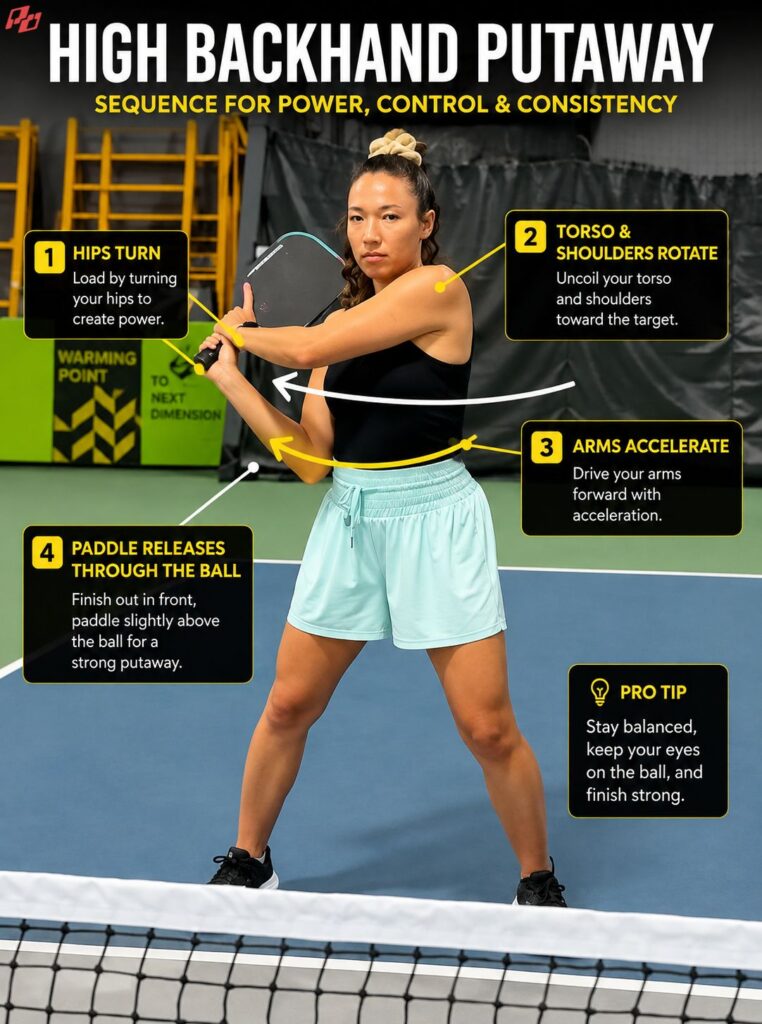
You aren’t merely taking the paddle farther back. You’re loading the body.
Your Left Hand Shouldn’t Just Be Along for the Ride
This is probably the biggest technical mistake recreational players make when learning a two-handed backhand.
They put the left hand on the paddle…
…and continue hitting a right-handed backhand.
The second hand is basically decorative.
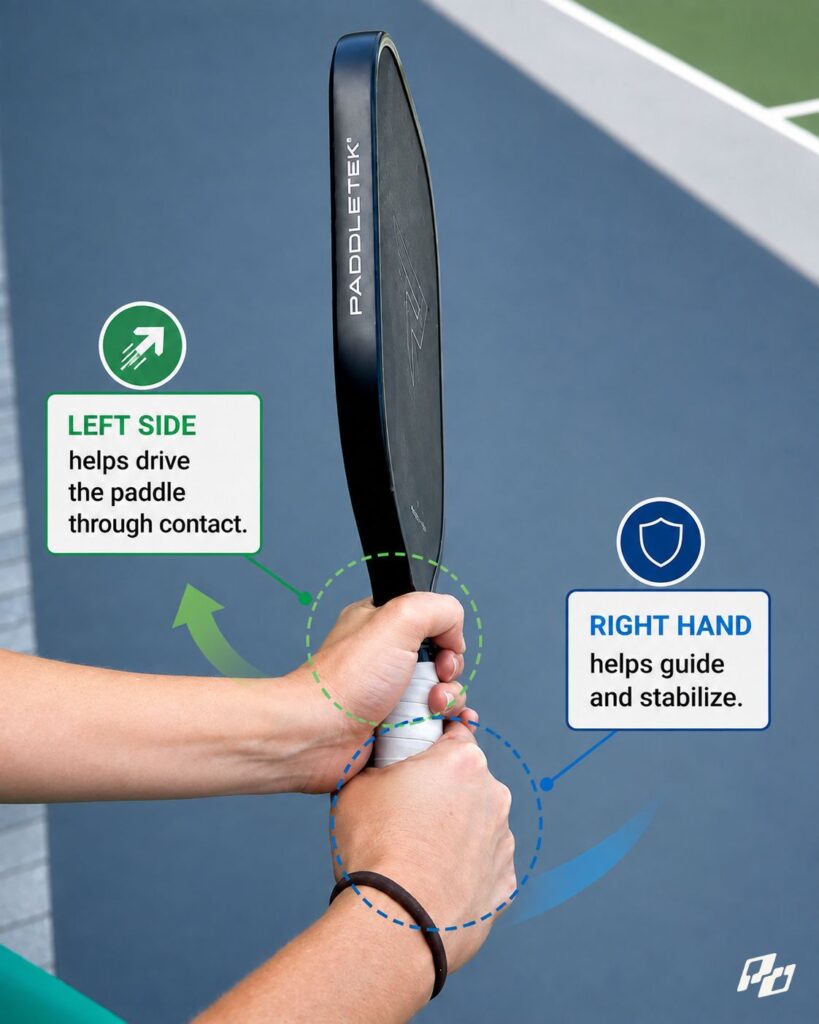
For a right-handed player, the two-handed backhand should be driven largely by the left, non-dominant arm. A useful way to learn the motion is to practice left-handed forehands so the non-dominant side learns to create the swing instead of just riding along.
That gives you an excellent practice cue:
Think left-handed forehand attached to a right-handed backhand.
Your right hand helps guide and stabilize. Your left side helps drive the paddle through contact.
That distinction can completely change how powerful the shot feels.
The Setup: Turn Before You Swing
When the high ball comes to the backhand, don’t immediately throw your hands at it.
Turn first.
For a right-handed player:
- recognize that the ball is attackable
- rotate the hips and shoulders
- create enough space that the ball isn’t jammed against your chest
- load the paddle on the backhand side
- accelerate through contact using the torso and left arm
You should feel coiled, not stretched. If the ball has already reached your body before you start rotating, you’re late.
Cue
Turn first. Hands second.
That small sequencing change produces much cleaner power.
Watch Coach Jordan Briones break down exactly how to hit a high backhand putaway with power and control:
@brionespickleball Backhand Putaway Power in 30 Seconds!
♬ original sound – Briones Pickleball
Don’t Confuse Rotation With a Giant Backswing
There is an important catch.
More body turn does not mean take the paddle halfway around your back.
High-ball putaways should use the kinetic chain—legs, hips, trunk, shoulder, and arm working together—rather than trying to create power with an oversized arm swing or wrist-dominant motion.
This matters because you’re still standing close to the kitchen.
A giant backswing:
- takes longer
- advertises the attack
- makes contact timing harder
- can leave you unable to handle the next ball
Your body supplies the bigger engine. That means your hands don’t need an enormous runway.
Contact Needs to Be Out in Front
The two-handed backhand gives you stability, but it also reduces your reach compared with one hand.
Don’t let a high backhand drift behind your shoulder and then try to rescue it with two hands. Create enough space to contact the ball comfortably in front and toward the backhand side.
This is particularly important for players transitioning from a one-handed backhand. With one hand, you may be accustomed to reaching farther.
With two hands, you want the ball closer to your power zone.
Finish the Swing—Don’t Stab the Ball
The original coaching cue of swinging through with the left hand and finishing toward the right shoulder is useful because it prevents a common mistake: stopping at contact.
A right-handed player’s two-handed backhand should continue naturally across the body after impact.
Think:
Load left → contact in front → finish right.
You don’t need to artificially force the paddle onto your shoulder.
The finish is evidence that your torso and non-dominant arm continued through the ball rather than simply punching at it.
That is where much of the usable pace comes from.
Power Isn’t the Same as Hitting as Hard as Possible
This is where a lot of recreational putaways go wrong. You finally get the high ball you’ve been waiting for and think:
100 percent.
But a putaway is successful because the opponent cannot make a useful next shot—not because your swing looked violent.
Ignatowich specifically discusses power versus placement when finishing points and teaches using two hands on high backhands to improve both power and control.
Against opponents at the kitchen, good targets include:
- the open gap
- the paddle-side hip or shoulder
- between opponents
- down toward the feet when the geometry allows
Against opponents stranded deeper, don’t automatically try to hit through them. Making the ball bounce deep and forcing them to contact it near their feet can be more effective than giving them a shoulder-high missile they can counter.
Cue
Finish the rally, not your swing-speed record.
When I Wouldn’t Use Two Hands
This shot is useful precisely because it has a specific window. Don’t force it when:
The ball is directly in front of your chest.
One hand is often faster and less cramped.
You’re badly stretched.
The second hand reduces reach.
The ball is genuinely overhead.
Use an overhead rather than contorting yourself into a two-handed backhand.
You don’t have time to turn.
Block or counter compactly instead of manufacturing a swing.
The ball isn’t actually high enough.
A ball below net height is a completely different attacking problem.
That last distinction is important.
A two-handed backhand can be used on low speed-ups and aggressive dinks too, but those shots rely much more heavily on topspin and net clearance.
The high putaway gives you the luxury of hitting through the ball.
One Hand or Two? Use This Test
| Ball | Better Starting Option |
|---|---|
| Fast ball directly at chest | One-handed block/counter |
| High ball between shoulders | Often one-handed |
| High ball outside backhand shoulder | Two-handed |
| Slower floating backhand popup | Two-handed putaway |
| Wide backhand requiring maximum reach | One hand may be necessary |
| Ball well above head | Overhead |
| Lower attackable backhand | Two-handed roll/flick can work |
These aren’t rigid rules. Pro players vary enormously in their preferences.
But they give recreational players a much better framework than simply deciding that every backhand should be one-handed or two-handed.
How to Learn It Without Wrecking Your Games
Don’t begin with live hands battles. Start with predictable feeds.
Have a partner stand across the net and feed slow balls around shoulder height to your backhand. Your first goal is not maximum power.
It is getting this sequence right:
Turn → space → load → contact in front → left hand through → recover.
Hit at perhaps 50–60% initially.
Once you can find the court repeatedly, increase pace.
Then randomize the feeds between chest, high backhand and overhead height. Now you have to decide one hand, two hands, or overhead before hitting.
That decision drill is arguably more useful than simply smashing 100 identical balls.
Should 3.5 Players Learn This?
Yes—if your basic volley mechanics are already reliable. For a 3.0 player, I would still prioritize a compact, dependable backhand volley first.
For a 3.5–4.0 player who repeatedly gets attackable high backhands but cannot finish them, this is exactly the kind of additional shot worth developing.
Especially if you already use two hands on your backhand drive or dink.