In pickleball doubles, you can pressure opponents without touching the ball. Smart middle shading, credible poach threats, and timely fakes can shrink their comfortable targets and force hesitation. The key is staying balanced enough to recover so you create doubt without giving away an easy sideline.
Some doubles players disappear the moment the ball goes to their partner.
They stand on their half.
Watch the crosscourt exchange.
Wait politely for somebody to hit them a ball.
Better players do something very different. They make you account for them even when they aren’t hitting.
They squeeze toward the middle.
They show a poach.
They fake one.
They make you wonder whether the crosscourt dink you intended to hit is still available. Popular coach Dayne Gingrich describes this as making your presence felt off the ball.
I think there’s an even better way to think about it: make the hitter pay a visual tax. If the opponent has to spend even a little attention asking:
Is he coming?
Is the middle still open?
Can I go behind him?
then you have already changed the shot. You haven’t touched the ball. But you’re in the rally.
That is a major step from intermediate doubles toward advanced doubles.
The Player Who Isn’t Hitting May Have More Influence Than You Think
Imagine your partner is in a crosscourt dink rally. Your job is not to hug your sideline. But it’s also not to drift so far toward the middle that you leave an easy ball behind you.
The goal is to steal middle without giving away the line.
If you stay too wide, the opponent sees a comfortable crosscourt lane and plenty of middle. You’re covering your side, but applying almost no pressure.
If you squeeze too far, a balanced opponent can simply redirect down the line into the space you opened.
The better position is somewhere in between: shade toward the middle just enough that a loose crosscourt ball could become yours, while staying balanced enough to recover outside.
Think: threaten middle, recover line.
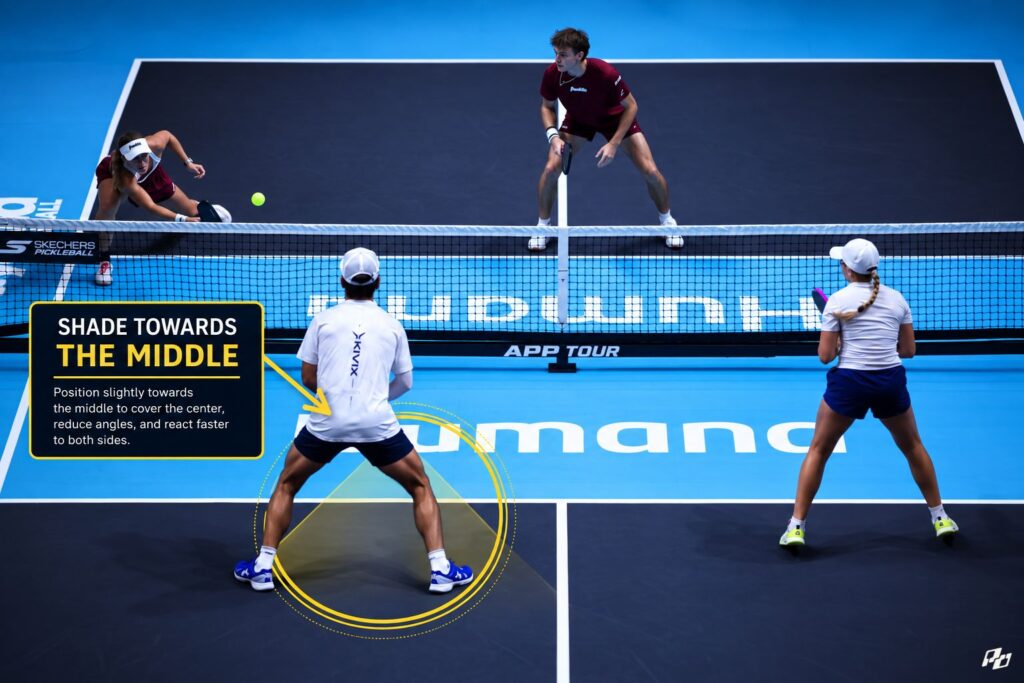
How far you can shade depends on the hitter. If they’re stretched, contacting low, or off balance, changing direction behind you is harder. That’s when you can steal more middle.
If they’re balanced with a comfortable ball, respect the line. They have more options.
A simple rule: the weaker their contact, the more court you can steal.
Your goal is not to eliminate every shot. It is to make the opponent give up their easiest option and choose a smaller, harder target instead.
That’s pressure.
A Fake Only Works If the Real Thing Exists
This is where rec players often misunderstand deception. They hear “fake poach” and start bouncing around.
Step middle.
Step back.
Wave the paddle.
Lean.
Shuffle.
That is not pressure. That is choreography.
A fake becomes powerful only after the opponent believes: this player might actually take my ball.
Once an opponent has seen a legitimate poach, even the possibility of another one can keep them guessing.
That means your sequence should usually be: establish the poach → show the poach → sometimes stay home.
Not: fake → fake → fake → never actually go.
There has to be evidence behind the threat.
Coach Christina Chin shows the same idea with her “fake and bake.” She establishes the wide dink first, waits for the opponent to start cheating toward it, then fakes that expected ball and attacks the space they just opened.
The fake works because the opponent already believes the original shot is coming:
What Makes a Poach Threat Credible?
Three things.
1. You Could Actually Reach the Ball
A useful middle squeeze puts you close enough that a loose ball is yours. If you’re pretending to poach something six feet away, nobody good cares.
Poaching instruction emphasizes moving on balls whose trajectory genuinely creates an interception opportunity rather than simply wandering into the partner’s space.
The opponent must believe: if I float this, they’re taking it.
That belief is the weapon.
2. You Stay Balanced
The easiest player to beat is the player trying too hard to look aggressive. If your fake pulls your weight completely across the middle, you’ve made the opponent’s decision easier: hit behind them.
A good fake may be only:
- a shoulder turn
- a small lean
- a paddle shift
- or one sharp step
Then you can still recover.
The goal isn’t maximum movement. It’s maximum doubt for minimum movement.
3. You Move at the Right Time
Move too early and the opponent simply reacts. Move too late and they never see you.
The useful window is generally around the hitter’s preparation, when they are still reading the court but beginning to commit to the shot.
You want your movement to become part of their decision. Not something they notice after the ball leaves the paddle.
Dayne’s Weirdest Cue Is Actually a Good One
Dayne makes a provocative point: if you’re pressuring the middle properly, you should occasionally get beaten down the line or behind you.
That sounds backwards.
Isn’t getting passed bad?
Of course.
But his point is about tradeoffs.
If nobody ever beats you behind your movement, there’s a good chance you’re never taking enough space to make them consider that shot.
Think of a cornerback who refuses to get beaten deep.
They can stand 20 yards off the receiver.
They’ll never give up the deep ball.
They’ll also give away everything underneath.
Pickleball has the same problem.
If you protect your sideline obsessively, you may give opponents effortless access to the highest-traffic area of doubles: the middle.
Recent analysis of high-level doubles reinforces how valuable middle control is because it reduces comfortable lanes and makes opponents create offense from smaller or less natural targets.
So yes: occasionally getting passed can be evidence that you’re applying real pressure. But here’s the clarification I would add to Dayne’s cue: getting beaten isn’t the goal.
You are not trying to manufacture two line winners against yourself every game. You’re trying to occupy enough middle that the opponent sometimes has to beat you somewhere harder.
That’s very different.
Think “Make the Court Smaller”
Your physical court remains 20 feet wide. The opponent’s usable court doesn’t. Suppose you stand passive.
They may feel comfortable with:
- crosscourt
- middle
- body
- line
Now squeeze the middle intelligently. Maybe crosscourt feels risky. Maybe the middle is covered. Suddenly they are considering:
- a sharper angle
- a difficult redirect behind you
- or a ball closer to the sideline
You have effectively removed comfortable court.
That is why poaching can create errors without producing a touch. Current poaching guidance specifically notes that once players feel middle pressure, they often redirect toward smaller targets or closer to the sidelines.
This is the hidden value. You’re not necessarily trying to intercept their best shot. You’re trying to make them stop hitting it.
Squeeze the Middle—Don’t Abandon Your Side
There is a giant difference between: middle pressure and middle addiction.
You don’t have to stand on the centerline. Your position should respond to where the ball is. When your partner is pulled wide, your partner has to respect the sharp angle.
You can usually shade inward and help protect the middle without mirroring your partner all the way toward the sideline.
Think of it more as a tilt than both partners sliding the same amount. The ball-side player moves more. The off-ball partner holds more of the middle.
I like this cue: partner protects the ball. You protect what comes next.
That’s an oversimplification, but a useful one.
Your partner is dealing with the current contact. You should be reading the likely next ball.
Read the Hitter Before You Get Greedy
This is where court presence becomes intelligent instead of annoying. Don’t poach because you feel energetic. Look at the hitter.
More attractive poach situation:
✔ They’re stretched
✔ Their paddle is below the ball
✔ They’re late
✔ They’re off balance
✔ They’ve shown the same crosscourt pattern repeatedly
✔ Their contact is likely to produce a softer or more predictable ball
Now your middle pressure has information behind it.
Worse poach situation:
✖ They’re balanced
✖ The ball is high
✖ They have plenty of time
✖ Their paddle is prepared
✖ They can easily redirect behind you
Now an exaggerated middle move can become a gift.
High or floating balls, repeated crosscourt patterns, and weak resets are far better opportunities than simply deciding, “I’m going this time.”
Don’t Just Watch the Ball—Watch Their Mind Change
A successful off-ball play doesn’t always end with: you hitting a winner. Sometimes it looks like:
- an opponent starting crosscourt and changing late
- a dink pushed wide
- an unnecessary speed-up
- a ball floated because they hesitated
- or a line attempt missed by three inches
Those are valuable clues. It’s easy to chalk the point up to a simple miss, but the better question is whether your positioning helped force that mistake.
That’s how you learn if your presence is real.
If opponents repeatedly play exactly their preferred pattern while you stand next to the middle, you’re probably not threatening anything.
If you begin seeing awkward redirects and last-second changes? Now you’re affecting decisions.
The Body Is Your Insurance Policy
Here’s a useful tactical twist. When opponents begin noticing your poach, they may try to punish you with the line.
You don’t always have to retreat all the way to protect it. You can make their alternative uncomfortable too.
Pro player Catherine Parenteau has advised using the body against an active poacher because a moving player has less space to extend the paddle freely.
Flip that idea around. If you’re the poacher, expect opponents to start attacking:
- your body
- your hip
- or the space behind you
That means your fake has to finish in a defendable position.
Paddle in front. Feet underneath you. Not leaning halfway into your partner’s court while admiring your deception.
Never Make Your Partner Guess Too
This is where aggressive rec players can become terrible partners. You want the opponents uncertain. Not your teammate.
If your partner doesn’t know whether you’re:
- Taking the middle
- Faking
- Switching
- Or returning home
your “presence” is hurting both teams equally.
A good poach can require a switch; a smaller one may allow you to recover. Either way, somebody must know who owns the space you just left.
Before a competitive game, you can keep it extremely simple: “If I cross all the way, switch.”
That’s enough. For regular partners, you can build actual poach/fake signals later.
The Best Presence Is Quiet
The scariest off-ball player isn’t necessarily the one bouncing around. It’s the player who looks balanced and still.
Then, at exactly the right moment:
Half-step middle.
Paddle appears.
Maybe they go.
Maybe they don’t.
Now the hitter has to solve another problem. That’s the part intermediate players usually miss. Court presence isn’t constant aggression. It’s credible uncertainty.
You are telling the opponent: “That shot is available—but only if I’m not coming.”
Once you’ve established that possibility, you don’t need to move dramatically every rally.
Sometimes the most powerful fake is simply standing close enough that they remember the last poach.