
To keep your legs fresh during long pickleball sessions, move more efficiently, take short breaks before you crash, fuel with carbs, stay hydrated, and replace sodium when you’re sweating heavily. Strength training off court also helps. If fatigue starts changing your balance, footwork, or coordination, it’s time to stop.
Most rec players don’t suddenly “run out of legs.” It happens in stages.
Your split step gets a little later. You stop sitting into your dinks. You reach instead of moving. Returns land shorter. You start standing taller between shots. Then someone hits a ball you would have handled easily an hour ago and your feet just…don’t get there.
That’s the important part: leg fatigue usually shows up in your movement quality before it shows up as “I’m exhausted.”
For intermediate players, especially 3.0–4.0 rec players in long open-play sessions, the goal shouldn’t be to somehow feel fresh forever.
It should be to delay the drop-off, recognize it early, and stop before fatigue starts changing how you move.
That’s a much smarter way to stay on the court longer.
First: Pickleball Fatigue Is Not Just “Tired Legs”
A long session taxes several things at once:
- muscle endurance
- glycogen and blood glucose
- hydration
- temperature regulation
- balance and reaction quality
Pickleball is stop-and-start, but that doesn’t make it easy. You repeatedly accelerate, brake, shuffle, lunge, recover, and hold a semi-crouched ready position.
That pattern is especially demanding on the:
quads
calves
glutes
hamstrings
And because so much of the game involves deceleration and lateral movement, fatigue can make you sloppy before it makes you feel “spent.”
That’s when late-session mistakes start looking technical even though they’re really physical.
The Non-Obvious Fix: Spend Less Leg Energy Early
Fresh legs at Hour 2 are partly earned in Hour 1. The goal is not to move less. It’s to stop wasting movement that doesn’t help the point.
Here’s what that looks like in actual rec play:
- Between points, stand up and relax. You do not need to stay in a deep athletic crouch while someone retrieves the ball or the score is being called. Let the quads recover.
- In transition, advance in stages. Hit, move forward, then split or stabilize as the opponent contacts. Don’t sprint blindly from baseline to kitchen and then have to brake hard.
- Let your partner own their ball. If the ball is clearly on their side, resist the instinct to drift over and “help.” Extra lateral movement adds up over two hours.
- Use fewer panic steps. Get to the ball early enough to take one or two clean adjustment steps instead of six tiny ones right before contact.
- Recover only as far as the point requires. After a wide dink or volley, get back to your proper position—but don’t overrun the middle and then shuffle back again.
- Walk between games instead of pacing. If you have a couple of minutes, actually let the legs come down rather than staying in constant motion.
- Choose the ball you can reach cleanly. Chasing a low-percentage lob into the fence may save one point and cost you energy for the next five.
- Use your body efficiently at the kitchen. Stay athletic, but not permanently squatted. Lower when the ball is coming to you, then come back to a more relaxed ready height.
The better player often isn’t the one moving the most. It’s the one who can switch between relaxed and explosive without living in the expensive middle ground.
That’s the real energy-saving skill: rest when the rally allows it, move decisively when it matters, then recover without adding extra steps.
Your First Warning Sign Is Usually Your Feet
Here’s a simple late-session checklist. If two or three of these start happening together, your legs are probably fading:
| What changes | What it often means |
|---|---|
| Split step becomes late or disappears | Reaction speed and leg stiffness dropping |
| You reach instead of taking one more step | Footwork economy deteriorating |
| You stand taller at the kitchen | Quads/glutes tiring |
| Returns get shorter | Less leg drive |
| You stop recovering after wide balls | Fatigue affecting positioning |
| Calves begin cramping or twitching | Possible fatigue, fluid/electrolyte issue |
| You start stumbling or crossing feet | Balance/control declining |
This is the stuff I’d watch more closely than simply asking: “Am I tired?”
Because by the time you feel wrecked, your movement quality may already have been bad for 20 minutes.
For Long Sessions, Carbs Actually Matter
This is where the “I had coffee and a protein bar” crowd often gets caught. If you’re playing for 45–60 minutes after eating normally, you may not need much extra fuel.
But once open play stretches beyond an hour, especially if intensity is decent, carbohydrate becomes more relevant.
Sports-nutrition guidance for stop-and-start exercise lasting roughly 1–2.5 hours commonly lands around 30–60 grams of carbohydrate per hour, depending on intensity and individual tolerance.
For rec pickleball, you do not need to treat that as a rigid prescription.
For many rec players, a simpler starting point is 15–30 g of easy-to-digest carbs around the 60–90 minute mark, then adjust based on session intensity, duration, and how you feel.
That could be:
- applesauce pouch
- banana
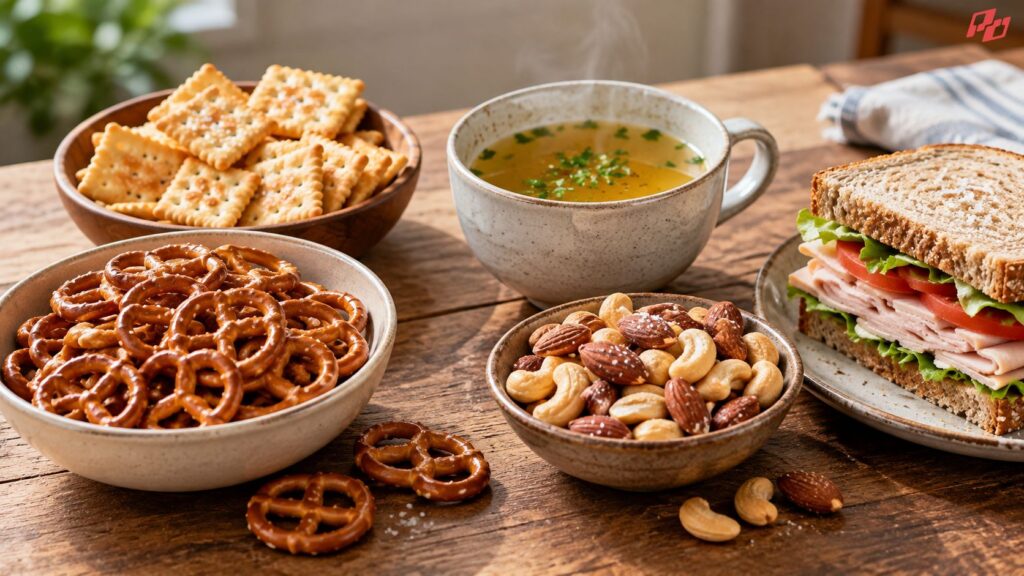
- pretzels
- fruit snacks
- dates
- sports drink
If your legs consistently feel dead late in the session but you’re barely eating anything, that’s worth testing.
The key is to fuel before you’re completely flat.
Older Players Should Pay Extra Attention to Hydration
Older players need to pay particular attention here.
Research on aging shows that thirst sensation can be blunted during exercise and heat, meaning older adults may drink less even while their bodies need fluid.
That makes “drink when thirsty” a little less foolproof in older players. The exact amount you need varies dramatically with:
- heat
- humidity
- body size
- sweat rate
- indoor vs. outdoor play
- medications
- how much you drank before play
So rather than obsessing over one universal number, watch your personal pattern.
A simple marker: weigh yourself before and after a typical long session.
If you’re repeatedly losing a large amount of body weight, you probably need to tighten up your hydration strategy.
And in hot conditions, the CDC specifically lists muscle cramps, heavy sweating, weakness, dizziness, headache, nausea, and shortness of breath as signs of overheating that deserve attention.
Electrolytes Help—But They’re Not Magic
If you’re playing for hours in the heat and sweating heavily, sodium is the main electrolyte you’re trying to replace, not magnesium.
The classic ACSM range of 0.5–0.7 grams of sodium per liter of fluid means roughly: 500–700 mg of sodium in 34 oz / 1 liter of fluid.
That can come from an electrolyte drink, powder packet, tablet, or food. The key is to check the sodium number on the label, because packets vary a lot.
For example:
- a packet with 500–700 mg sodium mixed into about 1 liter of water fits that general range well
- a packet with only 100–200 mg sodium is relatively light
- a packet with 1,000 mg or more is much more concentrated and may be more than some players need at once
You can also get sodium from food: pretzels, salted crackers, broth, salted nuts, or a salty sandwich can all contribute.
The important point is not “take an electrolyte packet.” It is: look at how much sodium you’re actually getting.
And don’t assume cramps automatically mean you need magnesium. Cramping and heavy legs can also come from overuse, heat, low carbohydrate, poor conditioning, or simply staying on court too long.
If you’re cramping repeatedly despite reasonable hydration and fueling, that’s something to discuss with a clinician rather than just adding more supplements.
Breaks Work Better Before You Need Them
One of the easiest fixes is also one rec players hate: sit out a game before you feel cooked.
If you know your movement usually starts falling apart around 90 minutes, don’t wait until Minute 89 to rest. Try taking 5–10 minutes after 45–60 minutes, especially in heat.
Get out of the sun if possible.
Sit.
Drink.
Have a small carb snack if the session is long enough to justify it.
Then go back in.
Short breaks are not weakness. They are pacing.
Experienced older players repeatedly mentioned to us limiting total games, taking days between harder sessions, and using recovery days rather than trying to match younger players game-for-game.
The Best Long-Term Fix Is Not Another Pickleball Session
This is where the answer gets less fun. If your legs are dying every session, playing more pickleball is not always the best way to fix it.
Strength training matters.
For older adults in particular, the National Institute on Aging recommends resistance training because it helps preserve the ability to perform demanding daily movements such as climbing stairs and rising from a chair.
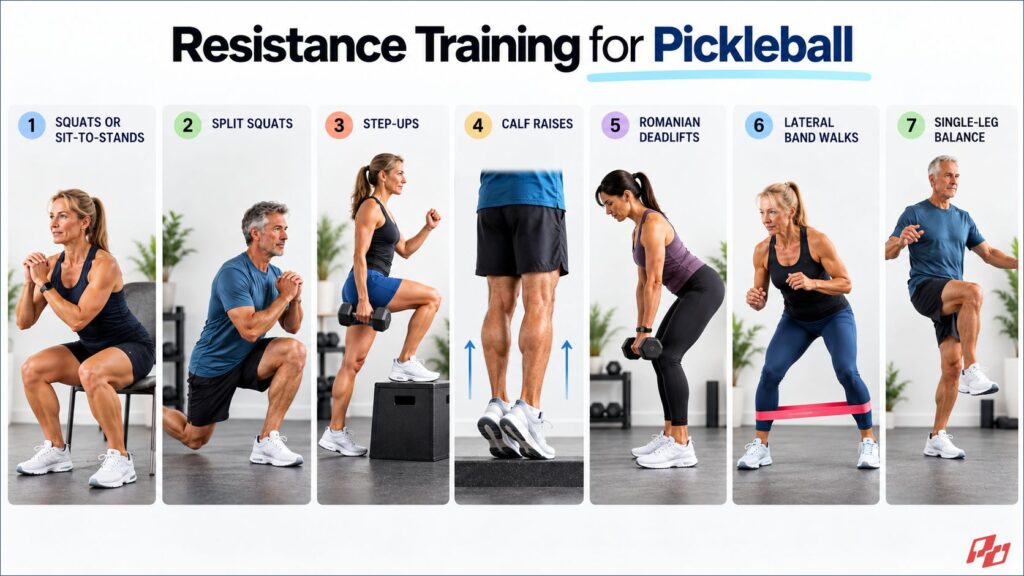
For pickleball, I’d prioritize:
- squats or sit-to-stands
- split squats
- step-ups
- calf raises
- Romanian deadlifts or hamstring work
- lateral band walks
- single-leg balance
Two well-designed strength sessions per week can do more for late-session leg durability than adding two more nights of open play.
That matches what a lot of experienced rec players report anecdotally too: consistent strength work appears repeatedly in discussions from players dealing with soreness and fatigue.
Conditioning Should Look a Little Like Pickleball
Steady walking and cycling are useful. But pickleball asks you to repeatedly: go → stop → recover → go again.
So your conditioning should include some of that rhythm. A simple court-conditioning block might look like:
20 seconds: lateral shuffle + short forward/back movement
40 seconds: easy walk
Repeat 6–10 times
Not maximal speed. You’re training the ability to produce repeated efforts without falling apart.
For older players, build gradually.
The NIDDK’s guidance for older adults is essentially “start low and go slow,” gradually increasing time, days, and intensity rather than making abrupt jumps.
Don’t Confuse Normal Fatigue With “Push Through It”
There is a point where tired legs are just tired legs. And there is a point where you should be done.
Usually manageable:
✅ heavy legs
✅ mild muscle fatigue
✅ slower movement that improves after a break
✅ normal post-exercise soreness
Time to stop:
❌ dizziness
❌ feeling faint
❌ nausea
❌ unusual shortness of breath
❌ chest pain or pressure
❌ irregular or racing heartbeat
❌ sharp joint or muscle pain
❌ repeated stumbling or loss of balance
❌ cramps that keep returning
❌ weakness that feels abnormal rather than simply tired
For older adults, the National Institute on Aging specifically says aerobic exercise should not cause dizziness, chest pain/pressure, or nausea.
And in hot conditions, heavy sweating plus weakness, headache, dizziness, nausea, or cramping can indicate heat exhaustion.
If confusion, loss of consciousness, or very high body temperature enters the picture, that can be heat stroke — a medical emergency.
That is no longer: “I should sit out one game.”
That is: stop and get help.
A Useful “Call It” Rule for Rec Players
Here’s the rule I’d use.
Don’t end the session simply because your legs feel tired. End it when fatigue starts changing how safely you move.
If you are:
- late to every split step
- stumbling
- crossing your feet accidentally
- unable to recover after lunges
- dragging one leg
- playing upright because you can no longer sit into position
you are no longer practicing good pickleball. You are rehearsing compromised movement. That is where one more game may not be worth it.
This matters even more for older players because falls and injury consequences become more significant with age.