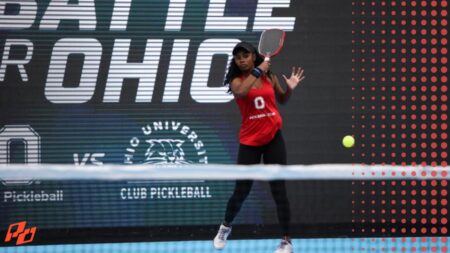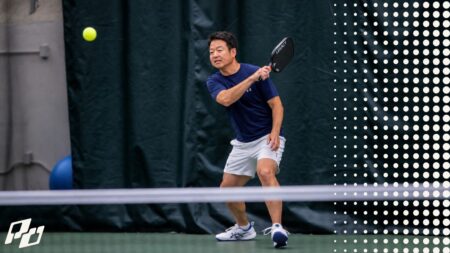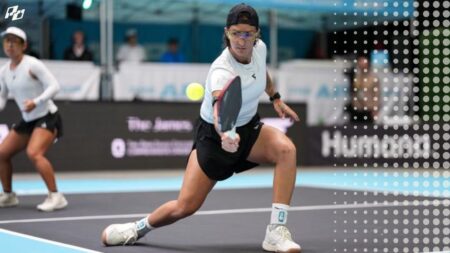

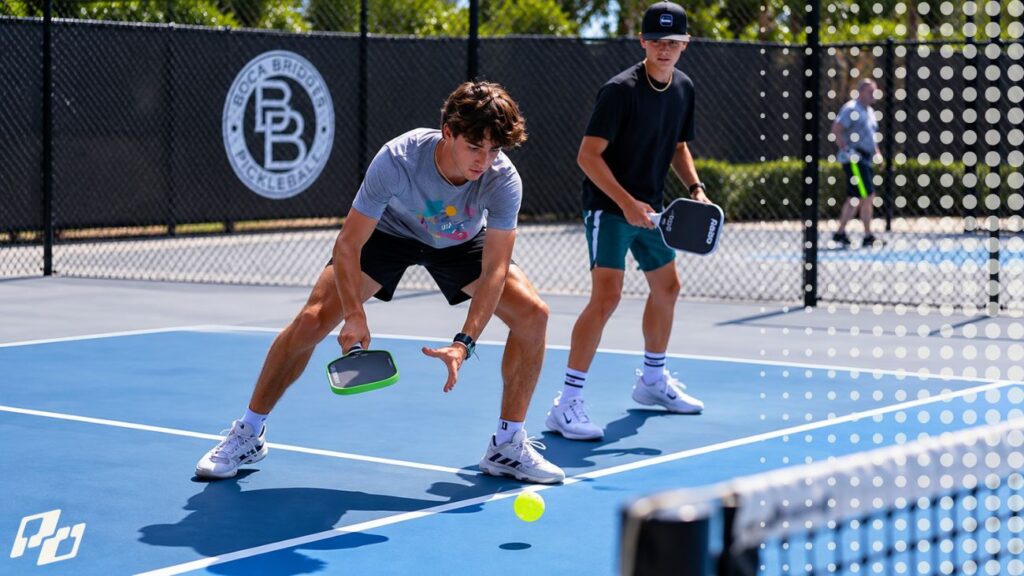
Better pickleball dinks start with footwork, not your paddle. Get your outside leg behind the ball, create a balanced contact point, and you’ll gain more control, disguise, and shot options. Good positioning also makes topspin and slice easier while reducing the reaching errors that hurt intermediate players most.
Intermediate players are often told to improve their dinks by making the swing smaller, softening their hands, or adding topspin.
All useful.
But watch a high-level dink exchange closely and something more important happens before the paddle ever moves: the player moves their body so the ball arrives inside a repeatable hitting window.
Gabe Tardio, one of the top men’s players on the PPA Tour and a multiple-time doubles champion, is a perfect example of this. One reason his dinking looks so efficient is that he rarely lets the ball pull him into an awkward reach. He moves early, gets his outside leg behind or outside the ball, and creates space to strike from a balanced position.
It sounds like a footwork detail. It’s really a shot-options advantage.
From that same setup, Tardio can roll wide, go middle, attack the body, change direction, or simply drop the ball soft. Because his positioning looks similar each time, opponents get fewer clues about what’s coming.
When you reach for the ball, you might have one decent option. When you get your body there first, you can have five.
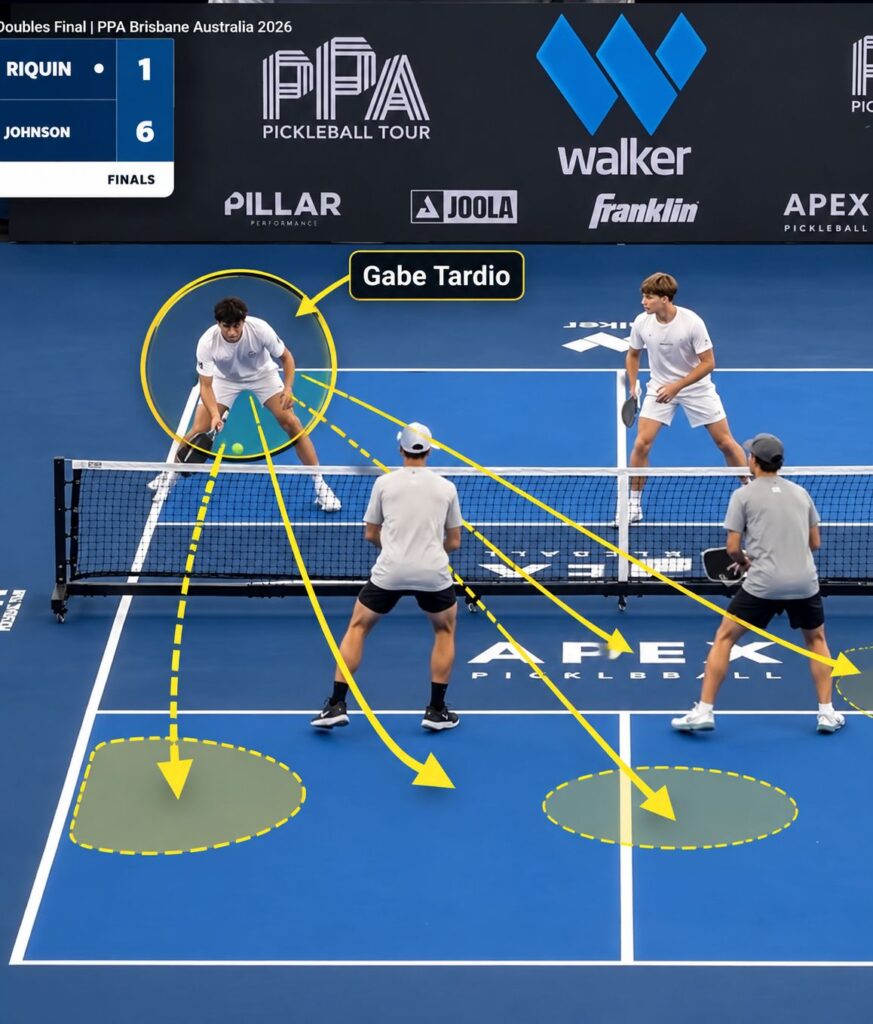
The useful rule: your foot should beat your paddle to the ball
For a right-handed forehand dink, imagine the ball traveling toward your right side.
A common 3.5-ish response is: ball moves → arm reaches → paddle improvises → feet follow late.
The better sequence is: ball moves → feet reposition → body settles → paddle swings.
One coaching cue captures it particularly well:
“Your outside foot has to beat the ball.”
The point isn’t that your shoe must occupy some mathematically perfect location. The point is that your base gets there before your hand has to rescue the shot.
That distinction matters.
Because the internet version of this advice—“always put your right leg outside the ball”—can become too rigid.
What Tardio’s positioning actually buys you
Imagine a right-handed player receiving a forehand dink wide to the right.
If you stay planted and simply extend your arm, the ball is now outside your body’s strongest working area. Your paddle path becomes more lateral, your wrist tends to get involved, and changing direction becomes difficult.
Now move the right foot far enough that the ball is roughly inside or just in front of that outside leg. Suddenly you have space.
Watch how Ben Johns, one of the most accomplished players in professional pickleball, and his older brother Collin Johns, a longtime elite doubles specialist and former regular partner of Ben’s, use their feet before the dink ever happens—creating space, balance, and multiple shot options instead of reaching and improvising.
From nearly the same preparation you can:
- roll crosscourt
- roll toward the middle
- go behind the opponent
- push a neutral dink
- or disguise a speed-up
That is the part intermediate players should care about.
Good footwork doesn’t merely make your dink more consistent. It makes your intention harder to read.
This is why the skill becomes significantly more valuable as you move toward 4.0 and beyond. At lower levels, simply landing a soft dink may be enough. As opponents improve, a harmless repetitive dink often just gives them another comfortable ball.
Aggressive dinking is less about hitting harder than it is about moving opponents and changing their contact position.
Here’s the non-obvious part: don’t chase spin first
This is where intermediates often go backward.
They see a pro roll a vicious topspin dink and think: I need more brush. Usually, they need more space.
Topspin is much easier when you have moved far enough around the ball for the paddle to travel from below it and through it without your arm getting trapped beside your hip.
Experienced players discussing this exact problem repeatedly make the same observation: move behind the ball, allow it to descend when appropriate, and create enough room to swing through it rather than manufacturing spin with the wrist.
One Reddit discussion involving a 3.7 player even drew a response from pro Zane Navratil, who emphasized balance and getting the paddle lower rather than simply forcing a flatter, more horizontal swing.
So use this hierarchy: Position → balance → contact → shape.
Not: Spin → hope.
For a forehand topspin dink, think “outside, under, through”
For a right-hander:
1. Outside
Move your right leg far enough to the right that you’re no longer reaching beyond it. You do not need an exaggerated lunge. Often one shuffle is enough.
Your goal is simply to create a comfortable hitting lane between your body and the ball.
2. Under
Let the paddle start below the ball.
If you’re hitting a more offensive roll dink, letting the ball come slightly off its apex can give you room to work up the back of it. Experienced players often describe this as allowing the ball to descend rather than rushing it immediately after the bounce.
3. Through
Do not perform a giant windshield-wiper brush.
Move forward and upward through the ball with a compact stroke.
The spin is a consequence of the swing path and paddle angle. Your legs don’t literally create the spin; they put your body in a position where the paddle can create it cleanly.
Our friend and pickleball coach Will East shares some excellent tips on the mechanics and technique behind a killer topspin dink:
@the_prince_of_pickleball Master the Forehand Top Spin Dink in Pickleball We talk about how to improve your forehand top spin dink in Pickleball. The key is to keep the paddle face open with an Eastern grip and simply lift up the bottom of the ball, rather than trying to roll the wrist. We also discuss making a C-shape with the elbow to accelerate through contact, and keeping the head stable like pro player Ana Bray to be aggressive without risk. #pickleball #pickleballtips #pickleballtiktok ♬ original sound – The Prince of Pickleball
Slice players need the same footwork—for a different reason
Suppose you prefer a slice dink.
You still want the outside foot to beat the ball. But now the positioning gives you room to send the paddle forward and slightly across/under the ball without chopping down or pulling your wrist sideways.
Again, the legs do not produce underspin.
They provide the stable platform and spacing that let the paddle face and swing path produce underspin.
That sounds like a technicality, but it changes how you practice. If your slice is floating, don’t immediately manipulate your wrist more. First ask:
Was I actually in position to hit this ball?
Avoid excessive wrist action on dinks, and move your feet instead of reaching outside a comfortable contact zone.
@the_prince_of_pickleball How to Master the Backhand Slice Dink 1️⃣ Lock and Scoop 2️⃣ Control with Shoulder 3️⃣ Slide Inside Foot LUZZ Paddle Coupon: Prince15 Link: https://bit.ly/4quYBSh Ball Machine: https://bit.ly/46pGOnl Ball Machine Coupon Codes: Princeerne Princeddp Clinic Schedule: https://bit.ly/3Nt0Gzy Next Pickleball Getway: VibeGetaways.com/will-curacao2026 #pickleball #pickleballtiktok #pickleballislife #pickleballtips #pickleballers @LuzzPickleball ♬ Music Sounds Better With You (feat. Thomas Bangalter) – Stardust & Benjamin Diamond & Alan Braxe
A better mental model: build a “contact corridor”
Forget trying to memorize exactly where your foot should land. Instead, picture a vertical corridor extending upward from your outside leg.
You want most routine bounce dinks to arrive somewhere inside that corridor or slightly in front of it, not several inches beyond it.
For a right-handed forehand: ball right → right leg gets there → ball stays inside the frame.
For a left-side movement: left leg becomes the outside leg.
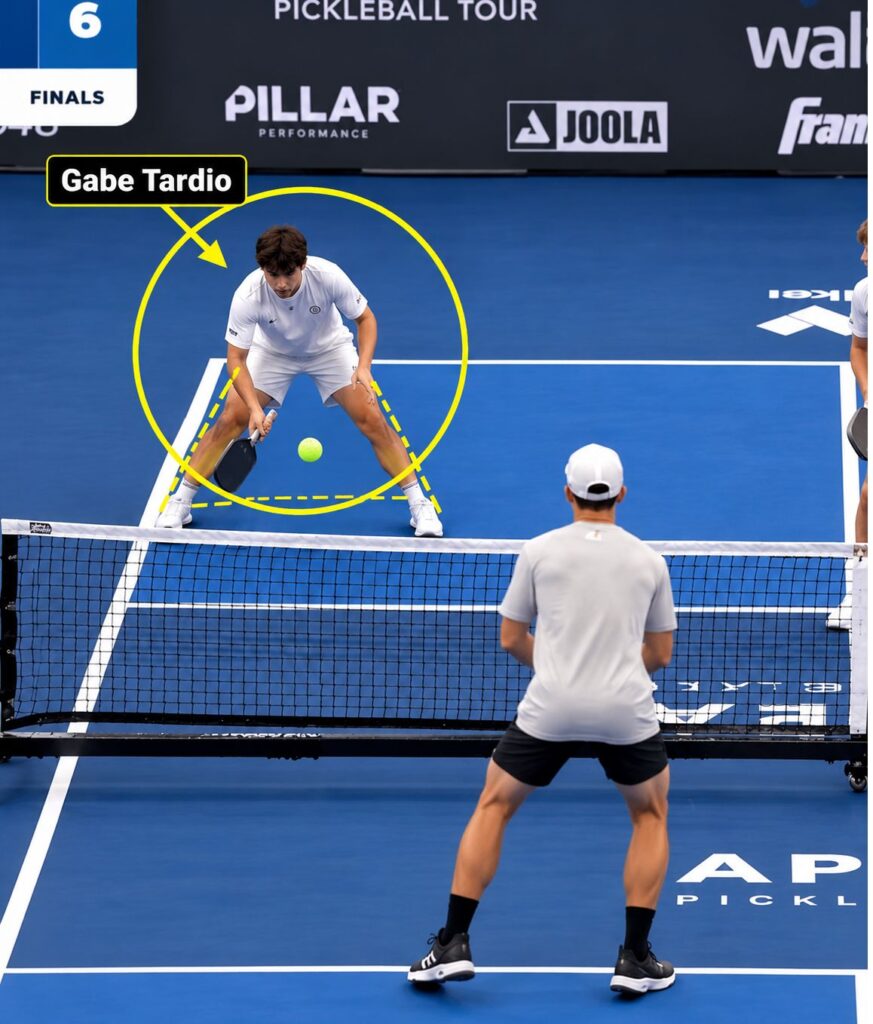
The concept works on backhands too, although two-handed backhands, open-stance dinks, half-volleys and emergency balls can change the exact geometry.
That is why “right foot outside every forehand” is useful as a training cue but dangerous as an absolute rule.
Use efficient footwork rather than overmoving. Sometimes a small shuffle or open stance is all you need instead of taking a big step into every dink.
So the real rule is:
Move enough that the paddle isn’t doing the footwork for you.
The mistake I would look for in your next game
Don’t count missed dinks. Count reaches. For one game, forget whether the ball went in.
Every time you hit a bounce dink, ask: was my paddle outside my base because I chose to hit there—or because my feet were late?
That separates tactical reaching from lazy reaching.
Sometimes reaching is correct. You may be taking a ball early, protecting your court position or cutting off an angle.
But if you’re routinely letting the ball drift beyond your outside knee before contact, you’re making every subsequent technical problem harder.
Players discussing higher-level dinking online often describe exactly this difference: lower-level players remain glued to the kitchen line and improvise with their hands, while stronger players move their feet—or occasionally give up a little ground—to create a better contact point.
And that leads to another useful upgrade.
Sometimes stepping back is more offensive than hugging the kitchen
Intermediate players are taught so aggressively to “get to the line” that they become terrified of giving up six inches.
But if a deep or heavy dink jams your feet, taking a small step backward can create room to let the ball fall into your strike zone.
Then hit.
Then reclaim the line.
The step-back dink can be an effective offensive tool because it creates room for a stronger forehand. The key is to recover back to the NVZ after the shot rather than staying several feet behind the line.

That’s sophisticated kitchen play: court position matters, but contact quality sometimes matters more for one shot.
Try this instead of another 100 cooperative dinks
Most dink drills accidentally reward bad footwork because the feeder sends everything comfortably to the same spot.
Try a five-window drill.
Have your partner randomly feed bounce dinks to: wide forehand → body → middle → body → wide backhand.
Your only objective for the first 20 balls is to beat the ball with your feet.
No aggressive spin.
No targets.
Just arrive, balance, hit.
Then repeat and add one constraint: on any ball where you establish the outside leg correctly, choose between two targets at the last moment.
Forehand wide? Either crosscourt or middle.
Backhand wide? Either middle or line.
Now you’ve connected footwork to the real payoff: disguise.
Finally, play skinny singles or crosscourt dinking and score yourself differently:
+1 if you contact the ball from a balanced position inside your contact corridor.
0 if you need an intentional reach.
–1 if your feet stay planted and the arm bails you out.
Don’t score the rally.
Score the geometry.
Do that for ten minutes and you’ll notice your dink improving without consciously thinking about your hand nearly as much.