
At the kitchen line, your position should change with the quality of your dink. After a strong crosscourt dink, shade toward the middle to take away the easiest reply. If the dink is neutral, stay balanced. If it sits up, hold your side and prepare to defend.
One of the easiest ways to lose pressure in doubles is to hit a good dink and then stay parked in the same spot.
The ball moves.
Your opponent moves.
But you do not.
That is how a strong shot turns back into a neutral rally.
At the kitchen line, your position should change with the ball. And if your crosscourt dink has pulled an opponent wide or forced them into a low contact, you usually want to move slightly toward the middle and make their next ball harder to find.
That is the pressure game.
Start with the inside foot
A useful way to judge your kitchen position is by your inside foot—the foot closest to the center line.
When you are neutral, that foot will usually sit comfortably on your half of the court.
When your crosscourt dink creates pressure, that inside foot can creep closer toward the center.
Not because you are abandoning your side. Because your opponent’s options have just become narrower.
A good crosscourt dink may force them to:
✔ Reach outside their body
✔ Contact below net height
✔ Move away from the center
✔ Play from a stretched position
That makes some replies much easier than others. The obvious escape is often back toward the middle.
⮕ If you stay wide, you give them that ball.
⮕ If you shift in, you take it away.
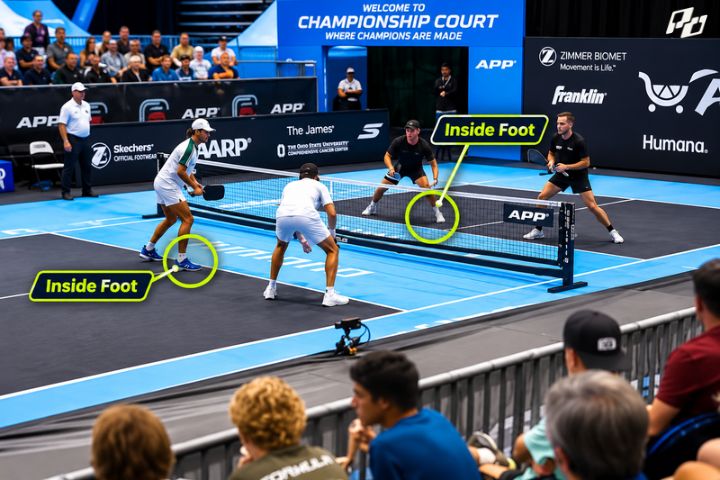
The better your dink, the more court you can take
This is the part that matters most. Do not decide your kitchen position before the shot. Let the quality of the dink decide it.
1. If your dink is strong
Maybe it lands near the outside foot, pulls the opponent off balance, or forces a low contact.
⮕ Now move in.
Your inside foot comes closer to the center line.
Your paddle stays in front.
You are looking to intercept the middle ball early.
2. If your dink is neutral
Stay more neutral.
Do not overcommit.
Your opponent still has enough balance and time to redirect.
3. If your dink sits up
Do not pinch middle.
Stay closer to your normal side, keep the team compact, and prepare for the attack. Protect the line and middle first.
If you need a little more reaction time, take a small step back from the kitchen line rather than retreating several feet.
Bad dink = stop taking court and get ready to defend.
Why moving toward the middle creates pressure
When you shade middle after a good crosscourt dink, you do three useful things at once.
⮕ First, you reduce the easiest target.
Middle is often the safest place for a pressured player to send the ball. By occupying it earlier, you make that option less comfortable.
⮕ Second, you take time away.
If the opponent sends the ball back toward center, you are already there.
You do not have to chase it after the bounce. You can take it earlier and keep them under pressure.
⮕ Third, you force a harder escape.
If the middle is crowded, the opponent may feel pushed toward the sharper crosscourt angle or a more difficult line shot.
That is exactly what you want.
You are not trying to cover every possible ball equally. You are trying to make the easiest ball disappear.
Check out popular pickleball coach Tanner Tomassi showing exactly how to take more middle balls by moving your inside foot toward the center and attacking with a compact motion.
What your partner should be doing
This only works properly if your partner shifts with you.
When you are the player crosscourt from the ball and you move toward the middle, your partner should remain responsible for the more immediate line threat.
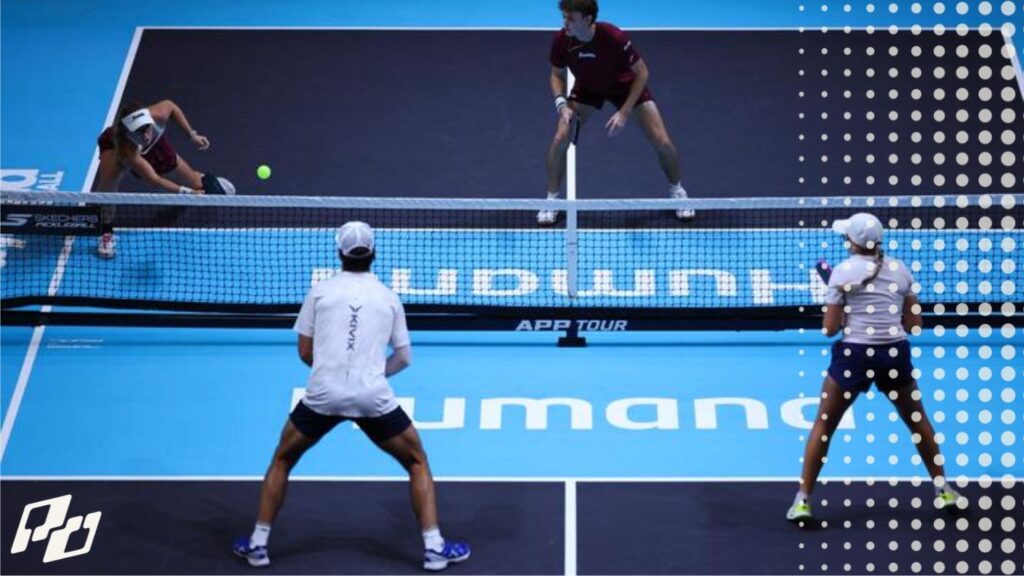
Think of the two of you as compressing the court together.
One player protects the line.
The other squeezes the middle.
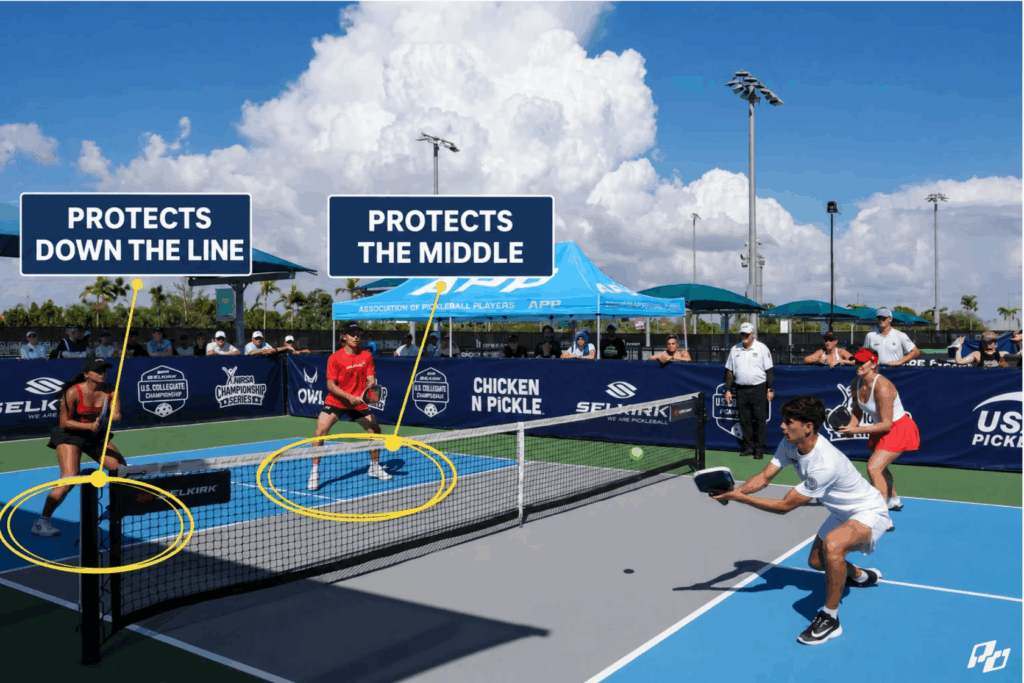
That keeps the gap between you small without leaving the sideline completely unprotected.
The mistake is when one player pinches middle and the other stays frozen. Now the team becomes stretched and confused.
Good kitchen positioning is shared positioning.
Where exactly should you stand?
There is no magic spot. Think in small adjustments.
If the rally is neutral, stay balanced on your side.
If your crosscourt dink pressures the opponent, move your inside foot perhaps half a step toward center.
If they are badly stretched and clearly defensive, you may take a little more.
If they recover balance or send a strong ball back, recover with them.
The movement should feel alive. Not dramatic. A few inches can matter. Half a step can matter a lot.
The kitchen line is not a set of parking spaces.
Check out this one-minute dinking and kitchen-line movement masterclass from Ben Johns and Gabe Tardio.
Do not confuse pressure with poaching
This is especially important in rec play. You are not trying to steal every middle ball from your partner.
You are trying to stand where the likely reply is going.
⮕ If the ball is clearly your partner’s, let them have it.
⮕ If the opponent is stretched and sends a floating middle ball, now you can hunt.
The difference is anticipation versus greed.
That distinction becomes much more important with regular partners. In competitive rec play, you can agree beforehand:
Ball in front of you: protect line.
Ball crosscourt from you: shade middle.
That makes the movement much cleaner.
In casual open play, be a little more conservative until you know how your partner covers the court.
The best time to move is immediately after contact
A common mistake is waiting to see where the opponent will hit before adjusting. That is too late.
Your movement should begin right after you see that your own dink has done its job.
- You hit crosscourt.
- You see the opponent reaching.
- Start moving.
Do not wait for their paddle to make contact. By then, the advantage is already disappearing.
The better players look fast partly because they are moving before the next ball is hit.
The middle ball is often the reward
A strong crosscourt dink frequently produces one of three things:
- a safe middle dink
- a weak speed-up through the center
- or a slightly elevated ball
If you have already shifted inward, all three become easier to handle.
That is how pressure compounds.
One good dink creates a weaker reply. Your position lets you take that reply early. That early contact creates another weak ball.
Now the rally starts to feel increasingly uncomfortable for the other team. That is what sustained pressure looks like at the kitchen.
It is rarely one spectacular shot. It is a series of increasingly uncomfortable contacts.
Try this in your next game
The next time you hit a crosscourt dink, do not immediately watch the ball. Watch the opponent.
⮕ If they are comfortable, stay balanced.
⮕ If they have to reach, move your inside foot toward the center.
⮕ If they are badly stretched, move a little more and get ready for the middle reply.
Then reset your position as soon as the advantage disappears.
That simple habit changes the kitchen from a place where you merely exchange dinks into a place where you gradually squeeze the court.
The goal is not to stand closer to the middle all the time. The goal is to take more court when your previous shot has earned it.
That is how a good dink becomes sustained pressure.