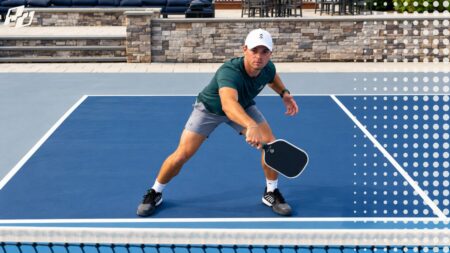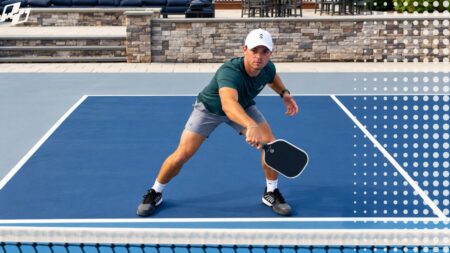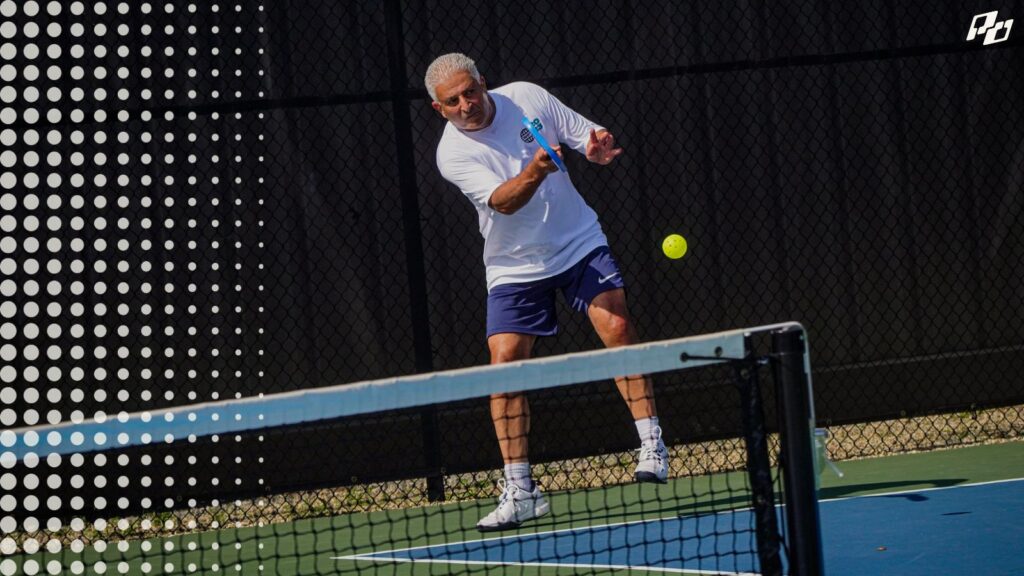
To add power to your pickleball serve, stop using only your arm. Start slightly closed, turn your hips and shoulders together, load the back leg, then transfer your weight forward through contact. This creates deeper, stronger serves with less effort and better control.
A lot of beginner and early-intermediate pickleball players want a stronger serve, so they do the most natural thing possible:
They swing harder with the arm.
At first, that feels like the answer. The paddle moves faster. The serve feels more aggressive. Maybe a few balls jump off the paddle and surprise the returner.
But then the problems show up.
The serve goes long.
The shoulder gets tight.
The contact point changes.
The ball floats short when you try to control it.
You miss more when you try to add pace.
And somehow, the harder you swing, the less reliable the serve feels.
That is because real serve power in pickleball does not come from the arm by itself. The arm is part of the chain, but it should not be the whole engine.
Better servers use the ground, legs, hips, core, shoulders, arm, and paddle in sequence. That full-body sequence is often called the kinetic chain — the transfer of force from the ground through the body into the paddle.
For rec players, this is huge because it means you may not need to “try harder” to serve harder.
You may need to organize your body better.
Why Arm-Only Serving Fails Beginners and Early Intermediates
The arm-only serve is popular because it feels simple. You stand at the baseline, drop or release the ball, swing the paddle, and hope the ball goes deep.
But mechanically, it has a low ceiling.
When you use only your arm, you are asking smaller muscles — shoulder, forearm, wrist — to create most of the speed. That usually causes three problems.
First, the serve becomes inconsistent. The paddle face changes more easily when the arm is doing everything. A tiny wrist change can send the ball high, long, short, or wide.
Second, the serve loses easy depth. A serve that relies only on arm speed often looks fast for a few feet, then lands short or sits up because the body did not drive through the shot.
Third, the serve can become physically irritating. If you play several mornings a week and serve dozens of times per session, muscling the ball with your shoulder and forearm can create unnecessary stress.
That is why a full-body serve matters. It gives you power with structure.
The Serve Is Not a Throwaway Shot
Some rec players still treat the serve as “just get it in.”
That is understandable for beginners. You cannot score if you miss the serve, and the serve must be legal. But once you become more comfortable, the serve should start doing more work.
A good serve can:
✓ push the returner back
✓ create a weaker return
✓ buy you time for the third shot
✓ target a weaker side
✓ start the rally with pressure
✓ force the opponent to move before they hit
The serve does not need to be an ace machine. In pickleball, aces are not the main goal for most rec players. The better goal is a deep, repeatable, slightly uncomfortable serve.
And that kind of serve usually comes from body sequence, not arm effort.
The Legal Frame: Power Still Has to Fit the Rules
Before we go deeper, remember that serve power has to stay legal.
Under USA Pickleball rules, a volley serve still has key restrictions, including an upward arc, contact below the waist, and paddle-head positioning requirements at contact. The drop serve remains another legal option with different mechanics because the ball is dropped and allowed to bounce before contact.
So the goal is not to turn your serve into a tennis serve. You are not serving overhead. You are not whipping from above the shoulder.
The goal is to create more legal power through better body organization.
The Hidden Fix: Use a More Closed, Turned Setup
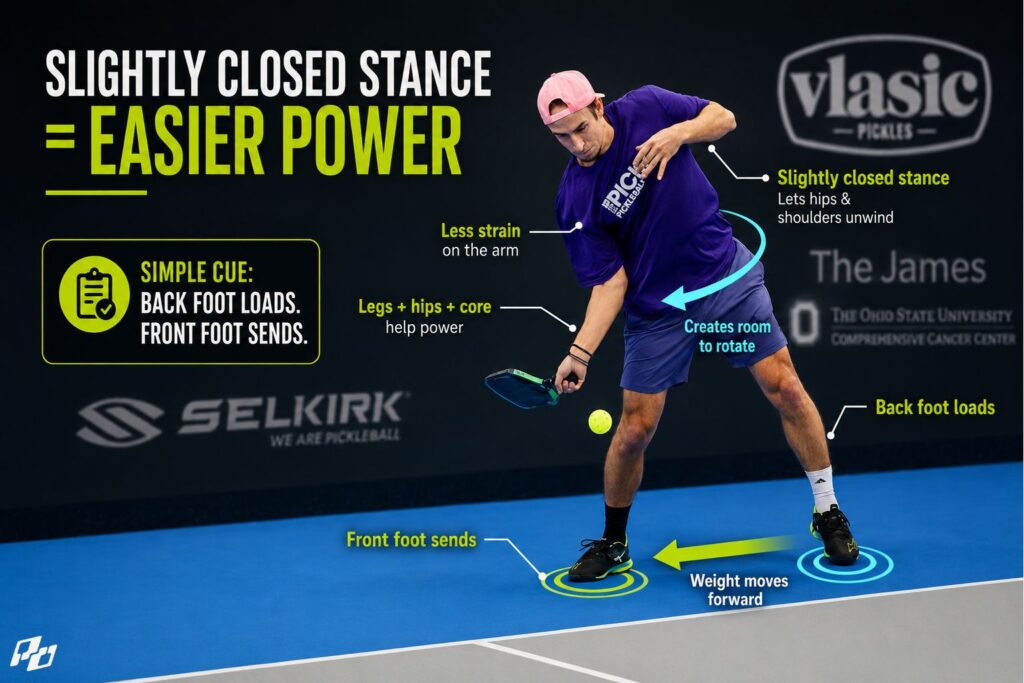
One of the most useful changes for beginner and early-intermediate players is learning how to start with a little more body turn.
A slightly closed stance means your body is not completely square to the net. Your front side is turned slightly away from the target, giving your hips and shoulders room to rotate through the serve.
Think of it like loading a spring.
If you stand square and swing only with the arm, there is not much stored energy. But if your hips and shoulders turn as one unit, then unwind smoothly, your body helps accelerate the paddle.
This does not need to be extreme.
You are not trying to look like a baseball pitcher. You are simply giving your body a chance to participate.
A useful cue: turn the unit, then send the ball.
Your hips and shoulders should feel connected, not scattered. The serve should feel like your body is helping the paddle move through contact.
Why a Closed Stance Can Help Add Power
A slightly closed stance helps because it gets more of your body involved instead of forcing your arm to do all the work.
First, it gives you room to rotate. When your hips and shoulders start slightly turned, you can unwind through the serve and create easier paddle speed.
Second, it helps your weight move forward. A stronger serve usually loads from the back leg and transfers into the front leg. If you stay stuck on your back foot, the serve often floats short. If you move forward through the ball, it usually feels deeper and cleaner.
Third, it reduces strain on the arm. Your arm still swings, but now your legs, hips, and core are helping create the power.
A simple cue: Back foot loads. Front foot sends:
The Kinetic Chain: What Should Happen First?
A good pickleball serve should feel like one smooth sequence:
Load → Rotate → Transfer → Swing → Finish
| Step | What It Means | Simple Cue |
|---|---|---|
| 1. Load | Set your base and feel a little weight in the back leg. You do not need a huge knee bend — just enough athletic bend to involve the legs. | Feel the ground before the paddle moves. |
| 2. Rotate | Turn your hips and shoulders together so your body stores energy before the swing. | Show your side pocket, then unwind. |
| 3. Transfer | Shift your weight forward through the serve instead of leaning back or flicking upward. | Step energy into the court. |
| 4. Swing | Let the arm and paddle accelerate after the body starts the motion. The arm delivers the power; it should not create all of it. | Arm is the whip, not the engine. |
| 5. Finish | Follow through smoothly toward your target so the serve has better depth and direction. | Finish where you want the ball to go. |
The Biggest Beginner Mistake: Trying to Add Power Before Depth
For beginners, power is tempting. But depth matters more.
A hard serve that lands short is not very useful. A deep serve with moderate pace is much more effective because it keeps the returner back and makes their return harder.
A good benchmark for rec players: can you land 7 or 8 out of 10 serves deep before trying to add more pace?
If not, do not chase speed yet. Build depth first. Then add pace.
This lines up with modern serve coaching that emphasizes measurable depth, repeatable contact, and legal mechanics before bragging about raw speed.
What “More Power” Should Actually Mean
For rec players, a more powerful serve should not mean swinging out of your shoes.
It should mean:
✓ deeper landing zone
✓ heavier ball
✓ better pace with the same effort
✓ more stable contact
✓ less shoulder strain
✓ better recovery after serving
✓ more pressure on the returner
The best compliment after a good serve is not always, “Wow, that was fast.”
It might be:
“That kept me back.”
“That jumped on me.”
“That was hard to return deep.”
“That forced me to rush.”
That is useful power.
Why This Tip Is Often Overlooked
This body-turn idea gets overlooked because the serve looks simple.
Unlike a drive or overhead, the serve starts from a still position. There is no incoming ball forcing you to move. So players assume the serve is mostly an arm swing.
But that stillness is exactly why your setup matters.
Because nothing is happening yet, you have time to create the right body shape. You can set your stance. You can load. You can turn. You can breathe. You can choose your target.
The serve is one of the few shots in pickleball where you fully control the start.
So if your setup is lazy, the whole shot suffers.
Closed Stance Does Not Mean Locked Stance
This is important.
A closed stance should help you rotate. It should not trap you.
Some players hear “closed stance” and turn so far sideways that they cannot swing naturally. Others close the feet but keep the hips stiff, so the serve becomes awkward.
You want a stance that gives you:
✓ balance
✓ hip rotation
✓ shoulder turn
✓ forward transfer
✓ clean contact
✓ easy recovery
Not a stance that makes you feel like you are stuck in cement.
A good starting point:
Place your front foot slightly angled toward the target area. Let your back foot sit behind and slightly to the side. Turn your hips and shoulders enough that you feel coiled, but not so much that your swing path becomes complicated:
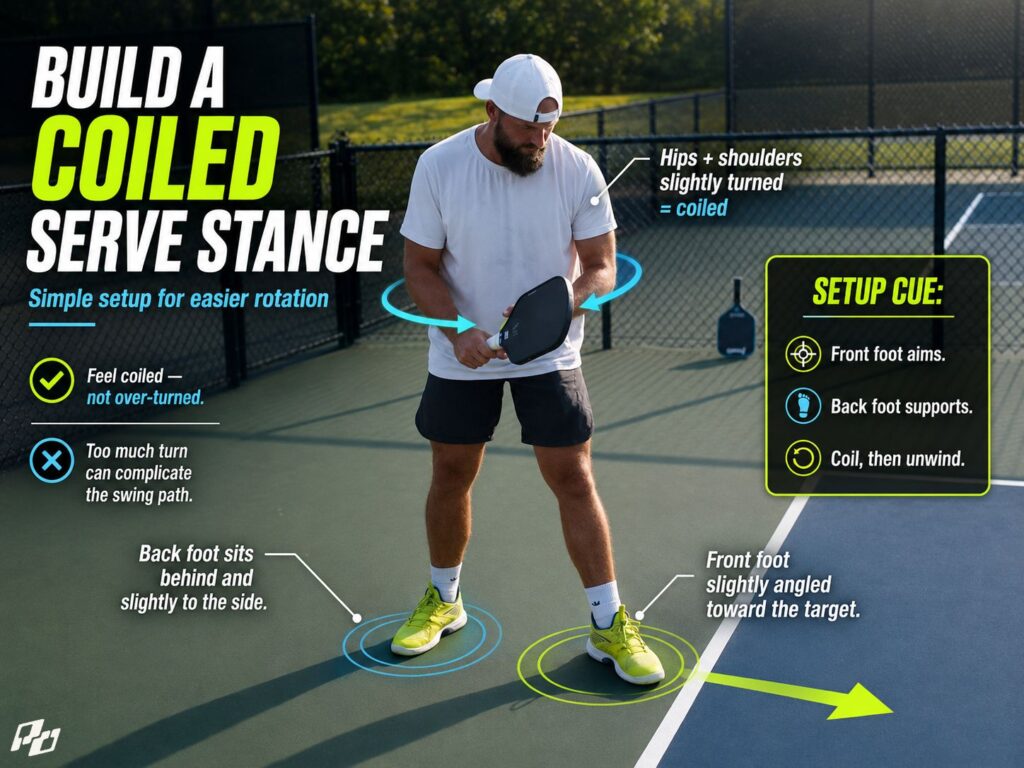
Cue: closed enough to load. Open enough to swing.
Does This Work for the Drop Serve Too?
Yes, but with a slightly different feel.
On a volley serve, the body turn and weight transfer happen as you release and contact the ball before it bounces.
On a drop serve, the ball bounces first, so you have a little more time to organize the swing. You can still load the back leg, rotate, transfer forward, and swing through the ball.
For many beginners, the drop serve can actually be a good place to learn body-powered serving because the bounce gives them a clearer timing window.
But the same rule applies: do not just arm it.
Use the legs, hips, core, and forward transfer.
How Seniors Should Apply This
For senior players, this tip is especially useful — but it should be applied smoothly, not aggressively.
The goal is not a violent rotation. The goal is efficient power.
If you have hip, back, knee, or shoulder limitations, do not exaggerate the turn. Make it smaller and smoother. Even a modest weight transfer can add depth without extra strain.
Cue: easy turn, deep serve.
Power should feel easier, not harder.
The Best Serve Targets for Beginners and Early Intermediates
Once your serve has more power, give it a job. Use big, smart targets instead of aiming randomly.
- Deep middle
This is the safest high-value serve. It reduces return angles and can create confusion between partners. - Backhand corner
Many rec players return weaker from the backhand side, especially when the serve lands deep. - Body serve
This jams players who like big swings and makes clean contact harder. - Wide serve
Use this later. It can stretch the returner, but it also opens angles if they handle it well.
For newer players, start with deep middle and backhand-side depth. Power without placement is just noise.
The “One Serve Upgrade” Progression
Here is a simple way to practice this without wrecking your serve.
⮕ Use it in games
In rec games, serve at about 75–85% effort. A reliable deep serve beats an occasional rocket with three misses.
⮕ Serve at 60% with your full body
Hit 20 relaxed serves and feel the sequence: load → rotate → transfer → swing → finish. If you cannot feel your legs and core, slow down.
⮕ Track depth
Hit 20 serves and count how many land in the back third of the service box. Goal: 12–15 out of 20 deep before adding pace.
⮕ Add one target
Choose deep middle or the backhand corner. Hit 20 more. Goal: 10+ deep and near your target.
⮕ Add pace without changing rhythm
Add only about 10% more paddle speed, not 50%. If accuracy collapses, you added arm instead of body.
Common Mistakes When Learning Body-Powered Serves
1. Chasing speed too soon
Problem: You try to hit harder before you can land deep serves consistently.
Fix: Build depth and control first, then add pace gradually.
Cue: Depth before drama.
2. Over-rotating
Problem: You turn too much and lose balance before contact.
Fix: Use a comfortable coil, not a full twist.
Cue: Turn enough to load, not enough to get stuck.
3. Opening too early
Problem: Your chest opens too soon, so the serve sprays wide or loses power.
Fix: Let the sequence happen naturally: load first, then unwind through the ball.
Cue: Uncoil through contact.
4. Messing up the ball release
Problem: You focus so much on body motion that your toss or drop becomes inconsistent.
Fix: Keep the ball release simple, repeatable, and in the same contact window.
Cue: Same release, same contact.
5. Snapping the wrist
Problem: You force a wrist snap and lose control of the paddle face.
Fix: Stay relaxed and let the paddle release naturally through the swing.
Cue: Relaxed wrist, stable face.
6. Falling backward
Problem: Your weight stays behind you, so the serve floats short or loses depth.
Fix: Transfer forward through the ball and finish balanced over your front side.
Cue: Finish over the front side.
How You Know the Fix Is Working
You will know your serve is improving when:
✓ the ball lands deeper with the same effort
✓ your shoulder feels less tense
✓ your serve has a smoother rhythm
✓ you miss fewer serves long when adding pace
✓ your follow-through feels balanced
✓ opponents return shorter or later
✓ you feel like your whole body is involved
The biggest sign is this: your serve feels easier, but the ball travels better.
The Simple Cue That Ties It Together
If you remember only one thing, make it this:
Turn, transfer, then swing.
That is the beginner-friendly version of the kinetic chain.
Turn the hips and shoulders.
Transfer your weight forward.
Then let the arm and paddle swing through.
Not arm first.
Not wrist first.
Not shoulder strain.
Body first, paddle last.