
A good down-the-line shot is earned, not forced. Use it when a poacher cheats middle, you’re pulled wide, or you can attack a backhand. Aim inside the sideline, hit with controlled pace, and shift with your partner so the next ball doesn’t burn you.
Down the line is one of those shots that looks simple until you actually try it.
The court is right there. The sideline is right there. Your opponent is leaning middle. You think, I’m going to burn them.
Then the ball sails wide, clips the tape, or floats straight into the opponent’s paddle.
That is why a lot of rec players either avoid the down-the-line shot completely or use it at the worst possible time. But when you understand which down-the-line shots work, when to use them, and what your partner should do after, it becomes one of the smartest doubles tools you have.
Down the line is not just a “winner” shot. It is a court-management shot.
It can keep a poacher honest.
It can target a weaker backhand.
It can give your partner a middle ball.
It can help you unwind a stack.
It can reduce your opponent’s angles.
It can punish players who over-cheat toward the middle.
But it has to be used with discipline.
First: Why Down the Line Is Riskier Than Crosscourt
Crosscourt is naturally safer in pickleball because the court is longer diagonally, the net is lower in the middle, and you have more room to shape the ball. Down the line is a shorter path, usually over the higher part of the net near the sideline, with less margin for error.
That does not mean down the line is bad. It means you should not treat it like a casual default.
A crosscourt shot is often the percentage ball.
A down-the-line shot is the punishment ball.
You use it when the court, opponent, and ball quality all give you a reason.
The Best Times to Hit Down the Line
1. When the Opponent Is Poaching Too Much
This is probably the most obvious and satisfying use.
If the player across from you keeps cheating middle, reaching across, or trying to take every ball with their forehand, the down-the-line shot says:
“You still have to guard your sideline.”
This is especially common in mixed doubles or any game where one player is dominating the middle. If they get too comfortable, you do not need to blast a heroic winner. You just need to put a firm, low ball behind their overcommitment.
The goal is not always to win the point immediately. Sometimes the goal is to make that player stay home next time.
And once they stay home, the middle opens again.
2. When You Get Pulled Wide
This is one of the biggest keys.
A good down-the-line shot usually starts with your court position. If the ball pulls you wide toward the sideline, you have a cleaner straight-line view into the opponent’s sideline lane. If you are more toward the middle, your down-the-line angle often has to travel too close to the sideline and becomes easier to miss wide.
So the first question is not, “Can I hit down the line?”
It is: did this ball pull me wide enough to give me a real line?
If yes, down the line may be available.
If no, crosscourt or middle is usually safer.
A useful cue: wide ball, straight lane. Middle ball, don’t force line.
3. When Your Forehand Lines Up With Their Backhand
This is the highest-value version for many right-handed rec players.
If you are right-handed on the right side of the court and you get a ball you can hit with your forehand down the line to a right-handed opponent’s backhand, that is often a strong pattern.
You are using your stronger shot into their more uncomfortable side.
That does not mean it is automatic. You still need the right ball. But if the opponent across from you has a weaker backhand, poor ready position, or tends to panic-block, this is a very useful target.
A good down-the-line shot does not have to be crushed. It just needs to arrive low and quickly enough that the opponent has to react from an uncomfortable contact point.
4. When You Are Returning Serve
The down-the-line return is underrated.
Most rec players return crosscourt by habit. That is often fine. But a down-the-line return can be very useful because it can:
- keep the return away from a dominant middle forehand
- force a backhand third shot
- give your partner a chance to poach the next middle ball
- and help you switch sides if you are stacking
This is especially helpful when returning against a team that wants one player’s forehand in the middle. If your return goes crosscourt right into that player’s forehand pattern, you may be feeding their strength. A down-the-line return can make them hit from the side they do not want.
The key is depth. A short down-the-line return is dangerous because it gives the serving team an easy attack. But a deep down-the-line return to the backhand can be a very smart doubles play.
5. When You Are Stacking or Switching
If you and your partner are stacking on the return, a down-the-line return can buy time.
Why?
Because the ball travels more directly in front of you, which can give the switching player a cleaner path to their preferred side. It also keeps the return away from the dangerous crosscourt angle that may expose your movement.
This is not just a shot choice. It is a positioning tool.
If you return crosscourt while trying to switch, you may create more chaos. If you return down the line deep, you often give your team a cleaner route into its preferred formation.
6. When You Need to Reduce Their Angles
Crosscourt creates angles. That can be good when you are in control, but dangerous when your opponent is better positioned or waiting to counter.
A clean down-the-line ball can narrow the opponent’s reply options. It can force them to hit from a more predictable lane, especially if you and your partner move correctly after the shot.
This matters because down the line is not complete until your team covers the next ball. More on that in a second.
The Down-the-Line Shots That Work Best
1. The Down-the-Line Return
This is probably the most practical down-the-line shot for intermediate rec players.
You have time.
The ball is coming from the serve.
You can set your feet.
You can choose depth.
You can target the backhand.
The best version is not a risky line-painter. It is a deep, controlled return with enough pace to keep the server back.
Aim a few feet inside the sideline, not on the line itself. Your target is not the stripe. Your target is the opponent’s backhand-side half of the court.
Cue: deep first. Line second.
If the return is deep and slightly inside the sideline, it still does its job. If you try to paint the line and miss wide, you gave away the point.
2. The Down-the-Line Drive
This is the shot people think of first, but it is also the one they overuse. A down-the-line drive works best when:
- you get a short or attackable ball
- you are balanced
- you can contact slightly closer to your body than a crosscourt drive
- you can keep your body turned
- and you can move forward through the target
The technical piece is important. Many players pull the ball crosscourt because they contact it too far out in front and their swing naturally travels across the body. To go down the line, you often need to let the ball get a fraction closer — not jammed, just slightly closer — so your paddle can travel more forward through the lane.
That does not mean waiting with your feet.
It means: move early with your body. Wait slightly with your paddle:
You still get to the ball. You still set your base. You still contact in front. You just do not over-reach so far that your swing path pulls the ball across court.
Cue: feet early, paddle patient.
3. The Down-the-Line Dink
Down-the-line dinks are not just soft little fillers. They can be very strategic. A good down-the-line dink can:
- move the opponent off balance
- stop them from camping crosscourt
- reset pressure
- force a low contact point
- and create a pop-up if placed deep enough in the kitchen
The key is knowing the difference between a defensive dink and an aggressive dink.
If you are under pressure, a shorter down-the-line dink into the safer part of the kitchen can reset the rally. If you are balanced and your opponent is leaning middle, a deeper down-the-line dink toward their outside foot can make them reach and break posture.
Cue: short to survive. Deep to pressure.
4. The Down-the-Line Flick
This is the advanced rec-player version.
A down-the-line flick works when the ball is high enough, close enough, and you are balanced enough to brush through it with control. It is especially useful when the opponent is leaning middle and leaves the sideline exposed.
But it is also one of the easiest shots to overcook.
If the ball is below net height, do not pretend you are Ben Johns. From below the net, a line flick needs spin, shape, and excellent contact. Most rec players are better off using a soft reset, a controlled dink, or a roll into a bigger target.
For a safer down-the-line flick:
✓ use a wide base
✓ lean forward without falling
✓ contact out front
✓ brush up the inside/back of the ball
✓ aim inside the sideline
The target should be uncomfortable, not perfect.
Cue: brush, don’t slap.
5. The Down-the-Line Counter
This one matters against bangers and speedups.
If someone attacks from wide near the sideline, many rec players panic and over-sell to cover the line. But if the ball is low and wide for the attacker, they often cannot hit a true missile down the line and keep it in. They are going over the higher part of the net with less court to work with.
So yes, you must respect the line — but you should not abandon your body defense or middle coverage.
James Ignatowich has taught this idea when neutralizing aggressive players: cover the line, but understand that the hard body ball may be more realistic than a clean down-the-line rocket from a low, wide contact.
For rec players, this is a huge clarification.
When defending a sideline speedup, do not think: “Line or nothing.”
Think: “Line is my job, but body ball is still dangerous.”
Use an outside step, keep the paddle organized, and be ready to block or counter.
The Mechanics: How to Actually Hit Down the Line
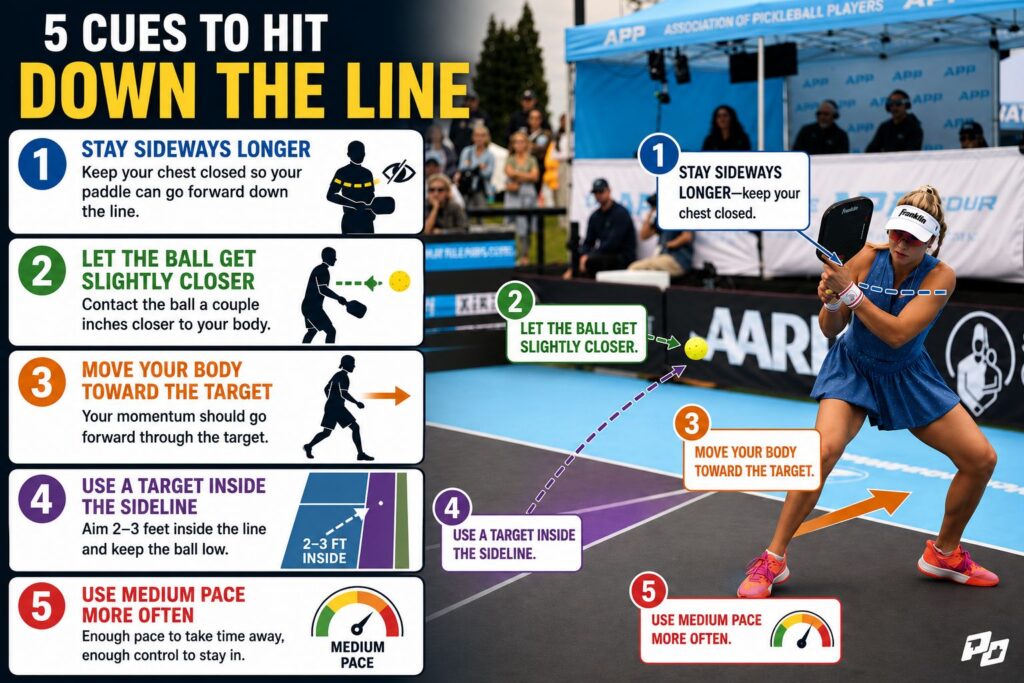
1. Stay Sideways Longer
Most missed down-the-line shots happen because players rotate their chest and shoulders too soon. Once the body opens early, the paddle path naturally pulls across the body and the ball leaks crosscourt.
On forehands and backhands alike, you want to stay closed just a split second longer so the paddle can travel more toward the target before your torso fully rotates.
A useful cue: “Hide the logo.”
Imagine there’s a logo on the front of your shirt. If your opponent sees it too early, you probably opened up too soon. Stay closed slightly longer, then extend through the line.
2. Let the Ball Get Slightly Closer
This is subtle.
If you contact too far out front, your swing may already be moving across your body. That is great for crosscourt. Not great for line.
For down the line, the contact is still in front, but often a couple inches closer than your crosscourt contact. That lets the paddle move forward instead of wrapping around.
But do not let it get into your ribs. That is how you get jammed.
Cue: closer, not cramped.
3. Move Your Body Toward the Target
Down the line is not just a paddle angle. Your body momentum matters.
If your body moves sideways, the ball often follows. If your body moves forward through the target, the shot becomes cleaner and more repeatable.
A good practice cue: walk through the lane.
After contact, your body should feel like it is moving toward the intended target, not drifting across your body or falling away.
4. Use a Target Inside the Sideline
Do not aim for the line.
Really.
At the rec level, aiming for the actual sideline is usually ego disguised as strategy. Aim two to three feet inside the line and keep the ball low. That gives you room for timing errors, wind, spin, and imperfect contact.
A ball that lands safely inside the line and forces a backhand is better than a highlight attempt that misses by six inches.
Cue: beat the player, not the paint.
5. Use Medium Pace More Often Than Max Pace
A good down-the-line shot does not need to be your hardest ball.
In fact, overhitting is one of the biggest reasons rec players miss it. You want enough pace to take time away, but enough control to keep the ball low and in.
Think: firm, low, controlled.
Not: kill shot.
A medium-pace ball to the backhand can be more effective than a max-pace ball into the fence.
What to Do After You Hit Down the Line
This is the part most players forget. A down-the-line shot changes the geometry of the point. Your team has to move with it.
If you hit down the line and then stay frozen, you may leave the middle open. If your partner does not shift, they may also leave a big seam.
The basic rule: follow the ball.
If you drive or return down the line, your side should generally shift toward that side. The player nearest the line respects the line and prepares for the block or counter. The partner shades middle because the likely reply often comes back through the middle or toward the open space.
This is especially true if your down-the-line shot pulls the opponent wide. A wide opponent often sends back a predictable ball: block middle, pop-up, reset, or crosscourt escape.
Your team should be ready.
Cue: hit line, close middle.
The Biggest Down-the-Line Mistakes
1. Hitting line from the wrong position
If you are not pulled wide enough, the lane may not really be there.
Fix: Use it when you have a clean lane, not when you’re forcing it from the middle.
2. Opening the body too early
This pulls the ball crosscourt or makes you overcorrect with the wrist.
Fix: Stay sideways longer. Hide the logo.
3. Aiming too close to the sideline
Now a smart shot becomes a low-margin gamble.
Fix: Aim inside the line and make the opponent hit.
4. Hitting too hard
Down the line gives you less court to work with.
Fix: Use firm, controlled pace.
5. Forgetting the next ball
A line shot that creates chaos for your own team is not smart strategy.
Fix: Follow the ball and have your partner shade middle.
6. Using it from below net height
Ripping a low ball down the line is usually a donation.
Fix: Dink, reset, or roll safely until the contact point gives you permission.
Best Down-the-Line Choices by Situation
| Situation | Best Down-the-Line Shot | Why It Works |
|---|---|---|
| Opponent is poaching middle | Firm drive or dink behind them | Keeps them honest and opens middle later |
| You are returning serve | Deep down-the-line return | Targets backhand, buys time, helps stacking |
| You get pulled wide | Controlled drive or roll | You have a clean straight lane |
| Opponent is leaning crosscourt | Down-the-line dink | Punishes early movement without huge risk |
| Ball is high at kitchen | Flick or speedup | Contact height gives you attacking margin |
| Ball is low at kitchen | Soft line dink or reset | Keeps it unattackable instead of forcing offense |
| Opponent attacks from wide | Line-aware block/counter | You protect line without overcommitting |
| Your team is stacking | Deep down-the-line return | Gives time to switch into preferred positions |
A Simple Drill Progression
Drill 1: Target Lane Returns
Place a cone or marker two to three feet inside the sideline and deep in the court.
Hit 20 returns down the line. Count only returns that are deep and inside the target lane. Do not count line painters. Count usable balls.
Goal: 14 of 20 deep and safe.
Drill 2: Wide-Ball Drive
Have a partner feed balls that pull you slightly wide. Your job is to move your feet early, stay turned, and drive or roll down the line with medium pace.
Focus on:
- feet early
- body sideways
- contact slightly closer
- finish forward
- aim inside the line
Goal: 7 of 10 low and in.
Drill 3: Dink Line Pressure
Start crosscourt dinking. Every fourth or fifth ball, redirect down the line into a safe target. Do not speed up. Just change direction without popping it up.
Goal: make the opponent move without giving them an attack.
Drill 4: Hit and Shift
Play half-court doubles. Every time one player hits down the line, both partners must call “shift” and move together: hitter follows the line, partner shades middle.
This trains the most important piece: what happens after the shot.
The Real Value of the Down-the-Line Shot
Down the line is not a shot you spam. It is a shot you earn.
Use it when you are balanced, when the ball pulls you wide, when you can target a backhand, when a poacher is cheating middle, or when your team needs time to stack or switch.
Technically, the shot is simple but not easy:
✅ stay sideways longer
✅ let the ball get slightly closer
✅ move your body toward the target
✅ aim inside the sideline
✅ use controlled pace
Strategically, the shot is even more important: you are not just trying to win the point. You are trying to change what your opponent feels allowed to do.
The first down-the-line ball may not win the point. But it can do something just as valuable:
It can make the poacher hesitate.
It can pin the dominant player to their sideline.
It can give your partner the next middle ball.
It can turn a predictable crosscourt rally into a real doubles problem.
That’s why intermediate players should learn it.
Not because down the line is always right — but because once opponents have to respect it, your crosscourt game becomes more dangerous too.